FreeCAD
Official source code of FreeCAD, a free and opensource multiplatform 3D parametric modeler.
- 36k
- C++
- LGPL-2.1
- 2 h ago
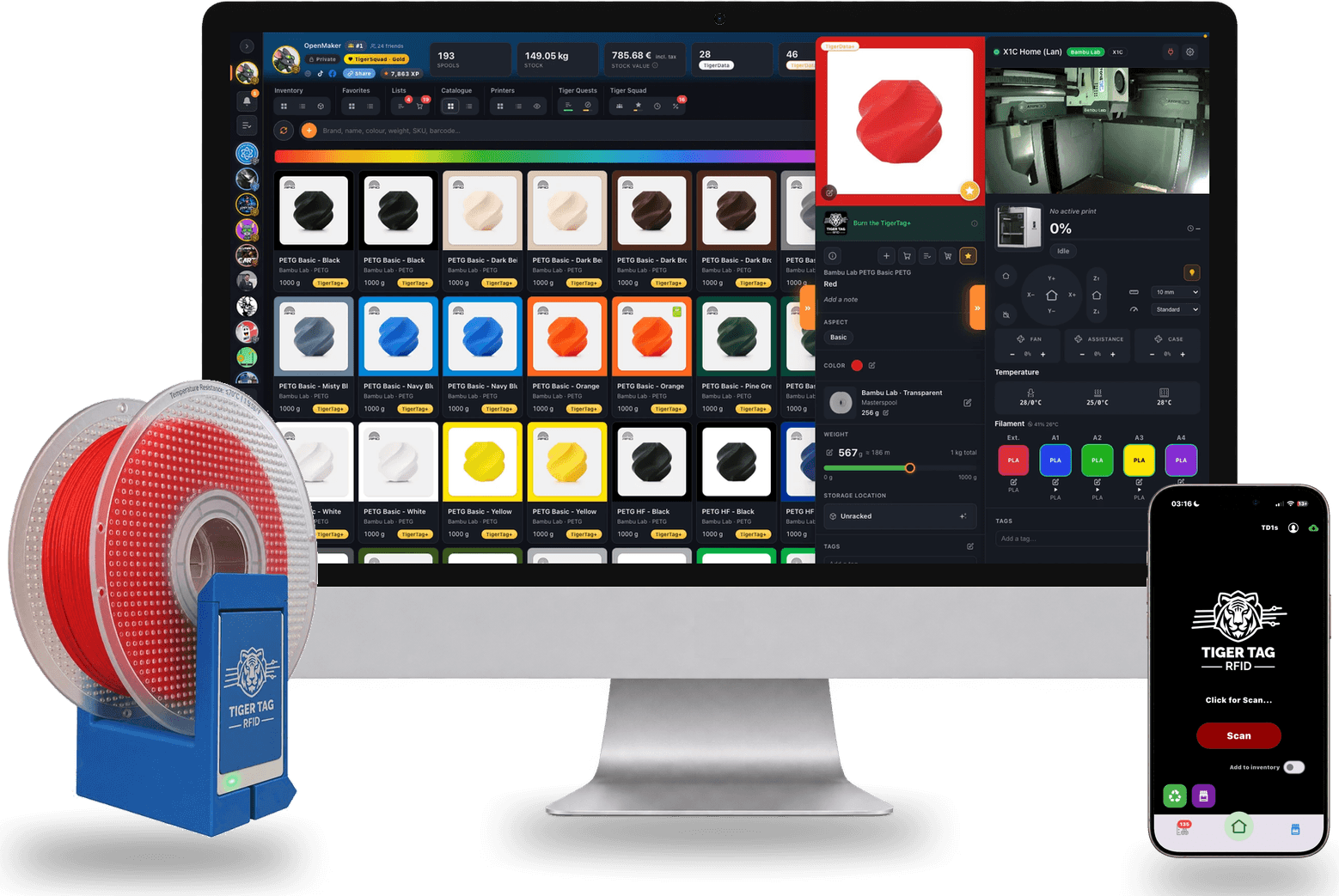
Third-party integration reference for the TigerTag ecosystem — Home Assistant, ESP32, Python examples.
Repo TigerTag-Project/TigerTag_Firebase_Integration, read from GitHub 10 h ago. TigerTag-Project has not joined Take My Repo.
TigerTag-Project/TigerTag_Firebase_Integration is a public repo on GitHub by TigerTag-Project. Third-party integration reference for the TigerTag ecosystem — Home Assistant, ESP32, Python examples. It declares the CC-BY-4.0 license on GitHub. It is written mainly in Python, has 5 stars and last changed on 2026-11-06. Nobody has reviewed it on Take My Repo yet, which says nothing about its quality. Read from GitHub on 2026-11-22.

English · Français · Deutsch · Español · Italiano · 中文 · Português (BR) · Português (PT) · Polski · Русский · Nederlands
🎯 Source of truth for any third-party integration. If your client talks to the TigerTag Firebase backend (Home Assistant, OctoPrint, Spoolman bridge, ESP32 firmware, custom script), this repo is the reference you build against. Anything that contradicts what's here (random forum posts, screenshots, leaked source) is wrong by definition — open an issue and we'll fix the doc.
What's documented = what's deployed. We commit to keeping them in sync, with a public
CHANGELOG.mdtracking every schema / rule / API change.
This repository is read-only documentation + reference examples. The actual TigerTag apps live in their own repos:
Part of the TigerSystem ecosystem.
If you're building something on top of TigerTag and you find a behaviour that disagrees with this documentation, the documentation wins — it means we shipped a regression. Please file an issue.
.
├── docs/
│   ├── 01-firebase-config.md      ← public Firebase config endpoint
│   ├── 02-authentication.md       ← email/password sign-in + token refresh
│   ├── 03-data-model.md           ← Firestore collections reference
│   ├── 04-friend-system.md        ← how friend access works (privateKey model)
│   ├── 05-rate-limiting.md        ← polling intervals, query limits, monitoring
│   └── clients/
│       ├── home-assistant.md      ← full HA component sketch (Python)
│       ├── esp32.md               ← ESP32 / scale firmware (REST + Arduino sketch)
│       ├── spoolman-bridge.md     ← Spoolman sync (TigerTag → Spoolman REST)
│       └── python-cli.md          ← minimal Python REPL example
├── rules/
│   └── firestore.rules            ← public copy of the deployed Security Rules
├── site/                          ← the showcase site (GitHub Pages), see site/README.md
└── examples/
    ├── home-assistant/            ← runnable HA custom component
    ├── esp32-arduino/             ← reference Arduino sketch
    └── python-cli/                ← `pip install -r requirements.txt` and run
| If you want to… | Read |
|---|---|
| Connect a Python script that reads YOUR own spools | docs/clients/python-cli.md |
| Build a Home Assistant integration (sensors per spool) | docs/clients/home-assistant.md |
| Wire a custom NFC/scale device to update spool weight | docs/clients/esp32.md |
| Sync TigerTag inventory to a Spoolman instance | docs/clients/spoolman-bridge.md |
Understand WHY a permission-denied error happens |
docs/02-authentication.md |
| See the live Firestore Security Rules | rules/firestore.rules |
docs/05-rate-limiting.md
for the full rationale.| Component | Version | Last verified against |
|---|---|---|
| Firebase JS SDK | 9.x compat | Tiger Studio Manager v1.4.3 |
| Firestore Security Rules | rules_version = '2' | 2026-05-02 |
| Auth methods | email/password, Google (browser only) | — |
Rules in rules/firestore.rules mirror what's deployed on the TigerTag
Firebase project. The single source of truth is the live deployment — this
file is a snapshot for review and PRs.
We treat this repo as a public contract. Concretely:
users/{uid}/inventory/{spoolId},
users/{uid}/racks/{rackId}, users/{uid}/friends/{friendUid} etc.docs/03-data-model.md. Adding new fields is
always allowed; renaming or removing existing ones requires a deprecation
cycle (≥ 3 months notice in the CHANGELOG).weight_available will always be net grams,
last_update will always be Unix milliseconds, deleted: true will
always mean "soft-deleted, hide from UI", etc.users/{me}/friends/{them} doc-existence
pattern that grants read access on inventory + racks won't be replaced
by a different mechanism without a migration path.identitytoolkit.googleapis.com and
securetoken.googleapis.com are Google's URLs — they're as stable as
Firebase Auth itself.apiKey and projectId in the public init.json. They only change
if we migrate the entire Firebase project (announced ≥ 6 months in
advance via the CHANGELOG).id_brand.json, id_material.json, etc.
gain new entries as TigerTag adds support for more filaments. Numeric
IDs are append-only; never reused for a different brand/material.cdn.tigertag.io/*
(e.g. setSpoolWeightByRfid). These are convenience wrappers; their
request/response shapes can evolve. Pin a version-tagged release if
you need lock-in.docs/05-rate-limiting.md). If we ever
introduce it on a specific endpoint (e.g. public-inventory scraping
protection), we'll announce it ≥ 1 month in advance.Every release that affects third-party clients gets an entry in
CHANGELOG.md, categorised as:
Follow this repo's releases on GitHub to get notified.
The TigerTag team commits to:
rules/firestore.rules to whatever is actually deployed.
The public copy is regenerated from the deployed file (currently
manually; a CI job to enforce parity is on the roadmap — see
CONTRIBUTING.md).If you spot drift — a field that exists in production but isn't here, a behaviour that doesn't match — please open an issue. We treat doc bugs with the same priority as code bugs.
TigerSystem is a personal, community open-source project, built and maintained in free time. Everything stays free; if it saves you a spool or two, you can support it:
Support goes to the maintainer — never required, always appreciated.
Found a typo, an outdated example, or want to add a client integration
(e.g. Node-RED, Domoticz, OpenHAB) ? PRs welcome on docs/ and examples/.
For changes to the Security Rules, open an issue first — those are deployed by the TigerTag team after review.
Copy the examples. Ship them. You owe us nothing.
README.md, docs/**, examples/**) — CC-BY-4.0rules/*.rules and every snippet in these pages) — Apache-2.0,
attribution waived for snippets pasted into your own projectFull detail, and what is not covered (the name, the logo, the service, the TigerTag+ signature):
see LICENSING.md.
The TigerTag protocol is CC-BY-4.0 with an irrevocable, royalty-free right to implement it — see TigerTag-RFID-Guide.
The TigerTag service itself (the Firebase project, the API and the catalogue) is operated by TigerSystem and is not covered by these licences.
TigerTag-Project/TigerTag_Firebase_Integration is a public repo on GitHub by TigerTag-Project. Third-party integration reference for the TigerTag ecosystem — Home Assistant, ESP32, Python examples.
It declares the CC-BY-4.0 license on GitHub.
Its maker has not tagged a system, so it is unknown here. Its README says what it needs.
Open "Take it" on its page: Take My Repo writes an install plan for your machine and hands it to your AI agent (Claude Code, Codex or Cursor), which asks you before each step. Take My Repo has not tested it on any machine.
Its last change on GitHub was on 2026-11-06. GitHub counts 0 open issues and pull requests. Take My Repo does not judge from that whether it is maintained.
Official source code of FreeCAD, a free and opensource multiplatform 3D parametric modeler.
Nobody has reviewed it on Take My Repo yet, which says nothing about its quality.
π RuView turns commodity WiFi signals into real-time spatial intelligence, vital sign monitoring, and presence detection — all without a single pixel of video.
The Postgres development platform. Supabase gives you a dedicated Postgres database to build your web, mobile, and AI applications.
:house_with_garden: Open source home automation that puts local control and privacy first.
Marlin is a firmware for RepRap 3D printers optimized for both 8 and 32 bit microcontrollers. Marlin supports all common platforms. Many commercial 3D printers come with Marlin installed. Check with your vendor if you need source code for your specific machine.
Tiger Studio — the free desktop printer + filament manager for the TigerTag open NFC standard. Windows, macOS, Linux (MIT).
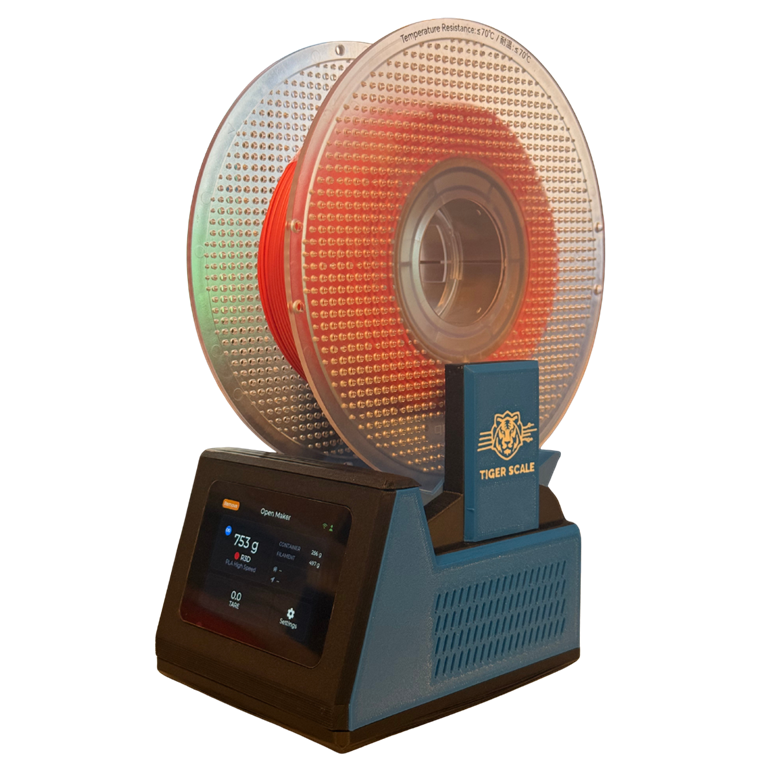
TigerScale V3 — the connected filament scale for the TigerTag open NFC standard. ESP32-S3, 3.5" touchscreen (LVGL), dual PN532 NFC readers, battery (MIT).
The open TigerTag protocol: NFC identification for 3D-printing materials. Full spec + public registry — 2,500,000+ chips in the field (CC-BY-4.0).
Free open-source firmware that turns the BIGTREETECH Panda Touch / K-Touch into one touchscreen for Bambu Lab, Creality, Elegoo, Anycubic, Snapmaker, FlashForge, Prusa, Klipper and OctoPrint printers.
TigerScale V2 (no longer developed — see Tiger-Scale-V3). Open-source connected scale for 3D-printing filament, ESP32 + RFID, MIT.
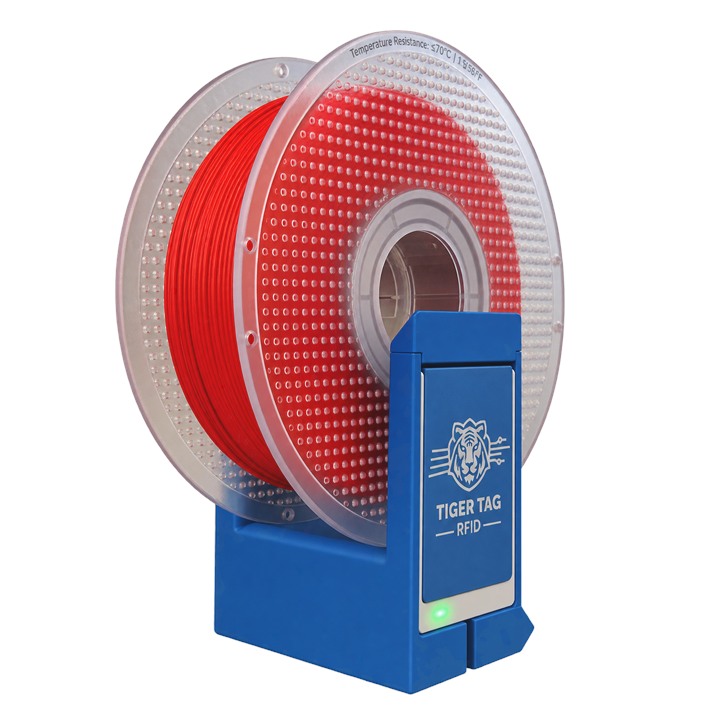
RFID spool scanner for 3D printers. Any printer. No setup. Just scan. ESP32 + PN532, open source.