opencommit
top #1 and most feature rich GPT wrapper for git — generate commit messages with an LLM in 1 sec — works with Claude, GPT and every other provider, supports local Ollama models too
- 7.6k
- JavaScript
- MIT
- 9 d ago
Standardized git commits with AI message generation, interactive prompts, validation, and GitHub integration. Works as a CLI, inside AI agents, and as a programmable TypeScript API.
Repo TimMikeladze/commit-it, read from GitHub 10 h ago. TimMikeladze has not joined Take My Repo.
TimMikeladze/commit-it is a public repo on GitHub by TimMikeladze. Standardized git commits with AI message generation, interactive prompts, validation, and GitHub integration. Works as a CLI, inside AI agents, and as a programmable TypeScript API. It declares the MIT license on GitHub. It is written mainly in TypeScript, has 1 stars and last changed on 2026-04-02. Nobody has reviewed it on Take My Repo yet, which says nothing about its quality. Read from GitHub on 2026-11-22.
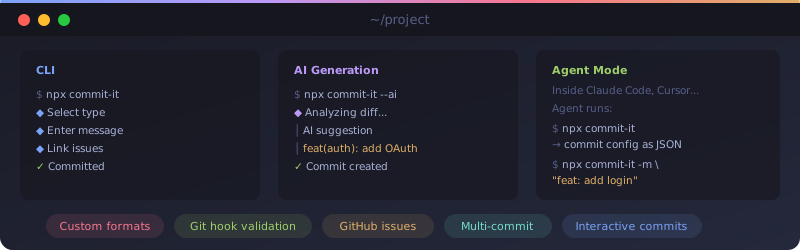
Standardized git commits with AI message generation, interactive prompts, validation, and GitHub integration. Works as a CLI, inside AI agents, and as a programmable TypeScript API.
npm install -g commit-it     # global
npx commit-it                # or run without installing
bunx commit-it               # bun users
Also available as cit and commit:
cit --ai                     # AI commit
commit -t fix -m "resolve bug"  # non-interactive
After installing, run the setup wizard to configure commit-it for your environment:
commit-it setup
This walks you through picking an AI provider (Claude, Codex, OpenCode, Cursor Agent), selecting a model, choosing a commit style (conventional or gitmoji), and setting your preferred editor. The config is saved to ~/.commit-it/config.json and applies globally. You can re-run it anytime to change your settings.
# Stage your changes + let AI write the message
commit-it --ai --all

# Or go interactive
commit-it --all
The --all (-a) flag stages all changes before committing, so you can skip git add entirely.
That's it. No config needed — commit-it uses sensible defaults (conventional commits, validation on, GitHub on).
commit-it init           # generate a config file
commit-it setup-alias    # type "commit" instead of "commit-it"
commit-it install-hook   # validate every git commit automatically
Don't like conventional commits or gitmoji? Define your own format. commit-it's template engine, custom types, and regex rules let you enforce any commit style your team uses.
Override the commit message shape with {{placeholders}} and {{#conditional}} sections:
export default defineConfig({
  // Bracket-style scopes: "fix[auth]: token refresh"
  template: '{{type}}{{#scope}}[{{scope}}]{{/scope}}: {{message}}',
})
export default defineConfig({
  // Ticket-prefix style: "[PROJ-123] add login page"
  template: '[{{type}}] {{message}}',
})
Available placeholders: {{type}}, {{scope}}, {{message}}, {{breaking}}. Wrap any placeholder in {{#field}}...{{/field}} to only render that section when the field has a value.
Replace the default feat/fix/docs types with whatever vocabulary fits your team:
export default defineConfig({
  validation: {
    allowedTypes: ['add', 'change', 'remove', 'fix', 'security', 'deploy'],
  },
})
Enforce any commit format with regex-based rules — Angular-style, JIRA-prefixed, uppercase categories, or anything else:
export default defineConfig({
  validation: {
    customRules: [
      {
        name: 'require-ticket',
        pattern: '[A-Z]+-\\d+',
        message: 'Must include ticket (e.g., PROJ-123)',
        level: 'error',
        invert: false,    // fail when pattern DOESN'T match
      },
    ],
  },
})
See Configuration for the full reference and Example Configurations for complete setups.
commit-it shells out to whichever AI CLI you have installed. No API keys needed.
| Provider | CLI | Auto-detected |
|---|---|---|
| Claude Code | claude |
Yes |
| OpenAI Codex | codex |
Yes |
| OpenCode | opencode |
Yes |
| Cursor Agent | agent |
Yes |
| Custom | any CLI | Configurable |
# Stage changes, then generate
commit-it --ai

# Use a specific provider
commit-it --ai --provider codex

# Stage everything + AI + no prompts (perfect for scripts)
commit-it -a --ai -y

# Split staged changes into multiple logical commits
commit-it --all --multi
The AI analyzes your staged diff and returns a structured suggestion (type, scope, message, body). You can accept, edit in $EDITOR, or decline and go manual.
On first use, a quick wizard helps you pick a provider, model, and commit style. Or create ~/.commit-it/config.json:
{
  "ai": { "auto": true, "provider": "claude" },
  "preset": "conventional",
  "editor": "code --wait"
}
Set ai.auto to true to always generate AI suggestions without the --ai flag.
When running inside an AI agent (Claude Code, Cursor, OpenCode, Aider, Cline, or any non-TTY environment), commit-it adapts automatically:
-m with a message — auto-parses type and scope, validates, and commits directly# Agent discovers the schema
$ commit-it
# → outputs JSON: { preset, template, types, scopes, validation, usage }
# Agent commits using the schema
commit-it -m "feat(cli): add agent detection"
Detection triggers: stdin is not a TTY, or env vars like CLAUDE_CODE, CURSOR_AGENT, CODEX_CLI, OPENCODE, AIDER, CLINE are set.
Running commit-it walks through:
1. Select type        ─── feat, fix, docs, refactor, etc.
2. Select scope       ─── suggested from changed files + PR labels
3. Breaking change?   ─── adds ! and BREAKING CHANGE footer
4. Reference issues   ─── search GitHub issues, pick Closes/Fixes/Ref
5. Commit message     ─── short description (pre-filled from AI)
6. Body               ─── optional detailed description
7. Co-authors         ─── from config, GitHub, or manual entry
8. Preview & confirm  ─── see full message, validate, commit
Smart defaults at every step: AI suggestions > previous commit > PR labels > config.
Requires the GitHub CLI (gh). All features degrade gracefully if gh isn't installed.
bug -> fix, feature -> feat)scopeLabelPatterns become scope suggestionscommit-it branch creates branches from issue titlesYou can reference multiple GitHub issues in a single commit. During the interactive flow, you'll be prompted to search for issues and choose how each one is referenced. After adding an issue, you're asked if you want to add another — repeat as many times as needed.
Each issue reference uses one of four actions:
| Action | Effect |
|---|---|
Closes |
Auto-closes the issue when the commit is merged |
Fixes |
Auto-closes the issue when the commit is merged |
Resolves |
Auto-closes the issue when the commit is merged |
Ref |
Mentions the issue without closing it |
References are appended as a footer in the commit message:
feat(auth): add OAuth support

Closes #42
Ref #99
Fixes #101
Use Ref when you want to link related context (e.g., a tracking issue or design doc) without auto-closing anything.
In agent mode, the schema output includes validation.requireIssue so agents know whether issue references are expected. Since there's no --issue CLI flag, agents include GitHub keywords directly in the commit message:
commit-it -m "feat(auth): add OAuth support" --body "Closes #42
Ref #99"
GitHub recognizes Closes, Fixes, Resolves, and Ref keywords anywhere in the commit message body or footer.
To require an issue reference on every commit, set validation.requireIssue:
export default defineConfig({
  validation: {
    requireIssue: true,
  },
})
Programmatic usage:
await directCommit({
  type: 'feat',
  message: 'add OAuth support',
  issueRefs: [
    { action: 'Closes', number: 42 },
    { action: 'Ref', number: 99 },
    { action: 'Fixes', number: 101 },
  ],
})
Skip all prompts by passing a message:
# Full conventional commit string (type auto-parsed)
commit-it -m "feat(auth): add OAuth support"

# Explicit type + message
commit-it -t fix -s auth -m "resolve token refresh"

# With body, breaking change, co-author
commit-it -t feat -m "redesign API" --body "Complete rewrite for v2" --breaking -c alice

# Dry run
commit-it -t refactor -m "extract validation" --dry-run
Works without config. When you need control, create commit.config.ts:
import { defineConfig } from 'commit-it'

export default defineConfig({
  preset: 'conventional',        // or 'gitmoji'
  scopeMode: 'single',           // 'multi-inline' | 'multi-body'
  scopeMap: {
    'src/cli/**': 'cli',
    'src/services/**': 'core',
    'tests/**': 'test',
    '*.md': 'docs',
  },
  coauthors: {
    alice: 'Alice Smith <alice@example.com>',
    bob: 'Bob Jones <bob@example.com>',
  },
  github: {
    enabled: true,
    scopeLabelPatterns: ['scope:', 'area:'],
    auto: { detectIssues: true, suggestReviewers: false },
  },
  validation: {
    enabled: true,
    maxHeaderLength: 72,
    requireScope: false,
    requireBody: false,
    noTrailingPeriod: true,
    customRules: [
      {
        name: 'no-wip',
        pattern: '\\bWIP\\b',
        message: 'WIP commits not allowed',
        level: 'error',
        invert: true,
      },
    ],
  },
})
Also supports .commitrc, .commitrc.json, .commitrc.yaml, package.json "commit" key, and more via c12.
| Option | Type | Default | Description |
|---|---|---|---|
preset |
'conventional' | 'gitmoji' |
'conventional' |
Commit format preset |
template |
string |
from preset | Custom message template with {type}, {scope}, {message} |
scopeMode |
'single' | 'multi-inline' | 'multi-body' |
'single' |
How multiple scopes appear |
defaults.scope |
string |
'' |
Pre-selected scope |
defaults.includeBody |
boolean |
true |
Default for "Add body?" prompt |
scopeMap |
Record<glob, scope> |
{} |
Map file patterns to scope names |
coauthors |
Record<alias, 'Name <email>'> |
{} |
Co-author aliases |
github.enabled |
boolean |
true |
Enable GitHub integration |
github.scopeLabelPatterns |
string[] |
['scope:', 'area:', 'component:'] |
Label prefixes for scope extraction |
github.auto.detectIssues |
boolean |
true |
Default to "yes" for issue prompt |
github.auto.suggestReviewers |
boolean |
false |
Suggest reviewers from collaborators |
validation.enabled |
boolean |
true |
Enable validation |
validation.maxHeaderLength |
number |
72 |
Max first-line length |
validation.maxBodyLineLength |
number |
100 |
Max body line length (warning) |
validation.requireScope |
boolean |
false |
Scope is mandatory |
validation.requireBody |
boolean |
false |
Body is mandatory |
validation.requireIssue |
boolean |
false |
Issue reference required |
validation.allowedTypes |
string[] |
from preset | Restrict to these types |
validation.allowedScopes |
string[] |
any | Restrict to these scopes |
validation.noTrailingPeriod |
boolean |
true |
Subject must not end with . |
validation.noLeadingCapital |
boolean |
false |
Subject must start lowercase |
validation.customRules |
CustomRule[] |
[] |
Regex-based custom rules |
| Command | Description |
|---|---|
commit-it |
Create a commit (default) |
commit-it branch |
Create a branch from GitHub issues |
commit-it validate -m "..." |
Validate a commit message |
commit-it init |
Generate a config file |
commit-it install-hook |
Install commit-msg git hook |
commit-it uninstall-hook |
Remove the git hook |
commit-it presets |
List available presets |
commit-it config |
Print resolved config as JSON |
commit-it setup |
Run the setup wizard |
commit-it setup-alias |
Add a shell alias |
| Flag | Alias | Description |
|---|---|---|
--type <type> |
-t |
Commit type (feat, fix, etc.) |
--message <msg> |
-m |
Commit message or full conventional string |
--scope <scope> |
-s |
Commit scope |
--body <text> |
Commit body | |
--all |
-a |
Stage all changes before committing |
--amend |
Amend the last commit | |
--breaking |
-b |
Mark as breaking change |
--ai |
Generate message from staged diff | |
--no-ai |
Disable AI even if auto-enabled | |
--provider <name> |
AI provider (claude, codex, opencode, agent, custom) | |
--multi |
Split changes into multiple commits | |
--verbose |
Show AI commands being run | |
--yes |
-y |
Skip all prompts (headless mode) |
--co-author <value> |
-c |
Add co-author by alias or "Name <email>" |
--no-github |
Skip GitHub API calls | |
--dry-run |
Preview without committing | |
-- |
Pass flags to git commit (e.g. -- --no-verify) |
Built-in rules, all configurable:
| Rule | Default | Description |
|---|---|---|
| Header max length | 72 | First line length limit |
| Conventional format | on | Must follow type(scope): subject |
| Blank line after header | on | Second line must be blank |
| Body max line length | 100 | Body line length (warning) |
| Scope required | off | Make scope mandatory |
| Body required | off | Make body mandatory |
| Issue required | off | Require issue reference |
| No trailing period | on | Subject can't end with . |
| No leading capital | off | Subject must start lowercase |
validation: {
  customRules: [
    {
      name: 'require-ticket',
      pattern: 'PROJ-\\d+',
      message: 'Must include a JIRA ticket (e.g., PROJ-123)',
      level: 'error',
      invert: false,    // fail when pattern DOESN'T match
    },
    {
      name: 'no-wip',
      pattern: '\\bWIP\\b',
      message: 'WIP commits not allowed',
      level: 'error',
      invert: true,     // fail when pattern DOES match
    },
  ],
}
Format: type(scope): message
Types: feat, fix, docs, style, refactor, perf, test, chore
Format: emoji message
Types: ✨ (feature), 🐛 (fix), 📚 (docs), 💅 (style), ♻️ (refactor), ⚡ (perf), ✅ (test), 🔧 (chore), 🚀 (deploy)
Every feature is importable:
npm install commit-it
import {
  directCommit,
  interactiveCommit,
  validateCommitMessage,
  parseCommitMessage,
  generateCommitMessage,
  getProjectSchema,
  isAgentEnvironment,
  isAIAvailable,
  defineConfig,
  loadConfig,
  getPreset,
  GitService,
  GitHubService,
  FormatValidator,
  renderTemplate,
  buildFullMessage,
} from 'commit-it'
const result = await directCommit({
  type: 'feat',
  message: 'add user authentication',
  scope: 'api',
  body: 'Implements OAuth with Google and GitHub providers',
  breaking: true,
  breakingDescription: 'All endpoints now require Bearer token',
  issueRefs: [{ action: 'Closes', number: 42 }],
  coAuthor: 'alice',
  stageAll: true,
  dryRun: false,
})

console.log(result.hash)    // commit SHA
console.log(result.message) // full formatted message
const result = await interactiveCommit({
  preset: 'conventional',
  useAI: true,
  provider: 'claude',
  stageAll: true,
  headless: false,
  extraArgs: ['--signoff'],
})
// Validate
const result = validateCommitMessage('feat(cli): add command', {
  maxHeaderLength: 72,
  requireScope: true,
  allowedTypes: ['feat', 'fix', 'docs'],
})
console.log(result.valid)   // true
console.log(result.errors)  // []

// Parse
const parsed = parseCommitMessage('feat(api)!: redesign endpoints\n\nBody text\n\nCloses #42')
// { type: 'feat', scope: 'api', subject: 'redesign endpoints',
//   body: 'Body text', isBreaking: true, issues: [42] }
const git = new GitService()
await git.getBranchName()      // "feature/new-api"
await git.getStatus()          // { staged: [...], unstaged: [...] }
await git.getStagedDiff()      // diff string
await git.getLastCommit()      // parsed commit object

const github = new GitHubService()
await github.searchIssues('login bug')   // [{ number, title, labels }]
await github.getCurrentPR()              // { number, title, labels }
await github.detectContext()             // full branch context
if (await isAIAvailable()) {
  const suggestion = await generateCommitMessage(diff, {
    branchName: 'feature/new-api',
    existingTypes: ['feat', 'fix', 'docs'],
  })
  // { type: 'feat', scope: 'api', message: '...', body: '...' }
}
import type {
  Config,
  CustomRule,
  ValidationConfig,
  DirectCommitOptions,
  InteractiveOptions,
  AICommitSuggestion,
  CoAuthor,
  CommitData,
  CommitType,
  Preset,
  CommitOptions,
  CommitResult,
  IssueReference,
  ParsedCommit,
  CommitContext,
  ScopeSuggestion,
  TemplateData,
  ParsedMessage,
  ValidationIssue,
  ValidationResult,
  FormatValidationResult,
} from 'commit-it'
export default defineConfig({
  preset: 'conventional',
  scopeMap: {
    'packages/core/**': 'core',
    'packages/cli/**': 'cli',
    'packages/web/**': 'web',
    'packages/api/**': 'api',
  },
  validation: {
    requireScope: true,
    allowedScopes: ['core', 'cli', 'web', 'api', 'docs', 'deps'],
  },
})
export default defineConfig({
  preset: 'conventional',
  github: { enabled: false },
  validation: {
    requireScope: true,
    requireBody: true,
    allowedTypes: ['feat', 'fix', 'docs', 'refactor', 'test', 'chore'],
    customRules: [
      {
        name: 'require-jira-ticket',
        pattern: '[A-Z]{2,}-\\d+',
        message: 'Must include JIRA ticket (e.g., PROJ-123)',
        level: 'error',
        invert: false,
      },
    ],
  },
})
export default defineConfig({
  preset: 'conventional',
  validation: {
    requireScope: true,
    customRules: [
      { name: 'no-api-keys', pattern: '\\b(api[_-]?key|api[_-]?secret)\\b', message: 'Possible API key in commit message', level: 'error', invert: true },
      { name: 'no-passwords', pattern: '\\b(password|passwd|pwd)\\s*[:=]', message: 'Possible password in commit message', level: 'error', invert: true },
      { name: 'no-tokens', pattern: '\\b(token|bearer|jwt)\\s*[:=]\\s*["\']?[A-Za-z0-9+/=]{20,}', message: 'Possible token in commit message', level: 'error', invert: true },
    ],
  },
})
export default defineConfig({
  preset: 'conventional',
  github: { enabled: true, auto: { detectIssues: true, suggestReviewers: true } },
  validation: {
    customRules: [
      { name: 'require-signoff', pattern: 'Signed-off-by: .+ <.+@.+>', message: 'DCO sign-off required. Use: git commit -s', level: 'error', invert: false },
    ],
  },
})
export default defineConfig({
  preset: 'conventional',
  validation: {
    maxHeaderLength: 50,
    maxBodyLineLength: 72,
    requireScope: true,
    requireBody: true,
    requireIssue: true,
    noTrailingPeriod: true,
    noLeadingCapital: true,
    allowedTypes: ['feat', 'fix', 'docs', 'refactor', 'test'],
    allowedScopes: ['core', 'api', 'ui', 'db', 'auth'],
  },
})
More examples in examples/configs/.
src/
├── cli.ts                  CLI entry point
├── index.ts                Public API exports
├── commands/               Command implementations
├── config/                 Config schema (Zod) and loading (c12)
├── presets/                Conventional and Gitmoji definitions
├── prompts/                Interactive commit flow
├── services/
│   ├── ai.ts               AI generation orchestration
│   ├── ai/                 Provider adapters (claude, codex, opencode, agent, custom)
│   ├── git.ts              Git operations (simple-git)
│   ├── github.ts           GitHub CLI wrapper
│   ├── validation.ts       Rule-based validation
│   ├── scope.ts            Scope suggestions
│   ├── coauthor.ts         Co-author utilities
│   ├── template.ts         Message templating
│   └── format.ts           Format validation
└── utils/                  Shared helpers
bun install          # install dependencies
bun run build        # build
bun run dev          # watch mode
bun test             # run tests
bun run test:coverage # with coverage
bun run lint         # check
bun run lint:fix     # auto-fix
bun run type-check   # type check
Run gh auth status to check if the GitHub CLI is installed and authenticated. If not, run gh auth login. GitHub features degrade gracefully when gh is unavailable.
claude --version, codex --version, opencode --version, or agent --versioncat ~/.commit-it/config.jsonRun commit-it config to see the resolved config. If you see only defaults, check for syntax errors in your config file.
commit-it uninstall-hook && commit-it install-hook
ls -la .git/hooks/commit-msg   # verify it exists
MIT
TimMikeladze/commit-it is a public repo on GitHub by TimMikeladze. Standardized git commits with AI message generation, interactive prompts, validation, and GitHub integration. Works as a CLI, inside AI agents, and as a programmable TypeScript API.
It declares the MIT license on GitHub.
Its maker has not tagged a system, so it is unknown here. Its README says what it needs.
Open "Take it" on its page: Take My Repo writes an install plan for your machine and hands it to your AI agent (Claude Code, Codex or Cursor), which asks you before each step. Take My Repo has not tested it on any machine.
Its last change on GitHub was on 2026-04-02. Take My Repo does not judge from that whether it is maintained.
Nobody has reviewed it on Take My Repo yet, which says nothing about its quality.
top #1 and most feature rich GPT wrapper for git — generate commit messages with an LLM in 1 sec — works with Claude, GPT and every other provider, supports local Ollama models too
The agent harness performance optimization system. Skills, instincts, memory, security, and research-first development for Claude Code, Codex, Opencode, Cursor and beyond.
Reverse engineer anything with agents, from app behavior down to native binaries.
A Reactive CLI that generates commit messages for Git and Jujutsu with Ollama, ChatGPT, Gemini, Claude, Mistral and other AI
📦 Develop & publish Typescript or React packages with ease. PostCSS, Vitest, Biome & Storybook support out of the box. Integrates with Github releases and automatically publishes to NPM. Code is built using tsup.
Real-time sync engine for TypeScript. Keeps a server-side database in sync with offline-first browser clients — optimistic writes, HLC conflict resolution, and end-to-end type inference over WebSocket, SSE, or polling.
🗃️ Turn-key solution for signed & secure file-uploads to an S3 compliant storage service such as R2, AWS, or Minio. Built for Next.js. Generates signed URLs for uploading files directly to your storage service and optionally integrates with a database to store additional metadata about your files.
✨ Transform gist into your personal key/value datastore. 💡Pair this with Next.js static sites and incremental static regeneration. Built with TypeScript.
🗂️ A React hook that enables you to read, write, and manage files directly - eliminating the need for repeated file selection dialogs. This capability is ideal for creating powerful browser-based tools.
🏁 Feature flags powered by GitHub issues and NextJS. Toggle the features of your app by ticking a checkbox in a GitHub issue. Supports server-side rendering, multiple environments, custom conditions, and can be deployed as a stand-alone feature flag server.