stanford-cs-221-artificial-intelligence
VIP cheatsheets for Stanford's CS 221 Artificial Intelligence
- 3k
- MIT
- 7 y ago
This work proposes an anytime iterative system to concurrently solve the multi-objective path planning problem and determine the visiting order of destinations. The paper has been uploaded to arXiv at https://arxiv.org/abs/2205.14853
Repo UMich-BipedLab/IMOMD-RRTStar, read from GitHub 8 h ago. UMich-BipedLab has not joined Take My Repo.
UMich-BipedLab/IMOMD-RRTStar is a public repo on GitHub by UMich-BipedLab. This work proposes an anytime iterative system to concurrently solve the multi-objective path planning problem and determine the visiting order of destinations. The paper has been uploaded to arXiv at https://arxiv.org/abs/2205.14853. It declares the AGPL-3.0 license on GitHub. It is written mainly in C++, has 40 stars and last changed on 2022-05-31. Nobody has reviewed it on Take My Repo yet, which says nothing about its quality. Read from GitHub on 2026-11-23.
VIP cheatsheets for Stanford's CS 221 Artificial Intelligence
This is a package for the system of multi-objective and multi-destination path planning, described in paper: Informable Multi-Objective and Multi-Directional RRT* System for Robot Path Planning(PDF)(arXiv). This work is submitted to International Symposium of Robotic Research (ISRR).
The experimental results confirm that by using the IMOMD-RRT* algorithm and the solver of relaxed traveling salesman problem (R-TSP). We outperform baseline (Bi-A* and ANA*) in terms of speed and memory usage.
[Note] This is a standalone c++ library to users to plugin to their system
without any dependency. Additionally, we also provide a ROS wrapper for the library.
Please checkout to ros_wrapper_isrr_release branch for more details.
This package has been tested under ROS Melodic and Ubuntu 20.04.
Multi-objective or multi-destination path planning is crucial for mobile robotics applications such as mobility as a service, robotics inspection, and electric vehicle charging for long trips. This work proposes an anytime iterative system to concurrently solve the multi-objective path planning problem and determine the visiting order of destinations. The system is comprised of an anytime informable multi-objective and multi-directional RRT∗ algorithm to form a simple connected graph, and a proposed solver that consists of an enhanced cheapest insertion algorithm and a genetic algorithm to solve the relaxed traveling salesman problem in polynomial time. Moreover, a list of waypoints is often provided for robotics inspection and vehicle routing so that the robot can preferentially visit certain equipment or areas of interest. We show that the proposed system can inherently incorporate such knowledge, and can navigate through challenging topology. The proposed anytime system is evaluated on large and complex graphs built for real-world driving applications
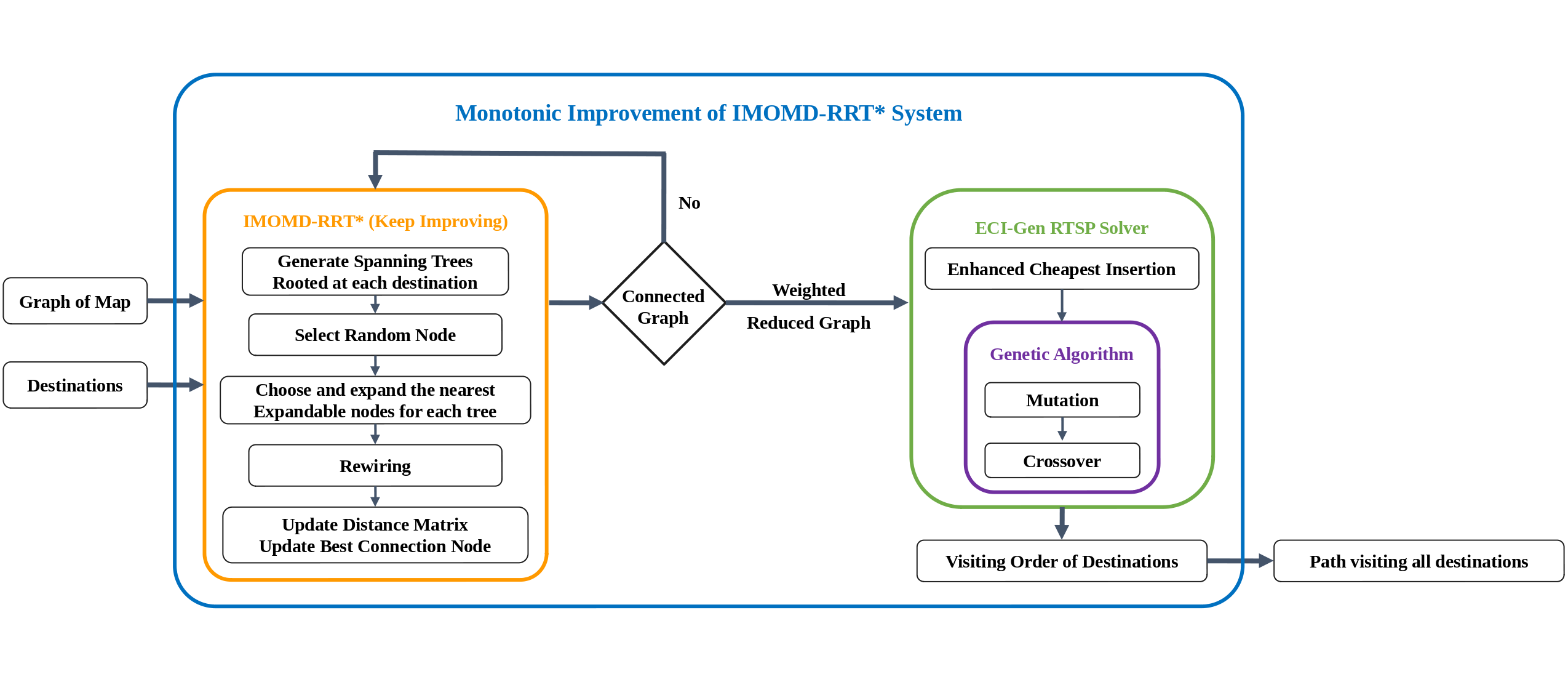
IMOMD-RRT* system consists of an anytime informable multi-objective and multi-directional algorithm to construct a connected weighted-undirected graph, and a polynomial-time solver to solve the relaxed TSP. The solver consists of an enhanced version of the cheapest insertion algorithm and a genetic algorithm, called ECI-Gen solver. The full system (the blue box) will continue to run to further improve the solution over time.
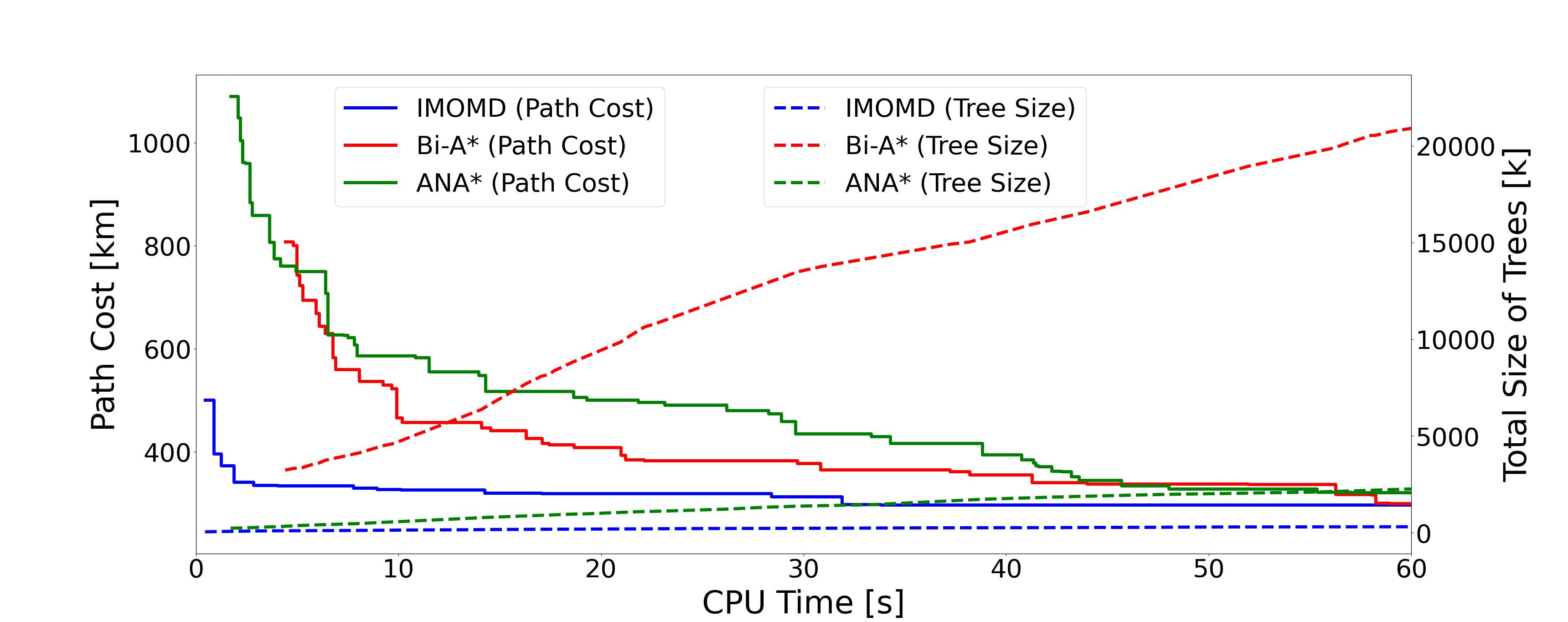
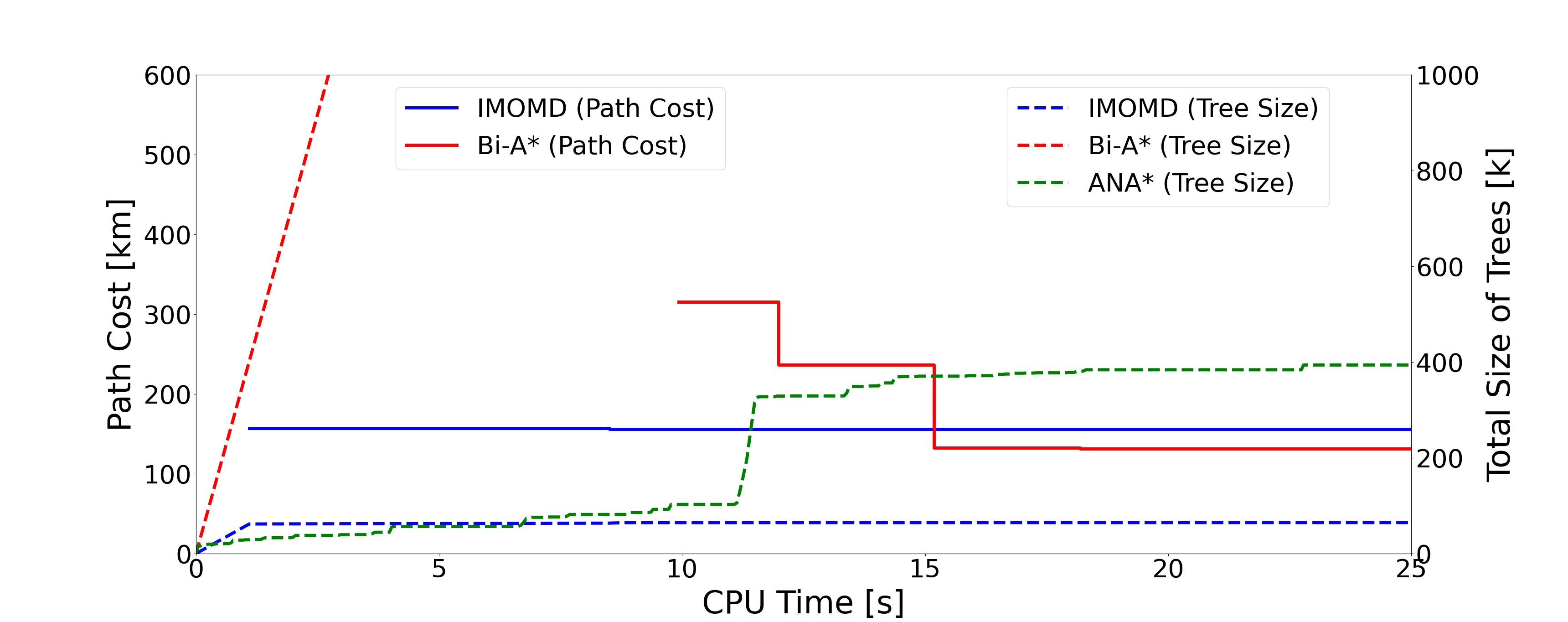
Quantitative results of the proposed IMOMD-RRT* system on two large maps (both graphs contain more than one million nodes and edges) built for real robotics and vehicle applications. The proposed system outperforms bi-A* and ANA*.
| Initial Solution Time [seconds] |
Initial Path Cost [kilometers] |
Final Memory Usage [# explored nodes] |
||
|---|---|---|---|---|
| Seattle |
IMOMD-RRT∗ | 0.44 | 501,342 | 49,768 |
| Bi-A∗ | 4.40 | 808,416 | 3,240,515 | |
| ANA∗ | 1.70 | 1,089,873 | 234,457 | |
| San Francisco |
IMOMD-RRT∗ | 1.10 | 156,807 | 61,785 |
| Bi-A∗ | 9.93 | 315,061 | 3,640,863 | |
| ANA∗ | Failed | Failed | Failed |
This section demonstrates the extensive evaluation of the IMOMD-RRT* system applied to two complex vehicle routing scenarios:
These maps are downloaded from OpenStreetMap(OSM), which is a public map service built for real applications.
To show the performance and ability of multi-objective and determining the visiting order, we randomly set 25 destinations in the Seattle map, which contains 1,054,372 nodes and 1,173,514 edges. There are more than 23! possible combinations of visiting orders and therefore it is intractable to solve the visiting order by brute force.
IMOMD-RRT* finds the first path faster than both Bi-A* and ANA* with a lower cost and then also spends less time between solution improvements. Additionally, the memory usage of IMOMD-RRT* is less than ANA* and much less than Bi-A* and 4.7 times less memory usage than ANA*
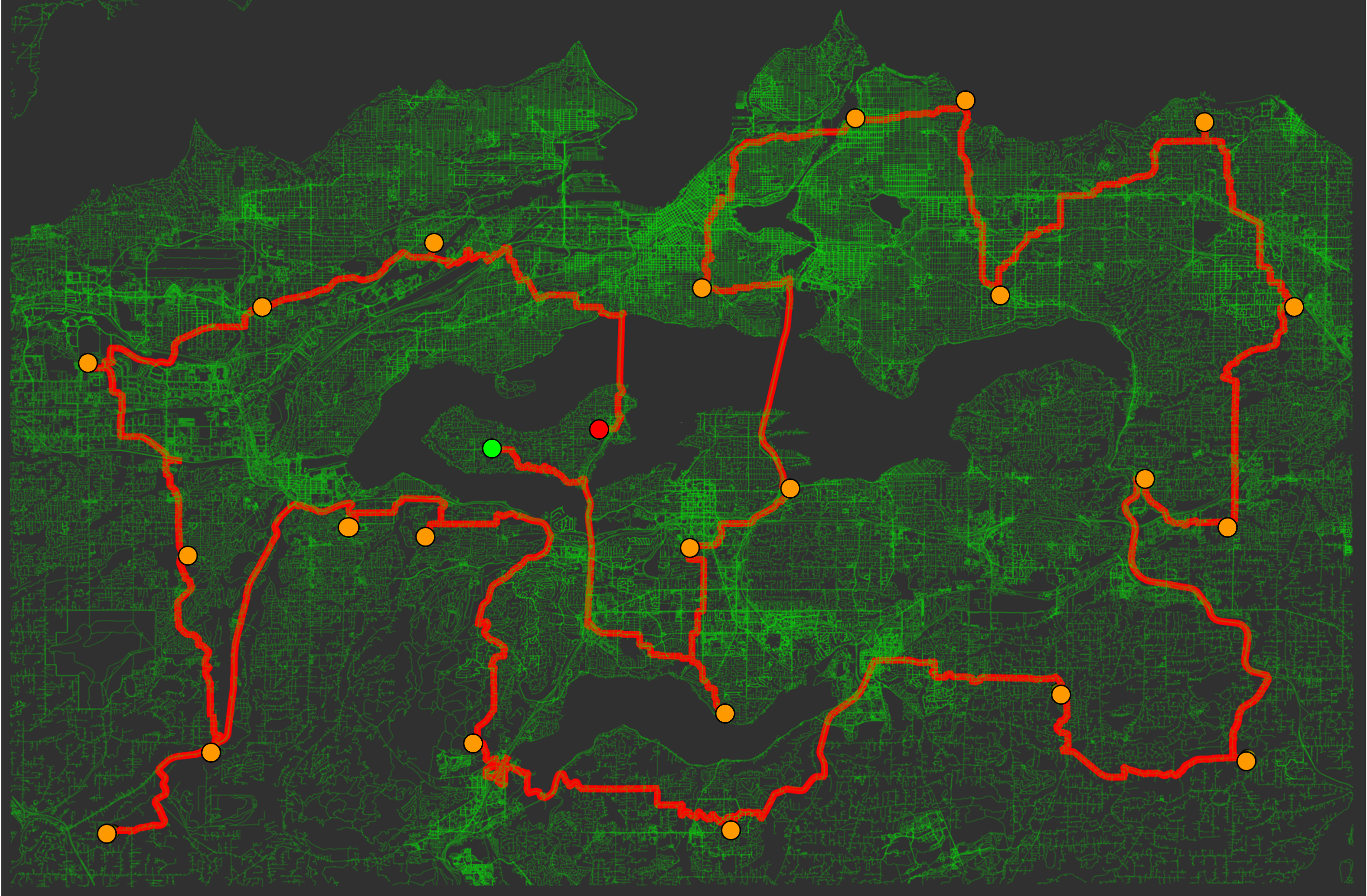
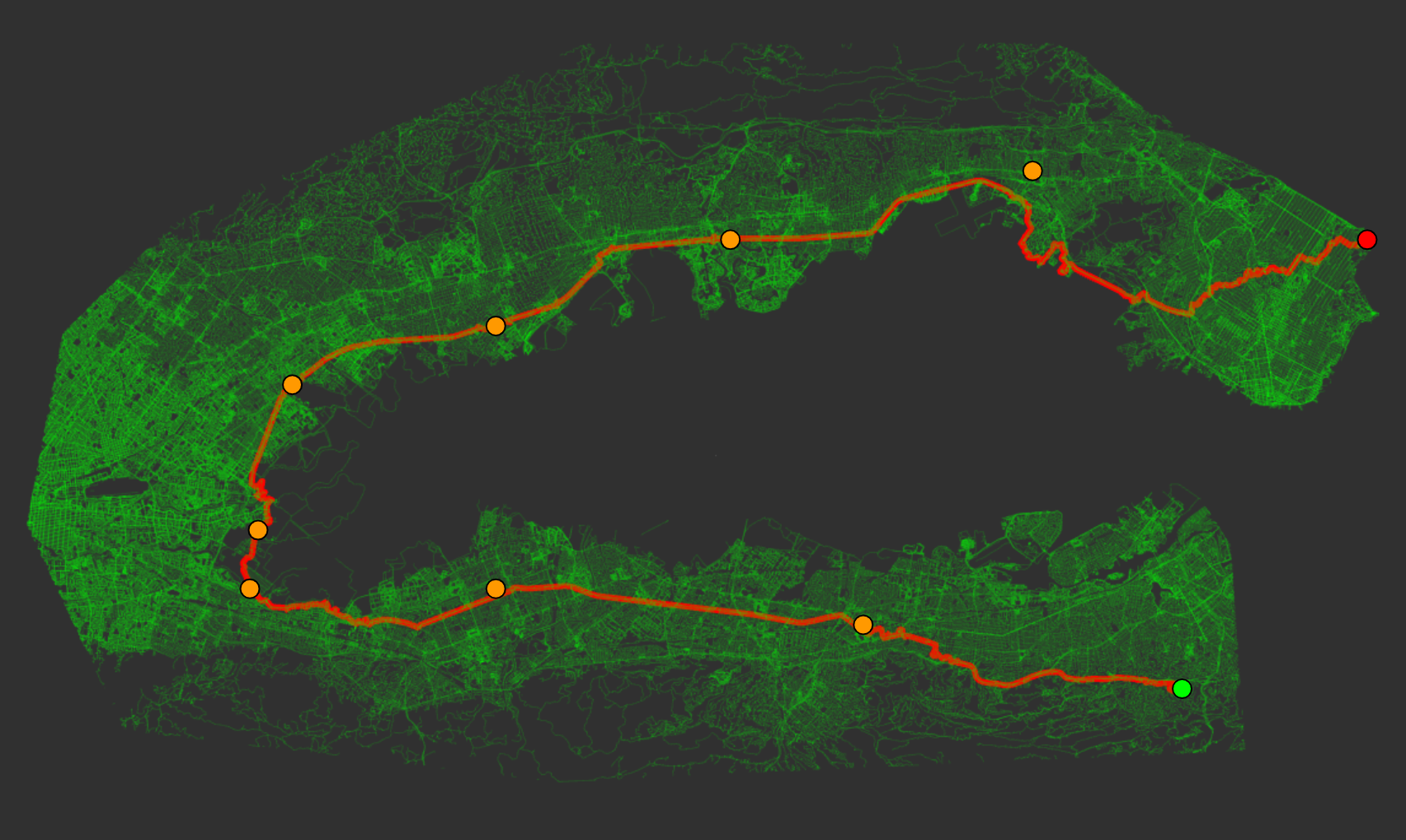
Prior knowledge through pesudo destinations can also be leveraged to traverse challenging topology, such as bug-traps. We provide 8 pseudo destinations to help escape the bug trap in San Francisco, where the source and target are separated by a body of water. The map contains 1,277,702 nodes and 1,437,713 edges.
IMOMD-RRT* escapes from the trap nine times faster than Bi-A*, whereas ANA* failed to provide a path within the given time frame. The proposed system also consumes 58.9 times less memory than Bi-A*
This is a standalone library for the proposed system. There is no required package to run the package. To plot the qualitative results, the following requirements are required:
[Note] To generate the result on paper, please download the OSM files into osm_data folder.
[How To Use Config File] In config/algorithm_config.yaml, you can change
parameters for the system.
Change the map/name in config/algorithm_config.yaml file to the name of
file of the map you want to find a path.
Change the destintaions/source_id, destinations/objective_ids,
destintaions/target_id to change the destinations for path planning. (idx
of nodes should not exceed the number of nodes of map.)
Check comments to change other parameters.
[Check only qualitative results]
maingeneral/system value to 1 and run maingeneral/system value to 2 and run mainchange map/name value to sanfrancisco_bugtrap.osm that you downloaded
into
osm_data
folder.
change general/pseudo value to 1
change rrt_params/goal_bias value to 0.3
change destinations/source_id, destinations/objective_ids, and
destinations/target_id value by comment out the values under Seattle and
uncomment the values under sanfrancisco_bugtrap.
IMOMD-RRT* : change general/system value to 0 and run main
Bi-A* : change general/system value to 1 and run main
ANA* : change general/system value to 2 and run main
[Plot quantitative results]
experiments folder to
experiments/large/seattle or experiments/bugtrap/sanfrancisco folder.experiments/plot_results.py into the folder name you placed CSV
files.experiments/plot_results.py into the file name you placed in the
above folder. ex) imomd.csv -> imomdexperiments/plot_results.py[Visualization through Rviz]
ros_wrapper_isrr_release branch and follow the instruction there.If you want to execute IMOMD-RRT* on your own customized map, it requires two data structure.
std::shared_ptr<std::vector<location_t>> raw_maplocation_t that includes id, latitude, longitudestd::shared_ptr<std::vector<std::unordered_map<size_t, double>>> graph{node_id, haversine distance}Please take a look fake_map.h for example.
The detail is described in: Informable Multi-Objective and Multi-Directional RRT* System for Robot Path Planning, Jiunn-Kai (Bruce) Huang, Yingwen Tan, Dongmyeong Lee, Vishunu R. Desaraju, and Jessy W. Grizzle (PDF)(arXiv).
@article{huang2022imomd,
      title={Informable Multi-Objective and Multi-Directional RRT* System for Robot Path Planning},
      author={Jiunn-Kai Huang and Yingwen Tan and Dongmyeong Lee and Vishnu R. Desaraju and Jessy W. Grizzle},
      year={2022},
      eprint={2205.14853},
      archivePrefix={arXiv},
      primaryClass={cs.RO}
}
UMich-BipedLab/IMOMD-RRTStar is a public repo on GitHub by UMich-BipedLab. This work proposes an anytime iterative system to concurrently solve the multi-objective path planning problem and determine the visiting order of destinations. The paper has been uploaded to arXiv at https://arxiv.org/abs/2205.14853.
It declares the AGPL-3.0 license on GitHub.
Its maker has not tagged a system, so it is unknown here. Its README says what it needs.
Training a humanoid robot for locomotion using Reinforcement Learning
:house_with_garden: Open source home automation that puts local control and privacy first.
π RuView turns commodity WiFi signals into real-time spatial intelligence, vital sign monitoring, and presence detection — all without a single pixel of video.
Motion planning(Path Planning and Trajectory Planning/Tracking) of AGV/AMR:python implementation of Dijkstra, A*, JPS, D*, LPA*, D* Lite, (Lazy)Theta*, RRT, RRT*, RRT-Connect, Informed RRT*, Voronoi, PID, DWA, APF, LQR, MPC, RPP, Bezier, Dubins etc.
Open "Take it" on its page: Take My Repo writes an install plan for your machine and hands it to your AI agent (Claude Code, Codex or Cursor), which asks you before each step. Take My Repo has not tested it on any machine.
Its last change on GitHub was on 2022-05-31. Take My Repo does not judge from that whether it is maintained.
Nobody has reviewed it on Take My Repo yet, which says nothing about its quality.
Take My Repo cannot say: it does not audit code and has not run IMOMD-RRTStar. What is known comes from GitHub. It declares the AGPL-3.0 license on GitHub. Its last change was on 2022-05-31. It has 40 stars, which measure popularity, not safety. Nobody has reviewed it on Take My Repo yet, which says nothing about its quality. Read the source before you run it. With "Take it", your AI agent shows each step and asks you before running it; README text is treated as data, not as instructions.