

ECC
The agent harness performance optimization system. Skills, instincts, memory, security, and research-first development for Claude Code, Codex, Opencode, Cursor and beyond.
- 310k
- JavaScript
- MIT
- 2 d ago
A Systematic Analysis and Discussion of Claude Code for Designing Today's and Future AI Agent Systems
Repo VILA-Lab/Dive-into-Claude-Code, read from GitHub 9 h ago. VILA-Lab has not joined Take My Repo.
VILA-Lab/Dive-into-Claude-Code is a public repo on GitHub by VILA-Lab. A Systematic Analysis and Discussion of Claude Code for Designing Today's and Future AI Agent Systems. It declares no license on GitHub. Public does not mean open source: without a license, nobody is granted the right to reuse it. It has 2,255 stars and last changed on 2026-11-10. Nobody has reviewed it on Take My Repo yet, which says nothing about its quality. Read from GitHub on 2026-11-24.
The agent harness performance optimization system. Skills, instincts, memory, security, and research-first development for Claude Code, Codex, Opencode, Cursor and beyond.
The Design Space of Today's and Future AI Agent Systems
English | 中文
A comprehensive source-level architectural analysis of Claude Code (v2.1.88, ~1,900 TypeScript files, ~512K lines of code), combined with a curated collection of community analyses, a design-space guide for agent builders, and cross-system comparisons.
[!TIP] TL;DR -- Only 1.6% of Claude Code's codebase is AI decision logic. The other 98.4% is deterministic infrastructure -- permission gates, context management, tool routing, and recovery logic. The agent loop is a simple while-loop; the real engineering complexity lives in the systems around it. This repo dissects that architecture and distills it into actionable design guidance for anyone building AI agent systems.
From Our Paper
Beyond the Paper
ask decision.| If you are a... | Start here | Then read |
|---|---|---|
| Agent Builder | Build Your Own Agent | Architecture Deep Dive |
| Security Researcher | Safety and Permissions | Architecture: Safety Layers |
| Product Manager | Key Highlights | Values and Principles |
| Researcher | Full Paper (arXiv) | Community Resources |
1,884 files · ~512K lines · v2.1.88 · 7 safety layers · 5 compaction stages · 54 tools · 27 hook events · 4 extension mechanisms · 7 permission modes
The architecture sections describe Claude Code v2.1.88. The design guide and resource catalog extend that analysis with work reviewed through October 6, 2026, and Claude Code and Codex release notes checked through October 14, 2026. The main PDF link opens arXiv v3, October 10, 2026, which redraws the layered architecture (Figure 3) and the context figure (Figure 6) and clarifies resume and pre-trust behavior. arXiv v2 and the April 2026 repository PDF remain available as archives.
Claude Code answers four design questions that every production coding agent must face:
| Question | Claude Code's Answer |
|---|---|
| Where does reasoning live? | Model reasons; harness enforces. ~1.6% AI, 98.4% infrastructure. |
| How many execution engines? | One queryLoop for all interfaces (CLI, SDK, IDE). |
| Default safety posture? | Deny-first: deny > ask > allow. Strictest rule wins. |
| Binding resource constraint? | ~200K (older models) / 1M (Claude 4.6 series) context window. Context-management stages activate under their own conditions. |
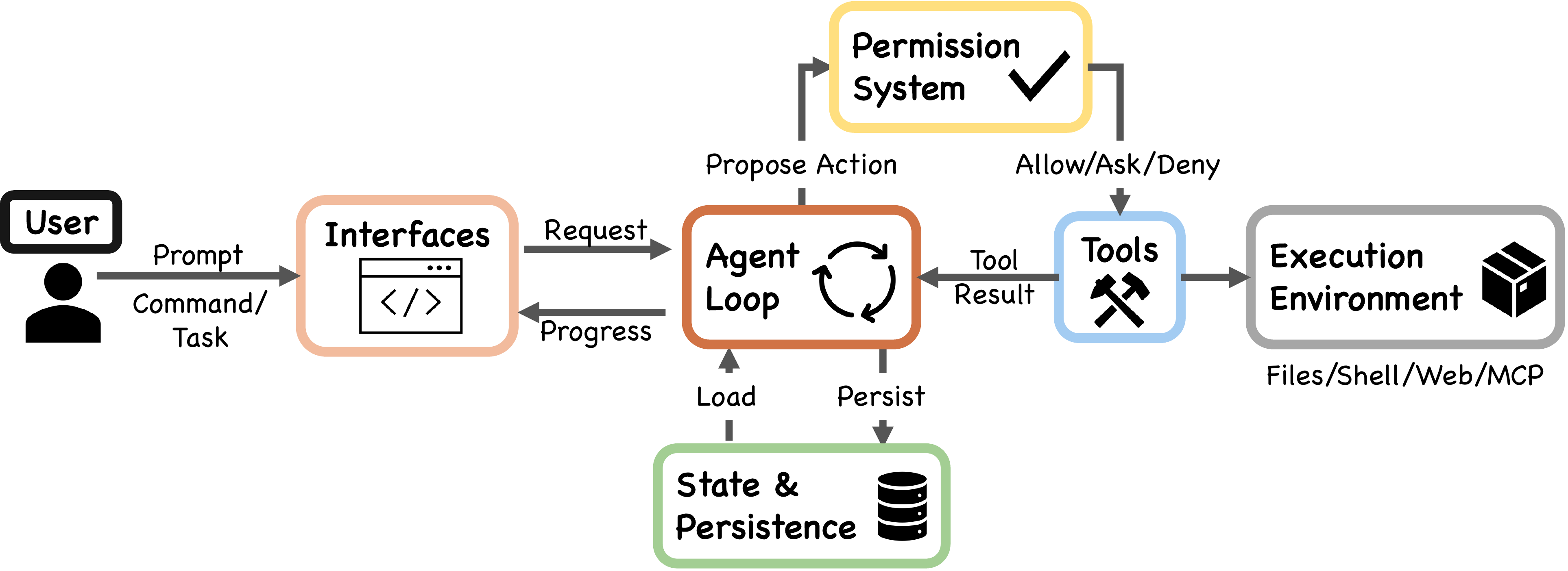
The system decomposes into 7 components (User → Interfaces → Agent Loop → Permission System → Tools → State & Persistence → Execution Environment) across 5 architectural layers.
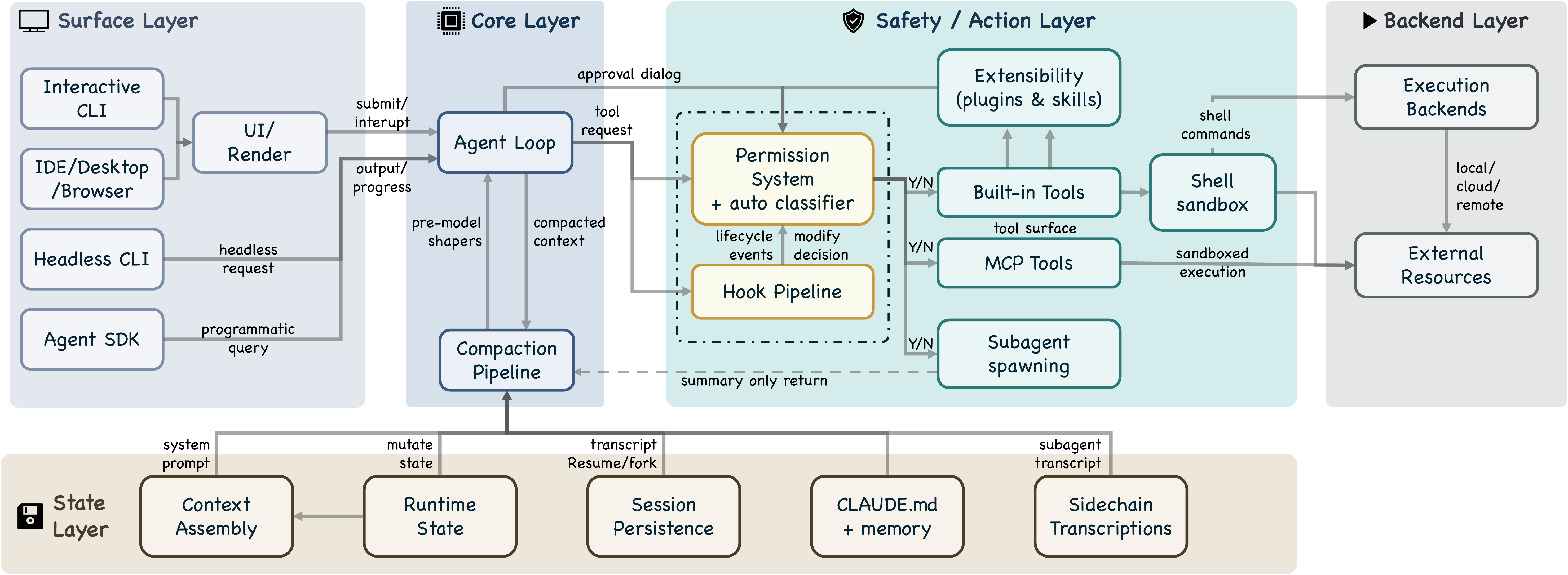
[!NOTE] For the full architectural deep dive -- 7 safety layers, 9-step turn pipeline, 5-layer compaction, and more -- see docs/architecture.md.
The architecture traces from 5 human values through 13 design principles to implementation:
| Value | Core Idea |
|---|---|
| Human Decision Authority | Humans retain control via principal hierarchy. When a 93% prompt-approval rate revealed approval fatigue, response was restructured boundaries, not more warnings. |
| Safety, Security, Privacy | System protects even when human vigilance lapses. 7 safety mechanisms. |
| Reliable Execution | Does what was meant. Gather-act-verify loop. Graceful recovery. |
| Capability Amplification | "A Unix utility, not a product." 98.4% is deterministic infrastructure enabling the model. |
| Contextual Adaptability | CLAUDE.md hierarchy, graduated extensibility, trust trajectories that evolve over time. |
| Principle | Design Question |
|---|---|
| Deny-first with human escalation | Should unrecognized actions be allowed, blocked, or escalated? |
| Graduated trust spectrum | Fixed permission level, or spectrum users traverse over time? |
| Defense in depth | Single safety boundary, or multiple overlapping ones? |
| Externalized programmable policy | Hardcoded policy, or externalized configs with lifecycle hooks? |
| Context as scarce resource | Single-pass truncation or graduated pipeline? |
| Append-only durable state | Mutable state, snapshots, or append-only logs? |
| Minimal scaffolding, maximal harness | Invest in scaffolding or operational infrastructure? |
| Values over rules | Rigid procedures or contextual judgment with deterministic guardrails? |
| Composable multi-mechanism extensibility | One API or layered mechanisms at different costs? |
| Reversibility-weighted risk assessment | Same oversight for all, or lighter for reversible actions? |
| Transparent file-based config and memory | Opaque DB, embeddings, or user-visible files? |
| Isolated subagent boundaries | Shared context/permissions, or isolation? |
| Graceful recovery and resilience | Fail hard, or recover silently? |
The paper also applies a sixth evaluative lens -- long-term capability preservation -- citing evidence that developers in AI-assisted conditions score 17% lower on comprehension tests.
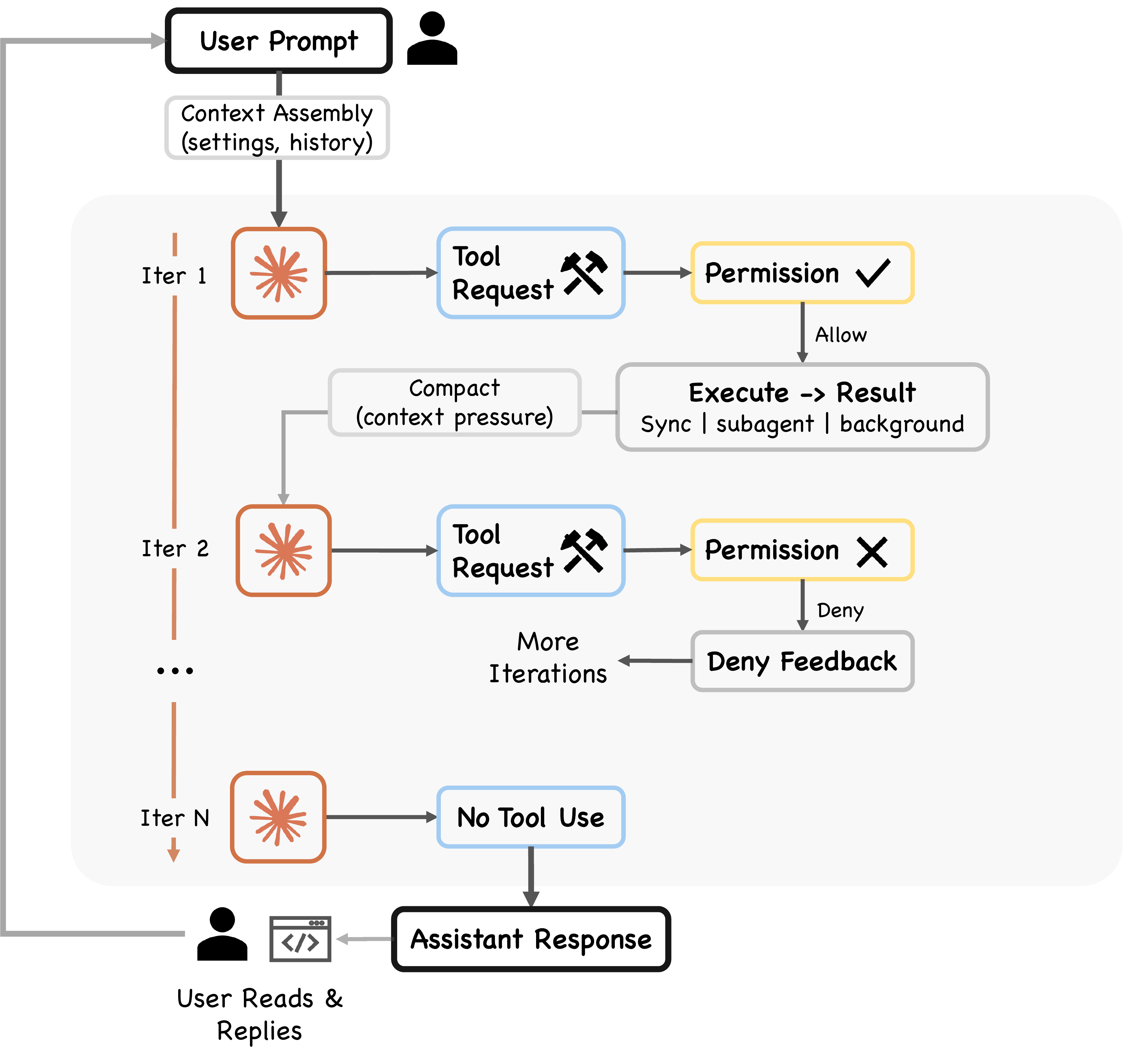
The core is a ReAct-pattern while-loop: assemble context → call model → dispatch tools → check permissions → execute → repeat. Implemented as an AsyncGenerator yielding streaming events.
Before a model call, context management considers five stages in order: Budget Reduction → Snip → Microcompact → Context Collapse → Auto-Compact. Feature gates, settings, and thresholds determine which stages change the context.
9-step pipeline per turn: Settings resolution → State init → Context assembly → Conditional context management → Model call → Tool dispatch → Permission gate → Tool execution → Stop condition
Two execution paths:
StreamingToolExecutor -- begins executing tools as they stream in (latency optimization)runTools -- classifies tools as concurrent-safe or exclusiveRecovery: Max output token escalation (3 retries), reactive compaction (once per turn), prompt-too-long handling, streaming fallback, fallback model
5 stop conditions: No tool use, max turns, context overflow, hook intervention, explicit abort
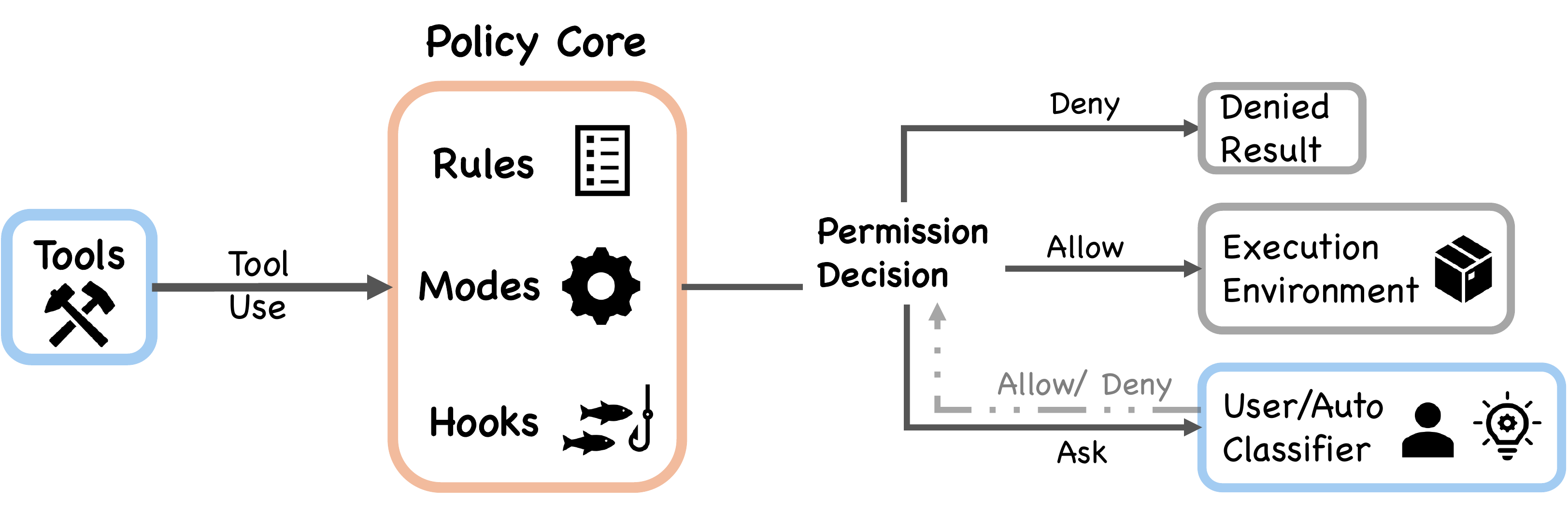
7 permission modes form a graduated trust spectrum: plan → default → acceptEdits → auto (ML classifier) → dontAsk → bypassPermissions (+ internal bubble).
Deny-first: A broad deny overrides a narrow allow in rule evaluation. 7 safety layers cover tool filtering, permission decisions, hooks, and sandboxing. In v2.1.88, the session bypass flag and computer-use app allowlist are not stored in the transcript, so a session resumed in a new process starts without them; these temporary states are separate from persistent permission settings.
[!WARNING] Bounded analysis: The legacy parser limits per-subcommand analysis to avoid blocking the event loop. If that path produces more than 50 subcommands, it returns
ask. This fallback requests an approval decision; it does not automatically allow the command.
Authorization pipeline: Pre-filtering (strip denied tools) → PreToolUse hooks → Deny-first rule evaluation → Permission handler (4 branches: coordinator, swarm worker, speculative classifier, interactive)
Auto-mode classifier (yoloClassifier.ts): Separate LLM call with internal/external permission templates. Two-stage: fast-filter + chain-of-thought.
Pre-trust execution window: 2 patched CVEs share this root cause -- in earlier releases, MCP server connections and settings environment variables took effect during initialization before the user accepted the trust dialog, creating a structurally privileged attack window outside the deny-first pipeline. In the analyzed v2.1.88 snapshot, the standard interactive startup path requires trust acceptance before hooks run, project MCP servers connect, or project settings environment variables beyond a safe allowlist apply.
VILA-Lab/Dive-into-Claude-Code is a public repo on GitHub by VILA-Lab. A Systematic Analysis and Discussion of Claude Code for Designing Today's and Future AI Agent Systems.
It declares no license on GitHub. Public does not mean open source: without a license, nobody is granted the right to reuse it.
Reverse engineer anything with agents, from app behavior down to native binaries.
Makes your AI agent think like the laziest senior dev in the room. The best code is the code you never wrote.
Fair-code workflow automation platform with native AI capabilities. Combine visual building with custom code, self-host or cloud, 400+ integrations.
Its maker tagged it for macOS, Windows and Linux, or as Docker or cross-platform. That is declared by the maker; Take My Repo has not tested it.
Open "Take it" on its page: Take My Repo writes an install plan for your machine and hands it to your AI agent (Claude Code, Codex or Cursor), which asks you before each step. Take My Repo has not tested it on any machine.
Its last change on GitHub was on 2026-11-10. GitHub counts 0 open issues and pull requests. Take My Repo does not judge from that whether it is maintained.
Nobody has reviewed it on Take My Repo yet, which says nothing about its quality.
Take My Repo cannot say: it does not audit code and has not run Dive-into-Claude-Code. What is known comes from GitHub. It declares no license on GitHub. Public does not mean open source: without a license, nobody is granted the right to reuse it. Its last change was on 2026-11-10. It has 2,255 stars, which measure popularity, not safety. Nobody has reviewed it on Take My Repo yet, which says nothing about its quality. Read the source before you run it. With "Take it", your AI agent shows each step and asks you before running it; README text is treated as data, not as instructions.





