Soup
Fine-tune LLMs from one YAML. Layer streaming trains an 8B model on a 4 GB laptop GPU.
- 11k
- Python
- Apache-2.0
- 19 h ago

Factual Preference Alignment is a research and engineering framework for studying and improving factual alignment in preference-optimized Large Language Models (LLMs).
Repo VectorInstitute/Factual-Preference-Alignment, read from GitHub 23 h ago. VectorInstitute has not joined Take My Repo.
VectorInstitute/Factual-Preference-Alignment is a public repo on GitHub by VectorInstitute. Factual Preference Alignment is a research and engineering framework for studying and improving factual alignment in preference-optimized Large Language Models (LLMs). It declares the MIT license on GitHub. It is written mainly in Python, has 3 stars and last changed on 2026-08-18. Nobody has reviewed it on Take My Repo yet, which says nothing about its quality. Read from GitHub on 2026-11-22.
🎉 Accepted at ACL 2026 Findings
🌐 Website: vectorinstitute.github.io/Factual-Preference-Alignment | 📄 Paper: arxiv.org/abs/2601.03027 | 📊 Dataset: Hugging Face
Factuality-aware Direct Preference Optimization is a research and engineering framework for studying and improving factual alignment in preference-optimized Large Language Models (LLMs).
The project introduces F-DPO, a factuality-aware extension of Direct Preference Optimization (DPO) that incorporates:
The repository provides end-to-end infrastructure for:
All components are config-driven, reproducible, and aligned with the Vector Institute AI Engineering Template.
aixpert/
│
├── src/aixpert/
│   ├── config/                  # Central config.yaml
│   ├── data_construction/       # 8-stage factual dataset pipeline
│   ├── training/                # Original-DPO & F-DPO training
│   ├── evaluation/              # GPT-4o-mini judge evaluation
│   └── utils/                   # Shared helpers
│
├── README.md
└── pyproject.toml
Standard DPO aligns models to human preferences, but does not explicitly discourage hallucinated yet preferred responses.
F-DPO introduces a factuality-aware margin:
(h_w, h_l) factuality indicators➡️ Result: Lower hallucination rates without sacrificing preference alignment
This repository contains a complete eight-stage pipeline for converting the Skywork Reward-Preference-80K dataset into balanced, factual-aware DPO datasets.
| Stage | Description |
|---|---|
| 1 | Skywork extraction & de-duplication |
| 2 | Preference pair conversion |
| 3 | Binary factuality scoring (GPT-4o-mini) |
| 4 | Canonical DPO transformation |
| 5 | Synthetic hallucination generation |
| 6 | Dataset merging |
| 7 | Balanced bucket construction |
| 8 | Optional preference flipping |
All paths and parameters are defined in:
src/aixpert/config/config.yaml
Every component — datasets, models, hyperparameters, outputs, and evaluation — is controlled via:
src/aixpert/config/config.yaml
Loaded using:
from utils.config_loader import load_config
cfg = load_config()
This enables:
python -m aixpert.training.run_dpo_training \
  --model "google/gemma-2-9b-it"
Trains standard DPO using Skywork preferences.
python -m aixpert.training.run_factual_training \
  --model_id "google/gemma-2-9b-it" \
  --short "gemma2-9b" \
  --delta 10
Each Δ value produces a separate fine-tuned model.
Evaluation is performed using GPT-4o-mini as an LLM-as-a-Judge.
| Metric | Meaning |
|---|---|
| factuality | Mean factual score |
| halluc_rate | % outputs below threshold |
| win_rate | Δ-model vs baseline |
| count | Prompts evaluated |
Run evaluation:
python -m aixpert.evaluation.evaluations.run_all_evaluations
Outputs:
eval_results.json
Models are registered centrally in config.yaml.
This project builds upon and extends the Skywork Reward-Preference-80K dataset.
We do not claim ownership of the Skywork dataset. All credit belongs to the original authors.
If you use this repository, please cite Skywork:
@article{liu2024skywork,
  title={Skywork-Reward: Bag of Tricks for Reward Modeling in LLMs},
  author={Liu, Chris Yuhao and Zeng, Liang and Liu, Jiacai and Yan, Rui and He, Jujie and Wang, Chaojie and Yan, Shuicheng and Liu, Yang and Zhou, Yahui},
  journal={arXiv preprint arXiv:2410.18451},
  year={2024}
}
For dataset-related concerns, please contact the Skywork authors via their paper or Hugging Face repository.
If you find this code or dataset useful for your research, please consider citing:
@inproceedings{chaduvula2026reducing,
  title={Reducing Hallucinations in LLMs via Factuality-Aware Preference Learning},
  author={Chaduvula, Sindhuja and Radwan, Ahmed Y and Farooq, Azib and Ioannou, Yani and Raza, Shaina},
  booktitle={Findings of the Association for Computational Linguistics: ACL 2026},
  pages={39488--39504},
  year={2026}
}
For questions, collaborations, or issues:
Resources used in preparing this research were provided, in part, by the Province of Ontario, the Government of Canada through CIFAR, and companies sponsoring the Vector Institute. This research was funded by the European Union's Horizon Europe research and innovation programme under the AIXPERT project (Grant Agreement No. 101214389), which aims to develop an agentic, multi-layered, GenAI-powered framework for creating explainable, accountable, and transparent AI systems.
We invite researchers and practitioners to build upon this framework.
VectorInstitute/Factual-Preference-Alignment is a public repo on GitHub by VectorInstitute. Factual Preference Alignment is a research and engineering framework for studying and improving factual alignment in preference-optimized Large Language Models (LLMs).
It declares the MIT license on GitHub.
Its maker has not tagged a system, so it is unknown here. Its README says what it needs.
Open "Take it" on its page: Take My Repo writes an install plan for your machine and hands it to your AI agent (Claude Code, Codex or Cursor), which asks you before each step. Take My Repo has not tested it on any machine.
Its last change on GitHub was on 2026-08-18. Take My Repo does not judge from that whether it is maintained.
Fine-tune LLMs from one YAML. Layer streaming trains an 8B model on a 4 GB laptop GPU.
Nobody has reviewed it on Take My Repo yet, which says nothing about its quality.
WikiChat is an improved RAG. It stops the hallucination of large language models by retrieving data from a corpus.
[NeurIPS 2024] SimPO: Simple Preference Optimization with a Reference-Free Reward
Easily fine-tune (SFT/RL), evaluate, and deploy Qwen, Gemma, or any open agentic LLM/VLM!
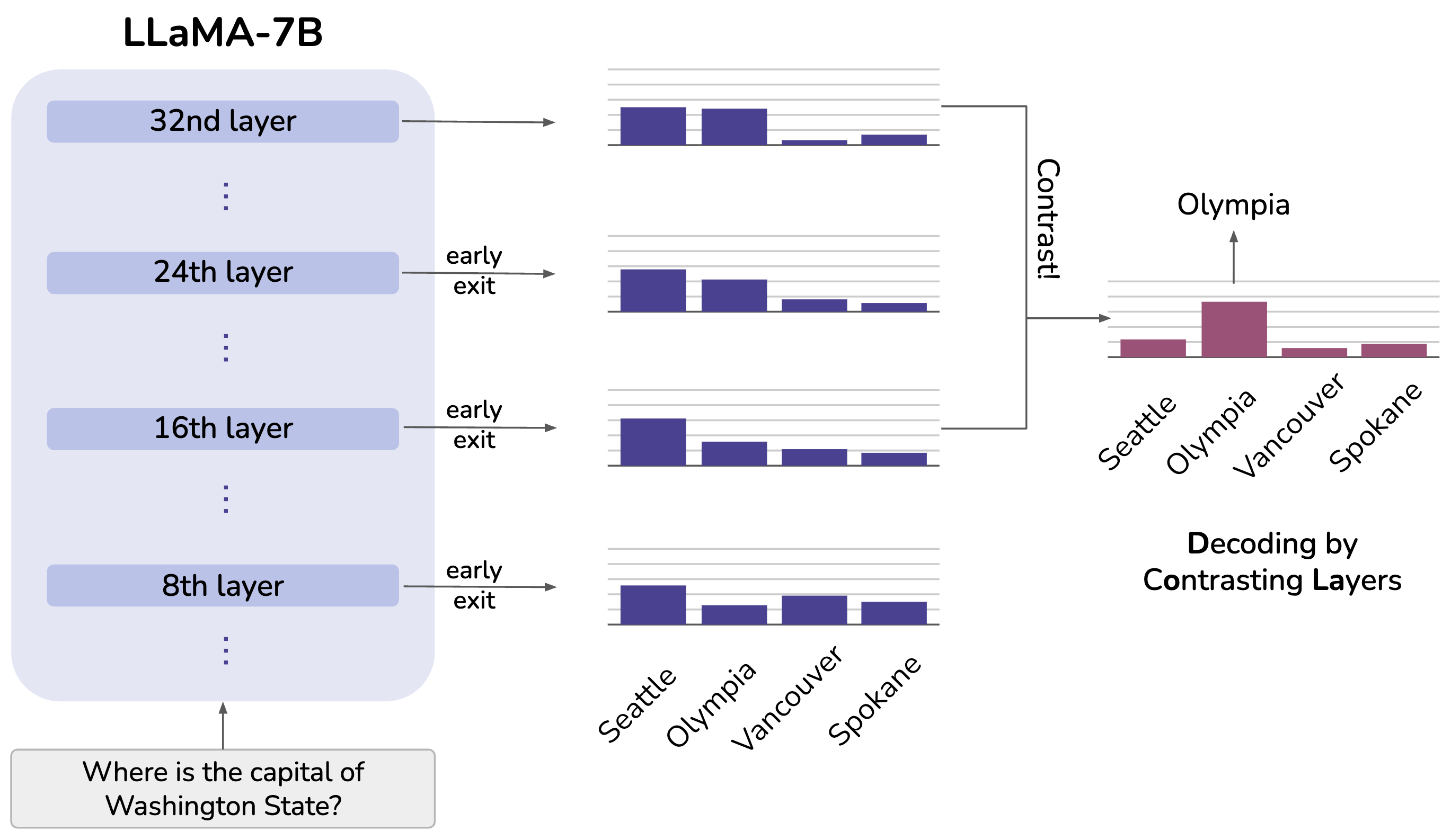
Official implementation for the paper "DoLa: Decoding by Contrasting Layers Improves Factuality in Large Language Models"
A framework for fine-tuning retrieval-augmented generation (RAG) systems.
An interpretable foundation model of the patient clinical timeline: event forecasting, calibrated time-to-event alerts, and concept-level interpretability, benchmarked head-to-head against tuned GBMs, tabular foundation models, and survival baselines on MIMIC-IV, eICU, and GEMINI via the MEDS standard.