

ECC
The agent harness performance optimization system. Skills, instincts, memory, security, and research-first development for Claude Code, Codex, Opencode, Cursor and beyond.
- 309k
- JavaScript
- MIT
- 16 h ago
Turn an API description into a CLI and MCP server your AI agent can use, with tests and template upgrades.
Repo WireCatLabs/cli-template, read from GitHub 2 h ago. WireCatLabs has not joined Take My Repo.
WireCatLabs/cli-template is a public repo on GitHub by WireCatLabs. Turn an API description into a CLI and MCP server your AI agent can use, with tests and template upgrades. It declares the Apache-2.0 license on GitHub. It is written mainly in TypeScript, has 1 stars and last changed on 2026-11-23. Nobody has reviewed it on Take My Repo yet, which says nothing about its quality. Read from GitHub on 2026-11-23.
The agent harness performance optimization system. Skills, instincts, memory, security, and research-first development for Claude Code, Codex, Opencode, Cursor and beyond.
Turn an API description into a CLI your agent can use in Claude Code, Codex or any app that speaks MCP. One command gives you the CLI with an MCP server, and a test for every operation of the API. When the template improves, its upgrade command merges the change into the CLI you already edited.
upgrade merges the template's CI, release and agent files into your copy,
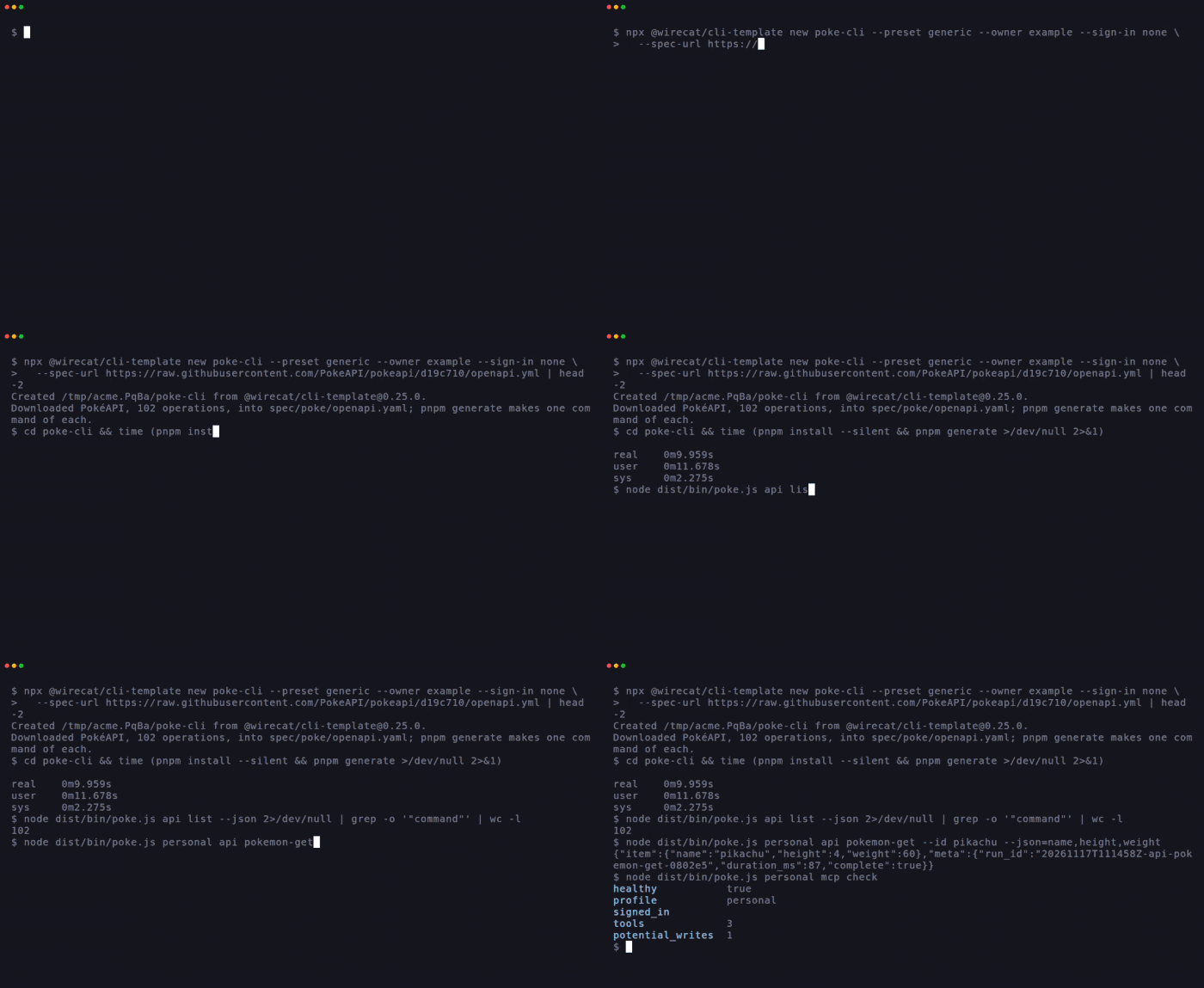
and updates of cli-core bring the fixes to the code. Your own commands are never touched.From PokeAPI's published description to 102 commands, a real answer and a working MCP server took 16 seconds with an empty pnpm store and 12 with a warm one, not counting npx's own download. Nine of WireCat's own CLIs are made from the template, see CLIs built with it.
There are two ways in. Pick the one that fits what you have.
| You have | Start with | You get |
|---|---|---|
| The address of the service's API description | new --spec-url <url> |
A CLI with one command per operation, the MCP server and the skill |
| An API description and a few lines saying how its records map to people and companies | new --from-config wirecat.config.ts |
The same, plus sign-in, sync into a local copy and the category's contract tests (CRM, tracker, content) |
| An agent and no time | npx skills add WireCatLabs/cli-template |
Your agent finds the description and runs new --spec-url for you |
npx @wirecat/cli-template new poke-cli --preset generic --owner example --sign-in none \
  --spec-url https://raw.githubusercontent.com/PokeAPI/pokeapi/d19c710/openapi.yml
cd poke-cli && pnpm install && pnpm generate
node dist/bin/poke.js personal api pokemon-get --id pikachu --json=name,height,weight
node dist/bin/poke.js personal mcp add claude-code --allow-writes
Put your own GitHub name in --owner and the address of your service's description in --spec-url, JSON or YAML.
--preset generic answers the questions only WireCat's own tools need, and any flag you give wins. Without it, new
asks for every missing answer and never guesses one. --allow-writes is there because the template's sample
comments commands can write, and mcp add refuses a profile with writes until you say so.
npx @wirecat/cli-template remove-sample drops the sample.
One file says which service it is, where its API description lives, how to check a token, and how the service's
records map to people, companies and deals. new builds the CLI from it, and the CLI keeps the file as the one place
to edit.
import { defineCli } from "@wirecat/cli-core/manifest"

export default defineCli({
  identity: { command: "acme", package: "@wirecat/acme-cli", prefix: "WCACME", service: "Acme", owner: "WireCatLabs" },
  spec: { kind: "openapi", from: "https://acme.example/openapi.json" },
  auth: { preset: "token", verify: { operation: "getMe", id: "workspace.id", name: "workspace.name" } },
  category: "crm",
  source: { provider: "acme", kinds: ["person"], entities: { person: { … } } },
})
npx @wirecat/cli-template new --from-config wirecat.config.ts
cd acme-cli && pnpm install && pnpm generate
node dist/bin/acme.js work session start    # takes the token and checks it with auth.verify
node dist/bin/acme.js work sync             # copies the records in, then only what changed
In a terminal, new asks for the answers the config does not hold, such as the content languages. A script or an
agent passes them as flags, listed in the kit reference. Outside WireCat, use your own
scope in package and your own name in owner. This path needs a real account and its token, since
session start checks the token against the service. The shape of source is CrmManifest in
@wirecat/cli-core/manifest.
--help, ask --json=name,height for
only the fields they need, and chain commands in a script.mcp serve, and ChatGPT or Claude in the browser through mcp serve --http behind your own tunnel.runs show tells you what was run.| Agent | How to connect |
|---|---|
| Claude Code, Codex | <cli> <profile> mcp add claude-code or mcp add codex (--allow-writes for a profile that may write), and <cli> skill install |
| Claude Desktop, Cursor | <cli> <profile> mcp config prints the entry to paste |
| ChatGPT, Claude in the browser | <cli> <profile> mcp serve --http --public-url <your tunnel> |
| Gemini CLI, OpenClaw, Hermes | <cli> skill install --for agents (or --for hermes) |
| What goes wrong with an API wrapper | What the template does |
|---|---|
| A one-time generator leaves you to copy its later fixes by hand | upgrade merges each template change file by file and asks before it touches a file you changed. src/, scripts/ and docs/ are yours and never touched |
| An agent deletes something you did not mean it to | Each profile sets allow, ask, readonly or deny per command and per API operation. A delete needs its own permission key, and the api group refuses to start without one. --dry-run shows what would run. Over MCP nobody can answer ask, so it runs: give the profile you serve readonly or deny where it matters |
The token sits in a .env file |
It stays in the OS keyring, under a profile you name, such as personal or work. No profile is ever assumed: a command without one stops and lists the profiles |
| The service changes its API | pnpm spec:sync downloads the description again, and pnpm generate follows |
| "It worked on my machine" | src/api.test.ts sends every operation to a fake built from the description, which refuses a request the description does not allow |
poke-cli/
├── spec/poke/openapi.yaml       the API description, and where it came from
├── wirecat.config.ts            with --from-config: the one file to edit
├── src/generated/               types, schemas and a manifest of every operation
├── src/commands/                the api group, the sign-in and your own commands
├── src/hooks.ts                 yours to add, named by `hooks` in the config: what the config cannot say
├── src/api.test.ts              every operation sent to a strict fake of the API
├── src/crm-contracts.test.ts    with a CRM config: cli-core's contracts for the category (tracker, content alike)
├── contracts/wirecat.json       what WireCat Desktop reads to show and run the tool
├── skills/                      the agent skill, with pages for the API
├── .github/workflows/           CI, the release and a monthly check
└── bin/release                  publishes each version to npm through GitHub
A CLI with a source, such as a CRM made from a config, also gets what cli-core gives every WireCat tool. It keeps a
local copy that sync updates with only the changes, so its lists and search can answer from the copy, also
offline. A contact joins a person from your other WireCat tools by the same email, and search all finds them
together. A CLI made only from a description has no store and no search. It calls the service live.
flowchart LR
  spec["API description<br/>OpenAPI 3, Swagger 2.0<br/>or Google Discovery"] --> config["wirecat.config.ts<br/>sign-in, category,<br/>field map"]
  config --> hooks["src/hooks.ts<br/>what the config<br/>cannot say"]
  hooks --> ready["cli-dev ready<br/>every check,<br/>with its evidence"]
  ready --> live["live check<br/>on a test account"]
  live --> release["bin/release<br/>npm"]
new --spec-url downloads an OpenAPI 3 or Swagger 2.0 description (https, or http from
localhost, at most 20 MB), puts its servers into the hosts
the CLI may reach, and records the address and a hash in spec/<command>/provenance.json. pnpm generate writes
one command per operation, its permission, its test and the skill's page. When the generator stops on part of the
description, it names the place. Add a patch with its reason in scripts/spec-model.ts, as the
OpenAPI guide shows. A Google Discovery document goes in with
--spec discovery and a line in scripts/sync-spec.ts.wirecat.config.ts says how to check a token and how the service's answers map to people,
companies and deals. pnpm generate turns it into code that cli-core runs, so paging, cursors, the request budget
and the store come from cli-core, not from code you write.src/hooks.ts, such as dropping old values of a field that
keeps its history. The config names the file, and pnpm source:check checks every operation and path the config
reads against the generated API.cli-dev ready. It runs the CLI's checks in a fixed order and says for each one whether it is verified, with
the evidence, and the one next step. A row is verified only by a script that passed, or by a live-check record of
exactly this code. Nothing is inferred.bin/live <account> runs scripts/live.sh against a test account and records
the pass. bin/release publishes to npm through GitHub.How much of a source a config could cover, we estimated by reading the code of five WireCat CLIs written by hand before the config existed (an estimate, give or take 10 points): between 42% (Bitrix24) and 87% (Google Drive), with HubSpot at about 60%. The rest is the service's own logic, and it stays in hooks. Drive and Yandex Disk are document sources, which a config does not cover yet.
| Layer | What it proves | Where |
|---|---|---|
| Every operation | The request each command sends is one the description allows, and a denied delete stops before anything is sent | src/api.test.ts |
Sign-in, with auth.verify |
session start checks the token with the operation the config names, and keeps nothing when the service refuses it |
src/commands/session.test.ts |
| Category contracts | The source behaves like every CRM in WireCat, faults included. For example "a full list cut after its first page goes on from that page in a new run, nothing lost or repeated" and "a clock off by ten minutes either way loses no change" | src/crm-contracts.test.ts, from cli-core |
| Ready | Every check before a release ran and passed on this code | pnpm exec cli-dev ready |
| Live | The CLI works against the real service | bin/live, on a test account |
cli-core has contracts for CRM, files, calendar, mail and meetings. A config wires CRM's today. For the others you write the source by hand and run the same contracts.
All of them are WireCat's own, public, and made from this template.
| CLI | What it does |
|---|---|
| hubspot-cli | HubSpot CRM: a local copy of deals, contacts and companies, an MCP server and every CRM read of HubSpot's API |
| bitrix24-cli | Bitrix24 CRM: deals and leads in a local store, any REST method, a permission on every write |
| amo-cli | amoCRM and Kommo: deals in a local store, any API v4 operation, a permission on every write |
WireCatLabs/cli-template is a public repo on GitHub by WireCatLabs. Turn an API description into a CLI and MCP server your AI agent can use, with tests and template upgrades.
It declares the Apache-2.0 license on GitHub.
Its maker has not tagged a system, so it is unknown here. Its README says what it needs.
Open "Take it" on its page: Take My Repo writes an install plan for your machine and hands it to your AI agent (Claude Code, Codex or Cursor), which asks you before each step. Take My Repo has not tested it on any machine.
Reverse engineer anything with agents, from app behavior down to native binaries.
VoiceStudio is the open-source, fully-local ElevenLabs alternative — voice cloning, voice design, video dubbing, dictation, transcription & audiobook creation in 646 languages.
Fair-code workflow automation platform with native AI capabilities. Combine visual building with custom code, self-host or cloud, 400+ integrations.
The 1st Collaborative AI Design Agent Workspace. Local-first and open source. Create motion, prototypes, websites, apps, dashboards, presentations, images, and videos with your team and AI agents. Share work, exchange feedback, and iterate together in one workspace.
Its last change on GitHub was on 2026-11-23. Take My Repo does not judge from that whether it is maintained.
Nobody has reviewed it on Take My Repo yet, which says nothing about its quality.
Take My Repo cannot say: it does not audit code and has not run cli-template. What is known comes from GitHub. It declares the Apache-2.0 license on GitHub. Its last change was on 2026-11-23. It has 1 stars, which measure popularity, not safety. Nobody has reviewed it on Take My Repo yet, which says nothing about its quality. Read the source before you run it. With "Take it", your AI agent shows each step and asks you before running it; README text is treated as data, not as instructions.


