
rea
Reverse engineer anything with agents, from app behavior down to native binaries.
- 472k
- TypeScript
- MIT
- 58 min ago
Offline anime image generation on the Snapdragon 8 Gen 1 NPU (Hexagon V69), no root. Android app.
Repo ayanoby/hexanima, read from GitHub 1 min ago. ayanoby has not joined Take My Repo.
ayanoby/hexanima is a public repo on GitHub by ayanoby. Offline anime image generation on the Snapdragon 8 Gen 1 NPU (Hexagon V69), no root. Android app. It declares no license on GitHub. Public does not mean open source: without a license, nobody is granted the right to reuse it. It is written mainly in C++, has 30 stars and last changed on 2026-11-18. Nobody has reviewed it on Take My Repo yet, which says nothing about its quality. Read from GitHub on 2026-11-21.
Anime image generation that runs entirely on your phone's NPU.
No root, no cloud, no account, no ads. Free and non-commercial.


HexAnima runs the Anima diffusion model and fine-tunes of it on the Hexagon NPU of Snapdragon 8 Gen 1 / 8+ Gen 1 phones. The diffusion transformer is executed by custom HMX kernels; the text encoder and the sampler run on the CPU. A 512x768 picture takes about 7 s with the 2B models and 12 s with the 2.9B models (4 steps, Xiaomi 12T Pro).
It can also run MOSS-Image 5B (OpenMOSS, Apache-2.0), a larger model that you prompt with plain sentences. Its text encoder (Qwen3.5-9B), the transformer and the decoder all run on the NPU: about 30 s for 512x768 and about 80 s for 1 Mpx; any size with sides that are multiples of 16 (up to 6144 patches). It is an optional ~14 GB download.
And Qwen-Image 2.1 Turbo (Qwen team; with the 4-step Lightning LoRA by LightX2V or without it, 8 steps): it draws legible text inside pictures, follows long prompts, and edits your photos by a prompt ("make the sky a sunset"). The text encoder (Qwen3-VL-8B), its vision tower, the 7B transformer and the VAE all run on the NPU.
About 40 s for 512x768, about 40-50 s for an edit (768x512 from a 512x512 photo); the weights (~14 GB, optional download) are streamed from storage for every picture. Non-commercial use only (Qwen Research License), see below.
And Mage-Flow-Edit-Turbo (Microsoft, MIT): a 4B model that draws and edits photos by a prompt in about 12 seconds a picture (a text encoder, a ViT, a 12-block transformer and the VAE, all on the NPU). The weights are about 8.7 GB (optional download) and are streamed from storage for every picture.
And MiniMax-H3-Image (MiniMax, 33B transformer and a Qwen3-VL text encoder, INT8-ConvRot, 6 steps without CFG, or 2 with the pDMD LoRA): sizes from 512 to 2048, about 2 minutes for 512x768 (the weights stream from storage for every picture). It is an optional 48 GB download from its own public repository ayanoby/hexanima-h3; MiniMax community licence: not for the US, EU, UK and South Korea, outputs must not be used to improve other AI models (the app asks for consent first). Powered by MiniMax-H3-Image.
And FLUX.3 Image Klein (Black Forest Labs, 5.6B, non-commercial FLUX Kommunity License): photorealism and legible text, 16 steps without CFG, about a minute for 512x512, with a live preview (9 GB, in the download catalog).
And LTX-2.5 Video (Lightricks, 22B distilled, LTX-2 Community License): short video from a prompt or from a photo (17-97 frames, 8 steps, no sound), saved as an MP4 with a player in the app (31 GB, in the download catalog). MiniMax-H3 Ref2VA makes video with a reference photo (the converted files are put in by hand, see h3/NOTES_REF2VA.md).
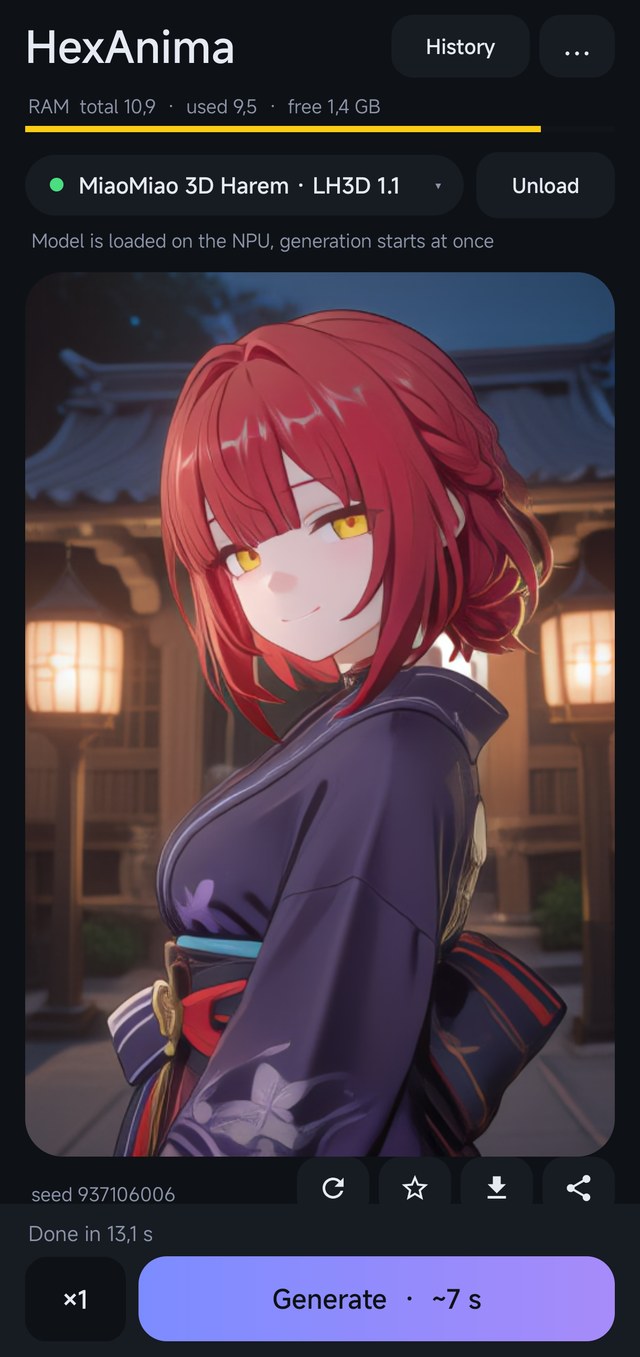
.safetensors, a strength slider, a check at once) and the number of steps entered by hand (the LoRA's own step count, usually 4 or 8). Anima, Qwen-Image 2.1 Turbo and MOSS-Image all work this way..safetensors file, the app checks it at once (layer names, shapes, rank, data type) and says why if it does not fit; a strength slider (0-2). The LoRA is folded with the 4-step adapter (or replaces the Turbo slot) on the phone (about 15 s the first time) and never leaves the device.Straight from the phone, 512x768, 4 steps, no upscaling, no editing (screenshots of the app; the date and battery are cropped out).


3D Harem LH3D 1.1 (2B, ~7 s) · RealSkin Anima 1.3 (2B, ~7 s) · Harem 2.9B BETA 1.1 (~12 s) · RealSkin 2.9B 1.0 (~12 s)
Four different prompts, 768x1024, 4 steps, about 60 s each, straight from the phone (same method as above, nothing retouched). Text in the picture is a strength of MOSS-Image but not a guarantee: short words usually come out right, longer or secondary text (shop-front boards, book covers, small signs) is often garbled. The pictures below are the first and only attempt for each prompt, bad text left as it is.


"neon sign that says OPEN LATE" (the sign is right, the boards are not) · "title at the top says THE LAST LIBRARY" (title right, subtitle garbled) · "board that says HEXANIMA" (right) · "the words GAME OVER in pixel font" (readable, with small glitches)
Your own LoRA. Pick a .safetensors file made for MOSS-Image; the app checks it at once (layer names, shapes, rank, data type) and tells you why if it does not fit (a FLUX or SDXL LoRA, a wrong shape, a rank above 128, a text-encoder-only file...). A strength slider goes from 0 to 2.
The LoRA is folded with the 4-step adapter (or replaces the Turbo slot) on the phone (about 15 s the first time for a new LoRA or strength, then cached) and never leaves the device. Left: without a LoRA, right: with a third-party style LoRA from Civitai (same prompt, seed and size; LoRAs stay under their authors' licenses).

Limits worth knowing: MOSS-Image only does text-to-image (no editing or image input), it needs about 14 GB of storage and was tested on a 12 GB phone only, and its weights are streamed from storage for every picture, so a picture takes 30 s at 512x768 and about 80 s at 1 Mpx.
Text-to-image: four prompts, three portrait 512x768 and one landscape 768x512, 4 steps, 40-50 s each, straight from the phone (nothing retouched, the first attempt for each prompt). The text in the picture is read from the prompt: the sign says HEXANIMA, the chalkboard Fresh Coffee $3, the neon sign OPEN.

Editing a photo by a prompt. The same four pictures after one edit each (the picture is the photo, the sentence is the whole instruction; an edit takes about a minute): "make her hair pink and change the sign text to "HELLO"" · "make it a sunny summer day: no snow, green trees and a blue sky" · "turn him into a smiling man wearing a red knitted hat" · "change the neon sign text from "OPEN" to "CLOSED"". Everything not mentioned stays as it was.

Limits worth knowing: about 14 GB of storage, tested on a 12 GB phone only, weights are streamed from storage for every picture (RAM use stays near 1.2 GB), the photo for an edit is reduced to about 0.4 Mpx, and non-commercial use only (Qwen Research License).
Text-to-image: four prompts at 576x768, 4 steps, about 12 s each, straight from the phone (nothing retouched, the first attempt for each prompt): a red fox in a snowy forest, a latte by a rainy window, an anime girl with silver hair under an umbrella, an anime village with a torii gate.

Editing a photo by a prompt. The same four pictures after one edit each (about 21 s at this size): "turn the scene into a snowy night with a full moon" · "make it a sunny morning outside the window" · "change her hair to pink and make it a bright daytime scene" · "turn it into winter, covered in snow, with no cherry blossoms". The first and third edits did what they were asked, the second and fourth only partly (the light got warmer, snow lay on the gate but the blossoms stayed): short, concrete instructions work best.

Limits worth knowing: about 8.7 GB of storage, tested on a 12 GB phone only, pictures up to 6144 patches (for example 1536x1024) and edits up to 3200 patches (1024x768), the MIT license.
 Tag suggestions Danbooru tags complete as you type |
 Templates Recent and saved prompts |
 Size picker Portrait, landscape, square, custom |
 Model picker Switch models in one tap |
 Model manager Size, speed, download and delete |
 Picture details Prompt, seed, size, model; reuse the settings |
 Multi-select Favourite, save, share or trash many at once |
 Favourites Starred pictures in one place |
 Settings Language, theme, idle unload, quality tags |
 Info Why 4 steps, which sizes work, MOSS-Image and LoRA notes, licenses |
 Light theme Light, dark or follow the system |
 13 languages Chosen in Settings |
 Trash Deleted pictures stay 30 days, restore any time |
 MOSS-Image Plain-sentence prompts, any size |
 Your LoRA Checked at once, strength slider, prepared on the phone |
 Five models MOSS-Image next to the four Anima models |
 Info: MOSS-Image Sizes, LoRA, licenses |
HexAnima-<version>.apk from the Releases page and install it (allow installs from your browser or file manager).ayanoby/anima-npu-packs) the first time.MOSS-Image, Qwen-Image, Mage-Flow and MiniMax-H3-Image are separate downloads in the same manager (each lives in its own Hugging Face repository with its own LICENSE and NOTICE.md).
Tips: download a base model, pick a Turbo LoRA file under it and set the steps the LoRA was made for (usually 4 or 8); without a Turbo LoRA use more steps (Anima base also takes CFG and a negative prompt). See Info in the app for the other notes. Versions before 1.5.0 shipped merged Turbo checkpoints; they are replaced by base + LoRA and can be deleted in the manager.
HexAnima is an independent, unofficial project. It is not affiliated with, endorsed by, sponsored by or otherwise connected to CircleStone Labs, NVIDIA, Qualcomm, Alibaba (Qwen), Microsoft, LightX2V, OpenMOSS, Unsloth, Black Forest Labs or the authors of the models it can download.
"Anima" and "Cosmos" refer to third-party models, "NVIDIA" and "Qualcomm", "Snapdragon", "Hexagon" are trademarks of their respective owners.
They are used only to describe what the software works with.
The models (MiaoMiao Harem / 3D Harem / RealSkin by MIAOKA, based on Anima by CircleStone Labs and NVIDIA Cosmos) stay under their authors' licenses: non-commercial use only.
Turbo (distillation) LoRAs are separate files that you pick yourself (for example Anima Turbo v1.1 Lora by somedoby, TURBO for ANIMA (V4-29B) by n_Arno, Lightning by LightX2V); they stay under their authors' licenses. See THIRD_PARTY.md.
MOSS-Image, Qwen3.5-9B, the rapid-moss 4-step adapter (darask0, on lodestones' 8-step DMD), the FLUX.2 small decoder (Black Forest Labs) and the Unsloth GGUF quantisations are all under the Apache License 2.0; the MOSS-Image pack holds converted copies (the changes are listed in its NOTICE.md, also shown in the app under Info -> Licenses).
Built with Qwen. Qwen-Image 2.1 Turbo and the Lightning v2-RL adapter (LightX2V; its repository declares no license of its own, so it is treated as a derivative of the Qwen Materials) are under the Qwen Research License Agreement: non-commercial use only, no redistribution of the model under another name, and the licence text travels with the files. Qwen3-VL-8B (Qwen team) and the Unsloth GGUF quantisations are Apache-2.0. The Qwen-Image pack holds converted copies (changes in its NOTICE.md, also in the app under Info -> Licenses). Qwen is a trademark of its owner, used only to name the model.
Mage-Flow-Edit-Turbo and Mage-VAE (Microsoft) are under the MIT License; the Qwen3-VL-4B text encoder and vision tower that ship with it are Apache-2.0. The Mage-Flow pack holds converted copies (changes in its NOTICE.md, also in the app under Info -> Licenses).
LoRA files that you load yourself stay under their authors' licenses; check them before you share pictures made with them.
A model author can ask for removal of their model from the download catalog: open a discussion in the Community tab of the model packs repository.
The APK includes the Qualcomm AI Engine Direct (QNN) runtime libraries (libQnnHtp*.so, libQnnSystem.so) under the Qualcomm AI Stack License.
They are redistributed only in object code and only as part of the app, never standalone; the license text and the third-party notices are in app/assets/licenses/ and in the app (Info -> Licenses).
Qualcomm may terminate that license at any time, in which case distribution of the APK stops.
app/: the Android app (plain Java, built without Gradle by app/build.sh), package com.hexanima.npu. Languages in app/assets/lang/.phone/: the on-device server (animad.cpp) and anima.sh, which the app runs.chainrun/, hexagon/mega/: helper processes and the Hexagon HMX kernels (see THIRD_PARTY.md for the Qualcomm files you have to supply).flux3/, ltx/: FLUX.3 Klein and LTX-2.5 (kernels, runners, pack conversion; flux3/hexagon/mega is the kernel tree shared with MiniMax-H3 Ref2VA, whose runner is h3/hexagon/mega/r2vrun.cpp). See flux3/README.md, ltx/README.md, h3/NOTES_REF2VA.md.patches/: patches for stable-diffusion.cpp (NPU/TE/VAE hooks, serve mode); android/build_sd.sh builds it.export/, tools/: model conversion (make_pack.py builds the downloadable packs), translations (build_lang.py, lang/), stage_jnilibs.sh.docs/PITFALLS.md: engineering notes on the NPU work.You need the Android SDK (build-tools 34, platform 34), Docker, the Qualcomm QNN SDK (download it from Qualcomm and accept its license) and, for the DSP kernels, the Hexagon SDK.
Paths in the scripts default to ~/anima-npu/sdk/.... The order is: build the native helpers (phone/build.sh, chainrun/build.sh, hexagon/mega/build*.sh, android/build_sd.sh),
copy them with tools/stage_jnilibs.sh, then app/build.sh produces and installs hexanima.apk.
The model packs are built by tools/make_pack.py and downloaded by the app from a Hugging Face repository (set in Main.DEFAULT_BASE).
The HexAnima source code is MIT (LICENSE). Models, QNN and the other components keep their own licenses: see THIRD_PARTY.md.
The app shows all required license texts and notices (Info -> Licenses): Qualcomm AI Stack License, QNN notices, Apache License 2.0 and the MOSS-Image notice; the files are in app/assets/licenses/.
ayanoby/hexanima is a public repo on GitHub by ayanoby. Offline anime image generation on the Snapdragon 8 Gen 1 NPU (Hexagon V69), no root. Android app.
It declares no license on GitHub. Public does not mean open source: without a license, nobody is granted the right to reuse it.
Its maker has not tagged a system, so it is unknown here. Its README says what it needs.
Open "Take it" on its page: Take My Repo writes an install plan for your machine and hands it to your AI agent (Claude Code, Codex or Cursor), which asks you before each step. Take My Repo has not tested it on any machine.
Its last change on GitHub was on 2026-11-18. Take My Repo does not judge from that whether it is maintained.
Nobody has reviewed it on Take My Repo yet, which says nothing about its quality.
Reverse engineer anything with agents, from app behavior down to native binaries.
Reference-image character and style transfer for Anima in ComfyUI (offset-RoPE reference frame + LoRA)
Run frontier LLMs and VLMs locally on Qualcomm devices across NPU, GPU, and CPU with a few lines of code
Lemonade helps users discover and run local AI apps by serving optimized LLMs right from their own GPUs and NPUs. Join our discord: https://discord.gg/5xXzkMu8Zk
Flutter makes it easy and fast to build beautiful apps for mobile and beyond