particle-life
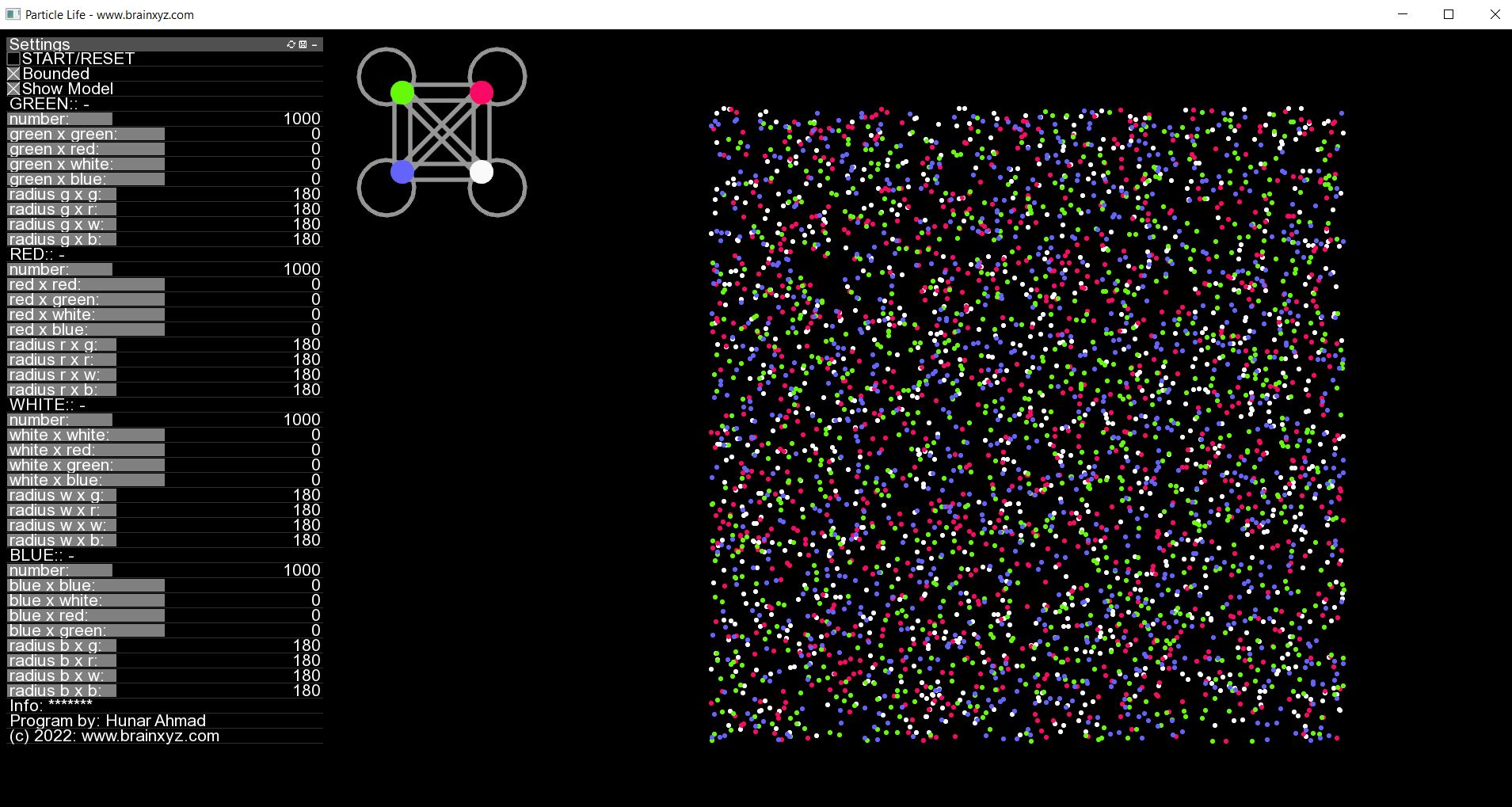
A simple program to simulate artificial life using attraction/reuplsion forces between many particles
- 3.4k
- HTML
- MIT
- 2 y ago
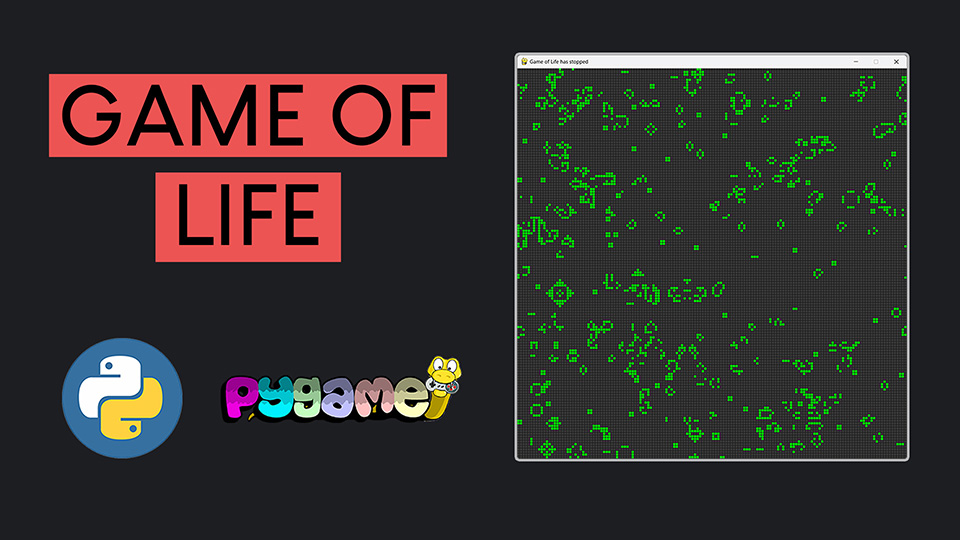
Conway's Game of Life in Python with pygame (pygame-ce). This project is accompanied by a video tutorial that explains everything in detail.
Repo educ8s/Python-Game-Of-Life-with-Pygame, read from GitHub 25 min ago. educ8s has not joined Take My Repo.
educ8s/Python-Game-Of-Life-with-Pygame is a public repo on GitHub by educ8s. Conway's Game of Life in Python with pygame (pygame-ce). This project is accompanied by a video tutorial that explains everything in detail. It declares no license on GitHub. Public does not mean open source: without a license, nobody is granted the right to reuse it. It is written mainly in Python, has 5 stars and last changed on 2025-01-12. Nobody has reviewed it on Take My Repo yet, which says nothing about its quality. Read from GitHub on 2026-11-24.
A simple program to simulate artificial life using attraction/reuplsion forces between many particles
This is a Python implementation of Conway's Game of Life using Pygame. The Game of Life, also known simply as Life, is a cellular automaton devised by the British mathematician John Horton Conway in 1970. It's a zero-player game, meaning its evolution is determined by its initial state, requiring no further input from human players. Players set up the initial configuration of cells on a grid, and then watch as generations evolve over time.
The project aims to provide an interactive experience, allowing users to visually explore the behavior of cellular automata through various patterns and configurations. Whether you're a seasoned programmer looking to experiment with Pygame and cellular automata, or a beginner curious about the fascinating world of emergent complexity from simple rules, this tutorial offers something for everyone.
| 📺 My YouTube Channel
| 🌍 My Website |
Getting started with the Game of Life simulation is straightforward. After cloning the repository and setting up your environment as outlined in the README, you're ready to launch the program and engage with the interactive simulation. Here's your guide to controlling and interacting with the Game of Life:
Enter to initiate the simulation. Observe as the cells transition through generations, adhering to the Game of Life's rules.Spacebar to pause the simulation at any moment.R to populate the grid with a random mix of alive and dead cells, perfect for kicking off a new simulation with unforeseen developments.C to clear the grid, turning all cells to a dead state.F, making the generations evolve quicker.S, giving you a closer look at each generation's transformation.With these controls at your disposal, you have complete mastery over the simulation, offering a sandbox to explore the depth of the Game of Life from your perspective. Try out various initial setups, speeds, and patterns to uncover the endless possibilities hidden within this simple, yet profound simulation. Dive into the captivating world of cellular automata and enjoy the exploration!
educ8s/Python-Game-Of-Life-with-Pygame is a public repo on GitHub by educ8s. Conway's Game of Life in Python with pygame (pygame-ce). This project is accompanied by a video tutorial that explains everything in detail.
It declares no license on GitHub. Public does not mean open source: without a license, nobody is granted the right to reuse it.
🐍🎮 pygame (the library) is a Free and Open Source python programming language library for making multimedia applications like games built on top of the excellent SDL library. C, Python, Native, OpenGL.
C++ Matrix: The Matrix Reloaded in Terminals (Number falls, Banners, Matrix rains, Conway's Game of Life and Mandelbrot set)
Some work on the paper, "Automated Lie-algebraic input space partitioning using first-order two-dimensional cellular automata" by me (Shrohan Mohapatra. (2020, June 5). Automated Lie-algebraic input space partitioning using first-order two-dimensional cellular automata. Zenodo. http://doi.org/10.5281/zenodo.3880404), here in the specific example with Game of Life for automated Lie-algebraic input
Its maker has not tagged a system, so it is unknown here. Its README says what it needs.
Open "Take it" on its page: Take My Repo writes an install plan for your machine and hands it to your AI agent (Claude Code, Codex or Cursor), which asks you before each step. Take My Repo has not tested it on any machine.
Its last change on GitHub was on 2025-01-12. Take My Repo does not judge from that whether it is maintained.
Nobody has reviewed it on Take My Repo yet, which says nothing about its quality.
Take My Repo cannot say: it does not audit code and has not run Python-Game-Of-Life-with-Pygame. What is known comes from GitHub. It declares no license on GitHub. Public does not mean open source: without a license, nobody is granted the right to reuse it. Its last change was on 2025-01-12. It has 5 stars, which measure popularity, not safety. Nobody has reviewed it on Take My Repo yet, which says nothing about its quality. Read the source before you run it. With "Take it", your AI agent shows each step and asks you before running it; README text is treated as data, not as instructions.