

ECC
The agent harness performance optimization system. Skills, instincts, memory, security, and research-first development for Claude Code, Codex, Opencode, Cursor and beyond.
- 310k
- JavaScript
- MIT
- 1 d ago
Coding agents like Claude Code and OpenAI Codex quietly record every session to disk as JSONL — messages, reasoning, tool calls, file edits and token usage. That data is a goldmine, but it lives in raw log files no one reads.
Repo everettjf/coding-agent-visualizer, read from GitHub 10 min ago. everettjf has not joined Take My Repo.
everettjf/coding-agent-visualizer is a public repo on GitHub by everettjf. Coding agents like Claude Code and OpenAI Codex quietly record every session to disk as JSONL — messages, reasoning, tool calls, file edits and token usage. That data is a goldmine, but it lives in raw log files no one reads. It declares the MIT license on GitHub. It is written mainly in TypeScript, has 20 stars and last changed on 2026-06-23. Nobody has reviewed it on Take My Repo yet, which says nothing about its quality. Read from GitHub on 2026-11-24.
The agent harness performance optimization system. Skills, instincts, memory, security, and research-first development for Claude Code, Codex, Opencode, Cursor and beyond.
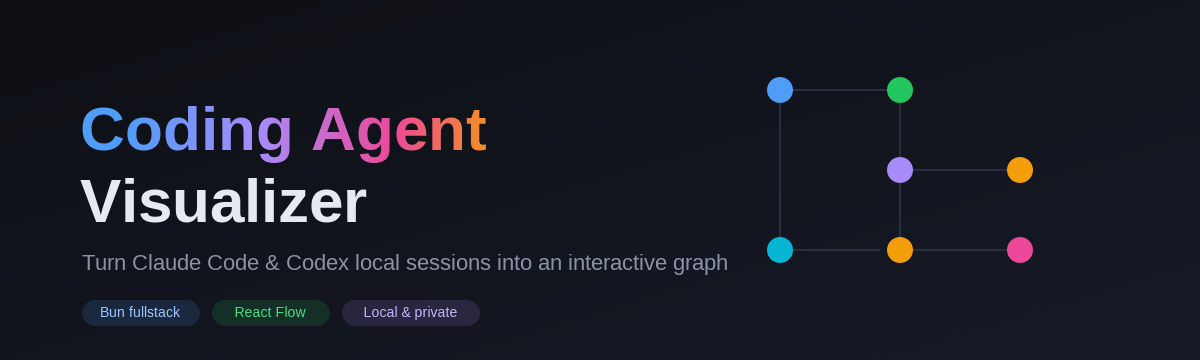
Turn the local session files of your coding agents into a beautiful, interactive map.
Coding agents like Claude Code and OpenAI Codex quietly record every session to disk as JSONL — messages, reasoning, tool calls, file edits and token usage. That data is a goldmine, but it lives in raw log files no one reads.
Coding Agent Visualizer reads those local files and renders them as an interactive execution graph, a distributed-tracing span waterfall, a token-cost flame graph, a file heatmap and an analytics dashboard — so you can actually see what your agent did, how it branched into sub-agents, which files it hammered, and where the tokens went.
No office mascots, no 3D robots. Just a fast, good-looking, useful lens on real agent runs. Everything runs locally — your transcripts never leave your machine.
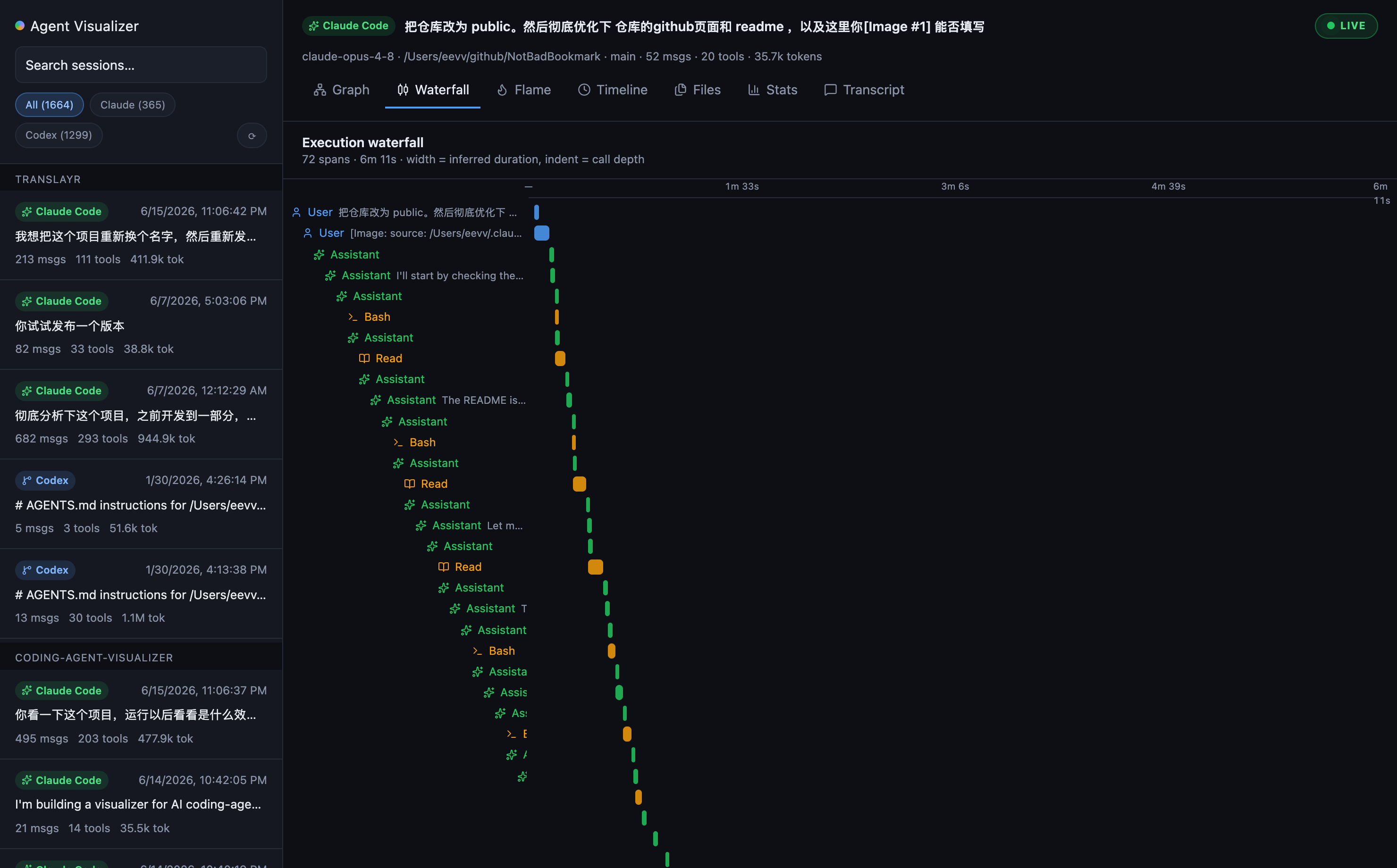
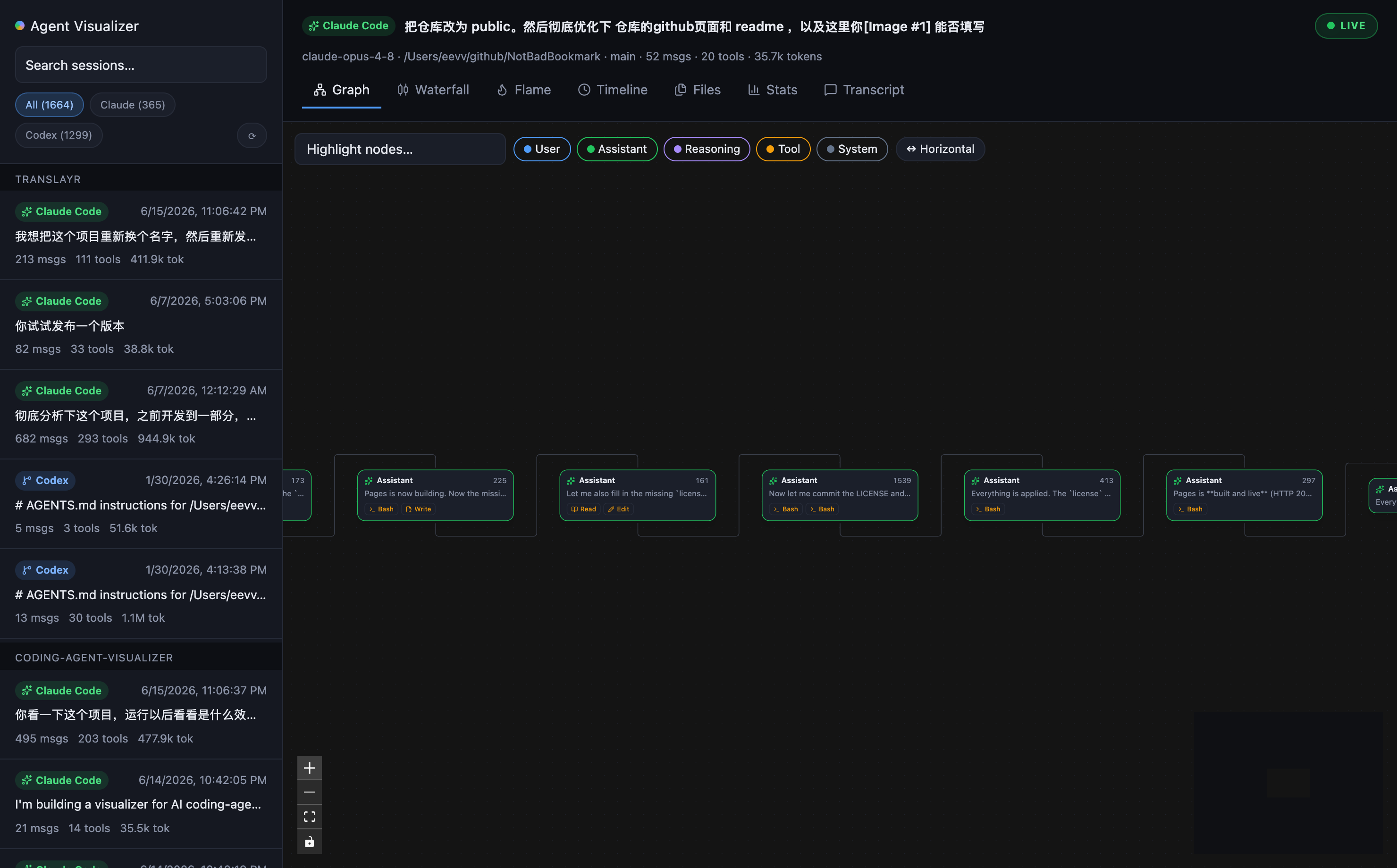
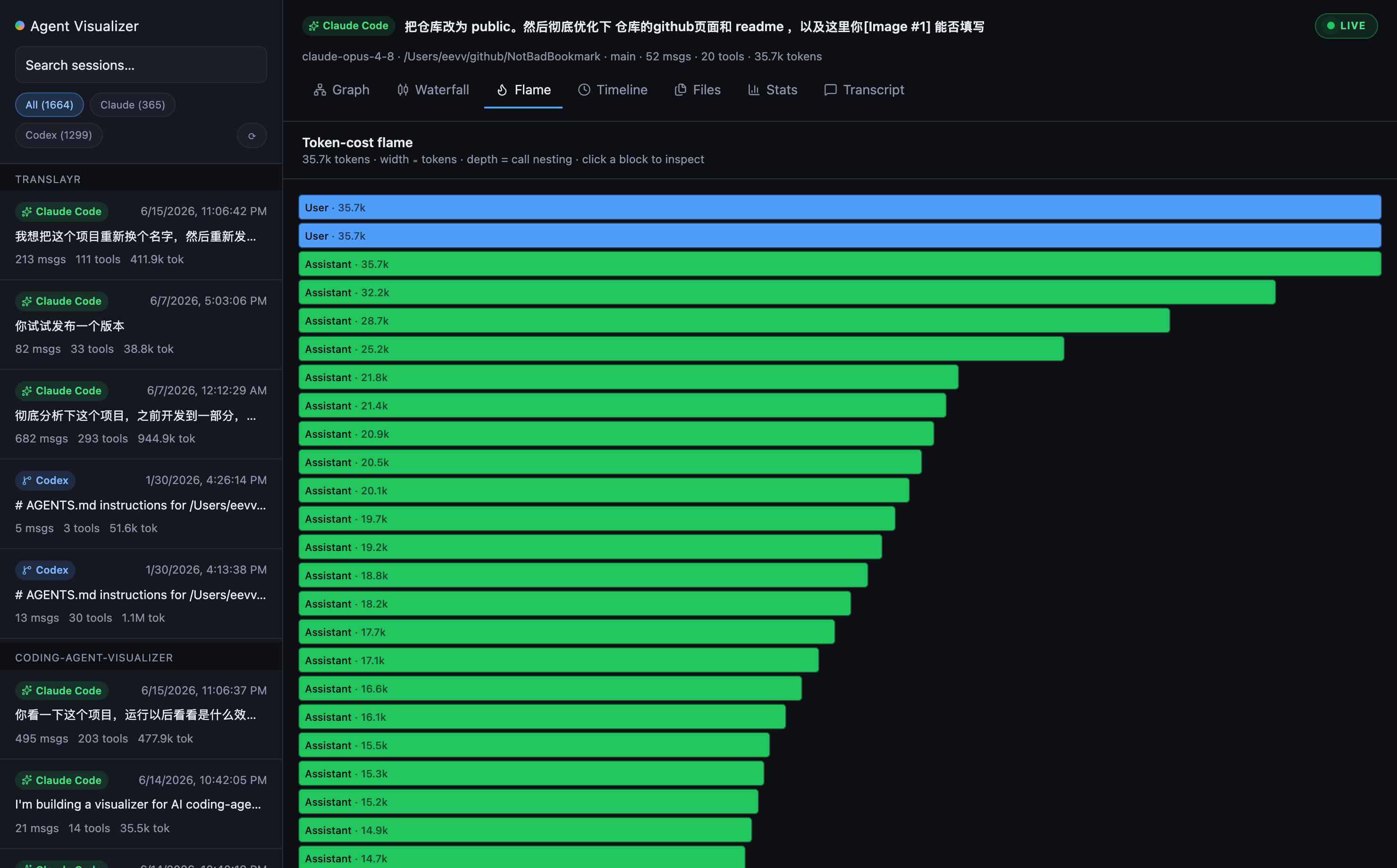
| Execution graph | Token-cost flame | Analytics |
|---|---|---|
 |
 |
 |
| 🕸️ Execution graph | Conversation rebuilt as a graph and laid out left-to-right with dagre. Tool-only turns fold into chips, fragments reconnect into one spine, sub-agents branch off — a readable flow instead of an endless staircase. |
| 🌊 Span waterfall | The distributed-tracing view (à la Jaeger / LangSmith / Phoenix): every event is a span, indented by call depth, positioned on a shared time axis, width = inferred duration. |
| 🔥 Token-cost flame | An icicle (top-down flame graph) where width ∝ tokens and depth = call nesting — a token-heavy turn or sub-agent jumps right out. Built on d3-hierarchy. |
| ⏱️ Timeline | Every event placed on a time track with role colors and previews — see the rhythm and gaps of a session. |
| 🗂️ File heatmap | Which files the session touched and how often, colored cool→hot by edit frequency. |
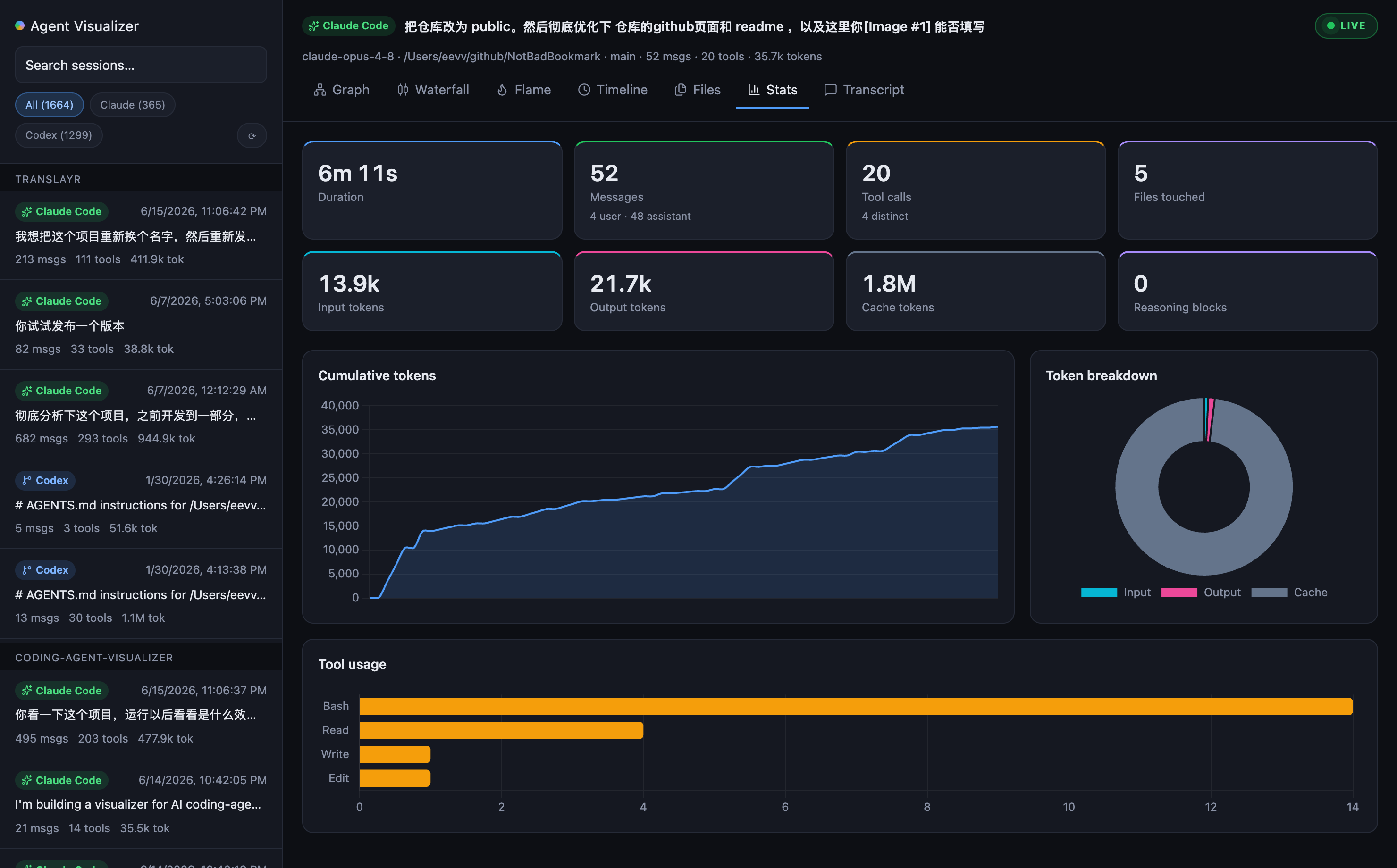
| 📊 Stats dashboard | Duration, message/tool counts, input/output/cache tokens, a cumulative-token line, a token-breakdown doughnut and per-tool bars — all rendered with Chart.js. |
| 💵 Real dollar cost | Token counts turned into USD under each model's published pricing (cache reads/writes priced separately) — per session on Stats, and aggregated total / per-model in analytics. |
| 💬 Transcript | A clean, readable conversation view with collapsible tool blocks. |
| 🔎 Full-text search | Search across every session body — messages, reasoning and tool I/O — with snippets, not just titles. |
| ⚖️ Compare sessions | Diff two runs metric-by-metric — duration, tokens, cost and tool usage with signed deltas — to see what changed when you tweaked a prompt. |
| 📂 Open any file | Drag-and-drop (or pick) a transcript from anywhere; the source is auto-detected and rendered through every view. |
| 🔍 Graph search & filters | Highlight matching nodes; toggle roles (hide reasoning/tools), flip layout horizontal/vertical. |
| 🧩 Diff & inspect | Click any node for full message / reasoning / tool I/O, with syntax-highlighted diffs for Edit/Write and one-click copy. |
| 🗂️ Multi-source | Claude Code, Codex, Gemini CLI, Qwen Code, OpenCode, Cursor and Cline today; a new agent is just one pluggable adapter away. |
| 📝 Annotations | Flag any turn and jot a private note (stored locally); export flagged turns as a Markdown review document. |
| 🌐 Online demo | A fully client-side demo — drop a transcript and explore it in the browser, nothing uploaded. |
| 🔴 Live tail | Toggle LIVE to stream a session into the graph as the agent writes to disk — watch it think in real time. |
| 📈 Cross-session analytics | Aggregate every local session: token & cost over time, tool-usage trends, and per-source / per-model / per-project breakdowns. |
| 🧬 Collapsible sub-agents | Fold a whole sub-agent (sidechain) branch into its entry node — collapse one or all at once to focus the graph. |
| 📤 Export | Save any session as Markdown or a self-contained, shareable HTML transcript — generated locally, nothing uploaded. |
Requires Bun (≥ 1.2). Install it if you haven't:
# macOS & Linux
curl -fsSL https://bun.sh/install | bash

# Windows (PowerShell)
powershell -c "irm bun.sh/install.ps1 | iex"
Run it without cloning:
bunx coding-agent-visualizer@latest # → http://localhost:19876
Set a different port with PORT=4000 bunx coding-agent-visualizer@latest. After a
global install (bun add -g coding-agent-visualizer@latest) you can launch it with
the short cav command.
Or grab a standalone binary (no Bun needed):
Download the executable for your platform from the latest release and run it — the whole app and the Bun runtime are bundled into one file:
./coding-agent-visualizer-darwin-arm64 # → http://localhost:19876
Or clone for development:
git clone https://github.com/everettjf/coding-agent-visualizer.git
cd coding-agent-visualizer
bun install
bun dev          # → http://localhost:19876
The app auto-discovers sessions from:
~/.claude/projects/<encoded-cwd>/*.jsonl~/.codex/sessions/YYYY/MM/DD/rollout-*.jsonl~/.gemini/tmp/<project-hash>/checkpoint-*.json~/.qwen/tmp/<project-hash>/checkpoint-*.json (Gemini-compatible fork)~/.local/share/opencode/storage/{session,message,part}/…state.vscdb SQLite (composer chats)…/saoudrizwan.claude-dev/tasks/<id>/Pick a session from the sidebar and explore — or drop any transcript file onto the window to visualize one from outside those locations. Nothing is uploaded anywhere.
A single Bun fullstack server (Bun.serve) serves both the React UI and a
tiny local-data API — no separate backend, no database, no telemetry.
src/
├─ lib/
│  ├─ types.ts            # UnifiedSession / SessionNode — the shared model
│  ├─ stats.ts            # computeStats() + buildTrace()/buildHierarchy() derivations
│  ├─ pricing.ts          # model → published USD rates; token breakdown → cost
│  ├─ analytics.ts        # cross-session aggregation (cost/time, tool & model trends)
│  ├─ discovery.ts        # scan all sources (mtime-cached), search, upload, dispatch
│  └─ adapters/
│     ├─ claudeCode.ts    # uuid/parentUuid tree → nodes; tool calls; tokens
│     ├─ codex.ts         # rollout response_items → nodes
│     ├─ gemini.ts        # Gemini Content[] (checkpoints) → nodes; also Qwen Code (fork)
│     ├─ opencode.ts      # session/message/part JSON files → nodes
│     ├─ cursor.ts        # state.vscdb SQLite composer chats → nodes
│     └─ cline.ts         # Cline task JSON (Anthropic messages + UI events) → nodes
│  ├─ pricing.ts          # model → published USD rates; token breakdown → cost
│  ├─ search.ts           # inverted index (prefix + TF ranking) for full-text search
│  └─ parseUpload.ts      # browser-safe "detect + parse a dropped transcript"
├─ cli.ts                 # `bunx coding-agent-visualizer` launcher
├─ server/index.ts        # Bun.serve: UI + /api/sessions, /api/session, /api/analytics, /api/search, /api/parse
└─ frontend/
   ├─ App.tsx             # sidebar, search, Radix tabs, export menu, panel orchestration
   ├─ demo.tsx            # standalone client-side online demo (GitHub Pages)
   ├─ GraphView.tsx       # React Flow + dagre graph, collapsible sub-agents
   ├─ DetailPanel.tsx     # node inspector (message / reasoning / tool / diff / notes)
   ├─ ui.tsx              # role/tool/source colors + lucide icon mapping
   ├─ lib/
   │  ├─ charts.ts        # Chart.js registration + dark-theme defaults
   │  ├─ highlight.tsx    # tiny dependency-free syntax highlighter for diffs
   │  ├─ annotations.ts   # local per-node flags + notes (localStorage) + export
   │  ├─ export.ts        # session → Markdown / self-contained HTML
   │  └─ utils.ts         # cn() Tailwind class merge helper
   └─ views/              # Waterfall / Flame / Timeline / Files / Stats / Transcript / Analytics / Compare
The UI is Tailwind v4 (via bun-plugin-tailwind, wired in bunfig.toml) with
Radix primitives and lucide icons; charts are Chart.js, the graph
layout is dagre, and the flame hierarchy uses d3-hierarchy.
Every adapter normalizes its raw format into one shape, so all views are source-agnostic and a new agent only needs a new adapter:
UnifiedSession {
  id, source, cwd, gitBranch, startedAt, endedAt,
  messageCount, toolCallCount, totalTokens, model,
  nodes: SessionNode[]          // DAG via parentId; tool calls are children
}

SessionNode {
  id, parentId, role: user | assistant | tool | reasoning | system,
  timestamp, isSidechain,       // isSidechain = Claude Code sub-agent branch
  text?, thinking?,
  tool?:   { name, input, result, isError, files[] },
  tokens?: { input, output, cacheRead, cacheCreation }
}
src/lib/adapters/<name>.ts exporting a parser that returns a
UnifiedSession (see claudeCode.ts as the reference).src/lib/discovery.ts.| Command | Description |
|---|---|
bun dev |
Dev server with hot reload |
bun start |
Production server |
bun run build |
Bundle the frontend to dist/ (also a CI build check) |
bun run compile |
Build a standalone single-file executable (no Bun needed to run) |
bun test |
Adapter + library unit tests (runs against fixtures/) |
bun run typecheck |
TypeScript check (tsc --noEmit) |
bun scripts/shot.ts |
Headless smoke test — opens every tab, reports runtime errors |
bun scripts/capture.ts |
Regenerate the README / landing-page screenshots |
All six adapters are covered by tests validated against realistic sample logs in
fixtures/: Claude Code / Codex / Gemini / Cline in adapters.test.ts, and the
non-JSONL OpenCode (fixture storage tree) and Cursor (in-memory SQLite) adapters
in extra.test.ts. Pricing/cost (pricing.test.ts), cross-session aggregation,
full-text search + upload detection (discovery.test.ts), the diff syntax
highlighter and the Markdown/HTML exporters are unit-tested too. The Claude Code
adapter is additionally verified against real local sessions (graph integrity:
single connected tree, tool results linked, files tracked).
Everything is read from your local disk and rendered in your local browser. There is no backend service, no account, and no network egress.
MIT © everettjf
everettjf/coding-agent-visualizer is a public repo on GitHub by everettjf. Coding agents like Claude Code and OpenAI Codex quietly record every session to disk as JSONL — messages, reasoning, tool calls, file edits and token usage. That data is a goldmine, but it lives in raw log files no one reads.
It declares the MIT license on GitHub.
Reverse engineer anything with agents, from app behavior down to native binaries.
Fair-code workflow automation platform with native AI capabilities. Combine visual building with custom code, self-host or cloud, 400+ integrations.
Knowledge infrastructure to make your agents smarter. Search, scrape and access 550+ data providers through one API.
Its maker has not tagged a system, so it is unknown here. Its README says what it needs.
Open "Take it" on its page: Take My Repo writes an install plan for your machine and hands it to your AI agent (Claude Code, Codex or Cursor), which asks you before each step. Take My Repo has not tested it on any machine.
Its last change on GitHub was on 2026-06-23. Take My Repo does not judge from that whether it is maintained.
Nobody has reviewed it on Take My Repo yet, which says nothing about its quality.
Take My Repo cannot say: it does not audit code and has not run coding-agent-visualizer. What is known comes from GitHub. It declares the MIT license on GitHub. Its last change was on 2026-06-23. It has 20 stars, which measure popularity, not safety. Nobody has reviewed it on Take My Repo yet, which says nothing about its quality. Read the source before you run it. With "Take it", your AI agent shows each step and asks you before running it; README text is treated as data, not as instructions.





