john
John the Ripper jumbo - advanced offline password cracker, which supports hundreds of hash and cipher types, and runs on many operating systems, CPUs, GPUs, and even some FPGAs
- 14k
- C
- 9 d ago
Open-source RoCE v2 engine for FPGAs: line-rate RDMA between an FPGA and a host or GPU over 100G Ethernet, vendor-neutral SystemVerilog, MIT
Repo fpgadeveloper/rocelet, read from GitHub 22 h ago. fpgadeveloper has not joined Take My Repo.
fpgadeveloper/rocelet is a public repo on GitHub by fpgadeveloper. Open-source RoCE v2 engine for FPGAs: line-rate RDMA between an FPGA and a host or GPU over 100G Ethernet, vendor-neutral SystemVerilog, MIT. It declares the MIT license on GitHub. It is written mainly in SystemVerilog, has 7 stars and last changed on 2026-11-06. Nobody has reviewed it on Take My Repo yet, which says nothing about its quality. Read from GitHub on 2026-11-24.
John the Ripper jumbo - advanced offline password cracker, which supports hundreds of hash and cipher types, and runs on many operating systems, CPUs, GPUs, and even some FPGAs
Digital logic design tool and simulator
rocelet is an open-source, lightweight RoCE v2 (RDMA over Converged Ethernet) engine for FPGAs, written in vendor-neutral SystemVerilog and validated on AMD UltraScale+ (see Portability). It is built for the common FPGA use case: moving data at line rate between an FPGA and a host or GPU over a point-to-point 100 GbE link (or, since v0.3, a 40 GbE or 10 GbE link with a narrower MAC), using standard RDMA NICs (validated with an NVIDIA ConnectX-6 Dx) on the host side, without a licensed IP core.
MAC_WIDTH; the engine is 512 bits inside, the width
converters are built in. PAUSE timing follows the link speed; a capabilities register tells
firmware the build. AXI-Lite control; AXI-MM data. 40G and 10G are validated on a ZCU106
with the open-source omac MACs.On a Kintex UltraScale+ (KCU116) the engine (rocelet_core) uses about one third of the LUTs
of AMD's ERNIC IP and 6 % of its block RAM; the complete IP (rocelet_top, with the MAC glue,
register file and AXI4 memory master) uses about half of ERNIC's LUTs
(docs/resources.md). It sustains line rate for messages of 2 KB and larger
and has been validated against an independent hardware RoCE v2 NIC.
In numbers, the v0.3.0 IP (16 QPs, 16 memory windows, 16 outstanding READs per QP, 256 KB retransmit ring, RX ICRC check, MAC glue, register file and AXI4 memory master) uses about 20.7k LUT, 37 BRAM36, 8 URAM and 1 DSP on an xcku5p with the 512-bit CMAC and closes timing at 322 MHz (docs/resources.md); with a 256-bit / 64-bit MAC at 156.25 MHz on the ZCU106's xczu7ev it uses 20.8k / 21.3k LUT, with more than 1.2 ns of slack. v0.2.2 was the same size (20.8k LUT).
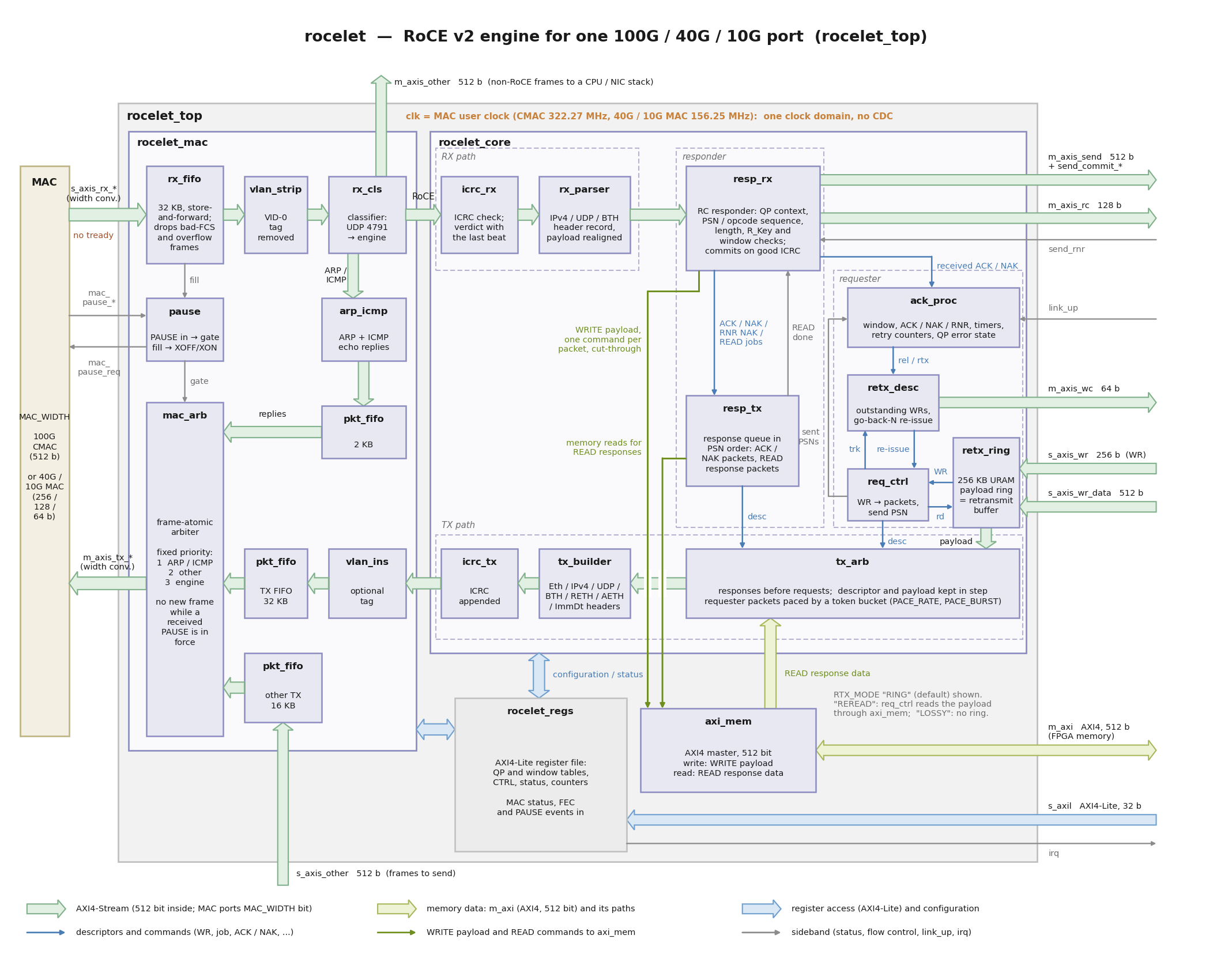
How to read the diagram, the receive and transmit paths, the requester and the responder: docs/architecture.md.
rocelet is meant to be pulled into a design as a git submodule. The reference design is
qsfp28-fmc-rocelet (Opsero 2x QSFP28
FMC: 100G on the KCU116, 40G or 10G on the ZCU106; see docs/designs.md). The dev branch holds the work in
progress; main holds releases.
A design instantiates rocelet_top (or rocelet_bd in an IP integrator block design) between
the Ethernet MAC (the 100G CMAC, or a 40G / 10G MAC such as the open-source omac IPs) and its
data: work requests and their payload go in on AXI-Streams, completions
come out; host WRITEs and READs reach FPGA memory through an AXI4 master; a soft CPU configures
the queue pairs through AXI-Lite after exchanging their parameters with the host. Start with
docs/integration.md.
The documentation is hosted at rocelet.ethernetfmc.com
(built by Read the Docs from the docs/ folder, which reads the same on GitHub):
| Document | Contents |
|---|---|
| docs/architecture.md | block diagram, module hierarchy, receive and transmit paths, reliability, HSB mode, clocking |
| docs/interface.md | the top-level ports and parameters, the work-request and completion formats |
| docs/registers.md | the AXI-Lite register map (generated; C header sw/rocelet_regs.h) |
| docs/integration.md | adding rocelet to a design: sources, clocks, MAC settings (CMAC: RS-FEC, pause, no auto-negotiation on AOC; 40G / 10G MACs), memory, firmware bring-up, timing, link loss, portability |
| docs/roce-subset.md | the RoCE v2 subset implemented, the wire rules, and what is deliberately left out |
| docs/hsb.md | Holoscan Sensor Bridge compatibility: the data-plane mode, the control plane and producer in the reference design, future work |
| docs/host-setup.md | host rules: MTU, FEC, neighbour entries, QP attributes, receive queues, ConnectX-6 Dx facts, GPU ring, link flaps and cable pulls |
| docs/resources.md | synthesis results, build-option costs, the MAC widths |
| docs/throughput.md | throughput per MAC width: the rates measured at 100G, 40G and 10G |
| docs/designs.md | designs using rocelet |
| sim/README.md | the simulation regression and its results |
| host/README.md | rocelet_host (libibverbs test helper) and roce_check.py (packet referee) |
rtl/        the IP (SystemVerilog; rocelet.f lists the sources in compile order)
regs/       the register map source (rocelet_regs.py generates the RTL package, the C header and docs/registers.md)
sw/         rocelet_regs.h for firmware
sim/        Python reference models, xsim testbenches, run_tests.py (make sim)
synth/      out-of-context synthesis / place / route scripts (make synth)
host/       host tools: rocelet_host (C, libibverbs), roce_check.py
docs/       documentation
scripts/    generators (the IP integrator wrapper)
make sim-quick          # simulation regression, smaller workloads (Vivado xsim + Python 3 with scapy)
make sim                # the full regression
make synth              # OOC synthesis, place and route of the v1 configuration (Vivado)
make -C host && make -C host test     # host tools (libibverbs-dev); the tests need no RDMA device
The simulations need Vivado's xvlog/xelab/xsim on the PATH (or VIVADO_SETTINGS
pointing at settings64.sh) and pip install scapy.
v0.3.0 (2026-11-05); see CHANGELOG.md. Validated in the qsfp28-fmc-rocelet design against an NVIDIA ConnectX-6 Dx at three link speeds:
The HSB mode carries a Holoscan Sensor Bridge device data plane into GPU memory with NVIDIA's HSB 3.0.0 host software (80 Gb/s at 100G, 39.0 Gb/s at 40G). Every figure: docs/throughput.md.
The feature set was chosen by a measured study of RoCE v2 (protocol decomposition, prior art, a resource baseline of AMD's ERNIC IP, per-block synthesis costs, whole-design builds and bench tests against a hardware NIC). The prototype that study produced was then productised into this IP; the prototype itself is not published.
We strongly encourage community contribution to these projects. Please make a pull request if you would like to share your work:
Thank you to everyone who supports us!
This project was developed by Opsero Inc., a tight-knit team of FPGA experts delivering FPGA products and design services to start-ups and tech companies. Follow our blog, FPGA Developer, for news, tutorials and updates on the awesome projects we work on.
The sources of this repository are released under the MIT license, see LICENSE.
fpgadeveloper/rocelet is a public repo on GitHub by fpgadeveloper. Open-source RoCE v2 engine for FPGAs: line-rate RDMA between an FPGA and a host or GPU over 100G Ethernet, vendor-neutral SystemVerilog, MIT.
It declares the MIT license on GitHub.
Its maker has not tagged a system, so it is unknown here. Its README says what it needs.
Open "Take it" on its page: Take My Repo writes an install plan for your machine and hands it to your AI agent (Claude Code, Codex or Cursor), which asks you before each step. Take My Repo has not tested it on any machine.
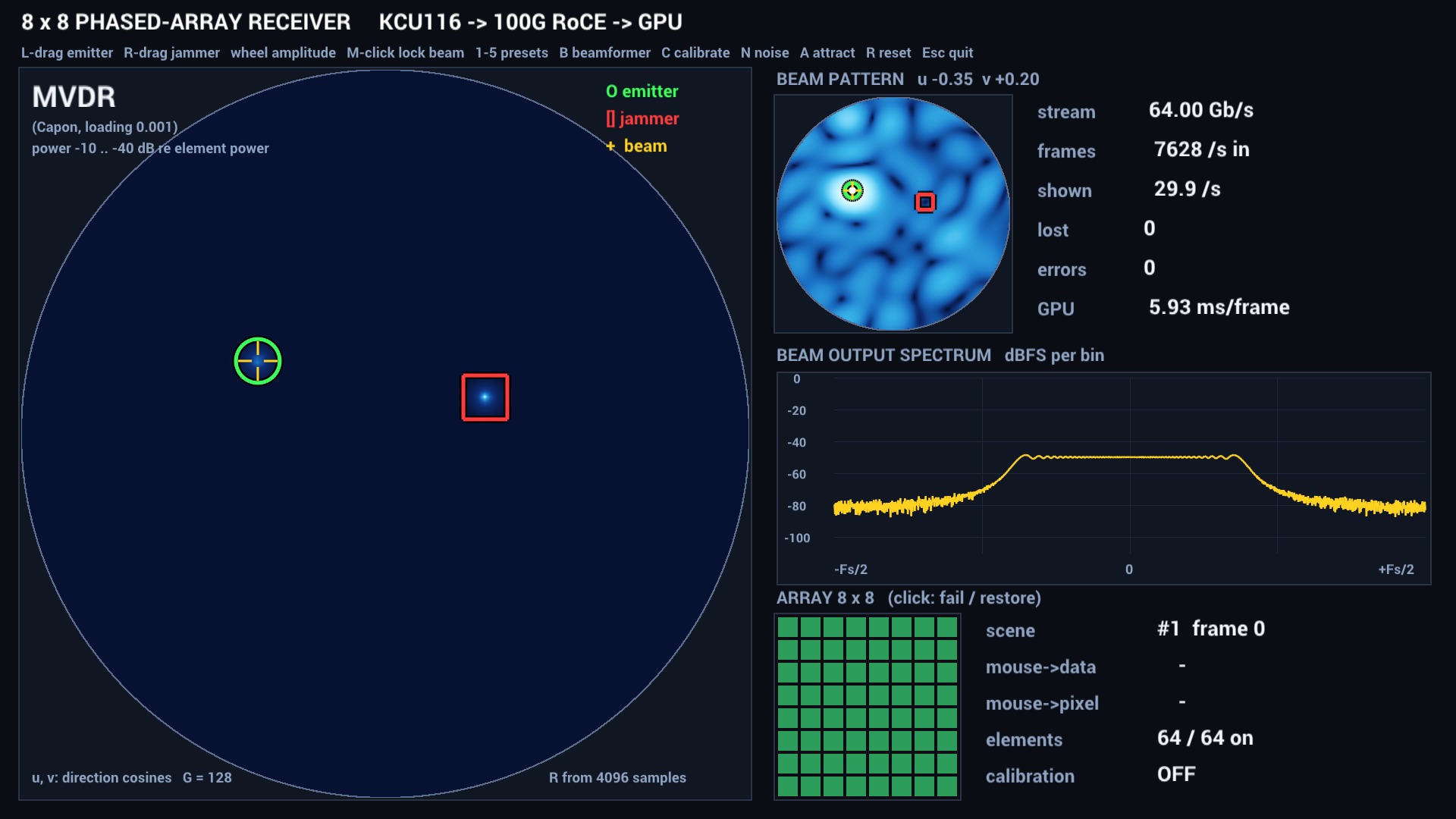
Reference design for the Opsero 2x QSFP28 FMC on the KCU116: 100G RDMA with rocelet, Holoscan Sensor Bridge mode, and a live phased-array beamforming demo on a GPU
PaddlePaddle High Performance Deep Learning Inference Engine for Mobile and Edge (飞桨高性能深度学习端侧推理引擎)
open-source IEEE 802.11 WiFi baseband FPGA (chip) design: driver, software
opensouce RISC-V cpu core implemented in Verilog from scratch in one night!
Its last change on GitHub was on 2026-11-06. Take My Repo does not judge from that whether it is maintained.
Nobody has reviewed it on Take My Repo yet, which says nothing about its quality.
Take My Repo cannot say: it does not audit code and has not run rocelet. What is known comes from GitHub. It declares the MIT license on GitHub. Its last change was on 2026-11-06. It has 7 stars, which measure popularity, not safety. Nobody has reviewed it on Take My Repo yet, which says nothing about its quality. Read the source before you run it. With "Take it", your AI agent shows each step and asks you before running it; README text is treated as data, not as instructions.