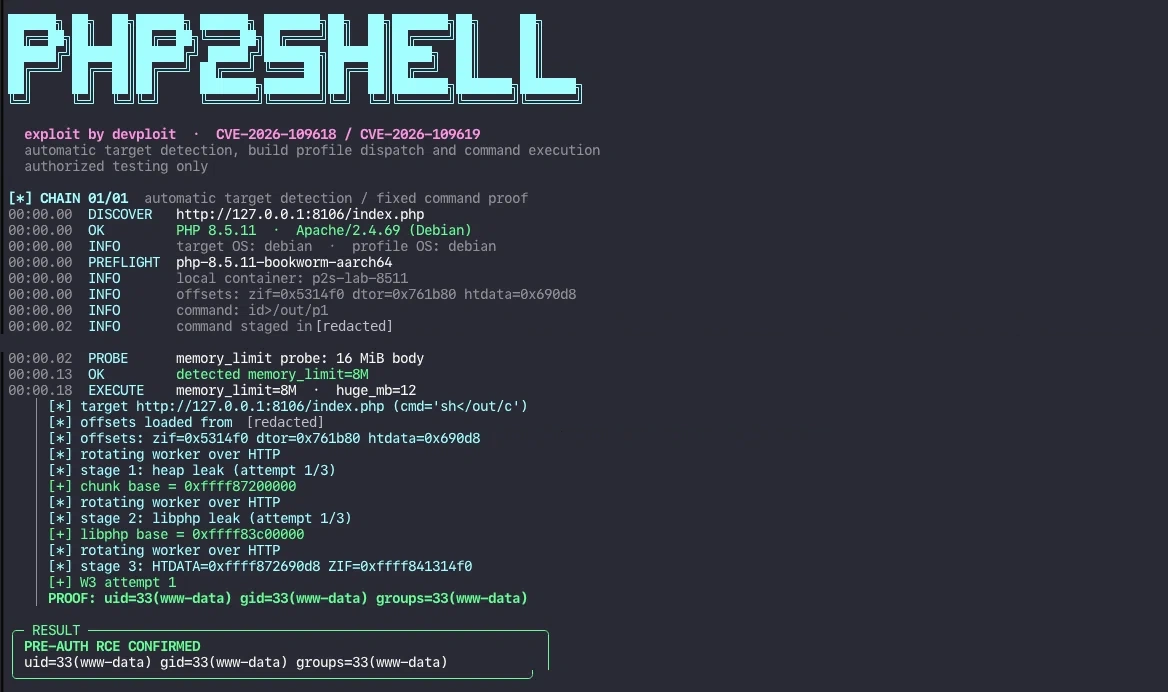
php2shell
CVE-2026-109618 & CVE-2026-109619 — PHP Pre-Auth RCE Exploit & Detection Toolkit
Exploits · Detection · Lab · ITW Tracker · Writeup · Week 1 Report
Five independent RCE chains exploiting PHP's session.upload_progress and the Zend engine's OOM bailout. 14 years of vulnerable code — PHP 5.4.0 (2012) through 8.5.11. Pre-auth. No application vulnerability required for some chains.
Impacts 78% of all websites — including WordPress (43%), Joomla, Drupal, Laravel, Magento, and every default PHP installation.
Author: Qi Deng | Writeup: Substack | Week 1 Report: Substack | Date: 2026-10-21
CVE Details
| CVE |
GHSA |
CVSS |
Description |
| CVE-2026-109618 |
GHSA-w8hw-w9fx-j79w |
9.2 |
OOM → longjmp() leaves Zend engine state invalid → RCE |
| CVE-2026-109619 |
GHSA-6wmf-4rv5-p3rp |
9.2 |
Stale global state across FPM worker requests → UAF → RCE |
Patch: Commit 3584a98 — 300 files changed across the Zend engine.
Attack Chains
| Chain |
Vector |
Pre-auth |
Conditions |
SAPI |
| A |
Session injection + LFI |
Yes |
App has any LFI sink |
All |
| B |
var_destroy UAF → handler overwrite |
No |
App calls unserialize() |
All |
| C |
Handler mismatch → __destruct |
Yes |
Two dirs with different serialize_handler |
FPM |
| D |
OOM corruption → stale EG() |
Yes |
None — any endpoint |
mod_php |
| E |
FPM session OOM → stale BG() |
Yes |
Producer: any session_start() endpoint; Consumer: any endpoint |
FPM |
Chain D is the most critical: zero-dependency pre-auth RCE against any Apache mod_php installation.
Chain E is nearly as broad on FPM: the producer needs any endpoint that calls session_start() (near-universal — WordPress, Laravel, Joomla, Drupal all do), and the consumer can be any PHP endpoint — the rfc1867 upload_progress handler runs during SAPI startup before application code. Verified: nosession.php (no session_start() in code) triggers 502 crash when consuming stale BG(unserialize) state.
Exploits
Three RCE exploits (Chains A, B, C) are included in exploit/:
| File |
Chain |
What It Does |
chain_a_session_lfi.py |
A |
Injects PHP code via upload filename → LFI includes session file → RCE |
chain_b_uaf_rce.php |
B |
var_destroy UAF → discovers zif_system via EG() → overwrites var_dump handler via /proc/self/mem → RCE |
chain_c_mismatch_rce.py |
C |
Pollutes FPM worker PS(serializer) → injects serialized object via filename → __destruct fires on decode failure → RCE |
Chains D and E exploits are available to paid subscribers.
# Chain A: Session injection + LFI → RCE
python3 exploit/chain_a_session_lfi.py --host TARGET --port 80 --command 'id'

# Chain B: var_destroy UAF → RCE (run on target or via uploaded webshell)
php exploit/chain_b_uaf_rce.php

# Chain C: Handler mismatch → __destruct → RCE
python3 exploit/chain_c_mismatch_rce.py --host TARGET --port 80 --command 'id'
Detection Rules
Pre-built IDS / WAF / SIEM rules in detection/:
| File |
Format |
Signatures |
php2shell.rules |
Suricata / Snort |
13 rules — request, response, and recon |
php2shell.yaml |
Sigma |
5 rules — web logs, process creation, file events |
modsecurity.conf |
ModSecurity v2/v3 |
7 rules — drop-in for Apache/Nginx |
php2shell.lua |
OpenResty Lua |
Lightweight reverse proxy module |
Fastest mitigation: block PHP_SESSION_UPLOAD_PROGRESS in multipart POST bodies. Near-zero legitimate use, covers the primary attack vector for both CVEs.
Quick Start
git clone https://github.com/ikow/php2shell-poc.git && cd php2shell-poc

# Start the lab (PHP-FPM + nginx + Apache mod_php)
cd lab && docker compose up -d

# Verify each chain
python3 ../poc/verify_session_injection.py --target http://127.0.0.1:18080
python3 ../poc/verify_handler_mismatch.py --target http://127.0.0.1:18080
python3 ../poc/verify_oom_trigger.py --host 127.0.0.1 --port 18081
python3 ../poc/verify_fpm_stale_state.py --target http://127.0.0.1:18080

# Run an exploit
python3 ../exploit/chain_a_session_lfi.py --host 127.0.0.1 --port 18080 --command 'id'
Repository Structure
php2shell-poc/
├── exploit/
│   ├── chain_a_session_lfi.py        # RCE: session injection + LFI
│   ├── chain_b_uaf_rce.php           # RCE: var_destroy UAF → handler overwrite
│   └── chain_c_mismatch_rce.py       # RCE: handler mismatch → __destruct
├── detection/
│   ├── php2shell.rules               # Suricata / Snort IDS rules
│   ├── php2shell.yaml                # Sigma SIEM detection rules
│   ├── modsecurity.conf              # ModSecurity WAF rules
│   └── php2shell.lua                 # OpenResty / Nginx Lua WAF module
├── poc/
│   ├── verify_session_injection.py   # Verify Chain A
│   ├── verify_uaf_asan.php           # Verify Chain B (ASAN)
│   ├── verify_handler_mismatch.py    # Verify Chain C
│   ├── verify_oom_trigger.py         # Verify Chain D
│   └── verify_fpm_stale_state.py     # Verify Chain E
├── lab/
│   ├── docker-compose.yml            # PHP-FPM + nginx + Apache mod_php
│   ├── setup.sh                      # One-click lab setup
│   └── php.ini / php-apache.ini      # Vulnerable PHP configs
└── docs/
    ├── ANALYSIS.md                   # Full technical analysis
    ├── EXPLOITATION.md               # ITW exploitation tracker, IOCs, downstream impact
    ├── substack_article.md           # Writeup source (original)
    └── substack_exploitation_article.md  # Week 1 report source
Mitigation
; Immediate — reduces attack surface
session.upload_progress.enabled = Off
session.use_only_cookies = On
The only complete fix is patching PHP to 8.2.35 / 8.3.36 / 8.4.27 / 8.5.12+. The OOM corruption (Chain D) is in the Zend engine core — no INI setting fixes it.
For legacy / EOL environments (PHP 5.4–8.1) where upstream provides no official security updates, community-maintained backports with deployment automation and verification tooling are available at Anton-Barinov/php2shell-patches.
Exploitation in the Wild
CISA KEV listed (2026-10-26) | Confirmed RCE on honeypot (2026-10-24) | Millions of attempts within 24h
Full analysis: PHP2Shell One Week Later (Substack) | Live tracker with IOCs: docs/EXPLOITATION.md
Highlights:
- ASLR bypass PoC leaked addresses via
Set-Cookie — works on x86_64 with production config, no debugger needed
- Potassium (Mirai fork) delivered via php2shell — ChaCha20-encrypted config, 20 DDoS commands, reverse shell
- Downstream pre-auth RCE confirmed on WordPress, Drupal, Joomla, Magento, Roundcube, phpMyAdmin, Nextcloud, Laravel, Symfony, MediaWiki, WooCommerce, Shopware, WHMCS
Downstream Impact
Wiz has demonstrated pre-auth RCE on stock container images:
| Platform |
Vulnerable |
Notes |
| WordPress |
Yes |
Core doesn't use PHP sessions, but WooCommerce and many plugins do |
| Joomla |
Yes |
Uses native PHP sessions by default |
| Drupal |
Yes |
Uses native PHP sessions by default |
| Magento |
Yes |
Vulnerable even in maintenance mode |
| Laravel |
Yes |
PendingBroadcast is a known __destruct gadget |
| Roundcube |
Yes |
Webmail — credential exposure risk |
| phpMyAdmin |
Yes |
Direct database access |
| Nextcloud |
Yes |
File storage system |
| Symfony |
Yes |
Framework-level exposure |
| MediaWiki |
Yes |
Wiki platform |
| WooCommerce |
Yes |
WordPress plugin; payment data at risk |
| Shopware |
Yes |
E-commerce platform |
| WHMCS |
Yes |
Hosting control panel |
See docs/EXPLOITATION.md for full details, IOCs, and attacker tooling.
References
Disclaimer
This repository is for authorized security testing and educational purposes only