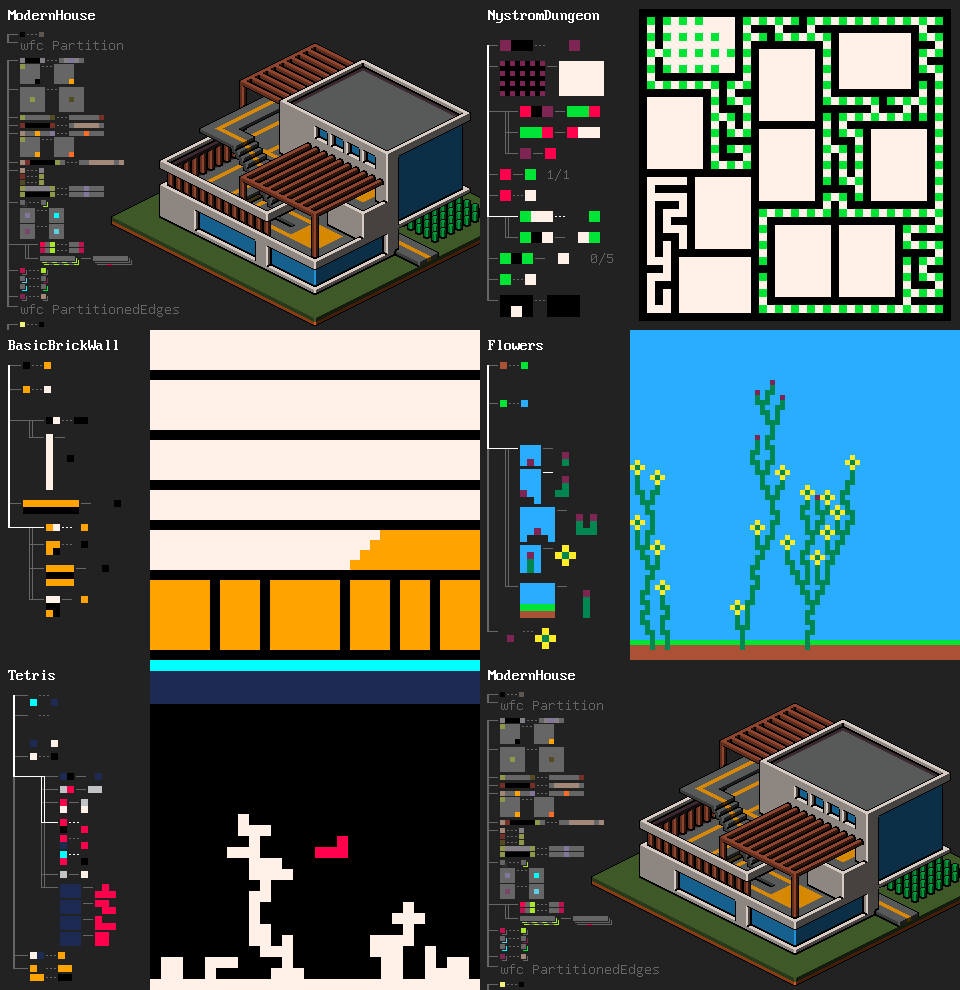
MarkovJunior
Probabilistic language based on pattern matching and constraint propagation, 153 examples
- 8.5k
- C#
- MIT
- 8 mo ago
Morphological modelling and generation of virtual microstructures for RVE studies
Repo jdirr/morphoGen, read from GitHub 1 min ago. jdirr has not joined Take My Repo.
jdirr/morphoGen is a public repo on GitHub by jdirr. Morphological modelling and generation of virtual microstructures for RVE studies. It declares the GPL-3.0 license on GitHub. It is written mainly in Python, has 68 stars and last changed on 2026-11-25. Nobody has reviewed it on Take My Repo yet, which says nothing about its quality. Read from GitHub on 2026-11-26.
Probabilistic language based on pattern matching and constraint propagation, 153 examples
Mirror of https://git.ffmpeg.org/ffmpeg.git
Virtual microstructures for the mechanics and physics of materials.
morphoGen generates random and architected media from models of mathematical morphology and stochastic geometry, describes them exactly, measures them against theory, computes their apparent properties up to their fracture, and tells how large a volume must be to represent them. It is a Python package with a command line and a graphical interface in the web browser.
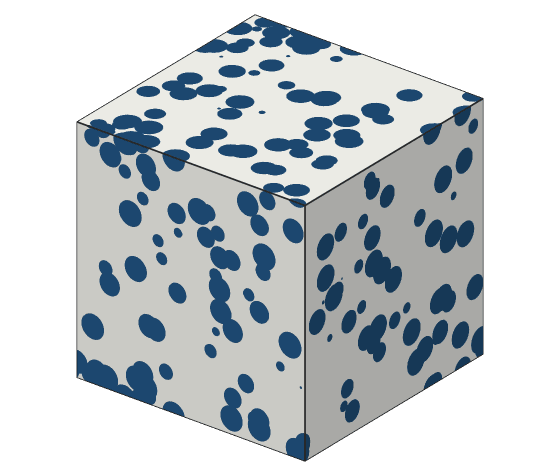
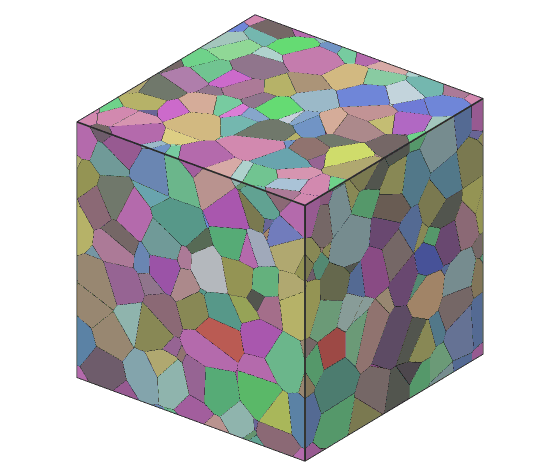
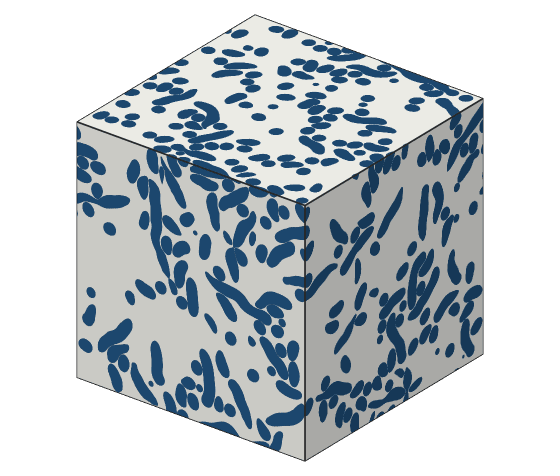
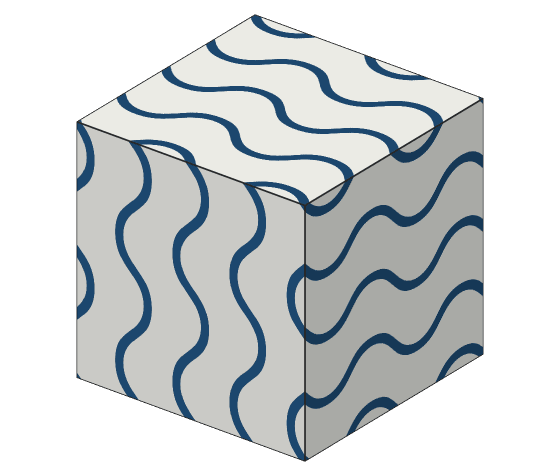
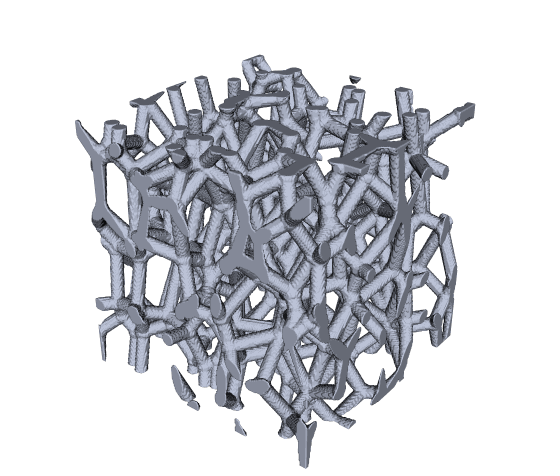
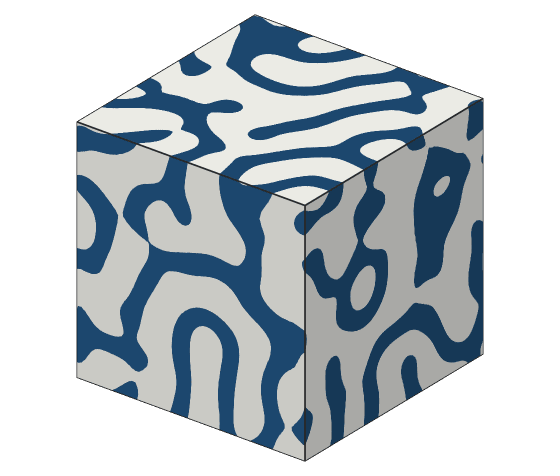
A study follows one chain, and each step is a part of the package:
| Step | What morphoGen does |
|---|---|
| Generate | 43 models: Boolean models, packings, fibres, tessellations, Gaussian fields, dead leaves, automata and growths, lattices, foams, triply periodic surfaces, woven textiles, bio-inspired structures; monodisperse or polydisperse; periodic or not, combined, nested; and the shapes of Microgen (3MAH) |
| Describe | an exact description of each realization (centres, axes, cells) and an implicit function for each phase, from which voxel images, surfaces and conforming meshes are cut at any resolution |
| Measure | fractions, specific surface, covariance, chords, tortuosity, percolation thresholds, stereology..., each beside the closed form of its model when there is one |
| Compute | elastic, thermal, electrical, dielectric, magnetic and diffusive properties, their couplings, harmonic regimes, waves, flow and sound: finite elements on conforming meshes (by default), an FFT solver on voxels (CPU or GPU), extended finite elements |
| Load | plasticity, crystal plasticity, viscoelasticity, hyperelasticity, damage and MFront laws along loading paths, in small or finite strains; macroscopic laws identified, reduced or learned from the responses |
| Break | the phase field of fracture, cohesive zones, cracks of any front, ductile growth; contact and friction; high-cycle fatigue |
| Size the RVE | the statistics of Kanit et al. (2003): the variance against the volume, the integral range, the volume and the number of realizations for a precision |
| Design | topology optimization of periodic cells, compatible assemblies of building blocks, rigidity of lattices, isogeometric shape optimization |
Two application modules build on this chain: metal sheets architectured by localized
laser treatment (morphogen.laser) and explicit dynamics with OpenRadioss
(morphogen.dynamics). Meshes, images, behaviours and results go to Abaqus, CalculiX,
AMITEX_FFTP, MFront, Z-set, Gmsh, Neper, DAMASK, FEniCSx and ParaView; particles to the
codes of discrete elements (LMGC90, LAMMPS, YADE), scenes to Blender, voxel images to JAX
and PyTorch, shapes to and from Microgen (3MAH).
python -m pip install "morphogen[all]"morphoGen needs Python 3.12 or newer, on Windows, macOS or Linux; every dependency comes as a binary wheel. The installation guide gives the environments, the installation from the sources and the optional components (NVIDIA GPUs, the stand-alone application, OpenRadioss, MFront). Without Python, the installers morphoGen JupyterLab of the releases (Windows, macOS) install a Python of their own with morphoGen and JupyterLab.
A model, a realization, its voxels, a measure against theory and three apparent properties, in a second:
import morphogen as mg
from morphogen.homogenization import Material, homogenize

model = mg.models.BooleanSpheres(radius=1.0, volume_fraction=0.3)
micro = model.generate(mg.Domain.cube(8.0, periodic=True), seed=1)  # centres and radii
image = micro.voxelize(shape=32)  # 32³ voxels: phase 0 (matrix), phase 1 (spheres)
theory = model.theory()
print(mg.analysis.volume_fraction(image), theory["volume_fraction"])  # 0.29 for 0.3

phases = {
    0: Material(young=3.0, poisson=0.35, conductivity=0.2),  # a polymer: GPa, W/(m K)
    1: Material(young=70.0, poisson=0.22, conductivity=1.0),  # glass
}
properties = ["bulk_modulus", "shear_modulus", "conductivity"]
out = homogenize(image, phases, properties=properties)
print({name: result.value for name, result in out.items()})  # 5.89, 2.59 (GPa), 0.33
The same from a configuration file, or from forms:
morphogen template homogenization_spheres -o study.yaml  # an example to start from
morphogen run study.yaml                                 # realizations and properties
morphogen gui                                            # the interface, in the browser
The documentation is online at jdirr.github.io/morphoGen:
If morphoGen serves your work, please cite it by the DOI of all its versions, 10.5281/zenodo.24340315, with the papers of the methods you use; CITATION.cff and the page Citing morphoGen give the reference.
Questions, bug reports and proposals are welcome as issues; changes go through pull requests (CONTRIBUTING.md).
Copyright © 2026 Justin Dirrenberger. morphoGen is free software: you can redistribute it and/or modify it under the terms of the GNU General Public License as published by the Free Software Foundation, either version 3 of the License, or (at your option) any later version. See LICENSE.
jdirr/morphoGen is a public repo on GitHub by jdirr. Morphological modelling and generation of virtual microstructures for RVE studies.
It declares the GPL-3.0 license on GitHub.
Its maker tagged it for macOS, Windows and Linux, or as Docker or cross-platform. That is declared by the maker; Take My Repo has not tested it.
Open "Take it" on its page: Take My Repo writes an install plan for your machine and hands it to your AI agent (Claude Code, Codex or Cursor), which asks you before each step. Take My Repo has not tested it on any machine.
An Optimized, Easy-to-use, Open-source GPU Solver for Large-scale Inverse Homogenization Problems
Written in C++ and using SDL, The Powder Toy is a desktop version of the classic 'falling sand' physics sandbox, it simulates air pressure and velocity as well as heat.
Its last change on GitHub was on 2026-11-25. GitHub counts 1 open issue and pull requests. Take My Repo does not judge from that whether it is maintained.
Nobody has reviewed it on Take My Repo yet, which says nothing about its quality.
Take My Repo cannot say: it does not audit code and has not run morphoGen. What is known comes from GitHub. It declares the GPL-3.0 license on GitHub. Its last change was on 2026-11-25. It has 68 stars, which measure popularity, not safety. Nobody has reviewed it on Take My Repo yet, which says nothing about its quality. Read the source before you run it. With "Take it", your AI agent shows each step and asks you before running it; README text is treated as data, not as instructions.