
GhostInTheMachine
A long-run causal emergence laboratory for computational consciousness research
- 1
- MIT
- 3 d ago
Repo kai9987kai/GhostInTheMachine, read from GitHub 1 d ago. kai9987kai has not joined Take My Repo.
In short
kai9987kai/GhostInTheMachine is a public repo on GitHub by kai9987kai. A long-run causal emergence laboratory for computational consciousness research. It declares the MIT license on GitHub. It is written mainly in Python, has 1 stars and last changed on 2026-11-22. Nobody has reviewed it on Take My Repo yet, which says nothing about its quality. Read from GitHub on 2026-11-24.
Similar repos
All alternatives to GhostInTheMachine GitHubRepo
evolving-cellular-automata

In the maintainer's words. Shown from GitHub; Take My Repo does not keep a copy.
Ghost in the Machine — preregistered experiments on authorship and self-model dynamics
What does it take for a synthetic agent's self-model to be stabilized by acting? Preregistered, null-calibrated, replicated.
Author/project lead: Kai Piper · Version 8.0 (v4 laboratory, v5 follow-up, v6–v7 mechanism, v8 closed-loop control & generalization) · 22 November 2026
Scientific status. This is a synthetic computational experiment. It does not create, detect, measure or prove phenomenal consciousness in any system. "GHOST-v4" names a preregistered conjunction of statistical results in a simulated network, and nothing more.
Browse the evidence & run live in your browser: docs/index.html is a filterable claims ledger & 11-sample meta-analysis observatory (ready for GitHub Pages from /docs), and docs/lab.html is a zero-dependency, offline interactive browser simulator where you can test architectures (default, ESN, GRU, bilinear), pure +B_M/−B_M feedback transplants, silence, desynchronization, DMN rerouting, and 12-seed paired mini-replications directly in your browser.
Current state of the evidence (after v8)
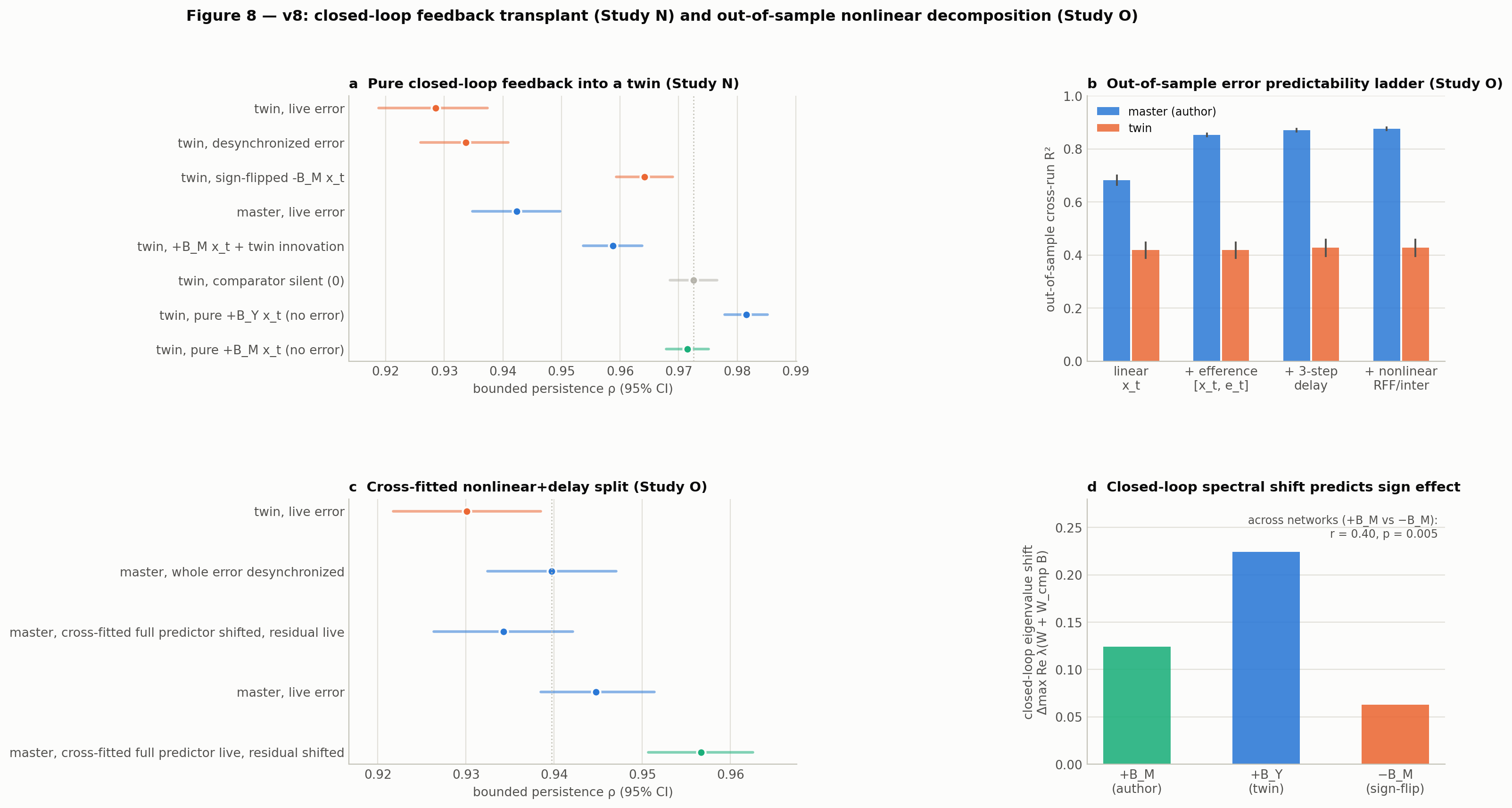
In this model family, the comparator injects a prediction-error signal (what happened minus what was predicted) into its target population. When an agent authors its own actions, 88% of that error is predictable strictly out-of-sample from its own state, motor efference copy and 3-step history (vs 43% for a cross-yoked twin), forming a sign-specific closed-loop stabilizing feedback controller; the remaining 12% irreducible residual actively perturbs. This persistence effect holds across 11 independent samples (504 networks): +0.134 nats (I² = 0.10, 449/504 networks positive, bounded ρ +0.0159, I² = 0.00, zero drift over study order p = 0.86), and generalizes beyond the 12-population motif to an unstructured sparse ESN, a gated GRU and a nonlinear world.
How we know:
- v6: transplanting error streams moves the effect. An author given a non-author's errors loses almost the whole advantage (0.08 of the way from twin to master). A non-author given the author's errors recovers most of it (0.85).
- v6 and v7: timing matters, but only for the author. Desynchronizing an author's own errors costs persistence; desynchronizing a twin's costs nothing. The effect grows with comparator gain (v7 Study M).
- v8 Study N: direct closed-loop control into a non-author. Injecting the author's cross-fitted linear feedback
+B_M x_t(with zero error) directly into a twin raises bounded persistenceρfrom0.9285to0.9715(48/48networks,d_z = 1.51), still stabilizes under full twin innovation noise (44/48,d_z = 0.93), and is sign-specific (+B_M > −B_M,p = 0.010), predicted across networks by the global closed-loop eigenvalue shiftΔmax Re λ(W + W_cmp B)(r = 0.40,p = 0.005), while matching rather than exceeding comparator silence (0.9726,N3n.s.). - v8 Study O: strictly out-of-sample predictability (88% vs 43%) and revision of v7's
K3. Cross-run OOSR²jumps+0.170when adding motor efference copy for the author vs-0.0003for the twin (O2 d_z = 2.69), reaching0.88with 3-step history and nonlinearities (O1 d_z = 3.22). Once stripped out-of-sample, full feedback restores persistence (O3 d_z = 0.93) while the remaining 12% irreducible residual actively lowers persistence (O4 HL −0.0046,d_z = −0.50, two-sidedp < 0.001), revising v7's in-sample "both" verdict. - v8 Study P: cross-architecture generalization, multi-lag timescales and exact PID anatomy. Authorship stabilization survives stripping out the entire 12-population motif, ignition, broadcast and self-feedback in a bare ESN (
45/48,d_z = 1.21), strengthens in a gated GRU (46/48,d_z = 1.64), and survives a nonlinear bilinear motor world (38/48,d_z = 0.70; cross-archR²gap+0.293,d_z = 13.45). It extends across lags 1–20 (IAT d_z = 0.44; top-3 slow modes48/48,d_z = 1.73, while variance-maximizingPC1is weak/n.s.,p = 0.09) and raises within-selfΦ_R(42/48,d_z = 0.80), exact PID synergy (d_z = 0.96) and PID redundancy (d_z = 0.58), while exact Barnett–Seth dynamical independence stays flat (p = 0.65).
What did not hold up (or was revised):
- Causal emergence (Ψ). Still not replicated across 11 samples / 504 networks (
+0.070,I² = 0.50, 95% PI[−0.036, 0.175], order slope−0.010/sample,p = 0.08). v8 Study P's exact Gaussian MMI-PID explains why: authorship lifts both synergy and redundancy, and RosasΨdouble-counts the rising redundancy across all 12 units. - v7's "innovation restores" (
K3, revised in v8). Came from omitting efference copy and 3-step history in v7's linearx_t-only fit; once stripped out-of-sample, the 12% irreducible residual lowers persistence (O4). - Pure
+B_Mexceeding silence (N3, not supported).+B_M x_tmatches comparator silence rather than beating it (0.9715vs0.9726,p = 0.81). - The self population as special. The effect sits wherever the comparator projects (v5 Study F) and requires no 12-population motif (v8 Study P).
- v3's emergent-self event. It was a gain ramp held on by detector hysteresis.
Every number in the table below is checked in CI against the results file it comes from (tools/claims.py). Retracted and unreplicated claims stay in the ledger (docs/CLAIMS.md).
| claim | introduced | status | evidence |
|---|---|---|---|
| v3's sustained 'cross-theory' event is an emergent self-model regime | v3.0 | retracted | fires in 0.92 of master runs but also 0.75 of twins that never author their actions; persistence equals detector hysteresis in 1.00 of firing runs; gain cap reached in 0.96 of runs |
| Authoring one's own actions makes the slow collective mode of the self-model population more persistent | v4.0 | replicated | d_z 1.21 (v4, 48 networks) → 0.89 (replication, 48 new networks); KSG estimator 1.38; pooled over 11 independent samples / 504 networks: +0.134 nats, HKSJ 95% CI [0.122, 0.147], I² 0.10; 449/504 networks positive (bounded ρ +0.0159, I² 0.00; order slope -0.0003, p 0.86) |
| The authorship effect is carried by the comparator's prediction-error stream | v6.0 | supported | an author given a non-author's error stream falls to 0.08 of the way from twin to master (G1 d_z 1.02); a non-author given the author's stream rises to 0.85 (G2 d_z 0.99) |
| It is not only noise amplitude: the error must be in step with the network's own state | v6.0 | replicated | desynchronizing the author's own stream (identical values and spectrum) keeps only 0.60 of the effect (G3 d_z 0.64); rescaling the twin's stream to author amplitude lifts 0.08 to 0.36 (G4 d_z 1.19); replicated in v7 (K1 d_z 0.53) |
| An author's prediction error is largely predictable from its own state | v7.0 | replicated | a linear map of the network's current state predicts 0.64 of the author's error variance but 0.30 of the twin's (v7 Study K; Study L d_z 5.54); replicated strictly out-of-sample in v8 Study O (0.68 vs 0.42, d_z 4.18) and across ESN/GRU/bilinear architectures (P6 d_z 13.45) |
| Keeping the error in step with the network matters for the author, not for the twin | v7.0 | supported | desynchronizing costs the author 0.057 nats but the twin -0.011 (n.s.); difference d_z 0.66 |
| Both parts of the error matter, and they interact: the state-predicted part is a stabilizing loop | v7.0 | revised | in v7 (in-sample x_t only), state-predicted live reached 1.35 nats vs live 1.15 and rest-live 1.16 (K2 d_z 0.70, K3 d_z 0.28, shift 1.09); in v8 Study O (strictly cross-run OOS state+efference+delay+nonlinear), full feedback restores (O3 d_z 0.93) while the 12% irreducible residual actively lowers persistence (O4 HL -0.0046 on ρ, d_z -0.50, two-sided p 0.0002) |
| A pure state-feedback loop (+B_M x_t) into a non-author stabilizes its slow mode with sign specificity predicted by closed-loop eigenvalues | v8.0 | supported | injecting pure +B_M x_t raises twin bounded persistence ρ from 0.9285 to 0.9715 (N1 HL +0.0404, 48/48 networks, d_z 1.51), stabilizes even under full twin innovation noise (N4 HL +0.0255, 44/48, d_z 0.93), beats sign-flipped -B_M x_t (N2 HL +0.0066, d_z 0.41, p 0.010), and across networks the sign shift correlates with Δmax Re λ(W + W_cmp B) (r 0.40, p 0.005); it matches rather than exceeds comparator silence 0.9726 (N3 d_z -0.08, p 0.81) |
| Strictly out-of-sample, state plus motor efference copy and short history predict 88% of an author's error; the remaining 12% perturbs | v8.0 | supported | cross-run OOS R² climbs from 0.68 (linear x_t) to 0.85 (+efference copy), 0.87 (+3-step history) and 0.88 (nonlinear) for the author vs 0.43 for the twin (O1 gain +0.193, d_z 3.22); the efference-copy gain (+0.170 vs -0.0003) is author-specific (O2 d_z 2.69); cross-fitted full feedback restores persistence (O3 HL +0.0154, 40/48, d_z 0.93) while the 12% irreducible residual lowers it (O4 HL -0.0046, 15/48, d_z -0.50, two-sided p 0.0002) |
| Authorship stabilization and own-error predictability generalize beyond the 12-population motif to an ESN, a gated GRU and a nonlinear world | v8.0 | supported | master − twin bounded persistence ρ holds in an unstructured sparse ESN with no ignition, broadcast or self-feedback (P1 HL +0.0145, 45/48, d_z 1.21), a multiplicatively gated GRU (P2 HL +0.0255, 46/48, d_z 1.64), and a nonlinear bilinear motor world (P3 HL +0.0088, 38/48, d_z 0.70); mean cross-architecture own-error R² gap +0.293 (d_z 13.45) |
| Stabilization spans multi-lag slow-subspace timescales and raises within-self Φ_R, exact PID synergy and redundancy without decoupling from parts | v8.0 | supported | integrated autocorrelation time (lags 1–20) rises (P4 HL +1.55, 36/48, d_z 0.44) and top-3 slow modes rise in 48/48 networks (d_z 1.73) while variance-maximizing PC1 is weak/n.s. (d_z 0.32, p 0.09); within-self pairwise Φ_R rises (P5 HL +0.0071, 42/48, d_z 0.80) with exact PID synergy d_z 0.96 and redundancy d_z 0.58, while exact Barnett–Seth DI ratio stays flat (p 0.65) |
| The comparator perturbs the slow mode; authorship makes the perturbation smaller and better timed | v6.0 | supported | silencing the comparator raises master persistence from 1.12 to 1.46 nats (twin: 0.98 → 1.48); both fall as the comparator gain rises (master d_z -1.28, twin d_z -1.64) |
| The authorship effect grows with the comparator's gain | v6.0 | supported | present at half gain (Hodges–Lehmann 0.0114 on ρ, 42/48 networks) and growing with the gain (0.0114, 38/48); the v6 mean test had not been supported (J2 d_z 0.16) |
| The effect depends on the efference-copy/comparator loop | v4.0 | replicated | comparator interaction d_z 0.54 (v4) → 0.75 (replication); dose-response needs the comparator, d_z 0.62 |
| The effect is specific to the 'self' population | v4.0 | revised | self-specificity d_z 0.84 (v4); rerouting the comparator to DMN moves the peak there (DMN d_z 0.96 → 1.70; shift d_z 1.26) |
| Authorship increases causal emergence of the self (Rosas Ψ) | v4.0 | not replicated | d_z 0.59 (v4) → 0.20 (replication) → 0.12 in powered v7 test (p 0.15; 41/72) → 0.21 in v8 P (p 0.10); pooled over 11 samples / 504 networks: +0.070, HKSJ 95% CI [0.028, 0.111], I² 0.50, prediction interval [-0.036, 0.175], order slope -0.010/sample (p 0.08) |
| Preregistered verdict level 4 (GHOST-v4) | v4.0 | not replicated | level 4 in the v4 sample; level 3 in the preregistered replication; single-sample verdicts are noisy (see the Ψ entry) |
| Authorship increases the nonlinear arrow of time of the network dynamics | v4.0 | replicated | d_z 0.44 (v4) → 0.58 (replication) |
| Master and twin can be told apart blind, from the network dynamics alone | v4.0 | replicated | AUC 0.69 (v4) → 0.79 (replication); placebo master-vs-master AUC 0.50 |
| The effect grows with the degree of authorship | v5.0 | supported | per-network slope d_z 0.76, comparator-dependent (d_z 0.62) |
| The dose-response is a threshold at exactly full authorship | v5.0 | revised | 5% foreign actions cost 0.034 nats (I1 d_z 0.83); 1% cost nothing detectable (I2 d_z 0.09); foreign actions degrade even own-action predictions (I3 d_z 2.39) and persistence tracks the prediction error within networks (I4 d_z -2.55) |
| The effect survives other unit and coupling settings | v5.0 | supported | leak 1.0: d_z 1.05; leak 0.3: 0.87; radius 0.9: 1.32; radius 1.1: 0.53 |
| The effect is online: it exists while the comparator signal arrives | v5.0 | supported | appears when the comparator is switched on mid-run (d_z 1.28); disappears when switched off (d_z 0.83); residual when off at most +0.021 nats (90% CI upper bound) |
Questions
What is GhostInTheMachine?
kai9987kai/GhostInTheMachine is a public repo on GitHub by kai9987kai. A long-run causal emergence laboratory for computational consciousness research.
Is GhostInTheMachine open source?
It declares the MIT license on GitHub.
Does GhostInTheMachine run on macOS, Windows or Linux?
Its maker has not tagged a system, so it is unknown here. Its README says what it needs.
How do I install GhostInTheMachine?
Open "Take it" on its page: Take My Repo writes an install plan for your machine and hands it to your AI agent (Claude Code, Codex or Cursor), which asks you before each step. Take My Repo has not tested it on any machine.
More from kai9987kai
Everything by kai9987kai- AutoClickerThe AutoClicker is a Python-based tool that automates mouse clicks at selected coordinates. It features a list of coordinates for sequential clicking and a 'mega' auto clicker that offers faster clicking speed, limited only by your computer's specifications. 17
- kai9987kai.github.ioThis repository contains my personal website hosted on GitHub Pages. It’s a mixed-purpose site that I use to: Showcase projects and interactive web experiments (HTML/CSS/JS) Link social accounts (YouTube channels, Instagram, etc.) Host a 3D design portfolio Store screenshots / promo images for projects and general organization 5
- MalDuinoScriptsA compact collection of MalDuino Lite and MalDuino Elite HID automation scripts for learning, testing, and experimenting with USB keyboard/mouse payload behaviour in a controlled lab environment. 5
- webmayaWebMaya Advanced Studio is a browser-based 3D modeling, sculpting, material, and animation workspace built with Three.js. It runs as a single HTML file and provides a compact Maya-inspired interface for creating primitives, editing meshes, sculpting geometry, keyframing animation, importing/exporting GLTF assets, and saving projects locally. 3