InferenceFlow
Experimental auditable asynchronous inference. Submit batches, retrieve results and verify usage/settlement receipts.
Latest high-end follow-up: H100 SXM smoke report. 10/10 real requests and receipts passed, zero drift; larger stages were skipped by the time gate after cold startup. The pod is terminated. Posted RunPod GPU/disk cost $0.67913; displayed credit immediately after that run was $7.46 (historical). This does not complete the sustained hardware comparison or demonstrate H100 savings.
Latest complete multi-stage GPU validation: complete hosted A40 report and aggregate measurements. 1,010/1,010 real requests succeeded, including a controlled worker interruption, with 1,010 verified receipts, 1,010 unique usage/capture records and zero wallet drift. The independent watchdog terminated the pod; no paid resources remain. Displayed credit after that A40 run: $7.94 (historical).
Matched 100-request arms averaged 46.80 seconds baseline concurrent versus 53.31 seconds adaptive from API receipt through completion: adaptive was 13.9% slower. Pooled baseline output throughput was 2.67x sequential. Posted full validation GPU/disk cost is $0.21493; the initial quote estimate was $0.21523. These results support supervised execution/audit demonstrations, not a cheapest-inference or adaptive-savings claim. Public beta, live Stripe and automatic provisioning remain disabled.
Auditable execution receipts preserve model identity, prompt/payload/output hashes, token usage and request settlement checks through the API and Python SDK. They are unsigned operator records, not independent attestation or proof of zero retention. Wallet algorithms are unchanged. The hosted experiment verified all 1,010 real receipts against results and a separate SQL audit. This is a defensibility foundation; customer value and competitive economics remain to be established.
The code passed 254 tests (one real-GPU pytest skipped), 31 scheduler-v2 regressions, lint/type checks, the dashboard production build and a 40/40 mock hosted rehearsal with 40 verified receipts before the real run. Real GPU evidence is in the separate experiment report above.
Latest DeepInfer compatibility and budget readiness: source/CPU checks passed, native CUDA build and GPU execution unverified. No four/eight-B200 stock at the check; even five minutes on four B200s exceeds funds above the $5 floor. Current displayed credit: $7.26. No paid resources created.
Model-specific throughput tooling
The evidence-driven throughput controller provides a working offline profiler, bounded benchmark client, hash-bound evidence review and token-aware dispatch replay. Synthetic data cannot qualify a profile; live scheduling is unchanged. Latest DeepSeek has a pinned proposal manifest, with runtime/hardware validation still blocked. No throughput improvement or GPU savings is claimed.
Earlier experiment evidence
| Experiment |
Outcome |
| A40 REST log-contract failure |
Model initialized; zero customer admissions. Invalid source query fixed before the completed run. |
| A40 HTTP startup retry |
Zero admissions; independent cleanup confirmed. |
| A40 networking readback failure |
Zero admissions; provider response handling fixed. |
| Partial H100 run |
110/110 succeeded; comparison stages incomplete. Posted GPU/disk cost $1.36398. |
| Earlier A40 smoke |
10/10 succeeded with four active sequences; later stages not admitted. |
| Second L4 run |
410/410 succeeded with interruption recovery and no ledger drift; adaptive slower. Posted provider cost $0.21400138374883682. |
| First L4 run |
Initial real baseline evidence; subsequent recovery fixes documented separately. |
Hosted stage execution keeps the driver, telemetry, policy transitions and audits on GitHub. Provider read authority and independent cleanup credentials stay separate. GitHub protected environments require owner review. The owner has given standing financial approval while preserving a $5 RunPod credit floor, with fresh quote/balance/pending-cost checks, one pod at a time and an authenticated armed watchdog before each manual creation. The provider does not enforce that floor. Hard-deadline, provider-outage and all possible failure paths are not claimed live-proven.
Licensed under Apache License 2.0; model weights, images and dependencies retain their own licenses. Three extraction customer hypotheses and interview guide remain research only. Download v0.3.0 prerelease and release notes.
October 24 local backend validation (historical)
An isolated Docker backend and temporary HTTPS connection passed 14 mock checks, including 10 completed requests, outbound worker authentication, idempotency and ledger reconciliation. The complete backend suite passed 128 tests with 1 real-GPU test skipped; the targeted safety/readiness suite passed 23 tests. The reusable local rehearsal generates private credentials only under ignored .runtime/, blocks development login/payment routes, and supervises automatic shutdown. See the dated report. A subsequent genuine staging OIDC login passed with owner-restricted access, a protected wallet read and zero reconciliation drift. Those were the preparation blockers at that date; the October 25 reports above record real-mode staging and successful live teardown. This rehearsal used mock inference; no GPU inference performance or cost advantage is claimed.
October 23 readiness validation (historical)
NOT READY — BLOCKERS REMAIN. Final local validation: 113 tests passed, 1 real-GPU test skipped. See the complete live-site, scheduling, provider and GPU approval report, website screenshots and issue register, provider architecture, first-GPU economics and future private-alpha checklist. At that date, website fixes awaited publication and real GPU inference, savings, remote staging and independent cleanup were unverified; no paid GPU had been created. Current evidence is linked at the top of this README.
Private experimental real mode now has a separate REVIEWED_GPU_EXPERIMENT_ENABLED gate; public beta, Stripe and auto provisioning remain off. Worker metrics include cumulative engine tokens, overlap/idle and hardware memory. Provider selection remains simulation-only; optional providers cannot create/terminate or execute. Customer wallet/settlement algorithms are unchanged.
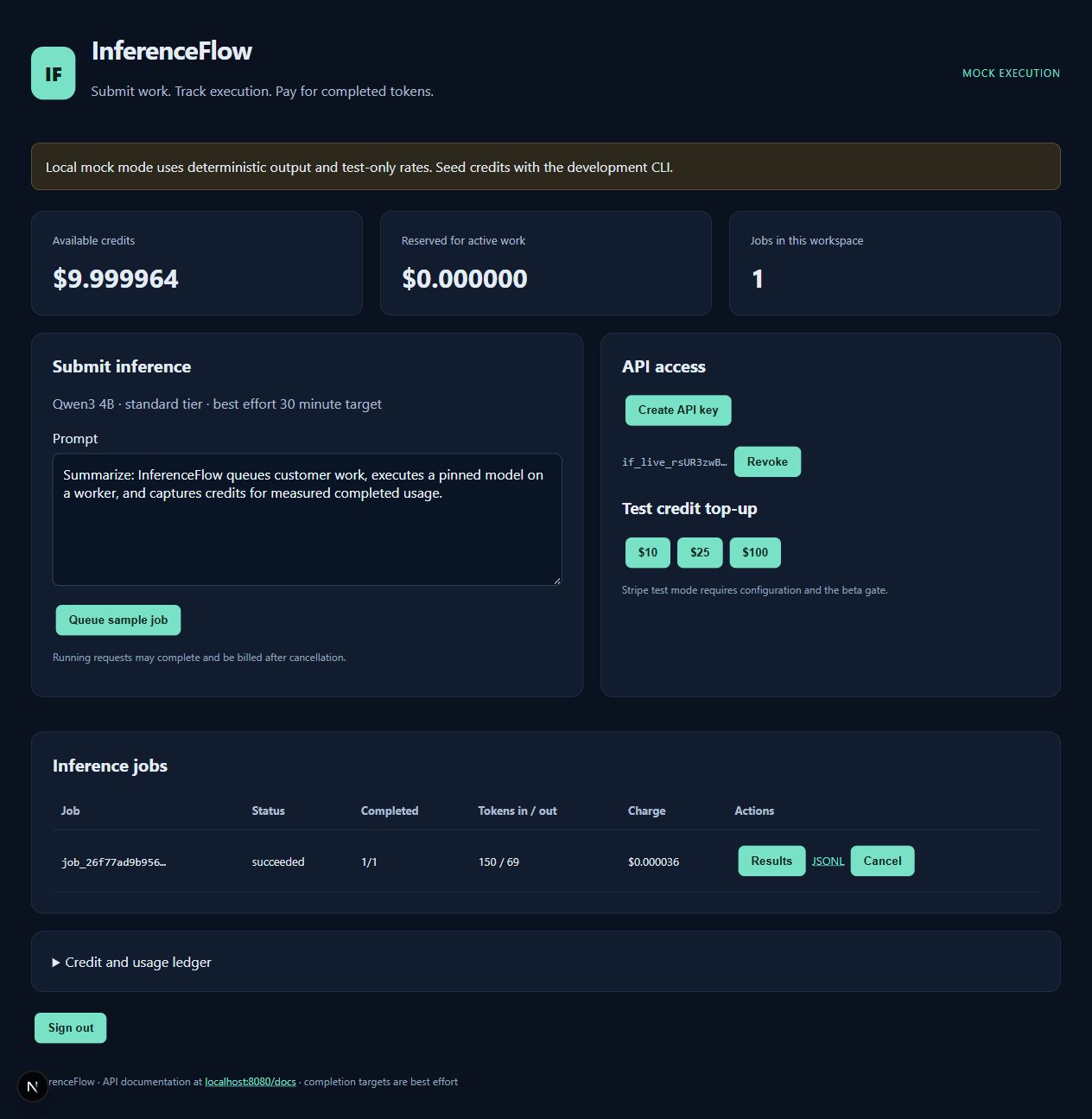
Submit inference batches. Track execution. Pay for completed tokens.
A prepaid asynchronous text-inference platform built with FastAPI, PostgreSQL, a durable scheduler, outbound GPU workers, vLLM, and Next.js.
Quickstart · Architecture · API and SDK · Testing · GPU deployment · Release notes
MVP prerelease: mock execution, staging OIDC, live L4 baseline inference/accounting and independent provider teardown have passed validation. GPU reconnect/recovery, matched policy comparisons, 1,000-request completion, external payments and sustainable economics remain unvalidated. Limited measured performance is in the dated real-inference report; no pricing advantage or production-readiness claim is made.
v0.3 on main: sub-hour scheduling
The multi-provider and batching readiness report distinguishes implemented/tested behavior and provides the manual comparison procedure. Worker overlap traces, engine metrics, four-slot limits, read-only billing audits and optional-provider discovery contracts are included. Runpod remains the only selectable execution provider; optional paid mutations, automatic failover and provisioning remain disabled. The October 25 L4 test measured four active sequences and sub-hour completion for two baseline stages only; adaptive benefits, larger-load reliability and cost advantage remain unproven.
V0.3 adds an opt-in 60-minute best-effort objective, explicit admission predictions, adaptive concurrency, recommendation-only capacity planning, and internal GPU economics. It preserves the existing queue, worker fences, idempotency and wallet ledger. PR #3, the engineering blog and readiness pull requests are merged into main. No paid capacity or public deployment is activated. The v0.3.0 prerelease identifies its original source snapshot; subsequent merged fixes do not move that release tag.
Apply migration 0006 and restart API/scheduler/worker together. To try v2 locally, add the following to .env before starting Compose or the native services: