
evolution-platformer
One Two Hundred: a 2D platformer where you build the level, then watch a population of neural networks evolve to beat it. Edit, play, evolve. Written in Rust.
- 0
- 3 wk ago
Repo nordicnode/evolution-platformer, read from GitHub 1 min ago. nordicnode has not joined Take My Repo.
In short
nordicnode/evolution-platformer is a public repo on GitHub by nordicnode. One Two Hundred: a 2D platformer where you build the level, then watch a population of neural networks evolve to beat it. Edit, play, evolve. Written in Rust. It declares no license on GitHub. Public does not mean open source: without a license, nobody is granted the right to reuse it. It is written mainly in Rust, has 0 stars and last changed on 2026-11-04. Nobody has reviewed it on Take My Repo yet, which says nothing about its quality. Read from GitHub on 2026-11-22.

One Two Hundred
A 2D platformer you build yourself, and an AI that learns to beat what you built.
Draw a level, play it yourself, then hand it to a population of 200 neural networks and watch them evolve: the first generations stand still or walk into pits, and a few hundred generations later one of them runs the level clean. Everything happens in one window, and the training can also run headless from the terminal.
Screenshots

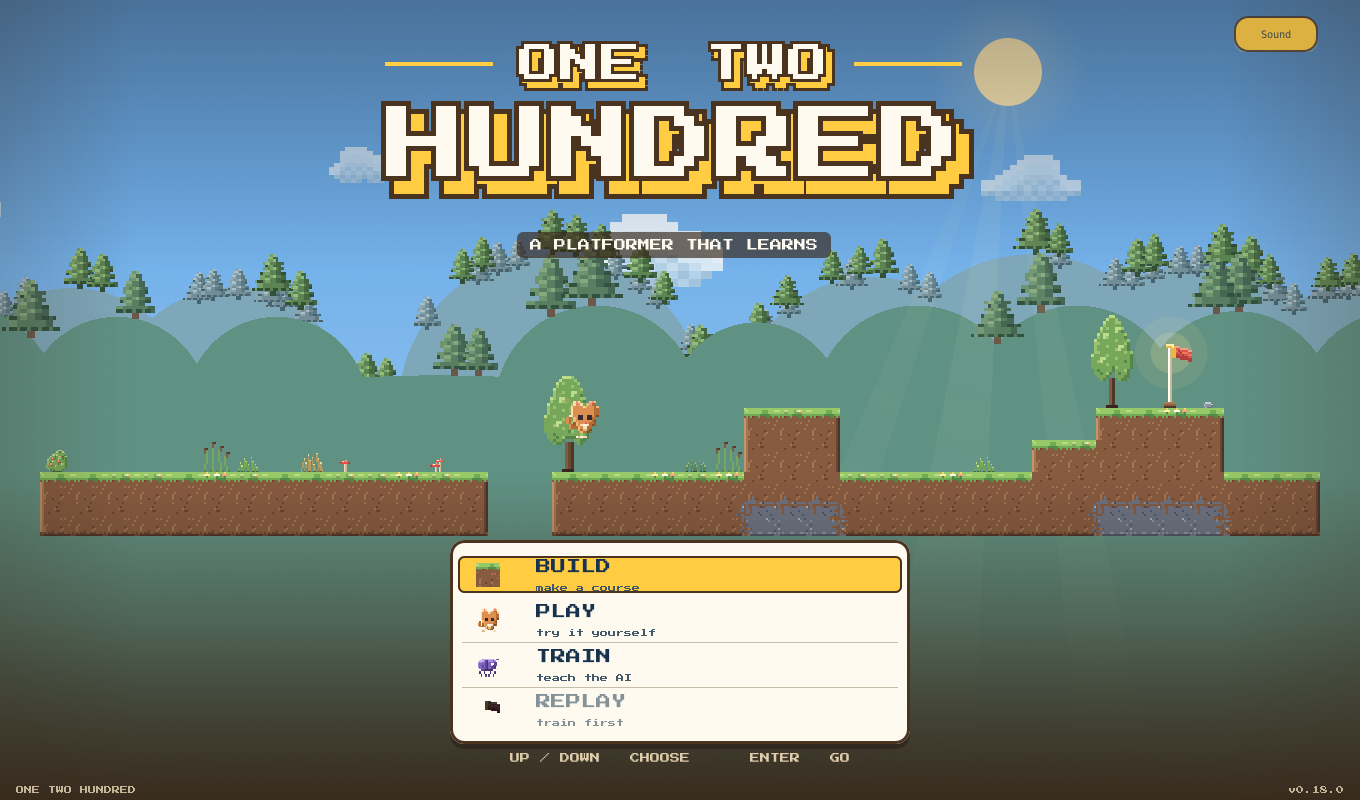
The title screen: the demo run plays behind the wordmark.

Everything a level is made of: the four materials and their brittle twins, the hazards and furniture, the cast and the scenery.

The editor, on levels/scratch-showcase.json, a level that uses every block
and enemy at once. The canvas is the game's own view; G adds the guides.

Evolve view: a run on L3 that has already found the flag, with the fitness chart below.

Replay view: the run's quickest win, with the rest of its generation ghosted beside it.
How it plays
Edit. Draw a level with the mouse: drag blocks, spikes, springs, enemies
and the flag out of the palette onto the canvas. The palette is one list cut
by what a part does — ground, hazards (what kills on touch), traversal
(what carries a body), enemies, the level's own marks and dressing, and the
two clearers — so a part is always where its behaviour says it is and nothing
is hiding behind a tab; / searches all of them at once, by name, by
description or by the word you actually think of ("trap", "pendulum",
"trampoline"). A lamp on the status line says whether the level can be beaten
at all; G turns on the guides — the tile grid, the reachability tint and the
full verdict — when you want to measure the level instead of look at it.
Play. Run the level yourself, against the clock. Once the AI has a best time on the level, the playtest races you against it, and you can turn on a ghost of the record-holding run to chase.
Evolve. Start a run and watch the population learn the level live: how far the best agents get, how many have reached the flag, and the quickest win so far. Save the best agent as a champion, carry it into the next run, or open the replay to watch its winning run with the rest of its generation ghosted beside it.
Features
- Level editor with a searchable parts palette, a game-view canvas (the guides are one key), undo/redo, eyedropper, line and rectangle tools, a browsable shelf of levels, and a mirror tool that flips the whole level in one step.
- Four building materials (grass, sand, brick, timber), all solid, plus one-way platforms and moving platforms with a visible travel guide.
- Trap tiles: cracked ground that crumbles shortly after something stands on it — the piece breaks off, falls, and shatters on the floor — and spring pads that throw whatever lands on them.
- Elements: water you swim in, lava that kills and throws fireballs, and vines you climb.
- Ropes: a line hanging from a ceiling that an airborne body catches with its hands and swings on. The arc is real physics — a pendulum with inertia, pumped by leaning and spent on release — so a rope turns a jump into a swing and a swing into a launch the running jump cannot match.
- Spiked balls: a ball on a chain that hangs asleep under a ceiling until a body comes near, and then swings. The pendulum is the same constraint physics the rope uses, the trigger is the wind-up rather than the blow, and the ball is a hitbox the whole way through its arc — there is no stomping it, only being somewhere else.
- Belts: a floor that moves what stands on it,
>and<in the level file, and it does not care what that is: a body walks on, a crate rides. The carry is a translation rather than a force, so a belt changes a jump's reach without changing the jump, and a body in the air over one is not carried at all — the tile is a floor with a direction, not a current. - Rocks: a boulder hung in a socket under a ceiling. A body that comes near wakes it, it shudders for half a second and falls once — under the same gravity a crate falls under — and then it is spent. A falling rock crushes; a settled one is a one-tile step, so the answer is to back off and let it come down, and the corridor it blocked is a corridor with a ledge in it. There is no clock and no second fall: the level really has changed by the time you get there.
- Crates: a one-tile solid a body can stand on and, by walking into it, shove along at
walking pace — the first thing in the pack a body can move. It falls if it is pushed off
an edge, stops flush at a wall or another crate, and stays where it was left — unless it was
left on a belt, which carries it away at the belt's pace with whatever is riding on top. In
the level file it is one
blockentity, and the sensors read it as the ground it is. - A physics engine of its own (
crates/dynamics): point masses, rigid links, ropes, gravity and tile collision, stepped one deterministic tick at a time. The rope you see is a world in it — a pinned tie, a chain of links and a grip at your hands — and the same crate is what the next falling crate, plank or boulder will be built from. - Enemies: patrolling walkers, chasers that hunt you and stop at ledges, flyers on a set flight path, and turrets that shoot along their row.
- A reachability check on every level, so the editor can say "beatable" or point at the jump that cannot be made.
- Evolution you can watch: a live fitness chart, champions you can save, continue from and race against, and replays with ghost populations.
- Learning you can read, not just a score: every run reports how many agents
solved, the best and median clock, the route leg and frame where the best
genome ended, a per-leg census of the whole population, and how spread out
its first decisions were. The window shows it in the Details panel,
trainprints it per generation, and--telemetry <PATH>writes one JSON object per generation for a later gate to read. - Runs that get unstuck: if a population stalls, the run can fall back to an easier version of the level, learn there, and carry what it learned back. Once a level is solved, a mastery mode keeps evolving for a faster time instead of stopping.
- A planner, as well as a learner: the deliberate controller (
Tin the playtest) works out a route through the level with the game's own physics and plays it, which answers levels whose trick is timing or waiting. That route can be compiled into a route plan — certified, cut into the same legs the training telemetry counts, with each leg's timing margin — and a fresh run starts a quarter of its first population from a clone of it. - Headless training with
train-cli: train, watch, replay champions, check levels, and run seed benchmarks, all from the terminal. A run started in the window can be resumed in the terminal and the other way round. - Synthesised sound, with no audio assets: an effect for every jump, stomp, spring and death; water and lava beds that fade in as you approach them, with splashes and swim strokes, and lava vents that announce a volley; an original minute-and-a-quarter theme that runs through intro, four sections, a bridge and a final chorus before it loops; and a sound switch on every screen.
The levels
Twelve levels ship with the game, each teaching one thing:
| Level | What it teaches |
|---|---|
l1-flat-run |
Nothing. A flat run to the flag |
l2-first-gap |
The first pit, and jumping on purpose |
l3-gauntlet |
Pits and spikes in sequence |
l4-rhythm |
A jump that has to be timed |
l5-tightrope |
Narrow ground and landing precision |
l6-marathon |
A long level, start to finish |
l7-ascent |
Wall jumps, as the way up |
l7-wall-school |
Wall jumps with nothing else going on |
l8-long-jump |
Sprinting, and the gap only a sprint jump clears |
l9-wait-and-climb |
A chain of everything, including waiting for a patrol |
l10-the-hunt |
Enemies: flyers, a chaser, a turret, a moving platform |
l11-the-elements |
Water, lava and vines |
There is also a set of small adversarial levels (levels/bat-*.json), one per
skill the AI is meant to have, and working levels named levels/scratch-*.json,
including the showcase level in the screenshot above, levels/scratch-rope.json
(a pit crossed only by swinging) and levels/scratch-ball.json (a corridor under a
spiked ball). The editor's palette has a rope brush that paints a cell at a time,
like every other part of a level: a click hangs one cell of line from the ceiling above
it, and dragging down grows that line a cell per row (a cell inside a line is refused,
because it is already rope). The spiked-ball brush paints a chain the same way: each
cell is one link, a click hangs the ball one link under the ceiling, and a drag down
carries the ball at the end of the stroke. The trigger's radius is the one stepper
under the palette, the way a platform's travel and width are two, and the drop ghost
draws the ball one cell below the paint it will hang from rather than under the
pointer.
levels/practice/ is a generated, certified practice suite: twenty-four
levels, six mechanics at four tiers, every one checked by the reachability
oracle and the timed planner before it is written. train-cli fuzz prints that
certification table, and train-cli fuzz --out levels/practice regenerates the
suite byte for byte from its own seed.
train-cli routeplan compiles a level's certified route into plan legs with
per-leg margins (--all --levels-dir levels/practice --out plans for the whole
suite). A level the oracle certifies but the planner cannot route is reported
as such; the window then starts that run's population random rather than warm.
train-cli train --from-plan goes further: its DAgger corrections are planned
from the state the clone actually reaches (one route crossing at a time), and a
leg curriculum takes the first leg the clone fails and spends the rest of the
fit budget on it. The clone line ends with the per-leg mastery reading — how
many legs were cleared, and which one stopped it.
Quick start
You need a Rust toolchain. From the top of the repo:
cargo build --release

# The game: title screen, then the editor on the first level
cargo run --release -p app

# Open a level straight into a run, a playtest, or a replay
cargo run --release -p app -- --evolve --level levels/l2-first-gap.json
cargo run --release -p app -- --play --level levels/l2-first-gap.json
cargo run --release -p app -- --replay --generations 20 --level levels/l3-gauntlet.json

# Headless: train a level, check whether a level can be beaten at all
./target/release/train-cli train --level levels/l3-gauntlet.json --generations 200 --pop 200 --stop-on-win
./target/release/train-cli train --level levels/practice/p17-mover-t2.json --telemetry out/p17.jsonl
./target/release/train-cli reach --level levels/l11-the-elements.json
./target/release/train-cli routeplan --level levels/practice/p17-mover-t2.json
./target/release/train-cli fuzz --out levels/practice

cargo test --workspace   # the test suite
train-cli --help lists everything the terminal can do.
Controls
Title screen: up/down and Enter choose, P goes straight to the
playtest, E straight to a run.
Edit: click paints, drag a palette item to place it, right-drag erases,
wheel zooms, middle-drag (or alt-drag) pans, ctrl+click picks the tile under
the pointer as your brush, shift-drag draws a line. / searches the palette,
Ctrl+S saves, Ctrl+Z and Ctrl+Y undo and redo, G toggles the guides
(grid, reachability tint, verdict), F fits the level, P plays.
Play: arrows or WASD move and jump, R restarts, G toggles the
record-holder ghost, T hands control to the planner, P or Esc goes back
to the editor.
Evolve: space pauses, N steps one generation, - and + change the
speed, S saves the champion, C continues from a saved champion, V
opens the replay, F toggles following the leader.
Press ? in any view for the full key card for that view.
More detail
This page is the short version, on purpose. The measurements, the numbered findings and the version history of the physics, sensors and scoring are in FINDINGS.md, and the forward plan for the AI is in AI_IMPROVEMENT_PLAN.md.
The game is in active development (currently sim 0.18.0, level format v5). Champion files record the exact physics and scoring they were trained under and are refused, rather than mis-replayed, if the game has moved on since.
Questions
What is evolution-platformer?
nordicnode/evolution-platformer is a public repo on GitHub by nordicnode. One Two Hundred: a 2D platformer where you build the level, then watch a population of neural networks evolve to beat it. Edit, play, evolve. Written in Rust.
Is evolution-platformer open source?
It declares no license on GitHub. Public does not mean open source: without a license, nobody is granted the right to reuse it.
Does evolution-platformer run on macOS, Windows or Linux?
Its maker has not tagged a system, so it is unknown here. Its README says what it needs.
How do I install evolution-platformer?
Open "Take it" on its page: Take My Repo writes an install plan for your machine and hands it to your AI agent (Claude Code, Codex or Cursor), which asks you before each step. Take My Repo has not tested it on any machine.