Off Grid AI
Enable every person to operate with the intelligence and capabilities of the entire enterprise. Source available. Five working AI use cases, live in 14 days, at zero cost. Set your rules once; everyone builds governed AI on top.
BUILT BY Wednesday Solutions · Made by Mac (@alichherawalla). Follow me for what ships next.
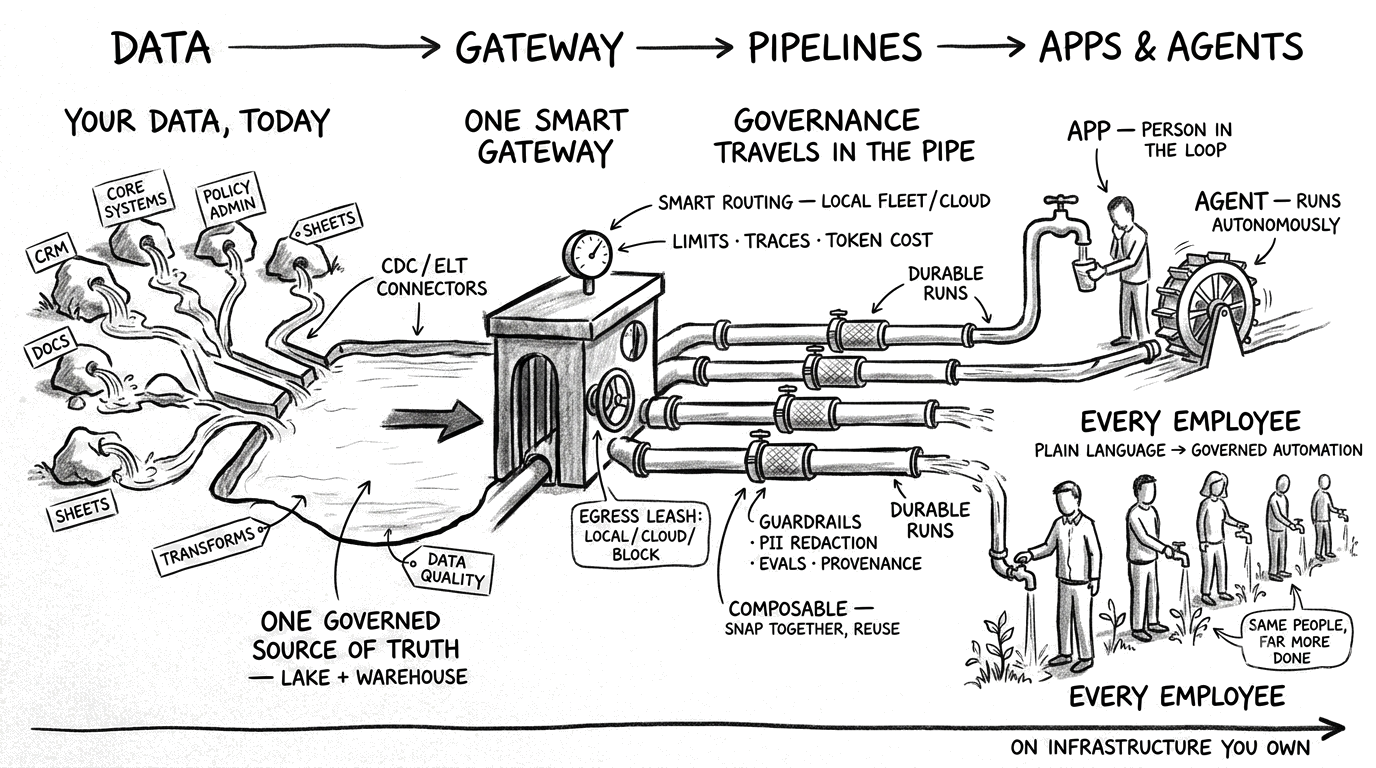
Every piece you need to run AI in a company already exists. A gateway to the models. Evals. Guardrails.
PII masking. Data pipelines. Audit. Lineage. Knowledge bases. The problem was never the parts. It was
wiring them into one thing that works, and keeping every team inside the rules.
AWS meant you stopped assembling servers. Off Grid AI means you stop assembling AI infrastructure.
It is one interface where all of it is already set up and connected. You define your organization's
rules, policies, guardrails, and knowledge once. Everyone builds on top of them. It just works.
git clone https://github.com/off-grid-ai/OGAC.git && cd console
npm install
cp .env.example .env.local        # fill in DATABASE_URL, AUTH_SECRET, AUTH_KEYCLOAK_*
make -C deploy up                 # the whole stack comes up, wired together
npm run db:push                   # create the schema
npm run dev                       # http://localhost:3000
That is the setup. It just works. Needs Docker and Node 22+. The full backing stack is one
docker compose bring-up, wired together, and every capability has a first-party default so you
only run the pieces you want. Run it on your own servers or in your cloud, your call.
What it is
A source-available platform you run on your own servers that makes your enterprise intelligent.
It harnesses the data and context already inside your organization, and lets your people and their
agents put frontier models to work on it, to raise their productivity, output, and quality. Every
run is secure, reliable, compliant, and governed, without anyone wiring that up per app.
Non-technical people build the apps. They describe what they need in plain language and get back a
working, governed workflow, tested in a sandbox before it touches anything real.
See it live
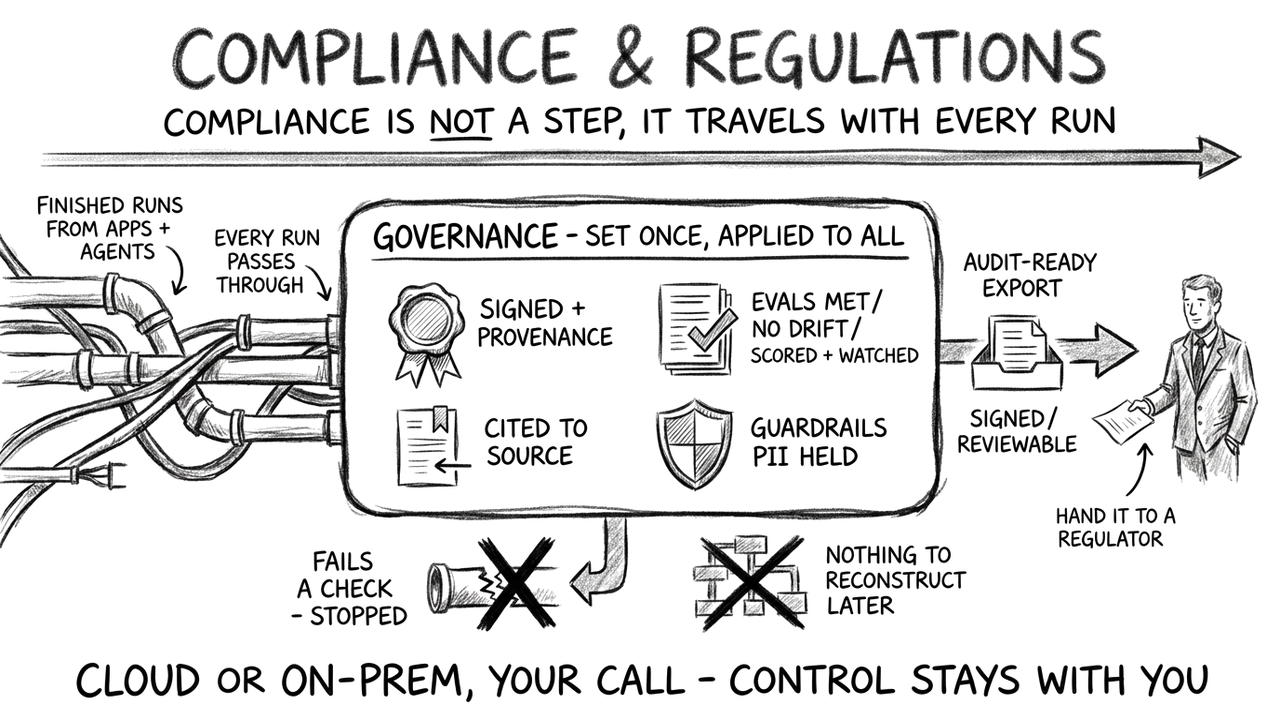
Click through two fully-seeded example tenants (a bank and a life insurer) on the live,
read-only demo:
Same platform, two industries: the gateway, guardrails, policies, pipelines, and the apps each team
built in plain language, all populated with realistic data.
Or see every feature, screen by screen →. The gateway, knowledge, the
Studio, agent QA, signed provenance, data, regulatory report packs, and FinOps, each with a
screenshot from the live console.
Build it in plain language
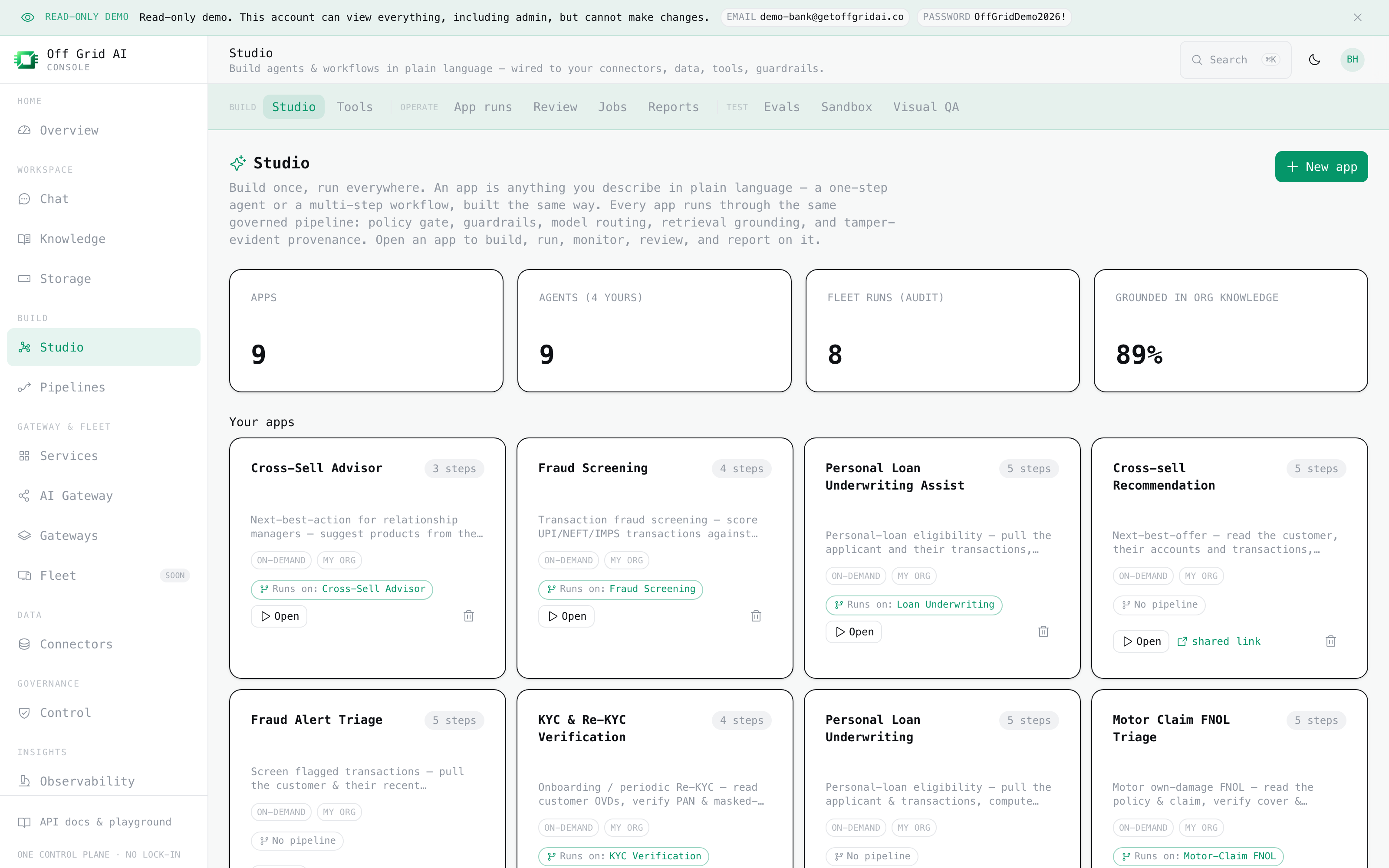
One place to build. Real apps and agents a business team can stand up in plain language: KYC,
underwriting, claims triage, reimbursements.
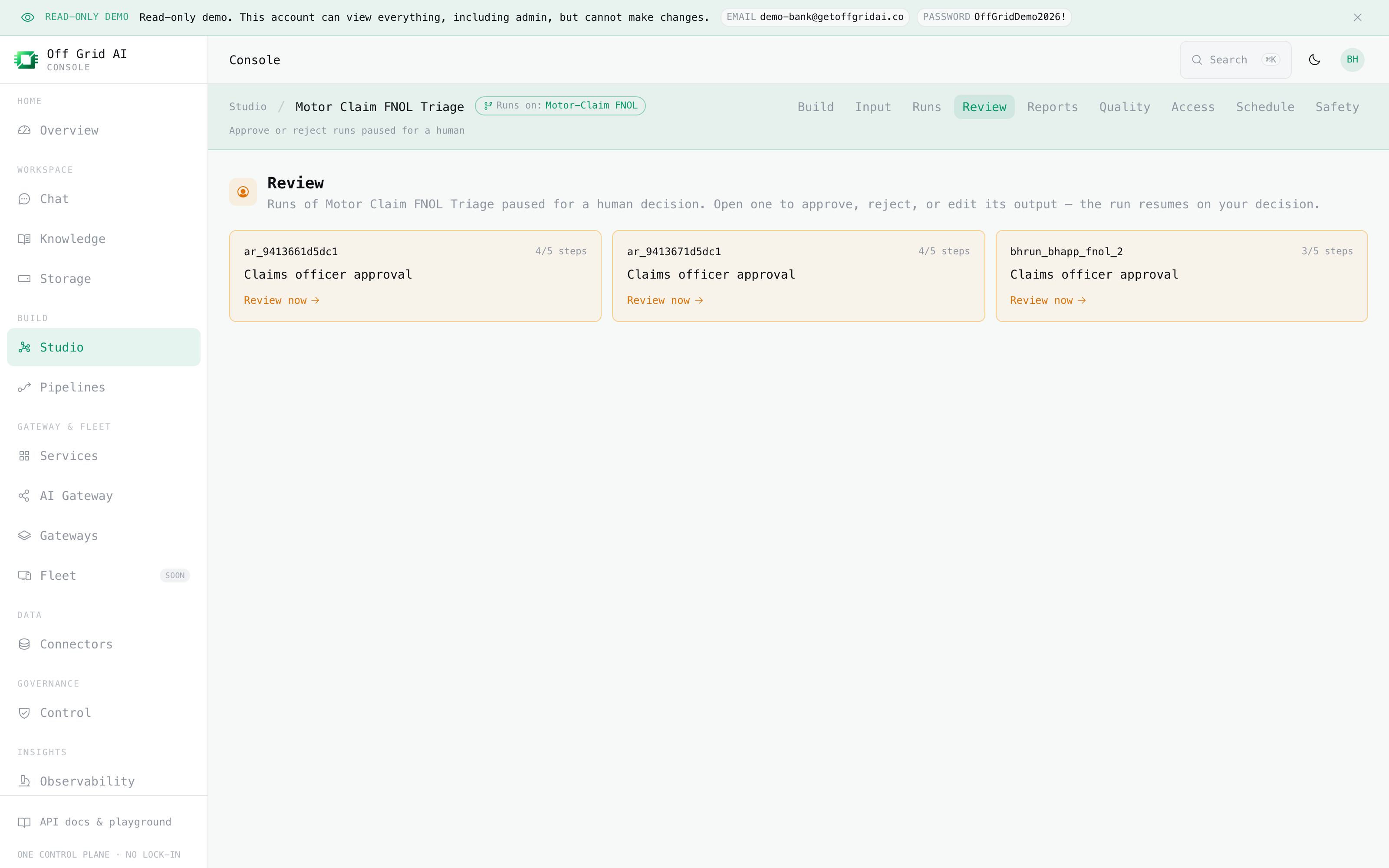
Anything that needs a person pauses for one. The approver opens it, decides, and the run resumes and
finishes on its own.
Set once, use everywhere
This is the part that changes how an enterprise runs AI.
An administrator defines the organization's rules, policies, guardrails, observability, data
lineage, and knowledge bases one time. From then on, every employee and every agent inherits them
automatically. Nobody re-implements governance. Nobody works around it. Nobody ships an app your
risk team has not already blessed.
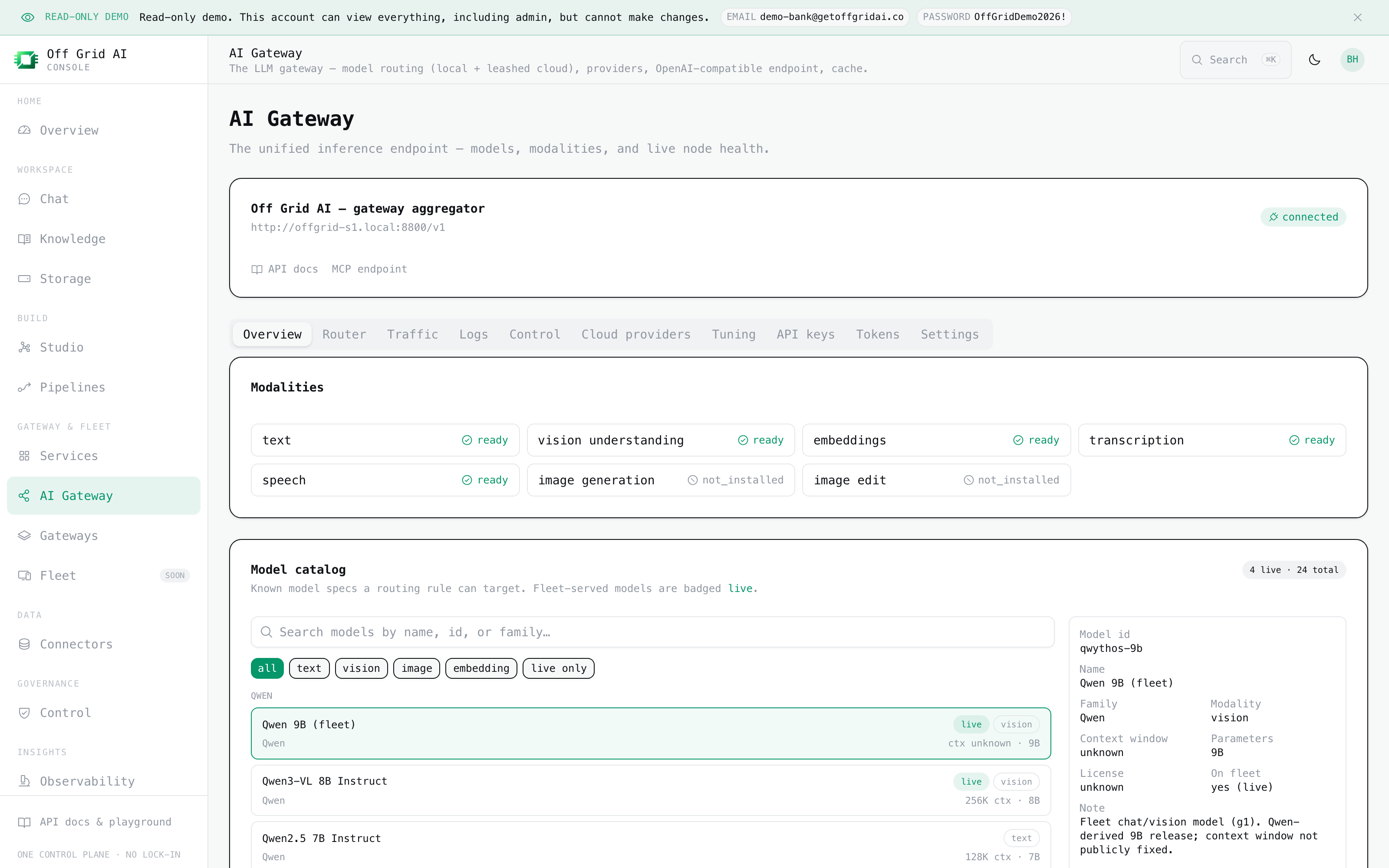
The rules live in one place and travel with every call, so moving fast and staying inside policy
stop being a trade-off.
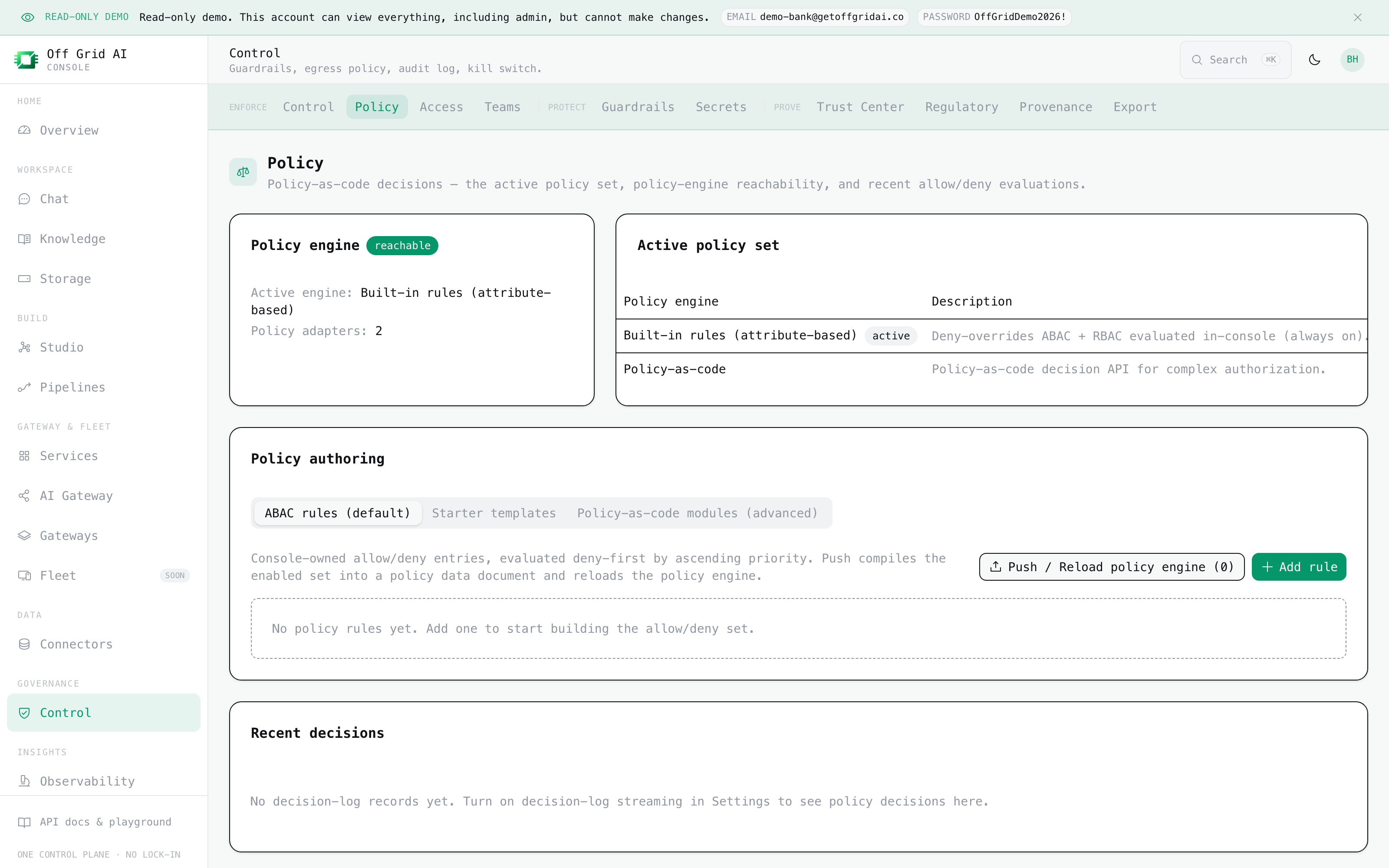
How it flows
   data  ->  gateway  ->  pipelines  ->  agents / apps  ->  compliance & regulations
 (your        (one         (evals,        (built by         (audited, cited,
  systems)     governed     drift,         non-technical      signed, reversible,
               model door)  guardrails,    people in          regulator-ready)
                            PII, policy)   plain language)
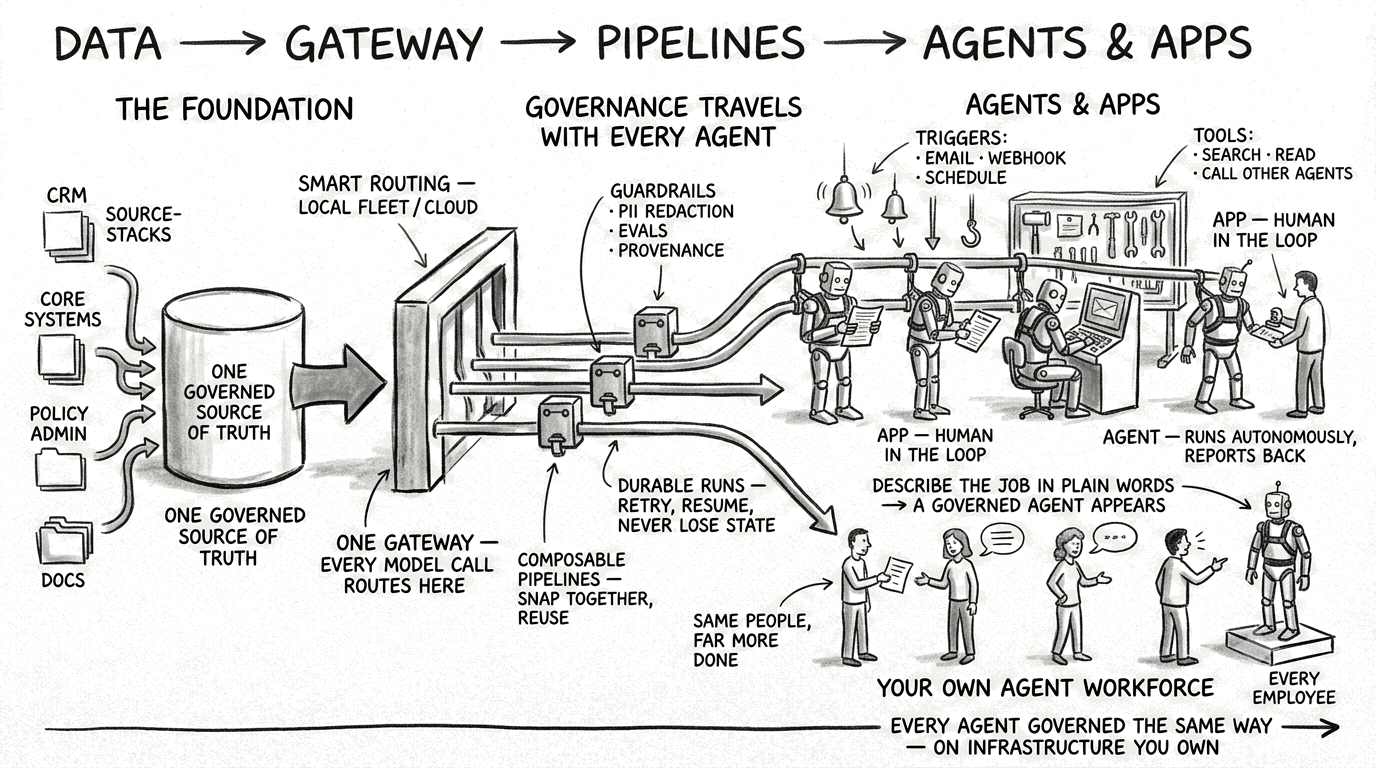
Compliance is not a stage you bolt on at the end. It travels with every run: signed, cited, scored,
guardrails held, and stopped the moment a check fails. At any point you hand a regulator a complete,
reversible account.
- Data. It connects to the databases, warehouses, and identity you already run. You change
nothing about your stack.
- Gateway. One governed door to every model. Local by default. Cloud routing is opt-in and masks
sensitive fields before a byte leaves the box.
- Pipelines. Bind a model, evals, a golden set, policy, guardrails, and drift to a use case once.
Everything built on top inherits all of it.
- Agents and apps. The people who know the work build the workflow, in plain language, in a
sandbox.
- Compliance. Every run is audited, every answer cited, every output signed. Export it and hand
it to a regulator.
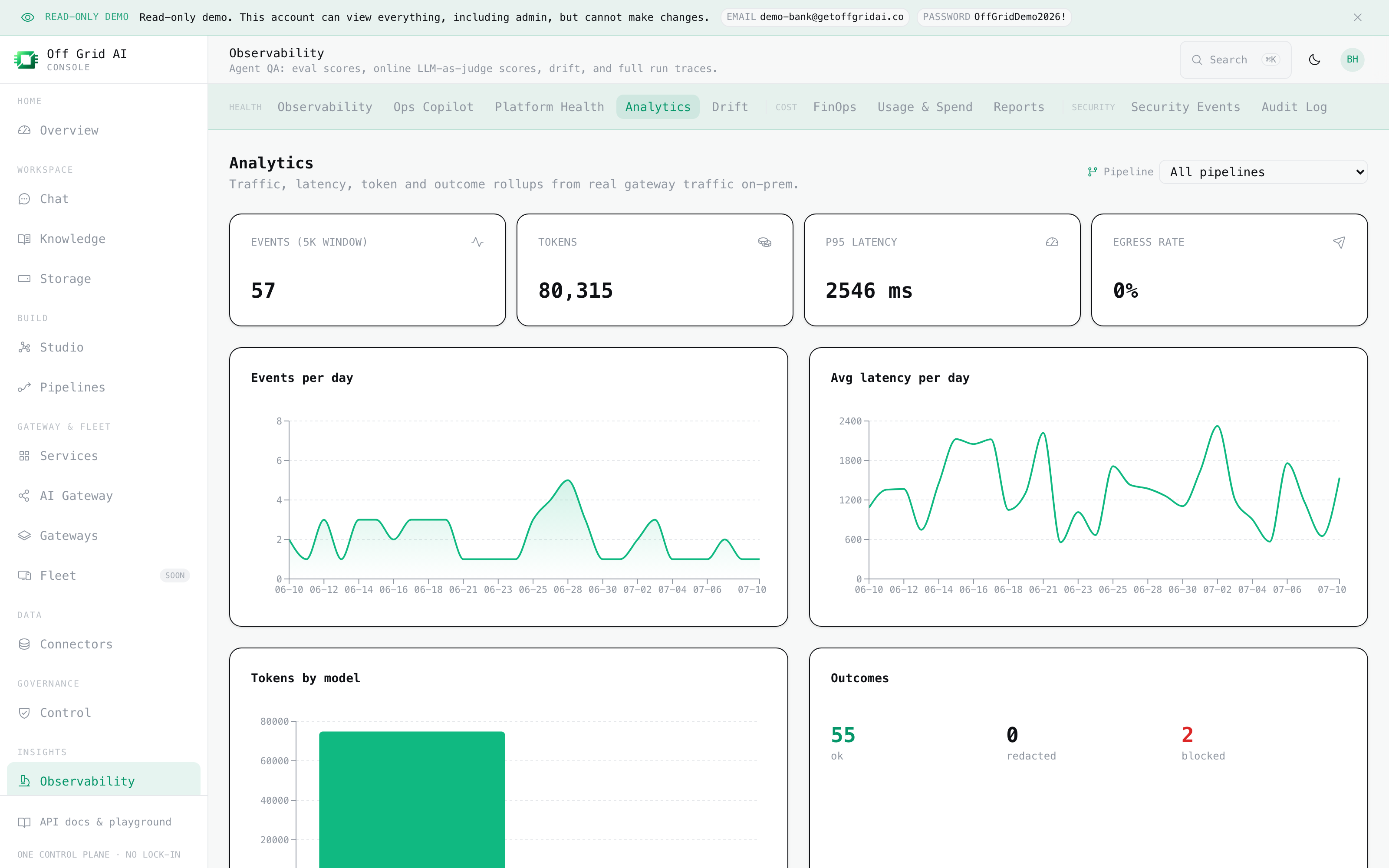
Take the live product tour → — the whole product, screen by screen, running on real data. Or open the console and click around read-only.
Why it matters
An enterprise reaches its full potential by amplifying its own moat: its data, its people, its
processes, its reach. Off Grid AI lets it do that through one governed interface, so putting AI to
work is a thing anyone in the org can do inside the rules, not a project that waits on a platform
team. Real change reaches people through the enterprises that serve them. This is how those
enterprises get intelligent.
The governance is ours. The engines are swappable.
Two layers, and the distinction matters.
The governance spine is Off Grid AI's own code, always on. It is not borrowed from a library.
Every model call runs through it, and it is what a pipeline binds once and every app inherits.
Three kinds of check, each honest about its cost:
- Deterministic, in-path, blocking, no meaningful latency. Policy and the egress leash (each
call resolves to local, cloud, or blocked per the data class), the regex PII floor, request-parameter
checks, and model rules. A call that is not allowed off the box does not leave.
- ML, in-path, blocking, latency-bearing. The model-based guardrails (prompt-injection,
toxicity, bias, ML PII detection) run on the request before the model answers. They screen and
can block, and they do add latency, because they are real inference. Enable per pipeline.
- LLM-as-judge, on the gateway model, out of band. A gateway model judges each run for
faithfulness to its cited sources and answer quality. Grounded runs must cite; the judge scores
whether they did. It runs after the answer, so it adds no latency, and feeds the eval and
observability layer.
Guardrails are tightening-only from the org default down.
On top of that: every run is signed, cited, and written to an append-only audit log; runs are scored
against a golden set and watched for drift; FinOps tracks per-key and per-user budgets and cost; and
controls map to ISO 42001, NIST AI RMF, and the EU AI Act with DPIA and regulator-ready exports.
None of that requires an external service. npm run dev has it on.
The engines are the swappable backends. For specific detection, decision, storage, and
observability steps, Off Grid AI ships a first-party default and lets you point one environment
variable at a best-in-class open-source engine. Same governance either way.
| Capability |
Default, no setup |
Swap in (one env var) |
In the console |
| Model gateway |
OGAD (Off Grid AI Desktop) in gateway mode, OpenAI-compatible, local fleet or cloud |
— |
Gateway |
| State + audit |
Postgres (append-only audit is always on) |
— |
everywhere |
| Identity / SSO |
Auth.js (NextAuth) with dev credentials |
Keycloak OIDC (or Google / Microsoft Entra) |
Access |
| Vectors / RAG |
LanceDB (embedded) |
Qdrant or pgvector |
Knowledge, Retrieval |
| Policy decisions |
first-party ABAC |
Open Policy Agent |
Control |
| Guardrails (screen prompts + responses) |
regex PII floor for data-movement redaction (always on, no network) |
LLM Guard (Protect AI) for content guardrails — PII/DLP, prompt-injection, toxicity, secrets, language, India recognizers folded in (OFFGRID_HTTP_GUARDRAIL_URL) |
Control |
| Evals + drift |
first-party golden set + PSI drift |
Ragas, Evidently (qa profile) |
Observability |
| Cost + budgets (FinOps) |
first-party pricing + budget enforcement |
— |
Insights |
| Compliance mapping |
first-party control catalog (ISO 42001 / NIST AI RMF / EU AI Act, article-level) + control-mapped framings (DPDP, GDPR, HIPAA, DORA, RBI, IRDAI) + exports |
— |
Governance |
| Response cache |
in-process |
Redis |
— |
| Feature flags |
Postgres |
Unleash (reads) |
Admin |
| Secrets |
env vars |
OpenBao (KV) |
Control |
| Audit search / SIEM |
Postgres audit |
OpenSearch (full-text + dashboards, read back into the UI) |
Control |
| LLM traces + scores |
first-party run trace |
Langfuse (span waterfall read back into the UI) |
Observability |
| Lineage |
audit-reconstructed |
Marquez (OpenLineage graph read back into the UI) |
Lineage |
| Data plane |
connect a source, sync it, warehouse it |
Airbyte sync, Kestra orchestration, ClickHouse warehouse |
Data |
Working, with a caveat we will not hide
- PII masking. The data-movement path is deterministic regex redaction (always on, no network). Content-path PII/DLP, injection, toxicity and secrets run through self-hosted LLM Guard