BentoML
The easiest way to serve AI apps and models - Build Model Inference APIs, Job queues, LLM apps, Multi-model pipelines, and more!
- 8.9k
- Python
- Apache-2.0
- 7 d ago
High-performance, AI-native server built from scratch in C + hand-written Assembly (SSE2/AVX2/AVX-512). Supports 10 AI providers — OpenAI, Groq, Anthropic Claude, Google Gemini, DeepSeek, Moonshot/Kimi, Zhipu GLM, Perplexity, Mistral AI, and local models via Ollama — all in one binary.
Repo okba14/NeuroHTTP, read from GitHub 3 d ago. okba14 has not joined Take My Repo.
okba14/NeuroHTTP is a public repo on GitHub by okba14. High-performance, AI-native server built from scratch in C + hand-written Assembly (SSE2/AVX2/AVX-512). Supports 10 AI providers — OpenAI, Groq, Anthropic Claude, Google Gemini, DeepSeek, Moonshot/Kimi, Zhipu GLM, Perplexity, Mistral AI, and local models via Ollama — all in one binary. It declares no license on GitHub. Public does not mean open source: without a license, nobody is granted the right to reuse it. It is written mainly in C, has 53 stars and last changed on 2026-05-29. Nobody has reviewed it on Take My Repo yet, which says nothing about its quality. Read from GitHub on 2026-11-20.
High-performance, AI-native server built from scratch in C + hand-written Assembly (SSE2/AVX2/AVX-512).
Supports 10 AI providers — OpenAI, Groq, Anthropic Claude, Google Gemini, DeepSeek, Moonshot/Kimi, Zhipu GLM, Perplexity, Mistral AI, and local models via Ollama — all in one binary.
📖 Arabic Version — النسخة العربية
sendfile/splice support for efficient static file servingconfig/aionic.conf via a simple pipe-delimited format_FORTIFY_SOURCE=2, -fstack-protector-strong/metrics endpoint for scraping/stats endpoint with live metricstools definitions to OpenAI-compatible providers; detect tool_calls in responsesimage_url) in chat completions for GPT-4o, Claude 3.5, Gemini 2.0response_format parameter support with JSON schema validation/v1/embeddings endpoint for generating vector embeddingscache_init_redis(); automatic fallback to in-memory if Redis unavailableplugin_install_from_github("owner/repo", "*.so")plugin_install_from_url()/v1/chat/stream| Provider | Models | Endpoint |
|---|---|---|
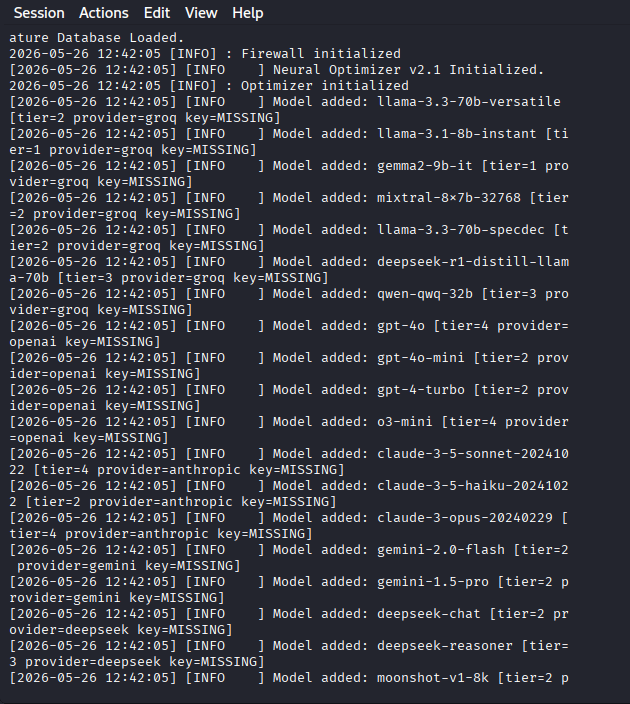
| Groq 🆓 | Llama 3.3 70B, Llama 3.1 8B, Gemma 2 9B, Mixtral 8×7B, DeepSeek R1, Qwen QWQ 32B | api.groq.com |
| OpenAI | GPT-4o, GPT-4o-mini, GPT-4 Turbo, o3-mini | api.openai.com |
| Anthropic | Claude 3.5 Sonnet, Claude 3.5 Haiku, Claude 3 Opus | api.anthropic.com |
| Google Gemini | Gemini 2.0 Flash, Gemini 1.5 Pro | generativelanguage.googleapis.com |
| DeepSeek | DeepSeek Chat, DeepSeek Reasoner | api.deepseek.com |
| Moonshot/Kimi | Moonshot v1 8K, Moonshot v1 32K | api.moonshot.cn |
| Zhipu (GLM) | GLM-4-Plus, GLM-4-Flash | open.bigmodel.cn |
| Perplexity | Sonar Pro, Sonar Deep Research | api.perplexity.ai |
| Mistral AI | Mistral Large, Mistral Small | api.mistral.ai |
| Local Ollama 🆓 | Any local model via Ollama | localhost:11434 |
# Ubuntu / Debian
sudo apt-get update
sudo apt-get install -y build-essential nasm libcurl4-openssl-dev libssl-dev libnghttp2-dev liburing-dev

# Fedora / RHEL
sudo dnf install -y gcc nasm libcurl-devel openssl-devel libnghttp2-devel liburing-devel

# Arch Linux
sudo pacman -S --noconfirm gcc nasm libcurl-compat openssl nghttp2 liburing

# Verify NASM is installed (required for assembly files)
nasm --version   # Should output NASM version 2.x+
git clone https://github.com/okba14/NeuroHTTP.git
cd NeuroHTTP

# Production build (optimized with LTO, -O3, -march=native)
make

# Debug build (AddressSanitizer, UBSan, stack protector)
make debug

# Clean rebuild
make rebuild

# Build only plugins
make plugins
# Start the server (default port 8080)
./bin/aionic

# Run debug build
./bin/aionic-debug

# Or via Make
make run
make run-debug
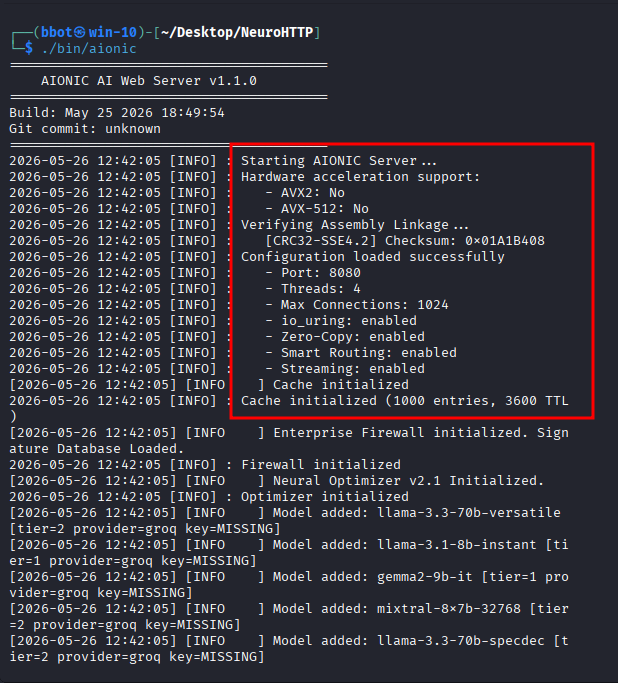
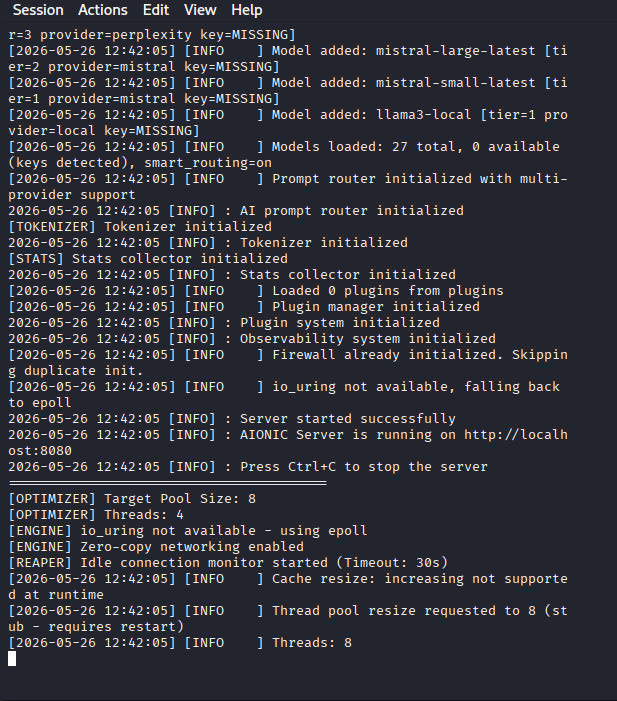
The server will display:
========================================
    AIONIC AI Web Server v2.0.0
========================================
Build: May 29 2026
Features: TLS1.3 HTTP/2 io_uring OCSP
========================================
    - Port: 8080
    - TLS Port: 8443
    - Threads: 4
    - Max Connections: 1024
    - io_uring: enabled
    - Zero-Copy: enabled
    - TLS: disabled
    - HTTP/2: enabled
    - Smart Routing: enabled
    - Streaming: enabled
    - Graceful Shutdown Timeout: 30s
========================================

---

## ⚙️ Configuration

All configuration lives in `config/aionic.conf`. Here is every option explained:

### Server Settings

```ini
port = 8080                    # HTTP listen port
thread_count = 4               # Worker thread count (legacy, event loop uses main thread)
worker_threads = 4             # Event loop worker pool size
max_connections = 1024         # Maximum concurrent connections
request_timeout = 30000        # Request timeout in milliseconds (30s)
buffer_size = 8192             # Internal I/O buffer size
max_request_size = 33554432    # Maximum request body size (32 MB)
log_file = logs/aionic.log     # Log file path
enable_cache = 1               # Enable response caching
cache_size = 1000              # Maximum cache entries
cache_ttl = 3600               # Cache TTL in seconds (1 hour)
enable_firewall = 1            # Enable WAF (SQLi, XSS, path traversal detection)
verify_ssl = 1                 # Verify SSL certificates for upstream AI endpoints
api_key = your-secret-api-key-here  # Server-wide API key for client authentication
enable_tls = 0                      # Enable TLS 1.3 HTTPS (requires cert and key)
tls_port = 8443                     # HTTPS listen port
tls_cert_file = config/cert.pem     # TLS certificate path (PEM)
tls_key_file = config/key.pem       # TLS private key path (PEM)
tls_ca_file = config/ca.pem         # CA bundle for OCSP (optional)
tls_enable_ocsp = 0                 # Enable OCSP stapling
tls_ocsp_refresh_interval = 3600    # OCSP refresh interval in seconds
tls_hsts_max_age = 31536000         # HSTS max-age in seconds (1 year)
enable_http2 = 1                    # Enable HTTP/2 (h2 via TLS ALPN + h2c upgrade)
http2_max_concurrent_streams = 256  # Max concurrent streams per connection
http2_max_header_list_size = 65536  # Max header list size
http2_initial_window_size = 65535   # Initial flow-control window size
http2_max_frame_size = 16384        # Max frame size
enable_iouring = 1             # Enable io_uring async I/O (falls back to epoll)
enable_zero_copy = 1           # Enable sendfile/splice zero-copy I/O
enable_ratelimiter = 1         # Enable per-IP rate limiting
rate_limit_rps = 100           # Max requests per second per IP
enable_observability = 1       # Enable metrics and tracing
enable_streaming = 1           # Enable SSE streaming endpoint
enable_smart_routing = 1       # Enable latency/health-aware provider routing
enable_keepalive = 1           # Enable HTTP/1.1 keep-alive
keepalive_timeout = 30         # Keep-alive timeout in seconds
API keys are read from environment variables for security. Never hardcode keys in config files.
# Groq (free, get key at https://console.groq.com/keys)
export GROQ_API_KEY="gsk_your_groq_key_here"

# OpenAI (get key at https://platform.openai.com/api-keys)
export OPENAI_API_KEY="sk-projXXXXXXX"

# Anthropic Claude (get key at https://console.anthropic.com/)
export ANTHROPIC_API_KEY="sk-ant-your-anthropic-key"

# Google Gemini (get key at https://aistudio.google.com/apikey)
export GEMINI_API_KEY="AIza_your_gemini_key"

# DeepSeek (get key at https://platform.deepseek.com/)
export DEEPSEEK_API_KEY="sk_your_deepseek_key"

# Moonshot / Kimi
export MOONSHOT_API_KEY="your_moonshot_key"

# Zhipu GLM
export ZHIPU_API_KEY="your_zhipu_key"

# Perplexity
export PERPLEXITY_API_KEY="pplx_your_perplexity_key"

# Mistral AI
export MISTRAL_API_KEY="your_mistral_key"
Add them to your shell profile (~/.bashrc, ~/.zshrc, etc.):
echo 'export GROQ_API_KEY="gsk_your_key"' >> ~/.bashrc
echo 'export OPENAI_API_KEY="sk_your_key"' >> ~/.bashrc
source ~/.bashrc
Or use a .env file:
# .env
GROQ_API_KEY=gsk_xxxx
OPENAI_API_KEY=sk-xxxx

# Load before running
export $(grep -v '^#' .env | xargs) && ./bin/aionic
Models are defined in config/aionic.conf using this format:
ai_model = <name>|<endpoint>|<env_var>|<max_tokens>|<temperature>
| Field | Description | Example |
|---|---|---|
name |
Model identifier (used in API calls) | gpt-4o |
endpoint |
Full API URL | https://api.openai.com/v1/chat/completions |
env_var |
Environment variable name for the API key | OPENAI_API_KEY |
max_tokens |
Maximum response tokens | 16384 |
temperature |
Sampling temperature (0.0–1.0) | 0.7 |
# OpenAI-compatible (OpenAI, Groq, Together, vLLM, LocalAI, Ollama)
ai_model = gpt-4o|https://api.openai.com/v1/chat/completions|OPENAI_API_KEY|16384|0.7
ai_model = llama-3.3-70b-versatile|https://api.groq.com/openai/v1/chat/completions|GROQ_API_KEY|8192|0.7

# Anthropic Claude (uses /v1/messages endpoint)
ai_model = claude-3-5-sonnet-20241022|https://api.anthropic.com/v1/messages|ANTHROPIC_API_KEY|8192|0.7

# Google Gemini (uses generateContent endpoint)
ai_model = gemini-2.0-flash|https://generativelanguage.googleapis.com/v1beta/models/gemini-2.0-flash:generateContent|GEMINI_API_KEY|8192|0.7

# DeepSeek
ai_model = deepseek-chat|https://api.deepseek.com/v1/chat/completions|DEEPSEEK_API_KEY|8192|0.7

# Moonshot / Kimi
ai_model = moonshot-v1-8k|https://api.moonshot.cn/v1/chat/completions|MOONSHOT_API_KEY|8192|0.7

# Zhipu GLM
ai_model = glm-4-plus|https://open.bigmodel.cn/api/paas/v4/chat/completions|ZHIPU_API_KEY|8192|0.7

# Perplexity
ai_model = sonar-pro|https://api.perplexity.ai/chat/completions|PERPLEXITY_API_KEY|8192|0.7

# Mistral AI
ai_model = mistral-large-latest|https://api.mistral.ai/v1/chat/completions|MISTRAL_API_KEY|8192|0.7

# Local model via Ollama (must be running on port 11434)
ai_model = llama3-local|http://localhost:11434/v1/chat/completions|OPENAI_API_KEY|4096|0.7
config/aionic.confThe model will automatically appear in /v1/models and be available for chat completions.
GET /health — Health CheckReturns server health status.
curl http://localhost:8080/health
{
  "status": "ok",
  "timestamp": 1779698657,
  "server": "AIONIC/1.0",
  "version": "1.0.0"
}
GET /v1/models — List ModelsLists all configured AI models.
curl http://localhost:8080/v1/models
{
  "models": ["llama-3.3-70b-versatile", "gpt-4o", "claude-3-5-sonnet-20241022", ...],
  "count": 27
}
POST /v1/chat — Chat CompletionSends a prompt to an AI model and returns the response.
curl -X POST http://localhost:8080/v1/chat \
  -H "Content-Type: application/json" \
  -d '{"prompt": "What is the capital of France?", "model": "llama-3.3-70b-versatile"}'
Parameters:
prompt (required) — The text prompt to sendmodel (optional) — Model name (uses default if omitted){
"response": "The capital of France is Paris.",
"model": "llama-3.3-70b-versatile",
"usage": {
"prompt_tokens": 12,
"completion_tokens": 8
}
}
POST /v1/chat/stream — Streaming ChatSame as /v1/chat but sends the response as Server-Sent Events (SSE).
curl -N -X POST http://localhost:8080/v1/chat/stream \
  -H "Content-Type: application/json" \
  -d '{"prompt": "Tell me a story", "model": "llama-3.3-70b-versatile"}'
Output format:
id: <request_id>
event: message
data: <chunk>

data: [DONE]
GET /stats — Server StatisticsReturns live server metrics.
curl http://localhost:8080/stats
{
  "requests": 42,
  "responses": 42,
  "active_connections": 1,
  "total_errors": 0,
  "total_ai_calls": 10,
  "uptime_seconds": 3600,
  "bytes_sent": 1048576,
  "bytes_received": 65536,
  "timestamp": 1779698657
}
GET /metrics — Prometheus MetricsReturns metrics in Prometheus text format for scraping.
curl http://localhost:8080/metrics
# HELP aionic_requests_total Total HTTP requests
# TYPE aionic_requests_total counter
aionic_requests_total 42
# HELP aionic_ai_calls_total Total AI model calls
# TYPE aionic_ai_calls_total counter
aionic_ai_calls_total 10
POST /v1/embeddings — Text EmbeddingsGenerate vector embeddings for text input.
curl -X POST http://localhost:8080/v1/embeddings \
  -H "Content-Type: application/json" \
  -d '{"model": "text-embedding-3-small", "input": "Hello world"}'
{
  "data": [{"embedding": [0.025, -0.009, ...], "index": 0}],
  "model": "text-embedding-3-small",
  "usage": {"prompt_tokens": 3}
}
GET /v1/providers — Provider ListReturns the list of configured AI providers.
curl http://localhost:8080/v1/providers
GET / — Root PageReturns the server welcome page or banner.
curl http://localhost:8080/
NeuroHTTP supports dynamic loading of shared library plugins at runtime.
Each plugin is a .so file in the plugins/ directory with these entry points:
| Function | Hook Point | When Called |
|---|---|---|
plugin_init() |
— | On server startup |
plugin_hook(0, ctx) |
PLUGIN_HOOK_PRE_REQUEST |
Before routing a request |
plugin_hook(1, ctx) |
PLUGIN_HOOK_POST_REQUEST |
After routing, before response |
plugin_hook(2, ctx) |
PLUGIN_HOOK_AI_PROMPT |
Before an AI API call |
plugin_hook(3, ctx) |
PLUGIN_HOOK_AI_RESPONSE |
After an AI API response |
plugin_hook(4, ctx) |
PLUGIN_HOOK_ON_CONNECT |
New client connection |
plugin_hook(5, ctx) |
PLUGIN_HOOK_ON_DISCONNECT |
Client disconnects |
plugin_cleanup() |
— | On server shutdown |
# Build all plugins
make plugins

# The .so files are output to build/plugins/
| Plugin | File | Purpose |
|---|---|---|
logstats |
plugins/logstats.c |
Logs all requests and AI prompts |
openai_proxy |
plugins/openai_proxy.c |
Intercepts AI prompts to add system instructions |
#define _POSIX_C_SOURCE 200809L
#include <stdio.h>

int plugin_init(void) {
    printf("[myplugin] Initialized\n");
    return 0;
}

int plugin_hook(int hook_point, void *ctx) {
    if (hook_point == 0) {  /* PRE_REQUEST */
        printf("[myplugin] Request received\n");
    }
    return 0;
}

void plugin_cleanup(void) {
    printf("[myplugin] Cleaned up\n");
}
Compile: gcc -fPIC -shared myplugin.c -o build/plugins/myplugin.so
| Command | Description |
|---|---|
make |
Build production binary (PIE, ASLR, RELRO) |
make debug |
Build with AddressSanitizer + UBSan |
make rebuild |
Clean + full rebuild |
make run |
Build and run the server |
make run-debug |
Build and run debug server |
make plugins |
Build plugin .so files |
make test |
Build and run main test suite |
make test-all |
Run all test suites (unit, fuzz, integration) |
make test-moderation |
Run content moderation tests |
make test-gateway |
Run AI Gateway tests (function calling, embeddings, vision, cost) |
make test-cache |
Run cache tests (in-memory, semantic) |
make test-firewall |
Run WAF tests (IP blocklist, whitelist, rate limits) |
make test-fuzz |
Run fuzz tests (random payloads, edge cases) |
make test-prompt-router |
Run prompt router tests (routing, cost, model management) |
make coverage |
Run all tests with gcov coverage analysis |
make check-deps |
Check system dependencies (hiredis, libcurl, openssl, nghttp2, nasm) |
make install |
Install to /usr/local/bin/aionic |
make uninstall |
Remove installed files |
make clean |
Remove build artifacts |
make benchmark |
Show benchmark command |
make docs |
Generate Doxygen docs |
make analyze |
Run cppcheck static analysis |
make format |
Format code with clang-format |
make memcheck |
Run valgrind memory check |
make profile |
Profile with gprof |
NeuroHTTP/
├── src/                    # C source files
│   ├── main.c              # Entry point, signal handling, init loop
│   ├── server.c            # HTTP server, connection management, event loop integration
│   ├── iouring_engine.c    # io_uring async I/O engine with epoll fallback
│   ├── tls.c               # TLS 1.3 wrapper (OpenSSL 3.6 / BoringSSL), OCSP stapling, ALPN
│   ├── http2.c             # HTTP/2 session management via nghttp2 (h2 + h2c)
│   ├── router.c            # Hash-table route dispatcher with middleware
│   ├── http_parser.c       # State-machine HTTP/1.1 parser
│   ├── config.c            # Configuration file parser
│   ├── arena.c             # Arena + Slab allocator + ArenaPool
│   ├── ratelimiter.c       # Token-bucket + sliding-window rate limiter
│   ├── observability.c     # Metrics, tracing, provider stats
│   ├── firewall.c          # WAF with SQLi/XSS detection, IP blacklist
│   ├── parser.c            # Legacy HTTP parser (used by older code)
│   ├── stream.c            # SSE streaming support
│   ├── cache.c             # Response cache
│   ├── plugin.c            # Dynamic plugin loader
│   ├── optimizer.c         # Runtime optimizer
│   ├── utils.c             # Utility functions
│   ├── ai/
│   │   ├── prompt_router.c # Multi-provider AI routing (latency/health/cost-aware)
│   │   ├── ai_gateway.c    # AI Gateway: function calling, embeddings, vision, cost tracking
│   │   ├── content_moderation.c # Built-in prompt/response content moderation
│   │   ├── stats.c         # Per-model statistics
│   │   └── tokenizer.c     # Token counting
│   └── asm/
│       ├── crc32.s         # CRC32 (SSE4.2) — hashing
│       ├── json_fast.s     # JSON tokenizer (SSE2/AVX2)
│       └── memcpy_asm.s    # Memory copy (SSE2–AVX-512)
├── include/                # Header files
│   ├── tls.h               # TLS 1.3 + OCSP + ALPN API
│   ├── http2.h             # HTTP/2 session API
│   └── ...
├── config/
│   └── aionic.conf         # Main configuration file
├── plugins/                # Plugin source files
└── Makefile
Client → TCP Accept (plain/TLS)
         │
         ├── TLS 1.3 handshake (if TLS port)
         │   ├── OCSP stapling, ALPN negotiation
         │   └── HSTS headers
         │
         ↓
   Event Loop (epoll / io_uring)
         │
         ├── HTTP/2? ──► h2c upgrade or ALPN h2
         │                   └── nghttp2 session → multiplexed streams
         │
         ↓
    HTTP Parser (state-machine HTTP/1.1 or HTTP/2 frames)
         ↓
      Firewall (WAF)
         ↓
    Rate Limiter (token bucket)
         ↓
      Route Dispatcher
         ├── /health → HealthHandler
         ├── /v1/models → ModelsHandler
         ├── /v1/chat → AI Provider Router
         │                ├── Groq
         │                ├── OpenAI
         │                ├── Anthropic
         │                ├── Gemini
         │                └── ...
         ├── /metrics → PrometheusHandler
         ├── /stats → StatsHandler
         └── /v1/providers → ProvidersHandler
         ↓
   Response → send() / sendfile() / nghttp2 submit_response()
         ↓
   Graceful Shutdown (SIGTERM/SIGINT)
      ├── Stop accepting new connections
      ├── Drain active connections (configurable timeout)
      └── Cleanup resources → exit
| Server | Connections | Requests/sec | Avg Latency | Transfer/sec |
|---|---|---|---|---|
| NGINX 1.29.3 | 10k | 8,148 | 114ms | 1.2 MB/s |
| NeuroHTTP | 10k | 2,593 | 57ms | 7.9 MB/s |
NeuroHTTP handles heavier AI-rich payloads with lower latency.
# Find the process using port 8080
fuser 8080/tcp

# Kill it
fuser -k 8080/tcp

# Or use a different port
# Edit config/aionic.conf: port = 8081
# Check that API keys are set
echo $GROQ_API_KEY
echo $OPENAI_API_KEY

# Check config file syntax
cat config/aionic.conf | grep ai_model

# Verify the key environment variable name matches
# If the config says OPENAI_API_KEY, then:
export OPENAI_API_KEY="sk-..."
# Check if the provider endpoint is reachable
curl -v https://api.groq.com/openai/v1/models

# Check server logs
tail -f logs/aionic.log

# Verify SSL (try with verify_ssl = 0 in config if you have certificate issues)
# In config/aionic.conf:
worker_threads = <number_of_cores>   # Match your CPU core count
max_connections = 10000              # Increase for higher load
keepalive_timeout = 60               # Keep connections alive longer
enable_zero_copy = 1                 # Enable for static file serving
enable_smart_routing = 1             # Distribute load across providers
# Ensure dependencies are installed
dpkg -l | grep -E "build-essential|nasm|libcurl"

# Clean and retry
make clean && make

# Try without optimization
make debug
MIT License — see LICENSE.
GUIAR OQBA 🇩🇿
"Building the next generation of AI-native infrastructure — from El Kantara, Algeria."
okba14/NeuroHTTP is a public repo on GitHub by okba14. High-performance, AI-native server built from scratch in C + hand-written Assembly (SSE2/AVX2/AVX-512). Supports 10 AI providers — OpenAI, Groq, Anthropic Claude, Google Gemini, DeepSeek, Moonshot/Kimi, Zhipu GLM, Perplexity, Mistral AI, and local models via Ollama — all in one binary.
It declares no license on GitHub. Public does not mean open source: without a license, nobody is granted the right to reuse it.
Its maker tagged it for Linux. That is declared by the maker; Take My Repo has not tested it.
Open "Take it" on its page: Take My Repo writes an install plan for your machine and hands it to your AI agent (Claude Code, Codex or Cursor), which asks you before each step. Take My Repo has not tested it on any machine.
The easiest way to serve AI apps and models - Build Model Inference APIs, Job queues, LLM apps, Multi-model pipelines, and more!
Its last change on GitHub was on 2026-05-29. GitHub counts 0 open issues and pull requests. Take My Repo does not judge from that whether it is maintained.
Nobody has reviewed it on Take My Repo yet, which says nothing about its quality.
RustFS is an open-source, S3-compatible high-performance object storage system supporting migration and coexistence with other S3-compatible platforms such as MinIO and Ceph.
Run compilers interactively from your web browser and interact with the assembly
The agent harness performance optimization system. Skills, instincts, memory, security, and research-first development for Claude Code, Codex, Opencode, Cursor and beyond.
Extension for Scikit-learn is a seamless way to speed up your Scikit-learn application
Hardware-accelerated, zero-copy systems file scanner for Node.js. Powered by AVX-512/AVX2/NEON SIMD, kernel mmap, and persistent thread pools for 50+ GB/s throughput with 0 MB V8 heap.
A lightweight and dependency-free C library for advanced string manipulation.
✨ My GitHub profile README | Low-level dev, blockchain explorer & cybersecurity researcher