espectre
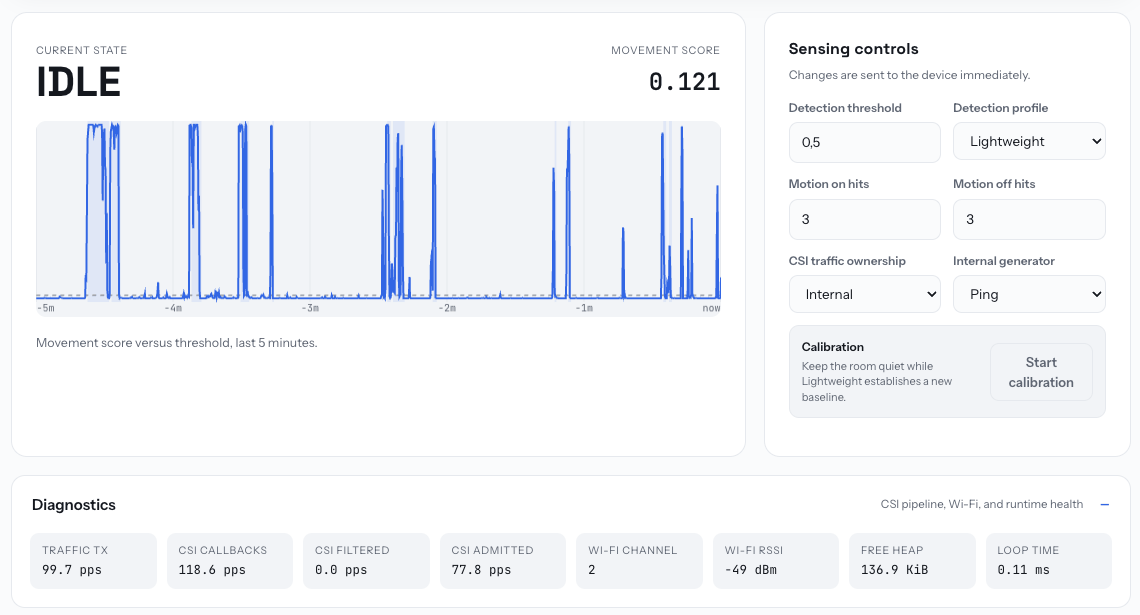
Wi-Fi motion sensing platform for ESP32. C++ SDK, ESPHome, Native, and Matter frontends, browser tools, and a CLI for the full device lifecycle. GPLv3 and commercial licensing.
- 9.9k
- Python
- GPL-3.0
- 22 h ago
Neural Text to Speech Vocoder for the Tang Nano
Repo pschatzmann/TangNanoVocoder, read from GitHub 3 h ago. pschatzmann has not joined Take My Repo.
pschatzmann/TangNanoVocoder is a public repo on GitHub by pschatzmann. Neural Text to Speech Vocoder for the Tang Nano. It declares the Apache-2.0 license on GitHub. It is written mainly in C, has 1 stars and last changed on 2026-10-12. Nobody has reviewed it on Take My Repo yet, which says nothing about its quality. Read from GitHub on 2026-11-25.
Wi-Fi motion sensing platform for ESP32. C++ SDK, ESPHome, Native, and Matter frontends, browser tools, and a CLI for the full device lifecycle. GPLv3 and commercial licensing.
TinyTTS is a proof of concept of a Neural Text to Speech functionality running entirely on a microcontroller. It is a small VITS-style model with 1.6M parameters, covering the whole pipeline. The conclusion: it is working but it is too slow, by a factor of about 20 on the fastest ESP32. Most of the work is the vocoder: about 440 million multiply-accumulates per second of audio, about 90% of the model's total. The flow is most of the rest. No microcontroller CPU does that in real time.
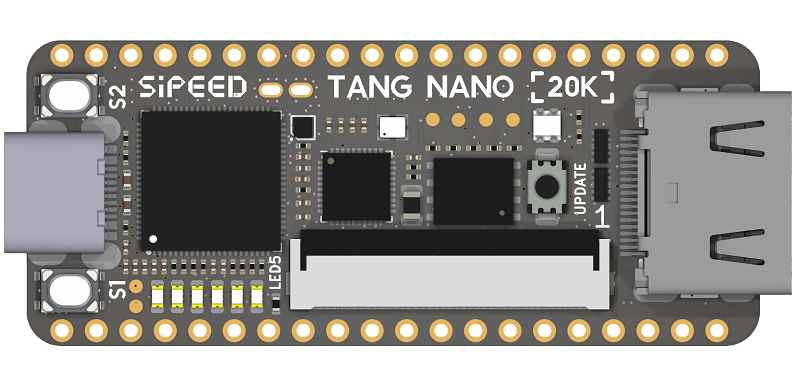
This project moves the neural model into hardware. A Sipeed Tang Nano 20K FPGA runs all of it - text encoder, duration predictor, flow and vocoder - fed by its own DMA from SDRAM rather than by a CPU, and plays the audio itself, over I2S or a PWM pin.
The microcontroller keeps only TinyTTS's G2P: it looks the words up in the
pronunciation dictionary and sends about 100 bytes of phoneme ids per sentence. That needs
1.1MB of flash and a few KB of RAM, so it runs on an RP2040 as well as on an ESP32
(examples/speak_rp2040).
The earlier split - TinyTTS's front end on an ESP32-S3, z_p over the link - is still there
(tnv::LatentVocoder), and the FPGA runs both kinds of sentences. So far the library has
run from a PC against the board (tests/test_desktop.cpp, the same code as on a
microcontroller), not yet on an RP2040 or ESP32 wired to it. See
Plan and Status.
To try it, start with Getting Started; all documents are listed under Documentation.
            text
             |
   +---------v-----------------------------------------+
   | MCU (RP2040, ESP32, ...): TinyTTS's G2P           |
   |  slim CMU dictionary 1.1MB (+ optional G2P model  |
   |  for unknown words 1.0MB) -> phoneme ids          |
   +---------+-----------------------------------------+
             | about 100 bytes per sentence ('X'), over SPI or UART
   +---------v-----------------------------------------+
   | Tang Nano 20K FPGA (program image 2.3MB, loaded   |
   | from its own flash at power-up: front end 39 ops, |
   | flow 116 ops, vocoder 102 ops)                    |
   |  SPI/UART receiver -> SDRAM (8MB)                 |
   |  op by op, from SDRAM, 16-bit fixed point:        |
   |   front end: embedding, text encoder, duration    |
   |            predictor, durations, z_p with noise   |
   |   flow:    convolutions on the engine,            |
   |            LayerNorm and attention unit -> z      |
   |   vocoder: 16-lane convolution engine (normal and |
   |            transposed), requantize, residual, tanh|
   |                                about 0.9 x real time
   |  -> I2S (onboard MAX98357A) or PWM pin            |
   +---------------------------------------------------+
| Document | Contents |
|---|---|
| Installation | The Arduino library on an ESP32 or RP2040; the development environment: host tools, FPGA toolchains (Gowin EDA, open source), simulators |
| Getting Started | From a PC: bitstream, program image in flash, speaking (tnv.py say), the desktop test |
| Using the Library | The Arduino API, what runs on the microcontroller and what on the FPGA, examples (ESP32, RP2040), wiring, data headers |
| Plan and Status | The project's phases, the current status (what has run on the board), what is open |
| Repository Layout | Directories and the main source files |
| Studies | The measurements behind the plan; the vocoder, the flow and the front end in fixed point (arithmetic, quality against TinyTTS); the model tool vocoder_model |
| Gateware | The FPGA design: blocks, the flow unit, the front end, hardware image format, link protocol, pins, building, simulation, resources, speed |
docs/tangnano20k.md with the measurements on this board.pschatzmann/TangNanoVocoder is a public repo on GitHub by pschatzmann. Neural Text to Speech Vocoder for the Tang Nano.
It declares the Apache-2.0 license on GitHub.
Its maker has not tagged a system, so it is unknown here. Its README says what it needs.
Open "Take it" on its page: Take My Repo writes an install plan for your machine and hands it to your AI agent (Claude Code, Codex or Cursor), which asks you before each step. Take My Repo has not tested it on any machine.
Run Faust DSP on a Sipeed Tang Nano 20K FPGA
VoiceStudio is the open-source, fully-local ElevenLabs alternative — voice cloning, voice design, video dubbing, dictation, transcription & audiobook creation in 646 languages.
利用 AI 大模型和自动化工作流,根据主题或关键词一键生成高清短视频。Generate HD short videos from a topic or keyword with an automated AI workflow.
Its last change on GitHub was on 2026-10-12. GitHub counts 0 open issues and pull requests. Take My Repo does not judge from that whether it is maintained.
Nobody has reviewed it on Take My Repo yet, which says nothing about its quality.
Take My Repo cannot say: it does not audit code and has not run TangNanoVocoder. What is known comes from GitHub. It declares the Apache-2.0 license on GitHub. Its last change was on 2026-10-12. It has 1 stars, which measure popularity, not safety. Nobody has reviewed it on Take My Repo yet, which says nothing about its quality. Read the source before you run it. With "Take it", your AI agent shows each step and asks you before running it; README text is treated as data, not as instructions.