ganja.js
:triangular_ruler: Javascript Geometric Algebra Generator for Javascript, c++, c#, rust, python. (with operator overloading and algebraic literals) -
- 1.6k
- JavaScript
- MIT
- 3 y ago
Symbolic Geometric Algebra/Calculus package for SymPy :crystal_ball:
Repo pygae/galgebra, read from GitHub 1 min ago. pygae has not joined Take My Repo.
pygae/galgebra is a public repo on GitHub by pygae. Symbolic Geometric Algebra/Calculus package for SymPy :crystal_ball:. It declares the BSD-3-Clause license on GitHub. It is written mainly in Python, has 288 stars and last changed on 2026-07-31. Nobody has reviewed it on Take My Repo yet, which says nothing about its quality. Read from GitHub on 2026-11-25.
:triangular_ruler: Javascript Geometric Algebra Generator for Javascript, c++, c#, rust, python. (with operator overloading and algebraic literals) -
Symbolic Geometric Algebra/Calculus package for SymPy.
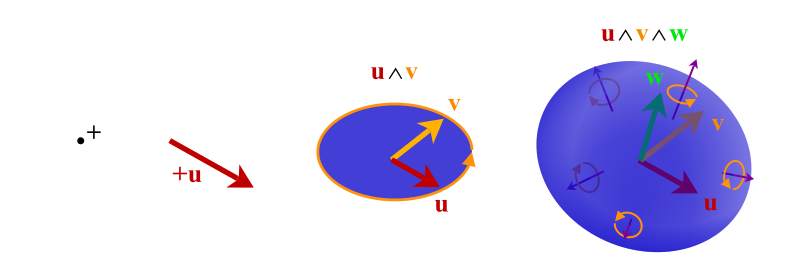
brombo/galgebra was originally written by Alan Bromborsky, but was no longer actively maintained, and as of 2019-11-25 no longer exists.
pygae/galgebra is a community fork, maintained by Pythonic Geometric Algebra Enthusiasts.
The fork supports Python 3, increases test coverage, sets up CI and linters, maintains releases to PyPI, improves docs and has many bug fixes, see Changelog.
For information on how GAlgebra is used in other projects, see Used by.
Important
Readers of Prof. Alan Macdonald's Linear and Geometric Algebra and Vector and Geometric Calculus, please check out Migrating guide for readers of LAGA&VAGC below.
If you are coming from sympy.galgebra or brombo/galgebra (unlikely nowadays), please check out section the old Migration Guide.
expand, factor, simplify, subs, trigsimp etc.| Operation | Python | Description |
|---|---|---|
A + B |
A + B |
Sum |
A - B |
A - B |
Difference |
AB |
A * B |
Geometric product |
A ^ B |
A ^ B |
Outer (wedge) product |
A . B |
A | B |
Inner (dot) product |
A ⌋ B |
A < B |
Left contraction |
A ⌊ B |
A > B |
Right contraction |
A / B |
A / B |
Division (A times B inverse) |
s / A |
s / A |
Scalar divided by multivector |
~A |
~A |
Reverse |
abs(A) |
abs(A) |
Norm |
A[k] |
A[k] |
Grade-k part |
| Method | Function | Description |
|---|---|---|
A.rev() |
rev(A) |
Reverse |
A.dual() |
dual(A) |
Dual |
A.undual() |
undual(A) |
Undual |
A.g_invol() |
g_invol(A) |
Grade involution |
A.ccon() |
ccon(A) |
Clifford conjugation |
A.exp() |
exp(A) |
Exponential |
A.inv() |
inv(A) |
Inverse |
A.norm() |
norm(A) |
Norm |
A.norm2() |
norm2(A) |
Norm squared |
A.mag() |
mag(A) |
Magnitude |
A.mag2() |
mag2(A) |
Magnitude squared |
A.sp(B) |
sp(A, B) |
Scalar product |
A.qform() |
qform(A) |
Quadratic form |
A.even() |
even(A) |
Even-grade part |
A.odd() |
odd(A) |
Odd-grade part |
A.scalar() |
scalar(A) |
Scalar (grade-0) part |
A.grade(k) |
-- | Grade-k part |
A.proj(blades) |
proj(A, B) |
Projection |
A.blade_coefs() |
-- | Blade coefficients |
A.components() |
-- | List of single-blade components |
A.get_coefs(k) |
-- | Grade-k coefficients |
The various derivatives of a multivector function is accomplished by multiplying the gradient operator vector with the function:
$$\begin{aligned} \nabla F &= \texttt{grad*F} \\\ F \bar{\nabla} &= \texttt{F*rgrad} \\\ \nabla {\wedge}F &= \mathtt{grad \verb!^! F} \\\ F {\wedge}\bar{\nabla} &= \mathtt{F \verb!^! rgrad} \\\ \nabla \cdot F &= \texttt{grad|F} \\\ F \cdot \bar{\nabla} &= \texttt{F|rgrad} \\\ \nabla \rfloor F &= \mathtt{grad \lt F} \\\ F \rfloor \bar{\nabla} &= \mathtt{F \lt rgrad} \\\ \nabla \lfloor F &= \mathtt{grad \gt F} \\\ F \lfloor \bar{\nabla} &= \mathtt{F \gt rgrad} \end{aligned}$$ $$\begin{aligned} F \nabla &= \texttt{F*grad} \\\ \bar{\nabla} F &= \texttt{rgrad*F} \\\ F {\wedge}\nabla &= \mathtt{F \verb!^! grad} \\\ \bar{\nabla} {\wedge}F &= \mathtt{rgrad \verb!^! F} \\\ F \cdot \nabla &= \texttt{F|grad} \\\ \bar{\nabla}\cdot F &= \texttt{rgrad|F} \\\ F \rfloor \nabla &= \mathtt{F \lt grad} \\\ \bar{\nabla} \rfloor F &= \mathtt{rgrad \lt F} \\\ F \lfloor \nabla &= \mathtt{F \gt grad} \\\ \bar{\nabla} \lfloor F &= \mathtt{rgrad \gt F} \end{aligned}$$Tip: an example for getting grad and rgrad of a 3-d Euclidean geometric algebra in rectangular coordinates:
from sympy import symbols
from galgebra.ga import Ga

o3d = Ga('e', g=[1,1,1], coords=symbols('x,y,z',real=True))
(grad,rgrad) = o3d.grads()
pdflatex/pdfcrop installedAfter installing GAlgebra (see section Installing GAlgebra below), in a Jupyter Notebook:
from sympy import symbols
from galgebra.ga import Ga

from galgebra.printer import Format
Format(Fmode = False, Dmode = True)

st4coords = (t,x,y,z) = symbols('t x y z', real=True)
st4 = Ga('e',
         g=[1,-1,-1,-1],
         coords=st4coords)

M = st4.mv('M','mv',f = True)

M.grade(3).Fmt(3,r'\langle \mathbf{M} \rangle _3')
You will see:
$$\begin{aligned} \langle \mathbf{M} \rangle _3 =& M^{txy} \boldsymbol{e}_{t}\wedge \boldsymbol{e}_{x}\wedge \boldsymbol{e}_{y} \\ & + M^{txz} \boldsymbol{e}_{t}\wedge \boldsymbol{e}_{x}\wedge \boldsymbol{e}_{z} \\ & + M^{tyz} \boldsymbol{e}_{t}\wedge \boldsymbol{e}_{y}\wedge \boldsymbol{e}_{z} \\ & + M^{xyz} \boldsymbol{e}_{x}\wedge \boldsymbol{e}_{y}\wedge \boldsymbol{e}_{z} \end{aligned}$$You may also check out more examples here.
For detailed documentation, please visit https://galgebra.readthedocs.io/ .
.github/workflows/ci.yml for more detailspip install galgebra
Then you are all set!
To install from the latest source code of GAlgebra:
git clone https://github.com/pygae/galgebra.git
cd galgebra
pip install -e .
Note that the optional -e argument is used here for a developer install so modifying the source will take effect immediately without the need of reinstallation.
Now you may run tests to verify the installation, run from the root of the repository:
pip install pytest
pytest test
Further, to run the complete test suite including the ones using nbval, just run:
pip install nbval
pytest --nbval examples/ipython/ --nbval examples/primer/ test --nbval-current-env --nbval-sanitize-with test/.nbval_sanitize.cfg
This could take more than 10 minutes, please be patient.
Readers of Linear and Geometric Algebra and Vector and Geometric Calculus might be guided by GAlgebra Primer (version September 15, 2023, accessed April 2, 2026) to download GAfiles.zip and copy gprinter.py, lt.py, mv.py, and GAlgebraInit.py¸ into where GAlgebra is installed.
These steps are NO LONGER NEEDED since GAlgebra 0.6.0 as they are merge into GAlgebra with tests, copying these files will cause conflicts and regressions of fixed bugs. Instead, you may follow the following steps:
pip install galgebra
For minor differences to those files, please check out the change log for GAlgebra 0.6.0. Also please note that:
GAlgebraInit.py is renamed to primer.py and can be imported like from galgebra.primer import * but it's usage is discouraged, although it saves some boilerplate code, this is not part of GAlgebra's maintained API, GAlgebra might remove it in future.examples/primer.Note that in the doc/books directory there are:
BookGA.pdf which is a collection of notes on Geometric Algebra and Calculus based of "Geometric Algebra for Physicists" by Doran and Lasenby and on some papers by Lasenby and Hestenes.pygae/galgebra is a public repo on GitHub by pygae. Symbolic Geometric Algebra/Calculus package for SymPy :crystal_ball:.
It declares the BSD-3-Clause license on GitHub.
Its maker tagged it for Windows and Linux. That is declared by the maker; Take My Repo has not tested it.
Open "Take it" on its page: Take My Repo writes an install plan for your machine and hands it to your AI agent (Claude Code, Codex or Cursor), which asks you before each step. Take My Repo has not tested it on any machine.
Simple animation libraries for delightful user interfaces
Multi-Joint dynamics with Contact. A general purpose physics simulator.
Its last change on GitHub was on 2026-07-31. GitHub counts 66 open issues and pull requests. Take My Repo does not judge from that whether it is maintained.
Nobody has reviewed it on Take My Repo yet, which says nothing about its quality.
Take My Repo cannot say: it does not audit code and has not run galgebra. What is known comes from GitHub. It declares the BSD-3-Clause license on GitHub. Its last change was on 2026-07-31. It has 288 stars, which measure popularity, not safety. Nobody has reviewed it on Take My Repo yet, which says nothing about its quality. Read the source before you run it. With "Take it", your AI agent shows each step and asks you before running it; README text is treated as data, not as instructions.