
streamcore-server
Open-source realtime voice agent server in Go with WebRTC (WHIP), barge-in, streaming STT/LLM/TTS pipelines, plugin system, multi-language SDKs, SIP telephony, ESP32 support & fully local mode.
- 249
- Apache-2.0
- 2 h ago
Repo streamcoreai/streamcore-server, read from GitHub 6 min ago. streamcoreai has not joined Take My Repo.
In short
streamcoreai/streamcore-server is a public repo on GitHub by streamcoreai. Open-source realtime voice agent server in Go with WebRTC (WHIP), barge-in, streaming STT/LLM/TTS pipelines, plugin system, multi-language SDKs, SIP telephony, ESP32 support & fully local mode. It declares the Apache-2.0 license on GitHub. It is written mainly in Go, has 249 stars and last changed on 2026-11-23. Nobody has reviewed it on Take My Repo yet, which says nothing about its quality. Read from GitHub on 2026-11-23.

StreamCore
Realtime media infrastructure for AI-powered applications
Talk to your AI over WebRTC — with interruption, streaming speech, and NAT traversal handled.
One Go binary. Bring your own agent.
▶ Talk to it now at streamcore.ai
No install, no signup — browser mic, and you can cut it off mid-sentence.
Live demo · Quick start · Docs · SDKs · Roadmap · Discord · 简体中文
Anyone can demo a voice agent. Then a real caller talks over it, pauses mid-sentence, dials in from behind a firewall that blocks UDP, or waits three seconds for the first word — and the demo stops being a product.
StreamCore is the layer that handles all of that. It owns the latency-sensitive media path between your users and your AI: WebRTC transport, adaptive turn-taking, barge-in, streaming STT/LLM/TTS, NAT traversal, session state, and realtime events — across browsers, phones, backends, telephony, and embedded devices.
What it deliberately does not own is your agent. Keep your prompts, tools, models, and business logic exactly where they are — four supported ways, no fork required.
Built with it: voice agents, realtime copilots, live translation, AI-hosted audio rooms, embedded voice devices, and phone applications.
Demo
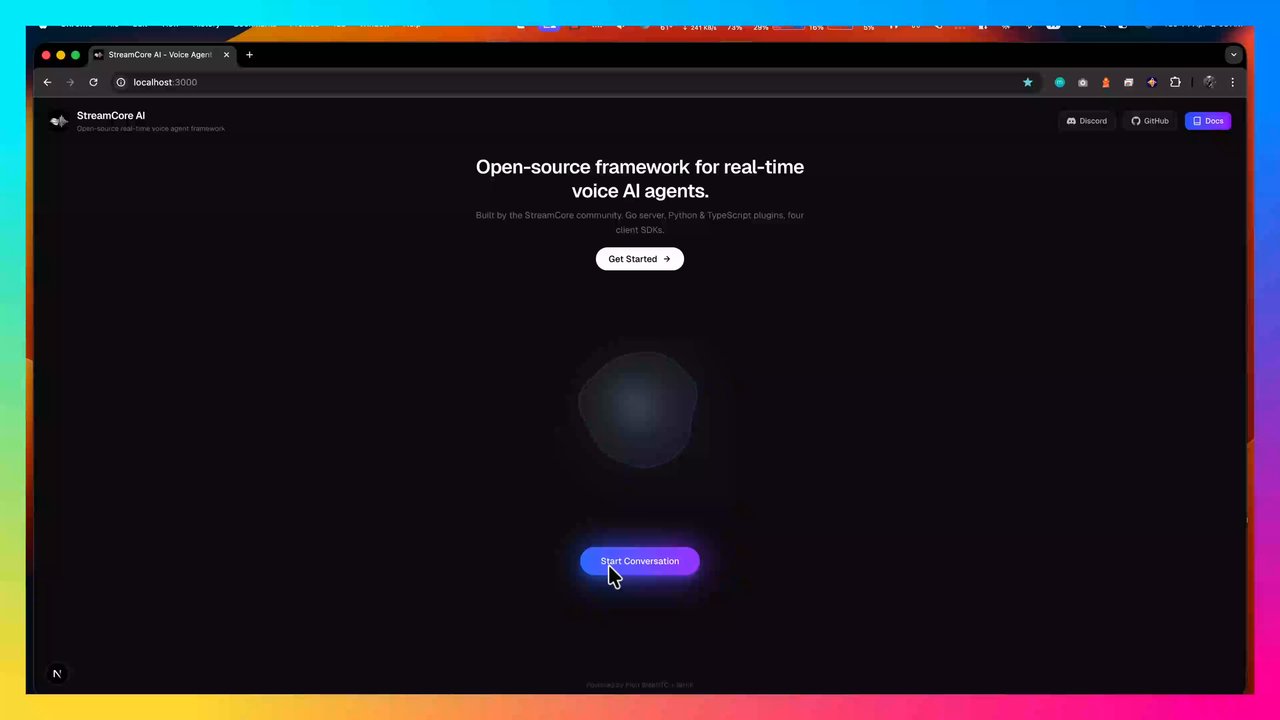
streamcore.ai runs this repo. Open it, hit Start Conversation, and interrupt the agent while it is talking. Per-turn STT, LLM, and TTS latency is on screen while you do it.
Prefer a recording? Watch the walkthrough.
Quick start
Two terminals, five minutes, and you are talking to it. Needs Go 1.25+ (or Docker) and API keys for an STT, LLM, and TTS provider. No keys? Run it fully local with Ollama + VibeVoice.
cp config.toml.example config.toml   # add your provider credentials
go run .
The server listens on :8080; clients connect to http://localhost:8080/whip.
Then talk to it from a browser:
git clone https://github.com/streamcoreai/examples.git
cd examples/typescript && npm install && npm run dev
Open http://localhost:3000 and start talking.
Docker, TURN ports, and production notes: Quick start guide.
What you get
| Transport | WebRTC audio over WHIP (RFC 9725) — one HTTP POST, no signaling socket. Opus/RTP both ways |
| Connectivity | Built-in Pion STUN/TURN on UDP and TCP 3478 — no external coturn. A network handover or NAT rebind is recovered by ICE restart on the same session, so the conversation survives it |
| Turn-taking | Adaptive VAD that tracks each call's noise floor, plus a debounce that merges mid-sentence pauses into one turn |
| Interruption | Barge-in that ducks agent audio, filters backchannels ("mm-hm"), and cancels in-flight LLM and TTS on a confirmed interrupt. On paths with no echo cancellation, such as telephony, the threshold is bounded by what the agent just sent so it never interrupts itself |
| Streaming | Streaming STT → streaming LLM → chunk-streaming TTS, so audio starts before synthesis finishes |
| Sessions & events | Server-generated session IDs, multi-peer sessions, DataChannel events for transcript, response, state, and per-turn latency |
| Reach | Browser, mobile, backend, CLI, SIP telephony, and ESP32 endpoints |
Full capability list: Capabilities.
Performance
We profile the server end to end the way a caller hears it: a harness dials in over WebRTC, speaks recorded sentences, and times the agent's audio as it arrives. Same machine and providers before and after (Deepgram nova-3, gpt-4o-mini, Cartesia sonic-3), one Go process for every call. Figures are p50 / p90.
| Before | Now | |
|---|---|---|
| End of speech → first audio, 3 calls | 2,611 / 2,917 ms | 1,562 / 1,830 ms |
| End of speech → first audio, 10 calls | 2,409 / 2,587 ms | 1,512 / 1,628 ms |
| End of speech → first audio, 20 calls | 2,598 / 3,138 ms | 1,417 / 1,570 ms |
| Slowest turn, 20 calls | 4,583 ms | 1,854 ms |
| Connect → greeting heard | 1,973 / 1,987 ms | 1,441 / 1,473 ms |
| "Stop." → agent silent | 975 ms | 818 ms |
| "Actually, tell me about…" → agent silent | 1,731 ms | 851 ms |
| Audio gaps over 200 ms, 20 calls | 5 | 0 |
| "Mm-hmm." while the agent talks | keeps talking | keeps talking |
With background conversation mixed under the caller (three other voices, no noise suppression):
| Background level | End of speech → first audio | Paused sentences answered twice | Turns taken from the room | |
|---|---|---|---|---|
| ~20 dB below the caller | Before | 3,982 / 5,945 ms | 5 of 9 | 11 |
| Now | 1,566 / 1,818 ms | 0 of 9 | 3 | |
| ~10 dB below the caller | Before | 3,496 / 5,309 ms | 7 of 9 | 45 |
| Now | 1,582 / 1,729 ms | 0 of 9 | 7 |
Each call costs about 16 MB of memory and 2% of one CPU core. Your numbers will vary with the providers' latency on the day, which accounts for most of each turn.
Not built yet
Listed so the table above stays honest — unticked items are real gaps today, not soon-shipping promises. Ticked ones shipped recently and stay listed for a release or two so you can see what moved:
- Session reconnection (server) — a dropped connection recovers on the same session via ICE restart, so the conversation and the running pipeline survive it
- Client-driven reconnection — the TypeScript, React Native, Go and Rust SDKs recover a network change automatically: ICE restart first, then a resume redial if the connection failed
- Session resume — a drop past the point ICE restart can help is recovered by redialling with a single-use token, reattaching to the running conversation. Every SDK runs restart-then-resume as one ladder, so a backgrounded phone rejoins the same conversation
- Panic recovery — a panic in one call's goroutines now ends that call alone: it recovers, logs the stack, and the session is reaped like any other ended call
- Session cap —
server.max_sessionsbounds live sessions globally; past it,POST /whipreturns 503 withRetry-After. Resumes are exempt - Env-var secrets — every API key and secret can come from the environment (
OPENAI_API_KEY,STREAMCORE_JWT_SECRET, …) instead ofconfig.toml. See Configuration - Metrics export —
/healthand timing events exist, no Prometheus/OpenTelemetry - Structured logging —
log.Printftext today, no JSON logs carryingsession_id - Versioned releases — a Docker image ships to GHCR on each GitHub release, but no version in the binary and no tagged standalone binaries yet
- Horizontal scaling — sessions live in process memory, so the server is single-node; reconnection and resume need sticky routing or an external store to work behind a load balancer
- HTTP agent endpoint —
llm.provider = "agent"POSTs each turn to an agent you host in any language; replies stream back as speech - Persistent memory — the built-in runtime forgets callers between sessions; BYO agents can already persist their own
Full TODO list, including ecosystem items: Roadmap / TODO. Want one of these? Say so in Discord — demand reorders the list.
Bring your own agent
StreamCore starts one layer below prompt-and-tool frameworks: the media path. Your intelligence stays yours, five ways —
- Tool call — plugins (Python/TS/JS) or native Go tools call into your existing backend
- Your agent — set
llm.provider = "agent"and each turn is POSTed to an HTTP endpoint you host, in any language - Your models — point
llm.provider = "ollama"at any Ollama-compatible URL you run - Your code — implement one small Go interface; the whole media path works unchanged
- Built in — or use StreamCore's optional agent runtime with tools, skills, RAG, and history
Details and code: Bring your own agent · Agent runtime.
Providers: Deepgram, AssemblyAI, OpenAI, Cartesia, ElevenLabs, MiniMax, Speechify, Telnyx, Ollama, Moonshine (local), VibeVoice (local), xAI Grok Voice (speech-to-speech), pgvector/Supabase for retrieval. See Providers.
OpenAI STT supports whisper-1, gpt-4o-transcribe, and gpt-4o-mini-transcribe through the independent openai.stt_model setting.
Telnyx STT fronts a dozen engines behind one key (telnyx.transcription_engine, default Deepgram so barge-in and live captions work out of the box); the in-house Telnyx engine is finals-only, so live captions show finals only and barge-in waits out the full backchannel window on VAD alone, and a startup log line says so.
Documentation
| Page | What's in it |
|---|---|
| Quick start | Docker, TURN ports, connecting a client, wiring your backend, fully-local setup |
| Capabilities | What the runtime does today, endpoints, AI integrations |
| Bring your own agent | Five ways to own the intelligence, including the HTTP agent endpoint and the llm.Client interface |
| Agent runtime | Plugins, skills, RAG, document ingestion |
| Developer agent | Optional GitHub App and Codex integrations: CI investigation, isolated worktrees, confirmation-gated pull requests |
| Providers | Grok speech-to-speech, MiniMax, local Moonshine and VibeVoice, per-provider caveats |
| Configuration | Full annotated config.toml reference |
| Protocol | WHIP signaling, DataChannel events, auth |
| Architecture | Media flow, why Go, package layout |
SDKs and examples
Connect from anywhere — every SDK speaks the same WHIP + DataChannel protocol:
React Native / Expo (@streamcore/react-native-sdk) is built but not yet published to npm.
Plugin SDKs: @streamcore/plugin and streamcore-plugin in plugin-sdk. Runnable browser, CLI, and TUI apps: examples.
Sponsors & Supporters
Thank you! Interested in sponsoring? Reach out for logo placement on GitHub + demo page.
Contributing
Read CONTRIBUTING.md first — it covers running the server locally, the four checks CI runs before you push, and the extra care the timing-sensitive media path needs. Good places to start: good first issue and help wanted.
Client SDKs, the SIP bridge, examples, and the ESP32 firmware live in their own repos under streamcoreai — send those changes there.
Security
Found a vulnerability? Don't open a public issue — report it privately through the Security tab. SECURITY.md covers scope, response targets, and the settings that matter on a public address — JWT auth on /whip above all.
Star history
License
Apache 2.0. See LICENSE.
Questions
What is streamcore-server?
streamcoreai/streamcore-server is a public repo on GitHub by streamcoreai. Open-source realtime voice agent server in Go with WebRTC (WHIP), barge-in, streaming STT/LLM/TTS pipelines, plugin system, multi-language SDKs, SIP telephony, ESP32 support & fully local mode.
Is streamcore-server open source?
It declares the Apache-2.0 license on GitHub.
Does streamcore-server run on macOS, Windows or Linux?
Its maker tagged it for macOS, Windows and Linux, or as Docker or cross-platform. That is declared by the maker; Take My Repo has not tested it.
How do I install streamcore-server?
Open "Take it" on its page: Take My Repo writes an install plan for your machine and hands it to your AI agent (Claude Code, Codex or Cursor), which asks you before each step. Take My Repo has not tested it on any machine.
Is streamcore-server still maintained?
Its last change on GitHub was on 2026-11-23. GitHub counts 17 open issues and pull requests. Take My Repo does not judge from that whether it is maintained.