

rtlamr
An rtl-sdr receiver for Itron ERT compatible smart meters operating in the 900MHz ISM band.
- 2.6k
- Go
- AGPL-3.0
- 4 d ago
FOSSIL (FOrtran Surfaces, Solids, Immersed boundaries and Level sets) is the geometry layer a simulation code needs, in pure modern Fortran with no C
Repo szaghi/FOSSIL, read from GitHub 4 d ago. szaghi has not joined Take My Repo.
szaghi/FOSSIL is a public repo on GitHub by szaghi. FOSSIL (FOrtran Surfaces, Solids, Immersed boundaries and Level sets) is the geometry layer a simulation code needs, in pure modern Fortran with no C. It declares no license on GitHub. Public does not mean open source: without a license, nobody is granted the right to reuse it. It is written mainly in Fortran, has 18 stars and last changed on 2026-11-16. Nobody has reviewed it on Take My Repo yet, which says nothing about its quality. Read from GitHub on 2026-11-18.
Geometry for simulation codes, in pure Fortran: surfaces and 2-D curves read, repaired, processed and measured; signed distances and level sets; immersed-boundary queries and AMR tagging; exact cut cells and their solver support; curvilinear blocks and overset assembly; body-fitted grids; moving bodies and collision; on the CPU or bit-exact on the GPU.
| 📂 STL in, STL out ASCII or binary, format detected, NaN and Inf rejected with a status; analyze gives the box, volume, centroid, connectivity, shells and bodies. First surface |
🩹 Repair dirty meshes sanitize removes slivers and duplicates, closes gaps and orients the normals outward; fill_holes patches and fairs the holes left. Repair |
🛠️ Geometry processing Exact booleans and self-intersections, decimation, isotropic remeshing, smoothing, alpha wrapping, marching cubes, segmentation. Processing and analysis |
|---|---|---|
| 🔬 Geometry analysis Mass properties, certified deviation and Hausdorff distance, feature edges, local thickness and gaps, curvature, named patches. Processing and analysis |
📏 Signed distance Closest facet on a SAH BVH, bit-exact against brute force; four sign algorithms, the fast winding number for surfaces with holes. Distance |
🌊 Level sets A signed-distance field on a stretched grid: exact narrow band, flood-fill signs, fast sweeping, an eikonal diagnostic. Distance fields |
| 〰️ 2-D curves Closed and open polylines for quadtree solvers, with the same queries as the surfaces; sections of any STL by a grid plane. Curves |
🎯 Immersed-boundary queries Per point: closest point, feature, pseudo-normal and body; image points and probes; wall distance with cutoff; wall curvature. IB queries |
🧭 AMR tagging Blocks and cells classified as cut, near, inside or outside from the tree alone; signed tag bands on a block. AMR tagging |
| 🧱 Exact cut cells Grid-line crossings decided by exact predicates; 2-D and 3-D fluid fractions, apertures and fluid pieces with their own volumes. Cut cells |
🧩 Cut-cell solver support Links between pieces, state- and flux-redistribution neighbourhoods, merge targets, moments, quadrature rules and coarse levels. Solver support |
🔄 Moving bodies Body-frame queries without a rebuild, an O(N) tree refit, and the swept geometry of a time step: exact swept volumes. Moving bodies |
| 💥 Collision detection Body-body distance with the closest pair; the time of first contact by conservative advancement, with no tunnelling; the first impact among many bodies. Contact |
🕸️ Structured blocks Curvilinear blocks: topology detection, certified cell validity, point location by tree or stencil walk, interpolation stencils, quality. Blocks and overset |
🔗 Overset assembly Holes by winding number, hole map or X-rays; donor candidates with their quality; explicit or implicit classification, orphans by cause, connectivity. Blocks and overset |
| 📐 Body-fitted grids Projection constrained to patches, feature curves and corners; 2-D hyperbolic extrusion; a wall-spacing and quality report with y1+. Body-fitted grids |
🚀 On the GPU, bit for bit OpenACC kernels shared with the CPU path: distances, rich queries, tagging and posed queries equal the CPU results bit for bit. GPU |
🆓 Free and portable Pure Fortran 2003+, no C; gfortran, ifx, nvfortran; FoBiS or fpm; GPLv3, BSD or MIT. Installation |
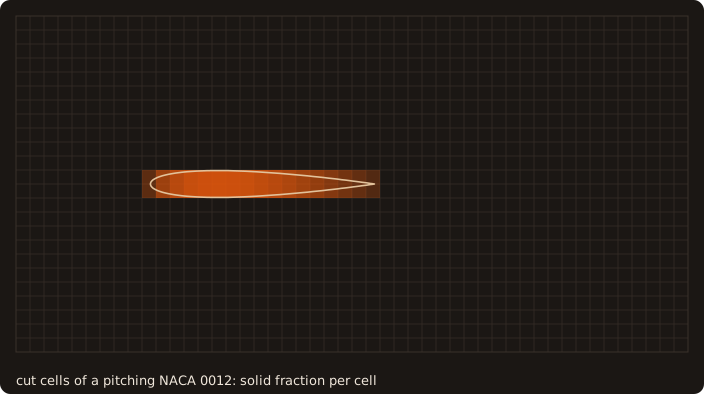
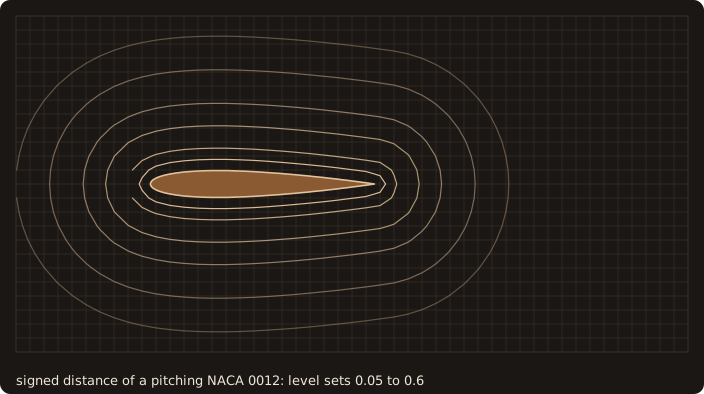
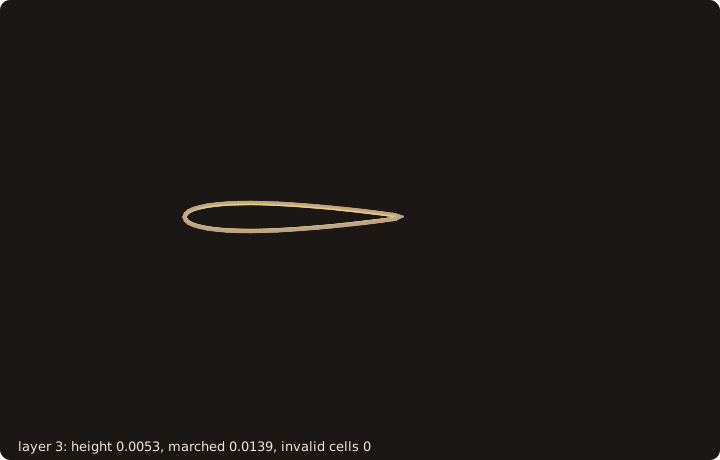
A NACA 0012 section pitching and translating through a Cartesian grid, every frame computed by FOSSIL: its exact cut cells and the level sets of its signed distance, with the pose passed to the query instead of rebuilding the tree.
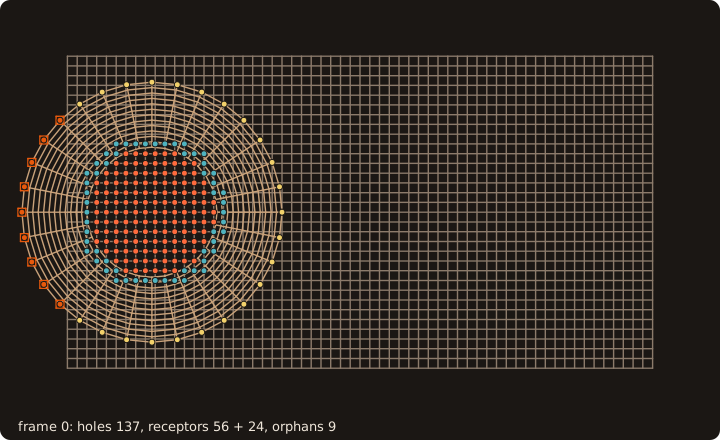
Grids around bodies: an overset assembly recomputed as the cylinder's O-grid moves through the background, with the orphans that appear where it leaves it, and a body-fitted O-grid marched out of the section by hyperbolic extrusion.
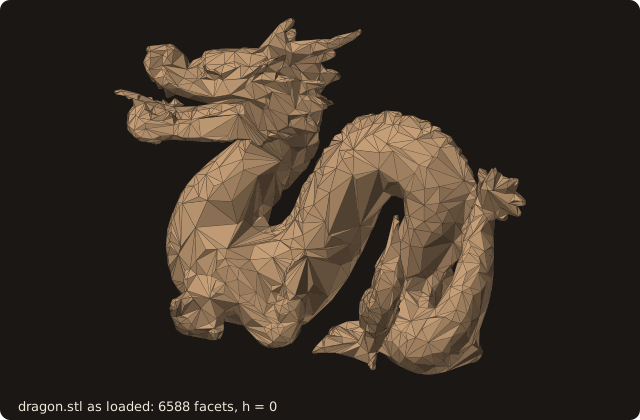
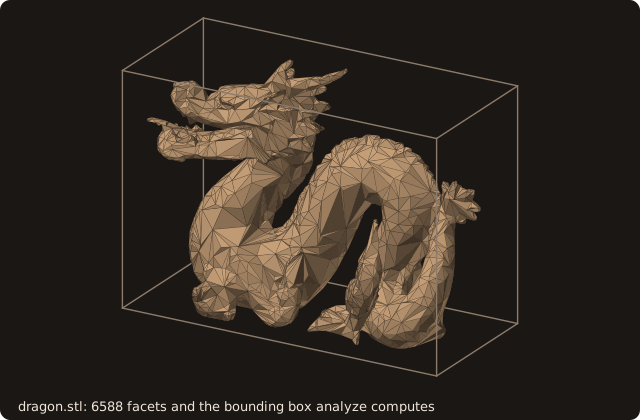 STL in, STL out the dragon loaded, 6588 facets, and the box analyze computes |
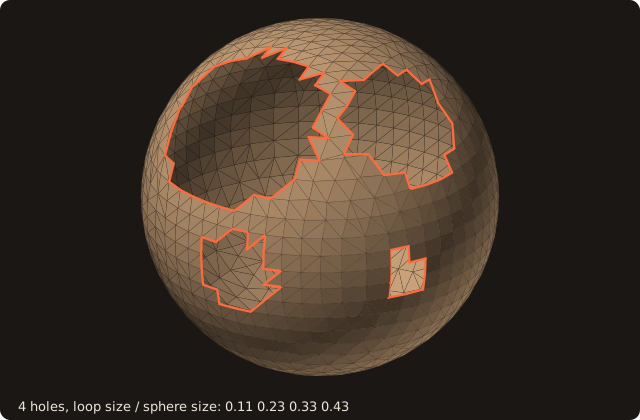 Repair dirty meshes holes closed one by one by fill_holes, refined and faired |
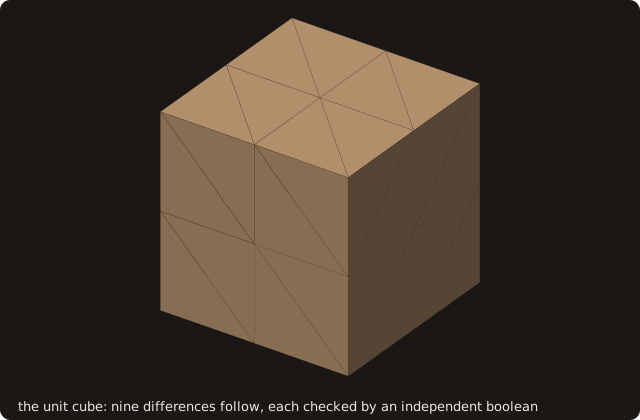 Geometry processing a block drilled nine times, each step checked by an independent boolean |
 Geometry analysis a decimation sweep coloured by its certified distance from the original |
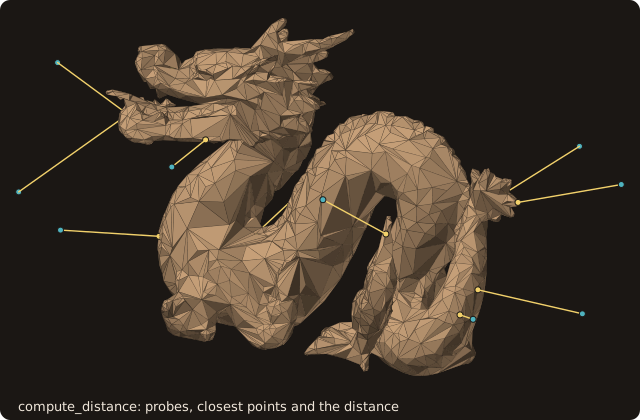 Signed distance probes and their closest points on the dragon |
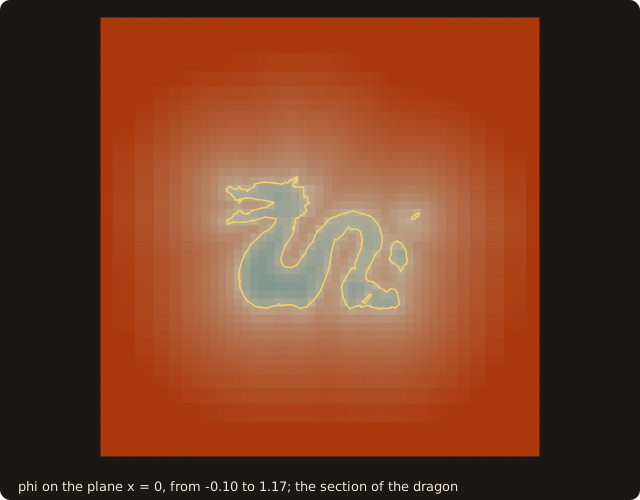 Level sets the signed-distance field on a stretched grid |
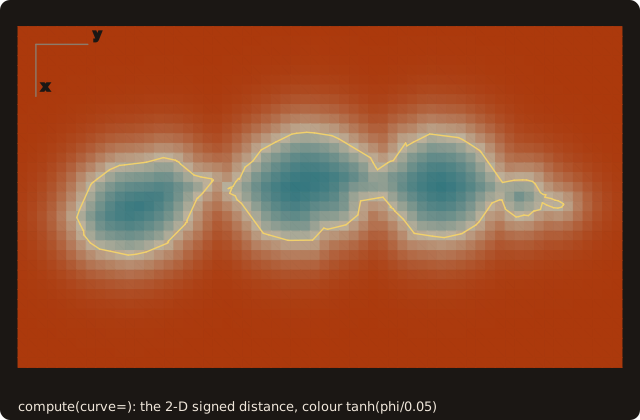 2-D curves a section of the dragon and its 2-D signed distance |
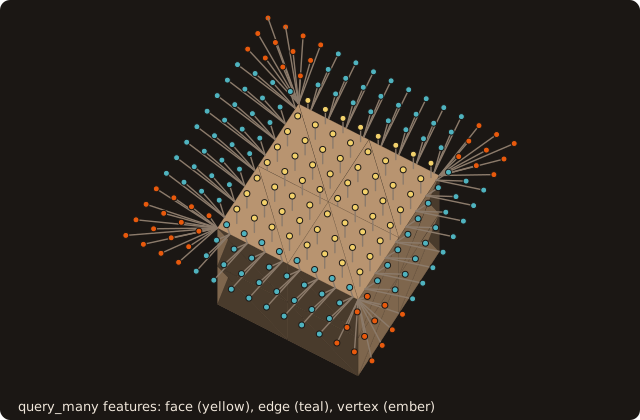 Immersed-boundary queries closest points on a face, an edge or a vertex |
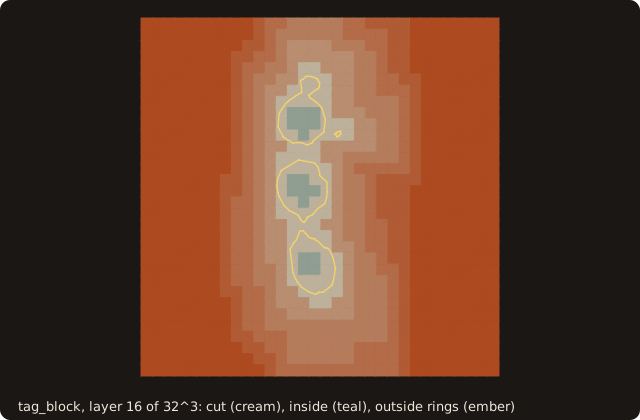 AMR tagging cut, inside and outside cells of a block, in signed bands |
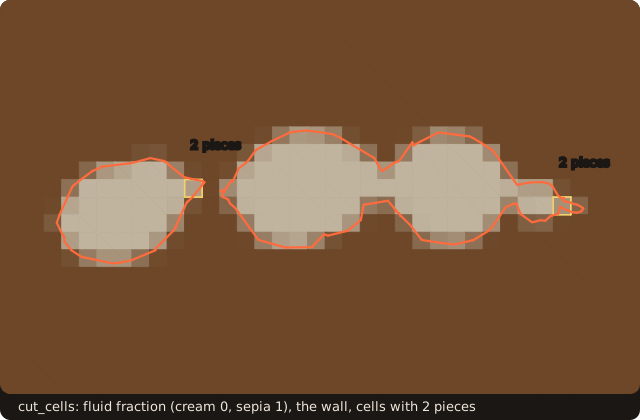 Exact cut cells the fluid fraction of the cut cells of a section |
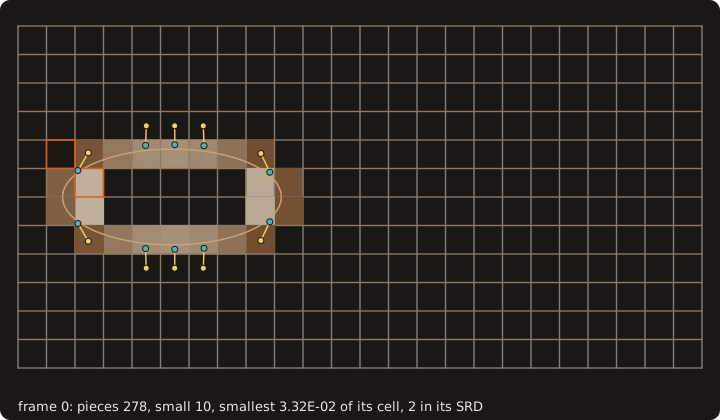 Cut-cell solver support the small pieces of a moving ellipse and their merge targets, every frame |
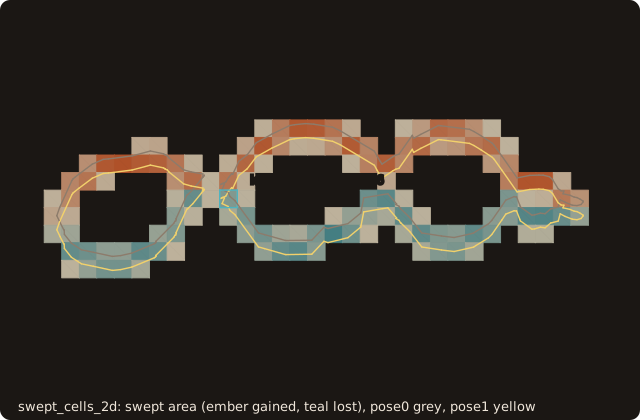 Moving bodies the area a moving section sweeps in a time step |
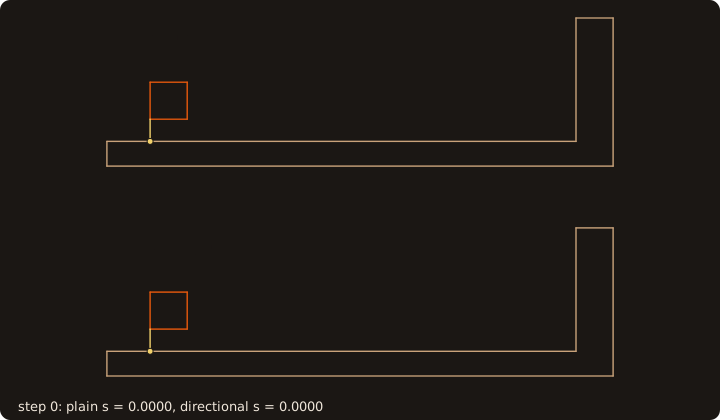 Collision detection conservative advancement to the time of impact: plain bound, 25 steps; directional, 5 |
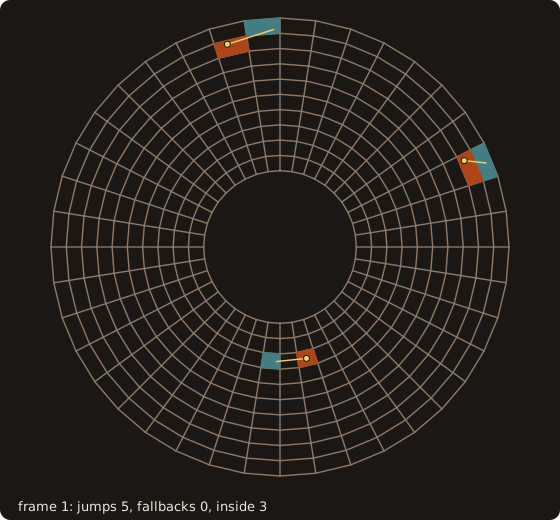 Structured blocks points tracked through an O-grid by stencil walks, across its seam |
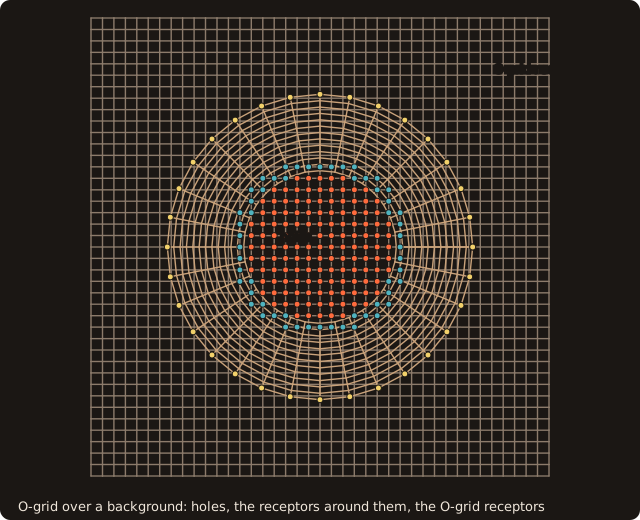 Overset assembly an O-grid over a background: the holes, the receptors around them, the O-grid's receptors |
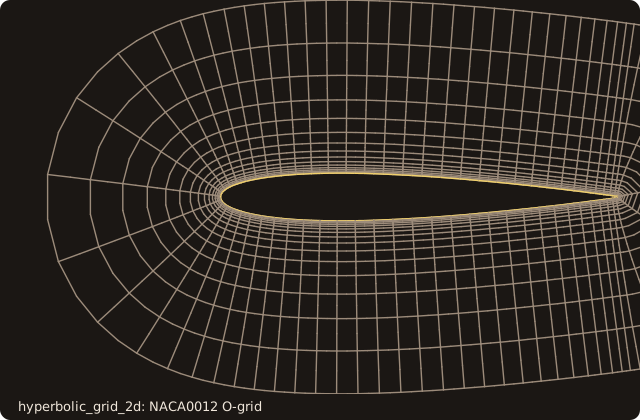 Body-fitted grids an O-grid marched out of a NACA 0012 section by hyperbolic extrusion |
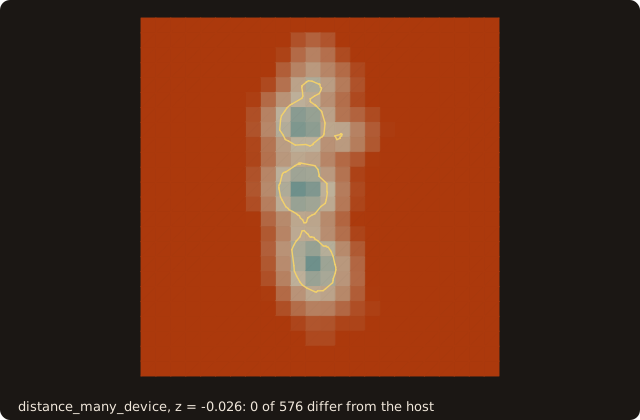 On the GPU, bit for bit the device code path on a slice: 0 differences from the host |
 Free and portable the tutorial programs, run one after the other |
Documentation
The tutorial, the cookbook and the reference are on the FOSSIL website. Every code sample there is a program compiled and run to produce the output shown.
Stefano Zaghi · stefano.zaghi@cnr.it
Chief Yak Shaver, Accidental Research Scientist, and HPC Farmer — CFD researcher who decided that one more day debugging Fortran build systems was one day too many, opened a Python REPL "just to prototype," and now finds himself maintaining a meshing library, a chimera assembler, an MPI load balancer, and the seven blog tabs he keeps meaning to read.
Claude (Anthropic)
Omniscient Code Oracle & Tireless Rubber Duck — AI pair programmer, responsible for writing the boring parts so humans don't have to.
Contributions are welcome — see the Contributing page.
This project is distributed under a multi-licensing system:
Anyone interested in using, developing, or contributing to this project is welcome — pick the license that best fits your needs.
use fossil
use penf, only: R8P
use vecfor, only: ex_R8P
implicit none
type(surface_stl_object) :: surface
real(R8P)                :: d

! Load (ASCII or binary, auto-detected) and run the full repair pipeline.
call surface%load_from_file(file_name='cube.stl', guess_format=.true.)
call surface%sanitize           ! degenerate / duplicate / non-manifold / winding
print '(A)', surface%statistics()

! Signed distance from a point — uses SAH BVH + pseudo-normal sign by default.
d = surface%distance(point=2.0_R8P * ex_R8P, is_signed=.true., is_square_root=.true.)
print '(A,ES12.5)', 'signed distance = ', d

call surface%translate(x=1.0_R8P, y=2.0_R8P, z=0.5_R8P)
call surface%save_into_file(file_name='cube-moved.stl')
See src/tests/ for more examples including clipping, distance queries, and validity predicates (is_watertight, is_manifold, is_volume).
For interactive use without writing Fortran, the companion fossilizer CLI (src/app/fossilizer.f90) wraps the library for command-line STL analysis and manipulation.
Upgrading from 2.x: see Upgrading to 3.0 for the changes in behaviour.
curl -fsSL https://github.com/szaghi/FOSSIL/releases/latest/download/install.sh | bash
It installs the latest release into ~/.local with the build system you choose among those FOSSIL ships
(--build fobis|fpm: a menu asks when you do not say), the compiler you name (--fc, --gnu, --intel,
--nvidia), one install per compiler (lib/fossil/<compiler>-<version>/, include/fossil/<compiler>-<version>/), and
makes it usable through pkg-config (pkg-config --cflags --libs fossil, with PKG_CONFIG_PATH=$HOME/.local/lib/pkgconfig).
The release carries FOSSIL's dependencies (BeFoR64, FACE, FLAP, FoXy, PENF, StringiFor, VTKFortran, VecFor). Pass
options after bash -s --, e.g. ... | bash -s -- --build fpm --prefix /opt/fossil; --help lists them all,
--uninstall removes the install. The installer is FoBiS's
(One-line installer).
Standalone — clone, fetch the dependencies into src/third_party/, and build:
git clone https://github.com/szaghi/FOSSIL && cd FOSSIL
fobis fetch                     # fetch the fobos [dependencies]
fobis build --mode static-gnu   # build static library
fobis build --mode tests-gnu && ./scripts/run_tests.sh  # build and run tests
As a project dependency — declare FOSSIL in your fobos and run fetch:
[dependencies]
deps_dir = src/third_party
FOSSIL = https://github.com/szaghi/FOSSIL
fobis fetch              # fetch and build
fobis fetch --update     # re-fetch and rebuild
git clone https://github.com/szaghi/FOSSIL && cd FOSSIL
fpm build --profile release     # fpm resolves the dependencies from fpm.toml
As an fpm dependency:
[dependencies]
FOSSIL = { git = "https://github.com/szaghi/FOSSIL.git" }
FOSSIL ships no CMake or Make build files.
szaghi/FOSSIL is a public repo on GitHub by szaghi. FOSSIL (FOrtran Surfaces, Solids, Immersed boundaries and Level sets) is the geometry layer a simulation code needs, in pure modern Fortran with no C.
It declares no license on GitHub. Public does not mean open source: without a license, nobody is granted the right to reuse it.
Its maker has not tagged a system, so it is unknown here. Its README says what it needs.
Open "Take it" on its page: Take My Repo writes an install plan for your machine and hands it to your AI agent (Claude Code, Codex or Cursor), which asks you before each step. Take My Repo has not tested it on any machine.
Its last change on GitHub was on 2026-11-16. Take My Repo does not judge from that whether it is maintained.
Nobody has reviewed it on Take My Repo yet, which says nothing about its quality.
An rtl-sdr receiver for Itron ERT compatible smart meters operating in the 900MHz ISM band.
Chimera: Pre-configured Desktop Utility Suite with Full Installer
📗 SheetJS Spreadsheet Data Toolkit -- New home https://git.sheetjs.com/SheetJS/sheetjs
Multiphysics Object Oriented Simulation Environment: A robust, modern, extendable, finite element/finite volume framework that excels at creating complex multiphysics simulations.
IMEI Repair 2026: Standalone Installer and Complete Setup for Device Repair Solutions
Fortran Object-Oriented Differential-equations Integration Environment, FOODIE


