WhyHaskellMatters
In this article I try to explain why Haskell keeps being such an important language by presenting some of its most important and distinguishing features and detailing them with working code examples. The presentation aims to be self-contained and does not require any previous knowledge of the language.
- 480
- Apache-2.0
- 3 y ago
Repo thma/WhyHaskellMatters, read from GitHub 9 min ago. thma has not joined Take My Repo.
In short
thma/WhyHaskellMatters is a public repo on GitHub by thma. In this article I try to explain why Haskell keeps being such an important language by presenting some of its most important and distinguishing features and detailing them with working code examples. The presentation aims to be self-contained and does not require any previous knowledge of the language. It declares the Apache-2.0 license on GitHub. It is written mainly in Haskell, has 480 stars and last changed on 2023-12-15. Nobody has reviewed it on Take My Repo yet, which says nothing about its quality. Read from GitHub on 2026-11-25.
Similar repos

Why Haskell Matters
Haskell doesn't solve different problems than other languages. But it solves them differently.
-- unknown
Abstract
In this article I try to explain why Haskell keeps being such an important language by presenting some of its most important and distinguishing features and detailing them with working code examples.
The presentation aims to be self-contained and does not require any previous knowledge of the language.
The target audience are Haskell freshmen and developers with a background in non-functional languages who are eager to learn about concepts of functional programming and Haskell in particular.
Table of contents
- Introduction
- Functions are first class
- Pattern matching
- Algebraic Data Types
- Polymorphic Data Types
- Immutability
- Declarative programming
- Non-strict Evaluation
- Type Classes
- Conclusion
Introduction
Exactly thirty years ago, on April 1st 1990, a small group of researchers in the field of non-strict functional programming published the original Haskell language report.
Haskell never became one of the most popular languages in the software industry or part of the mainstream, but it has been and still is quite influential in the software development community.
In this article I try to explain why Haskell keeps being such an important language by presenting some of its most distinguishing features and detailing them with working code examples.
The presentation aims to be self-contained and does not require any previous knowledge of the language. I will also try to keep the learning curve moderate and to limit the scope of the presentation; nevertheless this article is by no means a complete introduction to the language.
(If you are looking for thorough tutorials have a look at Haskell Wikibook or Learn You a Haskell
Before diving directly into the technical details I'd like to first have a closer look on the reception of Haskell in the software developers community:
A strange development over time
In a talk in 2017 on the Haskell journey since its beginnings in the 1980ies Simon Peyton Jones speaks about the rather unusual life story of Haskell.
First he talks about the typical life cycle of research languages. They are often created by a single researcher (who is also the single user), and most of them will be abandoned after just a few years.
A more successful research language might gain some interest in a larger community but will still not escape the ivory tower and typically will be given up within ten years.
On the other hand we have all those popular programming languages that are quickly adopted by large numbers of developers and thus reach "the threshold of immortality". That is the base of existing code will grow so large that the language will be in use for decades.
A little jokingly he then depicts the sad fate of languages designed by committees by flat line through zero: They simply never take off.
Finally, he presents a chart showing the Haskell timeline:
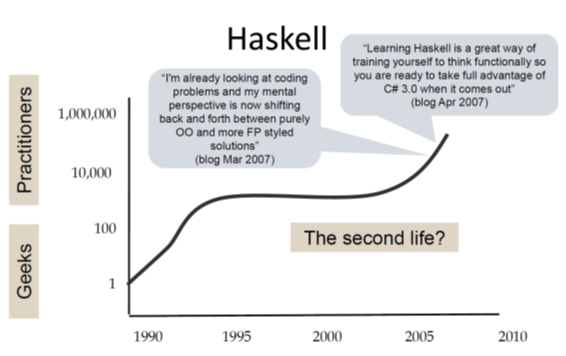
The development shown in this chart seems rather unexpected: Haskell started as a research language and was even designed by a committee; so in all probability it should have been abandoned long before the millennium!
Instead, it gained some momentum in its early years followed by a rather quiet phase during the decade of OO hype (Java being released in 1995). And then again we see a continuous growth of interest since about 2005. I'm writing this in early 2020, and we still see this trend!
Being used versus being discussed
Then Simon Peyton Jones points out another interesting characteristic of the reception of Haskell in recent years: In statistics that rank programming languages by actual usage Haskell is typically not under the 30 most active languages. But in statistics that instead rank languages by the volume of discussions on the internet Haskell typically scores much better (often in the top ten).
So why does Haskell keep being a hot topic in the software development community?
A very short answer might be: Haskell has a number of features that are clearly different from those of most other programming languages. Many of these features have proven to be powerful tools to solve basic problems of software development elegantly.
Therefore, over time other programming languages have adopted parts of these concepts (e.g. pattern matching or type classes). In discussions about such concepts the Haskell heritage is mentioned and differences between the original Haskell concepts and those of other languages are discussed. Sometimes people feel encouraged to have a closer look at the source of these concepts to get a deeper understanding of their original intentions. That's why we see a growing number of developers working in Python, Typescript, Scala, Rust, C++, C# or Java starting to dive into Haskell.
A further essential point is that Haskell is still an experimental laboratory for research in areas such as compiler construction, programming language design, theorem-provers, type systems etc. So inevitably Haskell will be a topic in the discussion about these approaches.
In the following sections we will try to find the longer answer by studying some of the most distinguishing features of Haskell.
Functions are First-class
In computer science, a programming language is said to have first-class functions if it treats functions as first-class citizens. This means the language supports passing functions as arguments to other functions, returning them as the values from other functions, and assigning them to variables or storing them in data structures.[1] Some programming language theorists require support for anonymous functions (function literals) as well.[2] In languages with first-class functions, the names of functions do not have any special status; they are treated like ordinary variables with a function type.
quoted from Wikipedia
We'll go through this one by one:
Functions can be assigned to variables exactly as any other values
Let's have a look how this looks like in Haskell. First we define some simple values:
-- define constant `aNumber` with a value of 42.
aNumber :: Integer
aNumber = 42

-- define constant `aString` with a value of "hello world"
aString :: String
aString = "Hello World"
In the first line we see a type signature that defines the constant aNumber to be of type Integer.
In the second line we define the value of aNumber to be 42.
In the same way we define the constant aString to be of type String.
Haskell is a statically typed language: all type checks happen at compile time. Static typing has the advantage that type errors don't happen at runtime. This is especially useful if a function signature is changed and this change affects many dependent parts of a project: the compiler will detect the breaking changes at all affected places.
The Haskell Compiler also provides type inference, which allows the compiler to deduce the concrete data type of an expression from the context. Thus, it is usually not required to provide type declarations. Nevertheless, using explicit type signatures is considered good style as they are an important element of a comprehensive documentation.
Next we define a function square that takes an integer argument and returns the square value of the argument:
square :: Integer -> Integer
square x = x * x
Definition of a function works exactly in the same way as the definition of any other value.
The only thing special is that we declare the type to be a function type by using the -> notation.
So :: Integer -> Integer represents a function from Integer to Integer.
In the second line we define function square to compute x * x for any Integer argument x.
Ok, seems not too difficult, so let's define another function double that doubles its input value:
double :: Integer -> Integer
double n = 2 * n
Support for anonymous functions
Anonymous functions, also known as lambda expressions, can be defined in Haskell like this:
\x -> x * x
This expression denotes an anonymous function that takes a single argument x and returns the square of that argument. The backslash is read as λ (the greek letter lambda).
You can use such as expressions everywhere where you would use any other function. For example you could apply the
anonymous function \x -> x * x to a number just like the named function square:
-- use named function:
result = square 5

-- use anonymous function:
result' = (\x -> x * x) 5
We will see more useful applications of anonymous functions in the following section.
Functions can be returned as values from other functions
Function composition
Do you remember function composition from your high-school math classes?
Function composition is an operation that takes two functions f and g and produces a function h such that
h(x) = g(f(x))
The resulting composite function is denoted h = g ∘ f where (g ∘ f )(x) = g(f(x)).
Intuitively, composing functions is a chaining process in which the output of function f is used as input of function g.
So looking from a programmers perspective the ∘ operator is a function that
takes two functions as arguments and returns a new composite function.
In Haskell this operator is represented as the dot operator .:
(.) :: (b -> c) -> (a -> b) -> a -> c
(.) f g x = f (g x)
The brackets around the dot are required as we want to use a non-alphabetical symbol as an identifier.
In Haskell such identifiers can be used as infix operators (as we will see below).
Otherwise (.) is defined as any other function.
Please also note how close the syntax is to the original mathematical definition.
Using this operator we can easily create a composite function that first doubles a number and then computes the square of that doubled number:
squareAfterDouble :: Integer -> Integer
squareAfterDouble = square . double
Currying and Partial Application
In this section we look at another interesting example of functions producing
other functions as return values.
We start by defining a function add that takes two Integer arguments and computes their sum:
-- function adding two numbers
add :: Integer -> Integer -> Integer
add x y = x + y
This look quite straightforward. But still there is one interesting detail to note:
the type signature of add is not something like
add :: (Integer, Integer) -> Integer
Instead it is:
add :: Integer -> Integer -> Integer
What does this signature actually mean?
It can be read as "A function taking an Integer argument and returning a function of type Integer -> Integer".
Sounds weird? But that's exactly what Haskell does internally.
So if we call add 2 3 first add is applied to 2 which return a new function of type Integer -> Integer which is then applied to 3.
This technique is called Currying
Currying is widely used in Haskell as it allows another cool thing: partial application.
In the next code snippet we define a function add5 by partially applying the function add to only one argument:
-- partial application: applying add to 5 returns a function of type Integer -> Integer
add5 :: Integer -> Integer
add5 = add 5
The trick is as follows: add 5 returns a function of type Integer -> Integer which will add 5 to any Integer argument.
Questions
What is WhyHaskellMatters?
thma/WhyHaskellMatters is a public repo on GitHub by thma. In this article I try to explain why Haskell keeps being such an important language by presenting some of its most important and distinguishing features and detailing them with working code examples. The presentation aims to be self-contained and does not require any previous knowledge of the language.
Is WhyHaskellMatters open source?
It declares the Apache-2.0 license on GitHub.