

MonitorControl
🖥 Control your display's brightness & volume on your Mac as if it was a native Apple Display. Use Apple Keyboard keys or custom shortcuts. Shows the native macOS OSDs.
- 35k
- Swift
- MIT
- 5 wk ago
Proximal Policy Optimization (PPO) written in C++ with PyTorch (LibTorch)
Repo thowell/ppo.cpp, read from GitHub 1 min ago. thowell has not joined Take My Repo.
thowell/ppo.cpp is a public repo on GitHub by thowell. Proximal Policy Optimization (PPO) written in C++ with PyTorch (LibTorch). It declares the MIT license on GitHub. It is written mainly in C++, has 17 stars and last changed on 2024-07-21. Nobody has reviewed it on Take My Repo yet, which says nothing about its quality. Read from GitHub on 2026-11-20.
Proximal Policy Optimization (PPO) written in C++.
Collect simulated experience with multi-threaded batch environments implemented in C++ and train policy + value function with PyTorch C++ (LibTorch).
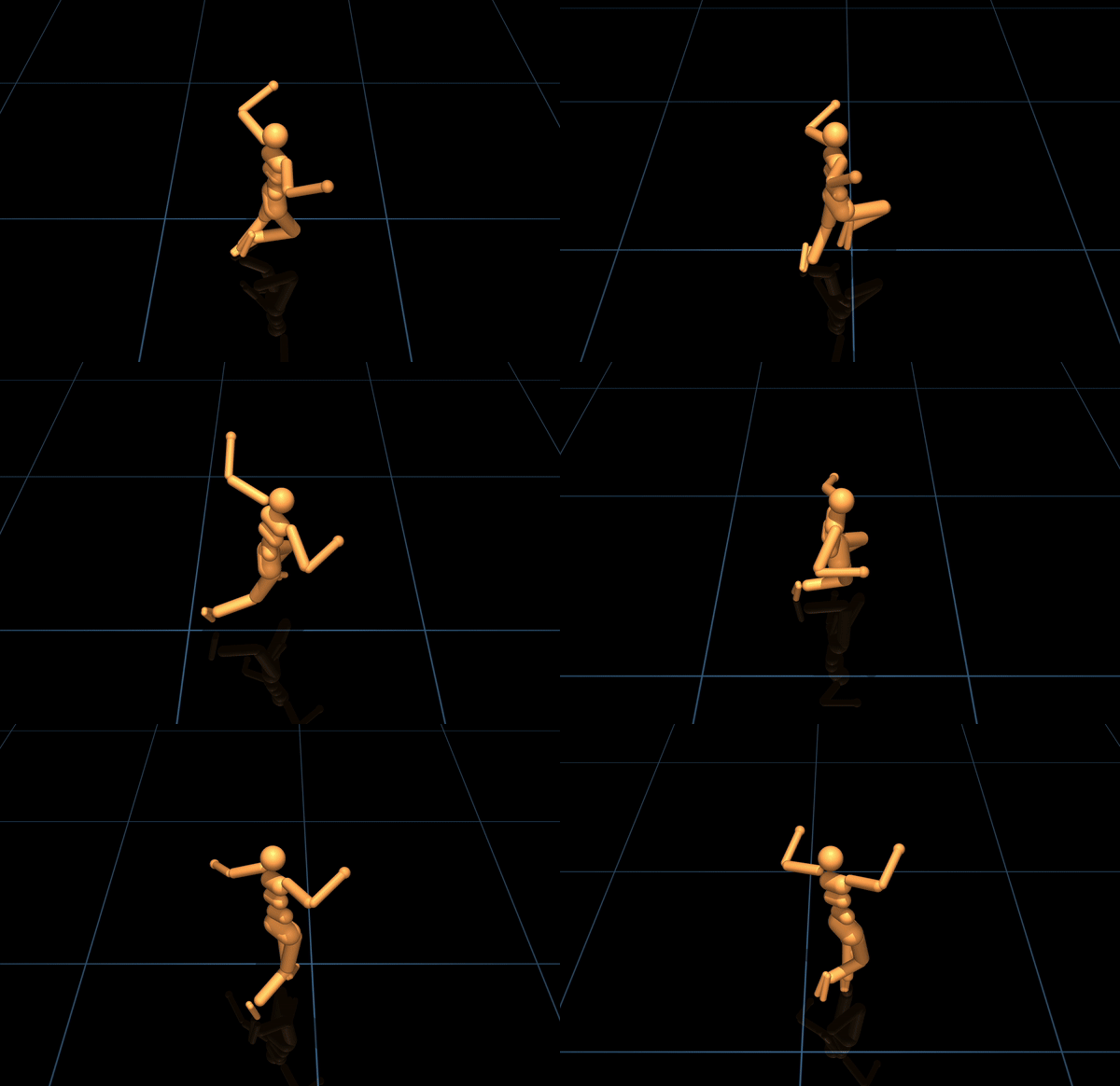
Train humanoid locomotion behavior in ~10 minutes (reward $\approx$ 5000) using 20 threads with Intel Core i9-14900K CPU to collect simulated experience from MuJoCo (C) and Nvidia RTX 4090 to train a neural network policy and value function with PyTorch (LibTorch) on Ubuntu 22.04.4 LTS.

From the build/ directory, run:
./run --env humanoid --train --visualize --checkpoint humanoid --device {cpu|cuda|mps}The saved policy can be visualized:
./run --env humanoid --load humanoid_{x}_{y} --visualize --device {cpu|cuda|mps}Visualize pretrained policy (requires Apple ARM CPU):
./run --env humanoid --load pretrained/humanoid_apple_arm --visualize --device cpu
ppo.cpp should work with Ubuntu and macOS.
Dependencies: abseil, libtorch, mujoco
Operating system specific dependencies:
Install Xcode.
Install ninja:
brew install ninja
sudo apt-get update && sudo apt-get install cmake libgl1-mesa-dev libxinerama-dev libxcursor-dev libxrandr-dev libxi-dev ninja-build clang-12git clone https://github.com/thowell/ppo.cpp
LibTorch (ie PyTorch C++) should automatically be installed by CMake. Manual installation can be performed (perform steps 1 and 2 below to create a /build directory first):
Install LibTorch 2.3.1 download and extract to ppo.cpp/build.
If you encounter warnings for malicious software for Torch: System Settings -> Security & Privacy -> Allow
You might also need to:
brew install libomp
install_name_tool -add_rpath /opt/homebrew/opt/libomp/lib PATH_TO/ppo.cpp/libtorch/lib/libtorch_cpu.dylib
Install LibTorch CUDA 12.1 2.3.1 download and extract to ppo.cpp/build
cd ppo.cppmkdir build
cd buildcmake .. -DCMAKE_BUILD_TYPE:STRING=Release -G Ninja
cmake .. -DCMAKE_BUILD_TYPE:STRING=Release -G Ninja -DCMAKE_C_COMPILER:STRING=clang-12 -DCMAKE_CXX_COMPILER:STRING=clang++-12
cmake --build . --config=ReleaseVSCode and 2 of its extensions (CMake Tools and C/C++) can simplify the build process.
ppo.cpp.clang-12.ppo target in "release" mode (VSCode defaults to
"debug").Setup:
--env: humanoid--train: train policy and value function with PPO--checkpoint: filename in checkpoint/ to save policy--load: provide string in checkpoint/
directory to load policy from checkpoint--visualize: visualize policyHardware settings:
--num_threads: number of threads/workers for collecting simulation experience [default: 20]--device: learning device [default: cpu, cuda, mps]--device_sim: simulation device [default: cpu, cuda, mps]--device_type: data type for device [default: float]--device_sim_type: data type for device_sim [default: double]PPO settings:
--num_envs: number of parallel learning environments for collecting simulation experience--num_steps: number of environment steps for each environment used for learning--minibatch_size: size of minibatch--learning_rate: initial learning rate for policy and value function optimizer--max_env_steps: total number of environment steps to collect--anneal_lr: flag to anneal learning rate--kl_threshold: maximum KL divergence between old and new policies--gamma: discount factor for rewards--gae_lambda: factor for Generalized Advantage Estimation--update_epochs: number of iterations complete batch of experience is used to improve policy and value function--norm_adv: flag for normalizing advantages--clip_coef: value for PPO clip parameter--clip_vloss: flag for clipping value function loss--ent_coef: weight for entropy loss--vf_coef: weight for value function loss--max_grad_norm: maximum value for global L2-norm of parameter gradients--optimizer_eps: epsilson value for Adam optimizer--normalize_observation: normalize observations with running statistics--normalize_reward: normalize rewards with running statisticsEvaluation settings:
--num_eval_envs: number of environments for evaluating policy performance--max_eval_steps: number of simulation steps (per environment) for evaluating policy performance--num_iter_per_eval: number of iterations per policy evaluationThis repository was developed to:
MuJoCo models use resources from IsaacGym environments, MuJoCo Menagerie, MJX Tutorial, and dm_control
PPO implementation is based on cleanrl: ppo_continuous_action.py.
thowell/ppo.cpp is a public repo on GitHub by thowell. Proximal Policy Optimization (PPO) written in C++ with PyTorch (LibTorch).
It declares the MIT license on GitHub.
Its maker has not tagged a system, so it is unknown here. Its README says what it needs.
Open "Take it" on its page: Take My Repo writes an install plan for your machine and hands it to your AI agent (Claude Code, Codex or Cursor), which asks you before each step. Take My Repo has not tested it on any machine.
Its last change on GitHub was on 2024-07-21. Take My Repo does not judge from that whether it is maintained.
Nobody has reviewed it on Take My Repo yet, which says nothing about its quality.
🖥 Control your display's brightness & volume on your Mac as if it was a native Apple Display. Use Apple Keyboard keys or custom shortcuts. Shows the native macOS OSDs.
Reverse engineer anything with agents, from app behavior down to native binaries.
Algorithm and model experiments for robot motion planning. Implemented in Julia.
Implementation and examples from Trajectory Optimization with Optimization-Based Dynamics https://arxiv.org/abs/2109.04928
A Julia package for constrained trajectory optimization using direct methods.