deep-active-inference-mc
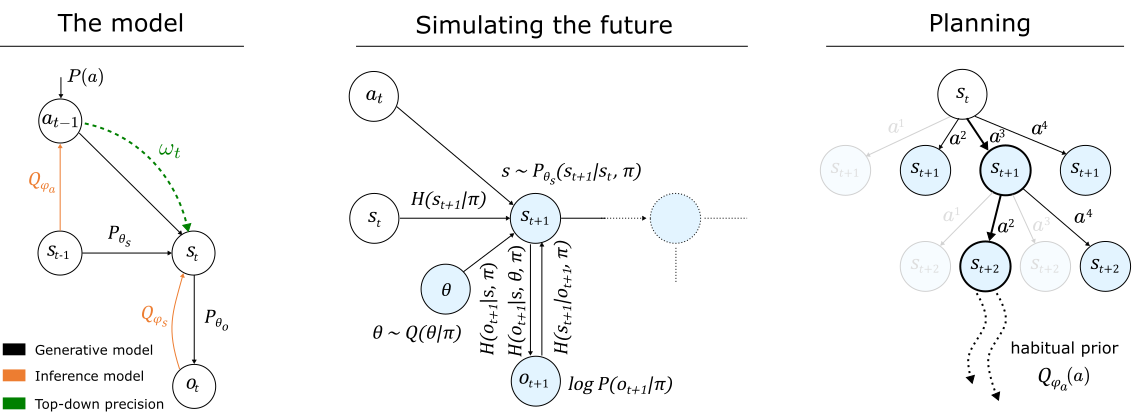
Deep active inference agents using Monte-Carlo methods
- 102
- Python
- GPL-3.0
- 17 mo ago
Deep active inference agents using Monte-Carlo methods
Transcripts, metadata, captions, and translations from the Active Inference Institute's video library — a structured, source-namespaced dataset generated by Journal-Utilities.
Unofficial repo for materials and code related to "Fundamentals of Active Inference" (Namjoshi 2026).
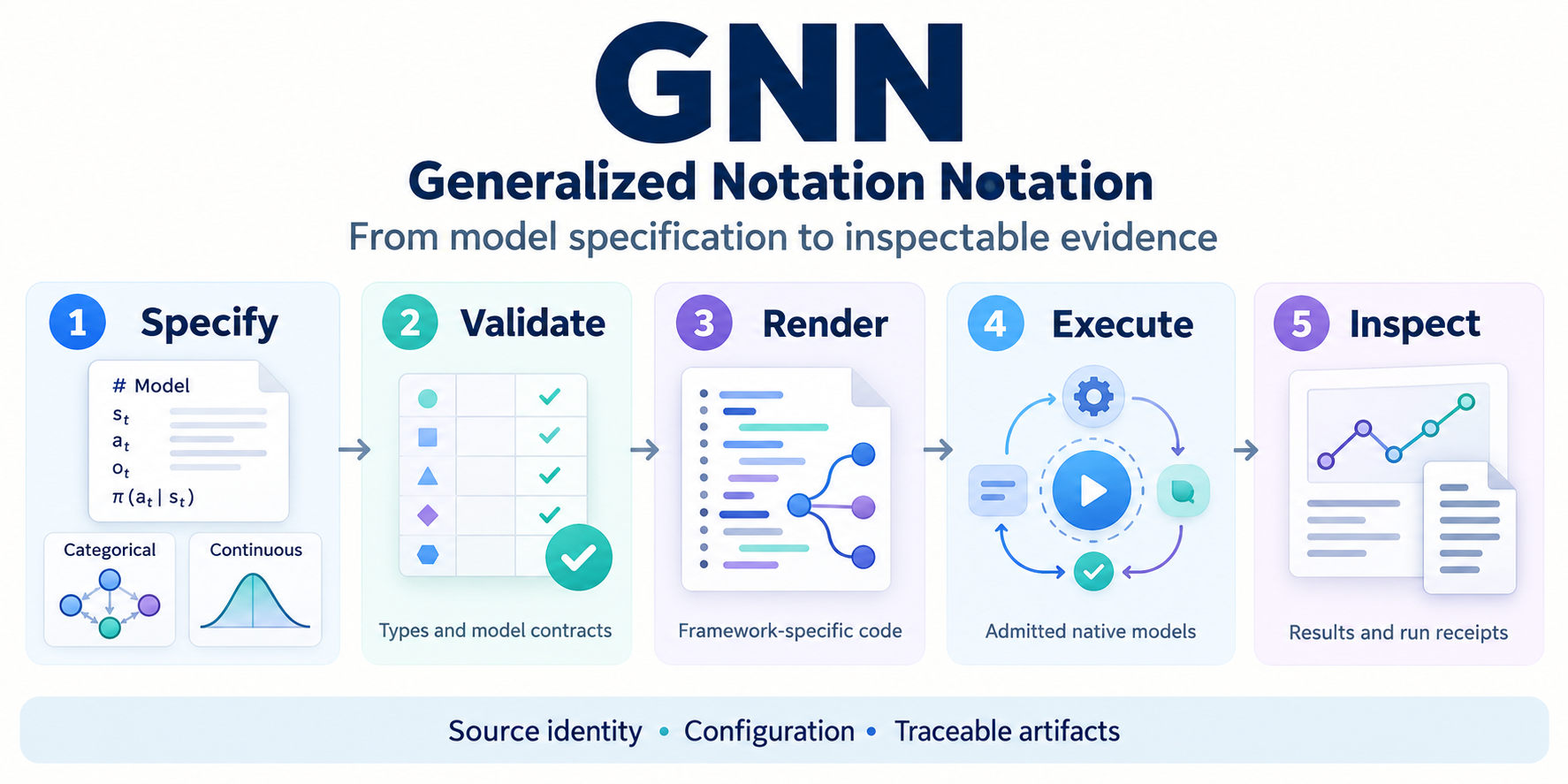
Methods for specifying, checking, typing, rendering, executing, analyzing, and visualizing state space models, for Active Inference and Beyond.
CPU-oriented Python library for discrete Active Inference experiments in radCAD and cadCAD: deterministic grid worlds, multi-agent transitions, generative-model helpers, and fail-closed validation.
Multi-language Active Inference framework combining ant-colony-optimization-inspired multi-agent simulation with variational message passing, implemented across 50 programming languages for research and benchmarking.
Knowledge base and Python package for discrete and continuous Active Inference: generative models, expected free energy, POMDP simulation, and an executable manuscript with reproducible validation commands.
GEO-INFER — a 45-module geospatial inference monorepo from the Active Inference Institute. Spatial analysis, active inference, domain modeling, agent workflows, and reproducible repository validation in one uv/Python workspace (H3, Bayesian models, place & risk).
Approved Active Inference Symposium program, consent-aware publishing tools, and searchable methods connected to the Institute's public research repositories.
A controlled vocabulary of 429 Active Inference and Free Energy Principle terms, published as a structured, versioned source with deterministic JSON/CSV exports and a browsable site.
CEREBRUM: Case-Enabled Reasoning Engine with Bayesian Representations for Unified Modeling
Open curriculum for Active Inference education, K-12 through PhD, with 14 level-adapted courses on a shared Free Energy Principle spine plus a Python publishing engine and YouTube transcript archive.
Self-paced "adventure mode" curriculum connecting Active Inference and Category Theory, for exploring category-theoretic tools used in active-inference research.
A portable, forkable ontology for modeling active and informational entities, roles, affordances, states, and interaction motifs across scientific ecosystems, with schema-validated YAML/JSON exports.
A computational meta-analysis of the Active Inference literature. An automated LLM pipeline extracts assertions from 849 papers across theory, tools, and domains, structuring them as nanopublications. By mapping these into a citation-weighted knowledge graph, this project provides a reproducible, living review of hypothesis-level consensus.
Study materials for the Active Inference Institute's reading group on Parr, Pezzulo & Friston's "Active Inference" (MIT Press, 2022): cleaned plaintext chapters and Julia/Jupyter computational notebooks.
Archive of research inputs on active inference and the free energy principle: literature searches, PDF keyword extraction scripts, a PubMed query notebook, ResearchRabbit exports, and an ontology snapshot.
Standalone catalog of formally verified theorems spanning the Free Energy Principle, Active Inference, Bayesian Mechanics, Information Geometry, and Thermodynamics.
AI-powered system for generating personalized Active Inference and Free Energy Principle curricula, combining live research (Perplexity) with content generation (OpenRouter), multilingual support, and rich visualizations
Static, multilingual public resource hub for the Active Inference Institute, served on GitHub Pages with no runtime framework, curated resource directories, and a sanitized public Open Source Map.
Installable Python package for reproducible ecological control, bioregion research, and auditable decision analysis, with a pymdp active-inference controller for simulating and comparing ecosystem trajectories.
Tunable mean-field deformation framework for multi-stream policy ensembles in active inference, with a machine-checked Lean 4 boundary, pymdp POMDP simulations, and closed-form entanglement decomposition of variational free energy
On-Policy Distillation formalized as Active Inference in finite variational models: reverse-KL free energy, student-induced sampling, a two-agent pymdp classroom, and machine-checked reproducible manuscript artifacts.
Deterministically translates Python, JavaScript, and TypeScript codebases into Active Inference GNN (Generalized Notation Notation) state-space models, with a reverse synthesizer that reconstructs runnable code from a GNN bundle.
Exposes the PyMDP active-inference library to AI agents and applications over the Model Context Protocol and a plain REST API: build generative models, infer states and policies, and simulate agents in environments
A high-integrity micro-learning platform for Active Inference and the Free Energy Principle: a validated prerequisite graph whose every quantitative claim is produced by a tested kernel, exported to SkillTree. DOI: 10.5281/zenodo.21865644
Julia project connecting Active Inference with RxInfer.jl: a package entry point plus a verified Beta-Bernoulli message-passing example, from the Active Inference Institute.
Robust federated Active Inference research project connecting FedGVI-style generalized variational inference (discrete-categorical) to Friston et al's federated belief-sharing framework, with a reproducible manuscript and evidence pipeline.
Closed-loop active-inference research scaffold analyzing synthetic sporadic waypoint data with a pinned FractalRabbit simulator and a real pymdp JAX agent, plus a reproducible manuscript and audit pipeline.
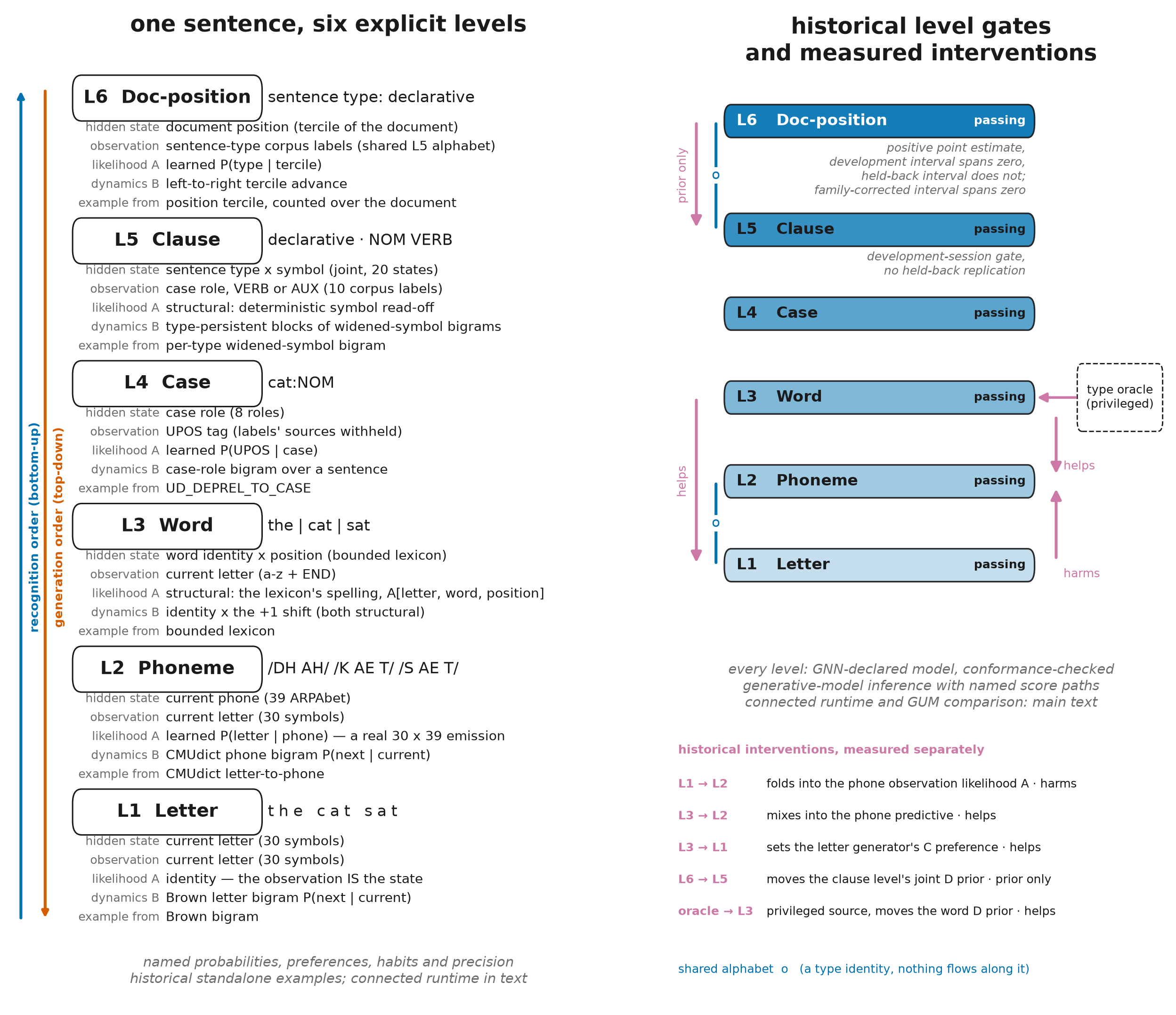
AILM: a fully explicit discrete language stack in pymdp, letters through document position, with a gate-audit method that binds every number to a recorded run.
Reproducible statistical-power simulation suite for adaptive studies with an embedded active-inference agent: multiple-testing corrections, sequential e-processes, and action-loop operating characteristics, using real pymdp inference.
Active Inference Institute Working Groups: draft Charter, Operating Procedures, and the position paper Coordinating the Field (doi:10.5281/zenodo.23066904)
Documentation-focused Active Inference Institute project repository, federated through InstituteOS via the .aii sidecar manifest.
Educational Jupyter notebooks exploring probabilistic and active inference with RxInfer.jl: Beta-Bernoulli coin-bias inference and variational message passing, from the Active Inference Institute.