

ECC
The agent harness performance optimization system. Skills, instincts, memory, security, and research-first development for Claude Code, Codex, Opencode, Cursor and beyond.
- 310k
- JavaScript
- MIT
- 2 d ago
Gen3 Predator by Aether AI: Ai-quantum reasoning & Public Off-Sec training evidence.
Repo AetherAI3/Predator, read from GitHub 17 min ago. AetherAI3 has not joined Take My Repo.
AetherAI3/Predator is a public repo on GitHub by AetherAI3. Gen3 Predator by Aether AI: Ai-quantum reasoning & Public Off-Sec training evidence. It declares no license on GitHub. Public does not mean open source: without a license, nobody is granted the right to reuse it. It has 13 stars and last changed on 2026-11-21. Nobody has reviewed it on Take My Repo yet, which says nothing about its quality. Read from GitHub on 2026-11-24.
The agent harness performance optimization system. Skills, instincts, memory, security, and research-first development for Claude Code, Codex, Opencode, Cursor and beyond.

AETHER AI · PREDATOR



AI security research, software repair, and authorized VM workflows.
Predator helps teams scope software-security questions, test candidate findings and repairs against authorized target software, and preserve only results that software verifies. This public repository is a research showcase and evidence collection; the CLI and operator engines remain private, with access reviewed separately.
| Area | Status |
|---|---|
| Current work | Gen3 research, scoped demonstrations, and selected open-source studies. |
| Evidence rule | Candidate rankings and model suggestions guide investigation; only supported results are banked. |
| Gen4 | Proposed research direction: cost-aware compute, verified replay, receiver-controlled admission, and gated learning. It is not a current product capability. |
| Not shown | No bounty has paid, no self-improvement has been demonstrated, and no quantum advantage has been established. |
The solid path summarizes the current research loop. The dashed path is a proposed Gen4 direction; it does not imply that broad repair distribution is live today.
flowchart LR
    S["Set authorized scope<br/>and acceptance checks"] --> C["Generate candidate<br/>finding or repair"]
    C --> V["Run native checks<br/>and independent verification"]
    V -->|Supported| E["Bank evidence<br/>and issue receipt"]
    V -->|Unknown or refuted| H["Halt, refute,<br/>or request review"]
    E -. "Proposed Gen4 path" .-> R["Package replay candidate<br/>with preconditions"]
    R -.-> O["Receiver verifies and<br/>decides local admission"]
    classDef future stroke-dasharray:5 5;
    class R,O future;
| Label | Meaning |
|---|---|
| MET / NOT MET / NOT RUN | Every gate was preregistered before the run; the verdict is reported either way, misses included. |
| measured on IBM hardware | A run on a real IBM quantum device, with IBM's billed time and signed receipt. |
| measured on a simulator | A classical simulation of a quantum circuit (FakeFez models one IBM device). No hardware time. |
| measured on fixtures, no quantum-computer time | A run on fixture tasks: tasks with a known answer, scored by a deterministic checker. |
| modelled | Arithmetic from measured per-unit costs; not a run. |
| built, not yet run | Code exists and passed offline tests; nothing paid has executed. |
| scripted agents | Stand-ins that follow a fixed script; not reasoning models. |
Predator's research engine, Crucible, works like a lockpick: hold verified evidence steady, test candidate chains against the real software, and bank only what holds.
Search method · Generations · Gen3 → Gen4 research · Safety model · Documentation index
| When | What happened | What it showed |
|---|---|---|
| March 2026 | Predator starts as a Gen2 project: AI- and quantum-assisted vulnerability analysis. | The idea. |
| October 2026 | One-week sprint. Predator Drive ran end to end through MCP for the first time, across several private security sprints and Predator's first bounty missions outside open-source research. | Predator can run a full mission and turn up findings within days. |
| Late October – November | Gen3 quantum comm ops: 400 agent briefings sent in one IBM job billed at 5 seconds, 400 of 400 intact, repeated on three message sets (measured on IBM hardware). | Hundreds of agents can be coordinated cheaply through IBM hardware, every message checked. No quantum advantage: the saving is IBM's billing for batched circuits. |
| November 2026 | Training our own small models on results the software verified (Experiments K–O, then Model-1). | A 2-billion-parameter model trained on 138 replies from a 9-billion-parameter model went from 5 to 62 correct on 108 new fixture tasks, above the larger model's 39.8 % (measured on fixtures); it learned the answer format, not a new skill. Model-1 (9 billion parameters, small adapter, CPU cluster): November 11, 91 % on 400 held-out synthetic cases against 49 % untrained (the always-HIT score), every reply stopped cleanly; November 12, a second adapter on the same base drove every stage of a whole 400-pin synthetic mission (selection was the verifier's, solved on CPU), 1,995 of 1,995 proposals valid, 172 of 178 findings at 3 false alarms against the scripted rule's 156, preregistered BEATS THE RULE (measured on fixtures). One seed each, synthetic code, Phase A's few-shot and random-adapter controls not run; a fixture shortcut found afterwards means the gain over the rule is not yet shown to be tracing skill. Details. |
| Mid-November 2026 | The self-improvement loop, Gen3 → Gen4 (design): meant to turn Model 1's failures into proven, replayable steps, then train them in. | First test (PL1, measured on fixtures): on Model 1's own stuck points, only the teacher's hint cleared the noise floor over a placebo; Nano's lockpick did no better than a random hint; where the evidence was already on screen, every hint verified 0 or 1 of 50. Our reading: the bottleneck is the decision. Next: train the decision (D1, preregistered, not yet run). No self-improvement shown yet. |
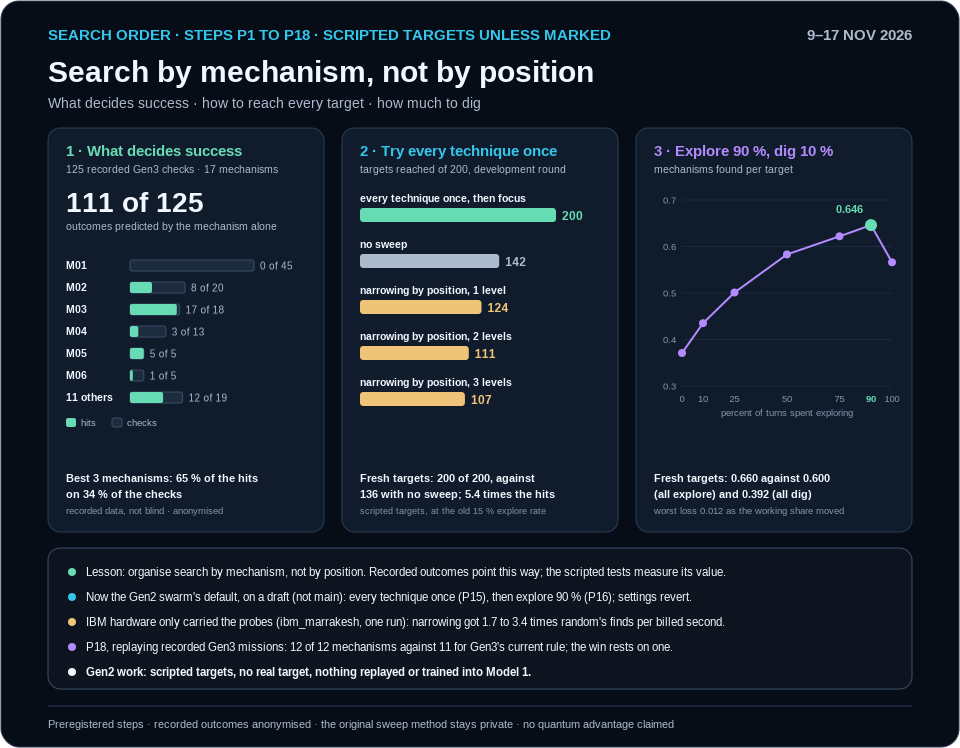
| November 9–17 | Search order: 17 small steps on the older Gen2 swarm's search, then one replay in Gen3. | Organise search by mechanism, not by position in a list: in recorded Gen3 outcomes the mechanism predicts 111 of 125 checks (not blind). Trying every technique once, then focusing, reached all 200 scripted test targets, against 68 % with no sweep; the swarm now also explores 90 % of the time (measured on fixtures; on a draft, not main). A replay of recorded Gen3 missions favoured the rule over Gen3's current one, on one mission (P18). |
Not there yet.
Source pins: the model result is bench/qcomms/o_frame/REPORT_O.md at private AETHER-PREDATOR-M commit 58ecf3db412feef68022cc4e88372567dd588f11; the later rounds and the bus are pinned in the comm-ops JSON (block status_2026_11_08); the IBM numbers are in Gen3 Quantum Comm Ops; Model-1 pins are in its section.
Ordinary computer search stays in charge; quantum experiments must earn a role with evidence. The tests described here have not shown a quantum advantage.
Predator picks from a menu of next moves that help, block or conflict with each other. A QUBO is the scorecard for those yes/no choices; energy is the score, lower is better. The score ranks candidates; only checks against the real software decide. Every run records which solver it used, including any quantum simulation or hardware.
Search order: by mechanism, not by position (November 9–17). Seventeen small, preregistered steps on the older Gen2 swarm taught one lesson: organise a search by mechanism (the kind of attack), not by where a candidate sits in a list. Recorded Gen3 outcomes point this way (not blind), the Nano lockpick's scripted result agrees, and the scripted steps measure what searching by mechanism is worth.
AetherAI3/Predator is a public repo on GitHub by AetherAI3. Gen3 Predator by Aether AI: Ai-quantum reasoning & Public Off-Sec training evidence.
It declares no license on GitHub. Public does not mean open source: without a license, nobody is granted the right to reuse it.
Its maker has not tagged a system, so it is unknown here. Its README says what it needs.
Open "Take it" on its page: Take My Repo writes an install plan for your machine and hands it to your AI agent (Claude Code, Codex or Cursor), which asks you before each step. Take My Repo has not tested it on any machine.
List of Computer Science courses with video lectures.
A professional, high-fidelity de-anonymization and vulnerability diagnostic framework. Features a zero-coupling modular architecture for browser-based intelligence gathering, hardware fingerprinting, and security research.
Its last change on GitHub was on 2026-11-21. Take My Repo does not judge from that whether it is maintained.
Nobody has reviewed it on Take My Repo yet, which says nothing about its quality.
Take My Repo cannot say: it does not audit code and has not run Predator. What is known comes from GitHub. It declares no license on GitHub. Public does not mean open source: without a license, nobody is granted the right to reuse it. Its last change was on 2026-11-21. It has 13 stars, which measure popularity, not safety. Nobody has reviewed it on Take My Repo yet, which says nothing about its quality. Read the source before you run it. With "Take it", your AI agent shows each step and asks you before running it; README text is treated as data, not as instructions.




