
x64dbg
An open-source user mode debugger for Windows. Optimized for reverse engineering and malware analysis.
- 50k
- C++
- 1 d ago
Playing with the VMProtect software protection. Automatic deobfuscation of pure functions using symbolic execution and LLVM.
Repo JonathanSalwan/VMProtect-devirtualization, read from GitHub 1 h ago. JonathanSalwan has not joined Take My Repo.
JonathanSalwan/VMProtect-devirtualization is a public repo on GitHub by JonathanSalwan. Playing with the VMProtect software protection. Automatic deobfuscation of pure functions using symbolic execution and LLVM. It declares no license on GitHub. Public does not mean open source: without a license, nobody is granted the right to reuse it. It is written mainly in Roff, has 1,554 stars and last changed on 2022-06-11. Nobody has reviewed it on Take My Repo yet, which says nothing about its quality. Read from GitHub on 2026-11-23.
An open-source user mode debugger for Windows. Optimized for reverse engineering and malware analysis.
FLARE Obfuscated String Solver - Automatically extract obfuscated strings from malware.
An experimental dynamic approach to devirtualize pure functions protected by VMProtect 3.x
I am sharing some notes about a dynamic approach to devirtualize pure functions protected by VMProtect. This approach has shown very good results if the virtualized function only contains one basic block (regardless of its size). This is a common scenario when binaries protect arithmetic operations. However, this approach is a bit more experimental when the target function contains more than one basic block. Nevertheless, we managed to devirtualize and reconstruct the binary code from samples that contain 2 basic blocks which suggests that it is possible to fully devirtualize small functions dynamically.
VMProtect is a software protection that protects code by running it through a virtual machine with non-standard architecture. This protection is a great playground for asm lovers [0, 1, 2, 3, 4, 5, 6, 11]. Also, there are already numerous tools that attack this protection [7, 8, 9, 12, 13]. In 2016 we took a look at the Tigress software protection solution and managed to defeat its virtualization using symbolic execution and LLVM. This approach has been presented at DIMVA 2018 [10] and I wanted to test it on VMProtect. Note that there is no magic solution that works on every binaries, there are always tradeoffs depending on the target and your goals. This modest contribution aims to provide an example of a dynamic attack against pure functions that are virtualized by VMProtect. The main advantage of a dynamic attack is that it defeats by design some VMProtect's static protections like self modifying code, key and operands encryption etc.
We consider a pure function a function with a finite number of paths and that does not have side effects. There can be several inputs but only one output. Below is an example of a pure function:
int secret(int x, int y) {
  int r = x ^ y;
  return r;
}
We rely on the key intuition that an obfuscated trace T' (from the obfuscated code P') combines original instructions from the original code P (the trace T corresponding to T' in the original code) and instructions of the virtual machine VM such that T' = T + VM(T). If we are able to distinguish between these two subsequences of instructions T and VM(T), we then are able to reconstruct one path of the original program P from a trace T'. By repeating this operation to cover all paths of the virtualized program, we will be able to reconstruct the original program P. In our practical example, the original code has a finite number of executable paths, which is the case in many situations involving intellectual property protection. To do so, we proceed with the following steps:
Let's take as a first example the following function: it takes two inputs and returns x ^ y which is protected by VMProtect.
int secret(int x, int y) {
  VMProtectBegin("secret");
  int r = x ^ y;
  VMProtectEnd();
  return r;
}
We start by identifying where functions are using VMProtect and how many arguments they have. For our example we may have something like below:
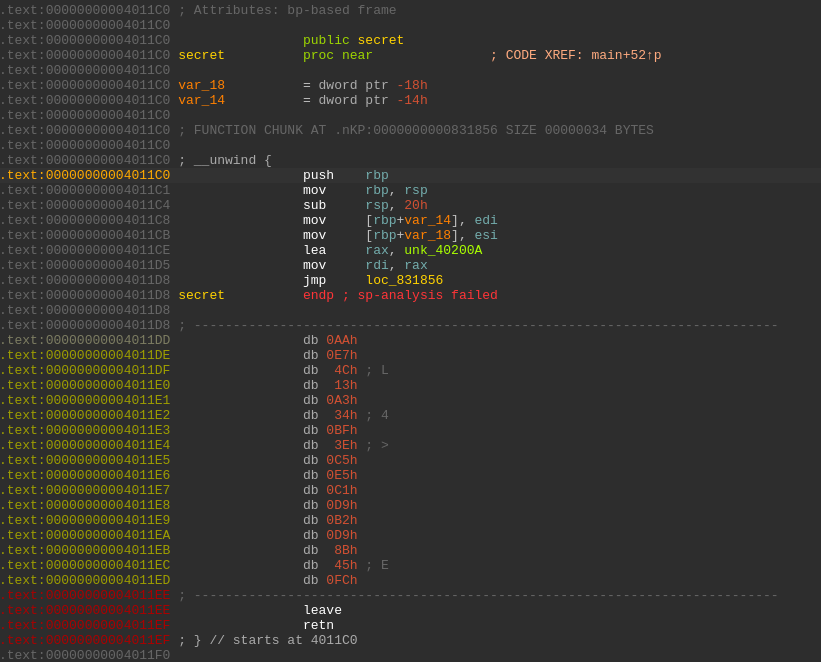
Just by reading the code we know that the function starts at the address 0x4011c0, have two 32-bit arguments (edi and esi)
and returns at 0x4011ef. That's all the reverse-engineering we need. Next parts will be automatic. Now we
have to generate an trace execution of this virtualized function. To do so we use a Pintool.
It only needs a start and an end address (for our example, 0x4011c0 and 0x4011ef) which represents the range
of the instrumentation. Note that any kind of DBI or emulator could do this job.
$ ./pin/pin -t ./pin/source/tools/VMP_Trace/obj-intel64/VMP_Trace.so -start 4198848 -end 4198895 -- ./vmp_binaries/binaries/sample2.vmp.bin 1 2 &> ./vmp_traces/sample2.vmp.trace
You can see the result here. The trace format uses three kind of operations: mr, r and i.
mr is a memory read access done by the instruction i, and r are the CPU registers. For example:
mr:0x7ffda459d718:8:0x227db4f8
r:0x40200a:0x0:0x7ffda459f571:0x2:0x40200a:0x0:0x0:0x7ffda459d688:0x0:0x0:0x7feee9b80ac0:0x7feee9b8000f:0xad1c3e:0x0:0x0:0x0
i:0x89173e:8:488BB42490000000
We have a memory read that loads an 8 bytes constant 0x227db4f8 from the address 0x7ffda459d718.
The instruction is executed at the address 0x89173e and its 8-bytes long opcode is 488BB42490000000 which is a
mov rsi, qword ptr [rsp + 0x90].
The register state before the execution is the following:
(1) RAX = 0x40200a          (9)  R8  = 0
(2) RBX = 0                 (10) R9  = 0
(3) RCX = 0x7ffda459f571    (11) R10 = 0x7feee9b80ac0
(4) RDX = 0x2               (12) R11 = 0x7feee9b8000f
(5) RDI = 0x40200a          (13) R12 = 0xad1c3e
(6) RSI = 0                 (14) R13 = 0
(7) RBP = 0                 (15) R14 = 0
(8) RSP = 0x7ffda459d688    (16) R15 = 0
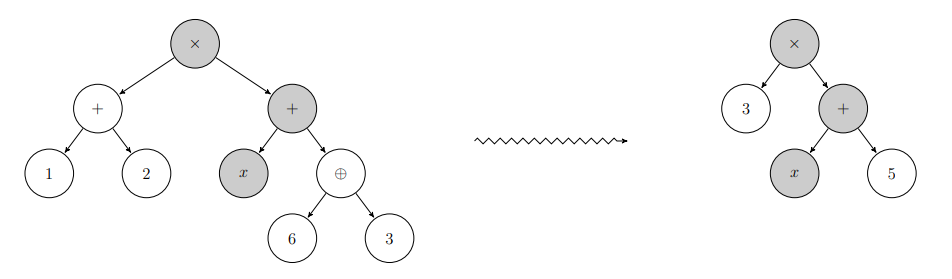
Once the VMP trace has been generated, we replay it using the attack_vmp.py script. This script uses Triton to build the path predicate of the trace. Note that all expressions which involve symbolic variables (inputs of the function) are kept symbolic while all non related input expressions are concretized. In other words, our symbolic expressions do not contain any operation related to the virtual machine (the machinery itself does not depend on the user) but only operations related to the original program.
For example, below is an example of a concretization. On the left we have an AST that contains subexpressions which do not involve
symbolic variable (1 + 2 and 6 ^ 3). So these branches are concretized and replaced by constants 3 and 5 which leads to
the AST on the right. This is how we devirtualize code.
A note on formula-level backward slicing: As it is common in symbolic execution, the symbolic representation is first
computed in a forward manner along the path, then all logical operations and definitions affecting neither the final result
nor the followed path are removed from the symbolic expression (formula slicing, a.k.a. formula pruning). This turns out to
perform on the formula the equivalent of a backward slicing code analysis from the program output. Thus, at the return of the
secret function, we have an expression of the relation between the inputs and the output without the instructions of VMProtect.
The ./attack_vmp.py script takes as parameters the trace file and the size of symbolic variables. Remember, it was edi and
esi, so they are 4 bytes long. The result of the script is the following:
$ ./attack_vmp.py --trace1 ./vmp_traces/sample2.vmp.trace --symsize 4
[+] Replaying the VMP trace
[+] Symbolize inputs
[+] Instruction executed: 12462
[+] Emulation done
[+] Return value: 0x3
[+] Devirt expr: (bvor (bvnot (bvor (bvnot (bvnot x)) (bvnot y))) (bvnot (bvor (bvnot x) (bvnot (bvand (bvnot y) (bvnot y))))))
[+] Synth expr: (bvxor x y)

[+] LLVM IR ==============================

; ModuleID = 'tritonModule'
source_filename = "tritonModule"

define i32 @__triton(i32 %SymVar_0, i32 %SymVar_1) {
entry:
  %0 = xor i32 %SymVar_0, %SymVar_1
  ret i32 %0
}

[+] EOF LLVM IR ==============================
As we can see, the devirtualized expression returned by the secret function is pretty concise and does not contain instructions from
the virtual machine.
(bvor
    (bvnot (bvor
             (bvnot (bvnot x))
             (bvnot y)
           )
    )
    (bvnot (bvor
             (bvnot x)
             (bvnot (bvand
                      (bvnot y)
                      (bvnot y)
                    )
             )
           )
    )
)
However, we did not manage to recover the original expression which was a simple XOR operation. It looks like the XOR has been
translated to bitwise operations. Luckily, we recently released new features in the Triton project which are
a synthesizer and a lifter to
LLVM-IR. Thus, we can synthesize the expression which gives us the expression
(bvxor x y). It's a good win and now we can go further by lifting this expression to LLVM-IR and then compile a new devirtualized
binary code.
Ok, now let's take a look at another example which tries to hide an MBA operation. The original source code is the following:
// This function is an MBA that computes: (x ^ 92) + y
// We will protect this MBA with VMProtect and see if we can recover "(x ^ 92) + y"
char secret(char x, char y) {
  VMProtectBegin("secret");
  int a = 229 * x + 247;
  int b = 237 * a + 214 + ((38 * a + 85) & 254);
  int c = (b + ((-(2 * b) + 255) & 254)) * 3 + 77;
  int d = ((86 * c + 36) & 70) * 75 + 231 * c + 118;
  int e = ((58 * d + 175) & 244) + 99 * d + 46;
  int f = (e & 148);
  int g = (f - (e & 255) + f) * 103 + 13;
  int r = (237 * (45 * g + (174 * g | 34) * 229 + 194 - 247) & 255) + y;
  VMProtectEnd();
  return r;
}
Like with the first example, we have to identify where this function starts and ends and generate a VMP trace.
$ ./pin/pin -t ./pin/source/tools/VMP_Trace/obj-intel64/VMP_Trace.so -start 4198857 -end 4199140 -- ./vmp_binaries/binaries/sample3.vmp.bin 1 2 &> ./vmp_traces/sample3.vmp.trace
Once the VMP trace is generated, let's run the ./attack_vmp.py script.
$ ./attack_vmp.py --trace1 ./vmp_traces/sample3.vmp.trace --symsize 1
[+] Replaying the VMP trace
[+] Symbolize inputs
[+] A potential symbolic jump found on CF flag: 0x821dac: popfq - Model: {0: x:32 = 0xa3, 1: y:32 = 0xff}
[+] A potential symbolic jump found on CF flag: 0x87f437: popfq - Model: {0: x:32 = 0xa3, 1: y:32 = 0xff}
[+] Instruction executed: 25085
[+] Emulation done
[+] Return value: 0x5f
[+] Devirt expr: In: (bvadd (bvadd (bvshl (bvadd (_ bv1 32) (bvnot (bvlshr (concat (_ bv0 8) (_ bv0 8) ((_ extract 15 8)  ...
[+] Synth expr: In: (bvadd (bvadd (bvshl (bvadd (_ bv1 32) (bvnot (bvlshr (concat (_ bv0 8) (_ bv0 8) ((_ extract 15 8)  ...

[+] LLVM IR ==============================

; ModuleID = 'tritonModule'
source_filename = "tritonModule"

define i32 @__triton(i8 %SymVar_0, i8 %SymVar_1) {
entry:
  %0 = xor i8 %SymVar_0, 92
  %1 = and i8 %SymVar_0, 0
  %2 = zext i8 %1 to i32
  %3 = or i32 0, %2
  %4 = shl i32 %3, 8
  %5 = zext i8 %0 to i32
  %6 = or i32 %4, %5
  %7 = and i8 %SymVar_1, 0
  %8 = zext i8 %7 to i32
  %9 = or i32 0, %8
  %10 = shl i32 %9, 8
  %11 = zext i8 %SymVar_1 to i32
  %12 = or i32 %10, %11
  %13 = zext i8 %7 to i32
  %14 = or i32 0, %13
  %15 = shl i32 %14, 8
  %16 = zext i8 %SymVar_1 to i32
  %17 = or i32 %15, %16
  %18 = lshr i32 %17, 7
  %19 = xor i32 %18, -1
  %20 = add i32 1, %19
  %21 = shl i32 %20, 8
  %22 = add i32 %21, %12
  %23 = add i32 %22, %6
  ret i32 %23
}

[+] EOF LLVM IR ==============================
The result is pretty interesting for several reasons. First, we successfully managed to avoid as much as possible instructions from the virtual machine as we went from 25085 instructions executed to 25 LLVM instructions. However, we did not manage to get a good synthesized version of the output (yes, I know, we are going further than just doing devirtualization). The advantage of lifting our symbolic expressions to LLVM-IR is that we can fully benefit from LLVM's optimization pipeline. Let's do this:
$ opt -S -O3 ./devirt/sample3.ll
; ModuleID = 'devirt/sample3.ll'
source_filename = "tritonModule"

; Function Attrs: mustprogress nofree norecurse nosync nounwind readnone willreturn
define i32 @__triton(i8 %SymVar_0, i8 %SymVar_1) local_unnamed_addr #0 {
entry:
  %0 = xor i8 %SymVar_0, 92
  %1 = zext i8 %0 to i32
  %2 = zext i8 %SymVar_1 to i32
  %3 = shl nuw nsw i32 %2, 1
  %4 = and i32 %3, 256
  %5 = add nuw nsw i32 %1, %2
  %6 = sub nsw i32 %5, %4
  ret i32 %6
}
Using LLVM optimizations we managed to remove noise from our devirtualized output and thus break the MBA.
We can see the XOR operation with its constant (%0 = xor i8 %SymVar_0, 92) and the + y (%6 = add nsw i32 %5, %1
JonathanSalwan/VMProtect-devirtualization is a public repo on GitHub by JonathanSalwan. Playing with the VMProtect software protection. Automatic deobfuscation of pure functions using symbolic execution and LLVM.
It declares no license on GitHub. Public does not mean open source: without a license, nobody is granted the right to reuse it.
Program for determining types of files for Windows, Linux and MacOS.
Its maker has not tagged a system, so it is unknown here. Its README says what it needs.
Open "Take it" on its page: Take My Repo writes an install plan for your machine and hands it to your AI agent (Claude Code, Codex or Cursor), which asks you before each step. Take My Repo has not tested it on any machine.
Its last change on GitHub was on 2022-06-11. GitHub counts 0 open issues and pull requests. Take My Repo does not judge from that whether it is maintained.
Nobody has reviewed it on Take My Repo yet, which says nothing about its quality.
Take My Repo cannot say: it does not audit code and has not run VMProtect-devirtualization. What is known comes from GitHub. It declares no license on GitHub. Public does not mean open source: without a license, nobody is granted the right to reuse it. Its last change was on 2022-06-11. It has 1,554 stars, which measure popularity, not safety. Nobody has reviewed it on Take My Repo yet, which says nothing about its quality. Read the source before you run it. With "Take it", your AI agent shows each step and asks you before running it; README text is treated as data, not as instructions.


