
SurveyBench
Reader-aligned academic survey writing benchmark https://arxiv.org/pdf/2510.03120
- 9
- 14 mo ago
Repo OpenDataBox/SurveyBench, read from GitHub 1 min ago. OpenDataBox has not joined Take My Repo.
In short
OpenDataBox/SurveyBench is a public repo on GitHub by OpenDataBox. Reader-aligned academic survey writing benchmark https://arxiv.org/pdf/2510.03120. It declares no license on GitHub. Public does not mean open source: without a license, nobody is granted the right to reuse it. It is written mainly in Python, has 9 stars and last changed on 2025-10-09. Nobody has reviewed it on Take My Repo yet, which says nothing about its quality. Read from GitHub on 2026-11-25.

SurveyBench: Can LLM(-Agents) Write Academic Surveys that Align with Reader Needs?
Introduction

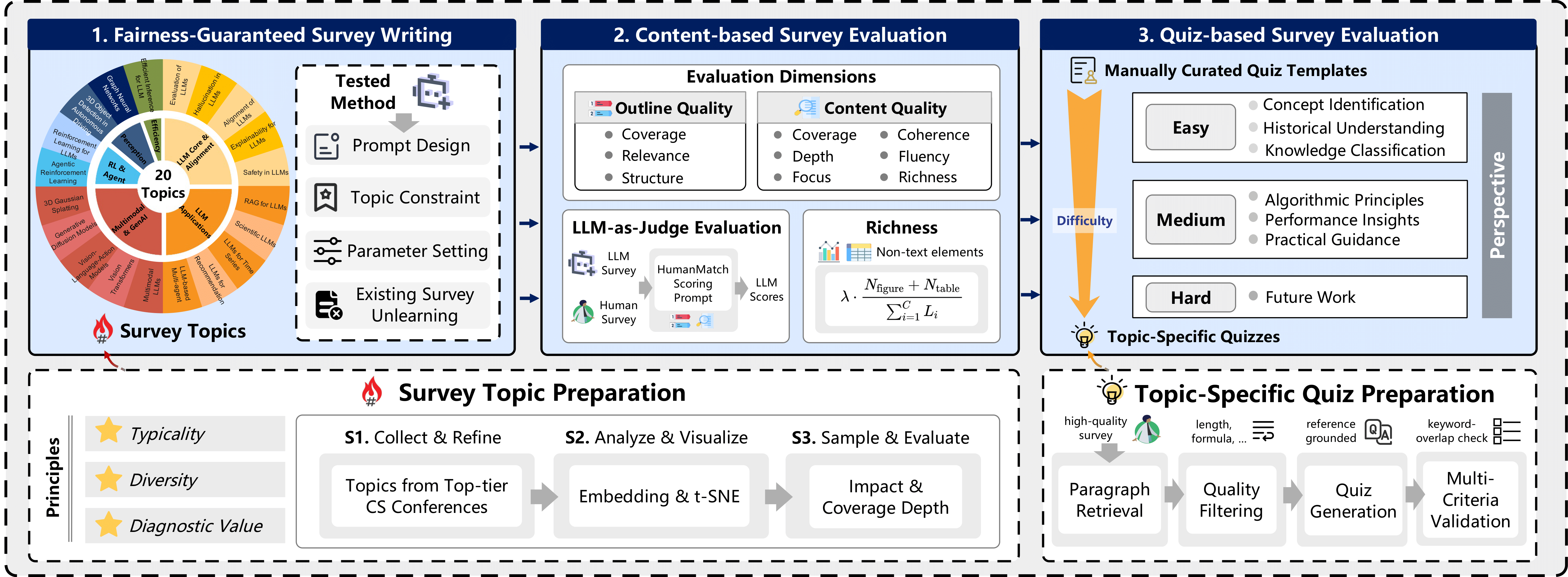
SurveyBench is a fine-grained, quiz-driven evaluation framework, featuring (1) typical survey topics source from recent 11,343 arXiv papers and corresponding 4,947 high-quality surveys; (2) a multifaceted metric hierarchy that assesses the outline quality (e.g., coverage breadth, logical coherence), content quality (e.g., synthesis granularity, clarity of insights), and non-textual richness; (3) a dual-mode evaluation protocol that includes content-based and quiz-based answerability tests, explicitly aligned with readers’ informational needs.
Dataset Introduction
Our survey topic acquisition process is divided into three stages.
First, we collect 127 candidate topics from authoritative computer science sources, including top conferences (e.g., ICLR, NeurIPS, CVPR, SIGMOD, SOSP), and refine them by removing duplicates and unifying terminology (e.g., merging “Brain-Computer Interfaces” and “Neural Coding”).
Second, for each refined topic, we cluster recent arXiv papers from the past three months by calculating embeddings (using the text-embedding-3-small model) from titles, abstracts, and key topics, and apply t-SNE for dimensionality reduction and visualization. As shown in Figure 4, we filter these topics based on publication volume, conceptual diversity, academic influence (citation counts and top-tier venue presence), and semantic overlap, ultimately selecting 9 key representative topics.
Finally, for each of the selected topics, we extract 4,947 survey papers from arXiv using “survey” or “review” keywords, and further filter them based on two criteria: (1) impact (citation counts from Semantic Scholar or arXiv-sanity), and (2) coverage depth (topical alignment with the retrieved papers), yielding a final set of 20 well-vetted topics for benchmark use.
Usage
Data Prepration
-
Place all generated survey files (
.md) into the directory:src/data/{MethodName}/ -
Human-written reference surveys should be placed under:
src/data/HumanSurvey/
Requirements:
-
Filename alignment:
For each topic, the.mdfilename must be identical between the LLM method directory andHumanSurvey.For example:
src/data/AutoSurvey/Multimodal Large Language Models.md src/data/HumanSurvey/Multimodal Large Language Models.md -
Survey format requirement:
All survey files must follow a consistent Markdown heading structure.For example:
# Title
## 1 Introduction
## 2 Section
### 2.1 Subsection
#### 2.1.1 Subsubsection
...
Content-based Evaluation
Here is an example command to evaluate the AutoSurvey method on content quality, outline quality and richness.
cd src
python run_content_eval.py --mode overall --survey_dir '../data/AutoSurvey' --human_dir '../data/HumanSurvey' --model gpt-4o-mini --api_key sk_xxx --api_url xxx --output_dir './result/content/AutoSurvey'
Arguments:
mode: Evaluation mode. Options:content→ Evaluate content quality (with/without human reference).outline→ Evaluate outline quality.richness→ Evaluate non-textual richness.overall→ Run all three evaluations (content with_ref,outline,richness).
setting: (Only valid if--mode content) Content evaluation setting. Options:with_ref→ Compare LLM survey against the human-written survey.without_ref_chapter→ Evaluate content chapter by chapter without human reference.without_ref_document→ Evaluate the whole document without human reference.
--model: The model used for evaluation (e.g. gpt-4o-mini).--api_key: API key for the evaluation model service.--api_url: API endpoint URL for the evaluation model service.--output_dir: Directory to save evaluation results.--survey_dir: Directory for survey files to evaluate.--human_dir: Directory for human-written survey files.
Quiz-based Evalaution
Here is an example command to run quiz-based evaluation on generated surveys:
cd src
python run_quiz_eval.py \
  --survey_dir '../data/AutoSurvey' \
  --human_dir '../data/HumanSurvey' \
  --output './quiz_result' \
  --llm "gpt-4o-mini" \
  --llm_api_key "sk_xxx" \
  --llm_api_url "https://api.openai.com/v1" \
  --emb_model "text-embedding-3-small" \
  --emb_dimension 1536 \
  --emb_api_key "sk_xxx" \
  --emb_api_url "xxx"
Arguments:
--survey_dir: Directory containing the generated survey files to evaluate.--human_dir: Directory containing the human-written survey files.--output: Directory to save evaluation results. Results will be stored in results/{your_output_dir}.--llm: The LLM used as a judge for quiz evaluation (e.g., gpt-4o-mini).--llm_api_key: API key for the LLM service.--llm_api_url: API endpoint URL for the LLM service.--emb_model: Embedding model used for semantic similarity calculation.--emb_dimension: Dimension of the embedding model.--emb_api_key: API key for the embedding model service.--emb_api_url: API endpoint URL for the embedding model service.
After running the script, evaluation results will be saved under results/{your_output_dir}.
Two types of JSON files are generated:
-
{topic}_specific_results.json- Contains the overall scores of topic-specific quizzes for the given topic.
-
{topic}_compare_results.json- Contains the results of general quiz comparisons.
- To keep the file concise:
answer_1refers to the human survey responses.answer_2refers to the generated survey responses.
compare results JSON Structure
| Field | Description |
|---|---|
better_answer_2_count |
Number of quiz questions where the generated survey (answer_2) outperformed the human survey (answer_1). |
better_answer_1_reasons |
List of questions where the human survey won, along with the LLM judge’s explanation. |
category_stats |
Win–loss statistics across 7 predefined quiz categories. |
total_questions |
Total number of quiz questions evaluated. |
Experimental Results and Analysis
We evaluate four typical methods to verify the effectiveness of SurveyBench, including AutoSurvey (GPT-4o), SurveyForge (GPT-4o), LLM×MapReduce-V2 (Gemini-flash-thinking), and OpenAI-DeepResearch.
| Dimension | OpenAI-DR | AutoSurvey | SurveyForge | LLM×MR-V2 |
|---|---|---|---|---|
| Outline Quality (1-5) | ||||
| Coverage | 3.39 | 3.83 | 3.86 | 4.31 |
| Relevance | 3.83 | 4.11 | 4.22 | 4.53 |
| Structure | 3.48 | 3.71 | 3.95 | 4.28 |
| Average | 3.57 | 3.88 | 4.01 | 4.37 |
| Content Quality (1-5) | ||||
| Coverage | 4.32 | 3.90 | 3.90 | 4.03 |
| Depth | 4.40 | 3.72 | 3.72 | 4.05 |
| Focus | 4.80 | 4.35 | 4.28 | 4.62 |
| Coherence | 4.25 | 3.98 | 4.00 | 4.00 |
| Fluency | 4.32 | 4.20 | 4.25 | 4.30 |
| Average | 4.42 | 4.03 | 4.03 | 4.20 |
| Richness | ||||
| Avg. Fig. Num. | 0.60 | -- | -- | 4.10 |
| Avg. Table Num. | 0.60 | -- | -- | 10.95 |
| Total Avg. | 1.78 | -- | -- | 5.04 |
Table1: Content-Based Evaluation Results (w/ human referenced)
Note: We (1) set the carefully selected human-written surveys scoring 5 in outline and content quality; and (2) test the human-written surveys that score 9.80, 5.45, 11.68 in the three Richness metrics ($\lambda=10^5$).
| Method | Easy (Concept) | Easy (Classification) | Easy (History) | Medium (Algorithm) | Medium (Application) | Medium (Profiling) | Hard (Prediction) | Topic-related details |
|---|---|---|---|---|---|---|---|---|
| AutoSurvey | 47.4% | 24.6% | 65.4% | 28.0% | 40.0% | 34.5% | 53.3% | 1.58 |
| SurveyForge | 39.7% | 39.1% | 37.9% | 20.0% | 41.5% | 56.7% | 52.5% | 1.48 |
| LLM×MR-V2 | 57.7% | 48.1% | 50.0% | 36.4% | 48.6% | 60.9% | 61.9% | 3.19 |
| OpenAI-DR | 53.8% | 55.9% | 77.5% | 68.0% | 69.8% | 47.3% | 69.2% | 1.97 |
Table2: Quiz-Based Evaluation Results
| Method | Topic Recency | Coverage | Relevance | Structure | Avg. | Coverage | Depth | Focus | Coherence | Fluency | Avg. |
|---|---|---|---|---|---|---|---|---|---|---|---|
| OpenAI-DR | New | 3.15 | 3.60 | 3.35 | 3.37 | 4.10 | 4.20 | 4.65 | 4.10 | 4.15 | 4.24 |
| Old | 3.63 | 4.07 | 3.62 | 3.77 | 4.55 | 4.60 | 4.95 | 4.40 | 4.50 | 4.60 | |
| AutoSurvey | New | 3.67 | 3.98 | 3.55 | 3.73 | 3.75 | 3.55 | 4.15 | 3.90 | 4.25 | 3.92 |
| Old | 4.00 | 4.23 | 3.87 | 4.03 | 4.05 | 3.90 | 4.55 | 4.05 | 4.15 | 4.14 | |
| SurveyForge | New | 3.68 | 4.20 | 3.90 | 3.93 | 3.70 | 3.55 | 4.20 | 3.80 | 4.15 | 3.88 |
| Old | 4.03 | 4.23 | 4.00 | 4.09 | 4.10 | 3.90 | 4.35 | 4.20 | 4.35 | 4.18 | |
| LLM×MR-V2 | New | 4.33 | 4.53 | 4.30 | 4.39 | 3.90 | 3.95 | 4.45 | 4.00 | 4.30 | 4.12 |
| Old | 4.28 | 4.53 | 4.25 | 4.36 | 4.15 | 4.15 | 4.80 | 4.00 | 4.30 | 4.28 |
Table3: Evaluation results on outline quality and content quality across New vs. Old topics.

Figure 1: Fine-Grained Evaluation. (a-d): Error Distributions; (e) LLM Token Utilization.
Content-based Evaluation
Unlike inflated results observed without human-written references, we incorporate high-quality human-authored surveys as reference standards. As shown in Table1, LLM-based methods achieve strong results in content-focused metrics. For example, OpenAI-DR scores only 4% below humans in content focus, and LLM×MR-V2 lags by just 9% in outline relevance, showing that LLM-generated surveys approach human surveys in readability and coherence. Among the methods, LLM×MR-V2 excels in outline quality, while OpenAI-DR ranks highest in content quality, thanks to reinforcement learning tailored for complex retrieval. However, OpenAI-DR ranks lowest in outline quality due to its concise nature and lack of hierarchical sub-sections.
Questions
What is SurveyBench?
OpenDataBox/SurveyBench is a public repo on GitHub by OpenDataBox. Reader-aligned academic survey writing benchmark https://arxiv.org/pdf/2510.03120.
Is SurveyBench open source?
It declares no license on GitHub. Public does not mean open source: without a license, nobody is granted the right to reuse it.
Does SurveyBench run on macOS, Windows or Linux?
Its maker has not tagged a system, so it is unknown here. Its README says what it needs.