transformers
🤗 Transformers: the model-definition framework for state-of-the-art machine learning models in text, vision, audio, and multimodal models, for both inference and training.
- 169k
- Python
- Apache-2.0
- 1 h ago
A 1.6B causal Transformer audio tokenizer with streaming, variable bitrates, and semantic alignment across speech, sound, and music
Repo OpenMOSS/MOSS-Audio-Tokenizer, read from GitHub 13 h ago. OpenMOSS has not joined Take My Repo.
OpenMOSS/MOSS-Audio-Tokenizer is a public repo on GitHub by OpenMOSS. A 1.6B causal Transformer audio tokenizer with streaming, variable bitrates, and semantic alignment across speech, sound, and music. It declares the Apache-2.0 license on GitHub. It is written mainly in Python, has 271 stars and last changed on 2026-06-16. Nobody has reviewed it on Take My Repo yet, which says nothing about its quality. Read from GitHub on 2026-11-25.
🤗 Transformers: the model-definition framework for state-of-the-art machine learning models in text, vision, audio, and multimodal models, for both inference and training.


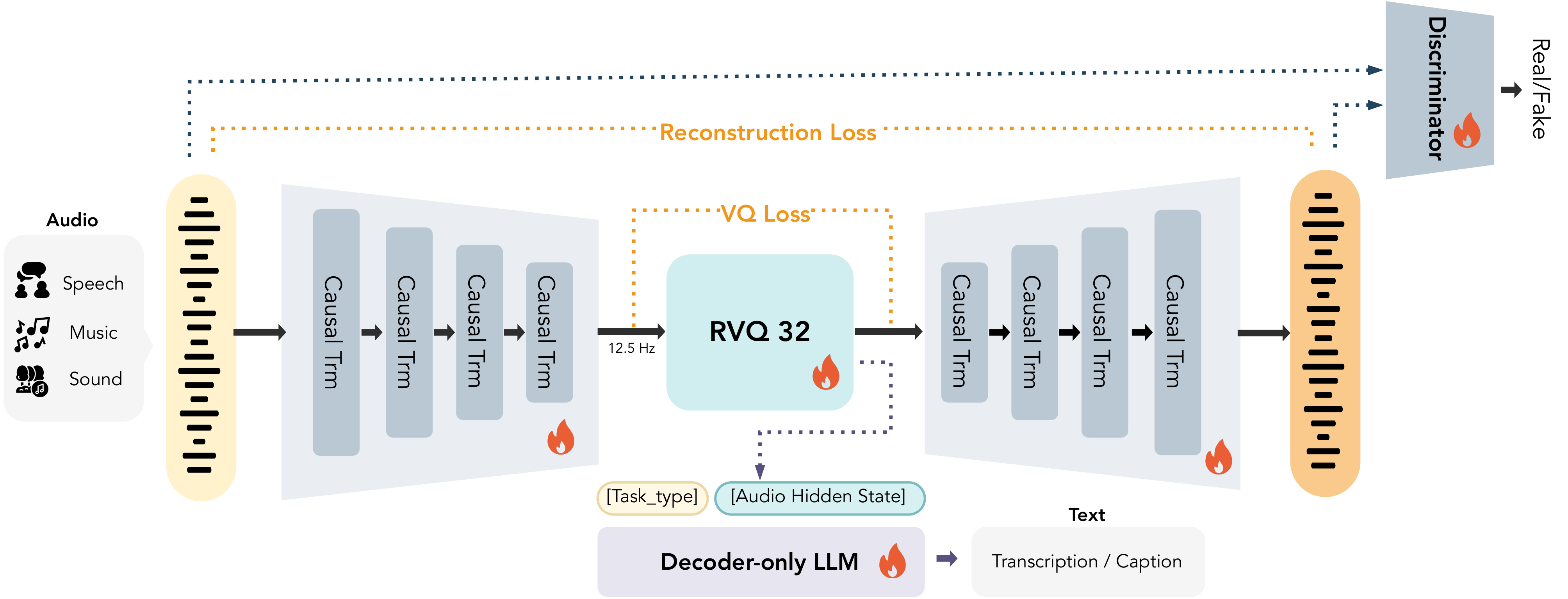
This is the code for MOSS-Audio-Tokenizer presented in the MOSS-Audio-Tokenizer: Scaling Audio Tokenizers for Future Audio Foundation Models. MOSS-Audio-Tokenizer is a unified discrete audio tokenizer based on the Cat (Causal Audio Tokenizer with Transformer) architecture. Scaling to 1.6 billion parameters, it functions as a unified discrete interface, delivering both lossless-quality reconstruction and high-level semantic alignment.
Key Features:
Summary: By combining a simple, scalable architecture with massive-scale data, the Cat architecture overcomes the bottlenecks of traditional audio tokenizers. It provides a robust, high-fidelity, and semantically grounded interface for the next generation of native audio foundation models.
This repository is the official implementation of MOSS-Audio-Tokenizer.
Architecture of MOSS-Audio-Tokenizer
onnx/ and trt/ directories for details. We also provide conversion scripts (onnx/export_onnx.py) for community reference.For MOSS‑TTS Family models and docs, visit the GitHub repos: https://github.com/OpenMOSS/MOSS-TTS and https://github.com/OpenMOSS/MOSS-TTS-Nano
| Model | Sampling Rate | Channels | Hugging Face | ModelScope |
|---|---|---|---|---|
| MOSS-Audio-Tokenizer | 24kHz | 1 channel (mono) | ||
| MOSS-Audio-Tokenizer (ONNX Runtime) | 24kHz | 1 channel (mono) | ||
| MOSS-Audio-Tokenizer-v2 | 48kHz | 2 channels (stereo) | ||
| MOSS-Audio-Tokenizer-Nano | 48kHz | 2 channels (stereo) |
| Model | Hugging Face | ModelScope |
|---|---|---|
| MOSS-TTS | ||
| MOSS-TTS-v1.5 | ||
| MOSS-TTS-Nano | ||
| MOSS-TTS-Local-Transformer | ||
| MOSS-TTS-Local-Transformer-v1.5 | ||
| MOSS-TTSD | ||
| MOSS-TTS-Realtime | ||
| MOSS-VoiceGenerator | ||
| MOSS-SoundEffect | ||
| MOSS-SoundEffect-v2.0 |
# Clone the repository
git clone https://github.com/OpenMOSS/MOSS-Audio-Tokenizer.git
cd MOSS-Audio-Tokenizer

# Install dependencies
conda create -n moss-audio-tokenizer python=3.10 -y
conda activate moss-audio-tokenizer
pip install -r requirements.txt
import torch
from transformers import AutoModel
import torchaudio

repo_id = "OpenMOSS-Team/MOSS-Audio-Tokenizer"
model = AutoModel.from_pretrained(repo_id, trust_remote_code=True).eval()

wav, sr = torchaudio.load('demo/demo_gt.wav')
if sr != model.sampling_rate:
    wav = torchaudio.functional.resample(wav, sr, model.sampling_rate)
wav = wav.unsqueeze(0)
enc = model.encode(wav, return_dict=True)
print(f"enc.audio_codes.shape: {enc.audio_codes.shape}")
dec = model.decode(enc.audio_codes, return_dict=True)
print(f"dec.audio.shape: {dec.audio.shape}")
wav = dec.audio.squeeze(0)
torchaudio.save("demo/demo_rec.wav", wav, sample_rate=model.sampling_rate)

# Decode using only the first 8 layers of the RVQ
dec_rvq8 = model.decode(enc.audio_codes[:8], return_dict=True)
wav_rvq8 = dec_rvq8.audio.squeeze(0)
torchaudio.save("demo/demo_rec_rvq8.wav", wav_rvq8, sample_rate=model.sampling_rate)
import torch
from transformers import AutoModel
import torchaudio

repo_id = "OpenMOSS-Team/MOSS-Audio-Tokenizer-v2"
# repo_id = "OpenMOSS-Team/MOSS-Audio-Tokenizer-Nano"
device = "cuda" if torch.cuda.is_available() else "cpu"

model = AutoModel.from_pretrained(repo_id, trust_remote_code=True).to(device).eval()

wav, sr = torchaudio.load("demo/demo_gt.wav")
if sr != model.sampling_rate:
    wav = torchaudio.functional.resample(wav, sr, model.sampling_rate)
if wav.shape[0] == 1:
    wav = wav.repeat(model.config.number_channels, 1)
elif wav.shape[0] > model.config.number_channels:
    wav = wav[: model.config.number_channels]

input_length = wav.shape[-1]

with torch.inference_mode():
    enc = model.encode(wav.unsqueeze(0).to(device), return_dict=True)
    dec = model.decode(enc.audio_codes, return_dict=True)

audio = dec.audio[..., :input_length]
torchaudio.save("demo/demo_rec_v2.wav", audio.squeeze(0).cpu(), sample_rate=model.sampling_rate)
print(f"enc.audio_codes.shape: {enc.audio_codes.shape}")
MossAudioTokenizerModel.encode and MossAudioTokenizerModel.decode support simple streaming via a chunk_duration argument.
chunk_duration is expressed in seconds.MossAudioTokenizerConfig.causal_transformer_context_duration.chunk_duration * MossAudioTokenizerConfig.sampling_rate must be divisible by MossAudioTokenizerConfig.downsample_rate.batch_size=1.import torch
from transformers import AutoModel
repo_id = "OpenMOSS-Team/MOSS-Audio-Tokenizer"
model = AutoModel.from_pretrained(repo_id, trust_remote_code=True).eval()
audio = torch.randn(1, 1, 3200) # dummy waveform
# 0.08s @ 24kHz = 1920 samples, divisible by downsample_rate=1920
enc = model.encode(audio, return_dict=True, chunk_duration=0.08)
dec = model.decode(enc.audio_codes, return_dict=True, chunk_duration=0.08)
For MOSS-Audio-Tokenizer-v2 or MOSS-Audio-Tokenizer-Nano, use 48kHz stereo input and output:
import torch
from transformers import AutoModel

repo_id = "OpenMOSS-Team/MOSS-Audio-Tokenizer-v2"
# repo_id = "OpenMOSS-Team/MOSS-Audio-Tokenizer-Nano"
device = "cuda" if torch.cuda.is_available() else "cpu"
model = AutoModel.from_pretrained(repo_id, trust_remote_code=True).to(device).eval()
audio = torch.randn(1, 2, 48000 * 6, device=device)

with torch.inference_mode():
    enc = model.encode(audio, return_dict=True, chunk_duration=0.08)
    dec = model.decode(enc.audio_codes, return_dict=True, chunk_duration=0.08)
# From repository root
mkdir weights
cd weights
git clone https://huggingface.co/OpenMOSS-Team/MOSS-Audio-Tokenizer-ONNX
cd -

# CPU version
pip install onnxruntime librosa soundfile

# GPU version (CUDA/TensorRT)
pip install onnxruntime-gpu librosa soundfile
OpenMOSS/MOSS-Audio-Tokenizer is a public repo on GitHub by OpenMOSS. A 1.6B causal Transformer audio tokenizer with streaming, variable bitrates, and semantic alignment across speech, sound, and music.
It declares the Apache-2.0 license on GitHub.
Its maker has not tagged a system, so it is unknown here. Its README says what it needs.
🎧 Open source music streaming app! Available for both desktop & mobile!
🐸💬 - a deep learning toolkit for Text-to-Speech, battle-tested in research and production
Self-Supervised Speech Pre-training and Representation Learning Toolkit
VoiceStudio is the open-source, fully-local ElevenLabs alternative — voice cloning, voice design, video dubbing, dictation, transcription & audiobook creation in 646 languages.
利用 AI 大模型和自动化工作流,根据主题或关键词一键生成高清短视频。Generate HD short videos from a topic or keyword with an automated AI workflow.
Open "Take it" on its page: Take My Repo writes an install plan for your machine and hands it to your AI agent (Claude Code, Codex or Cursor), which asks you before each step. Take My Repo has not tested it on any machine.
Its last change on GitHub was on 2026-06-16. Take My Repo does not judge from that whether it is maintained.
Nobody has reviewed it on Take My Repo yet, which says nothing about its quality.
Take My Repo cannot say: it does not audit code and has not run MOSS-Audio-Tokenizer. What is known comes from GitHub. It declares the Apache-2.0 license on GitHub. Its last change was on 2026-06-16. It has 271 stars, which measure popularity, not safety. Nobody has reviewed it on Take My Repo yet, which says nothing about its quality. Read the source before you run it. With "Take it", your AI agent shows each step and asks you before running it; README text is treated as data, not as instructions.