

AutoGPT
AutoGPT is the vision of accessible AI for everyone, to use and to build on. Our mission is to provide the tools, so that you can focus on what matters.
- 188k
- Python
- 19 min ago
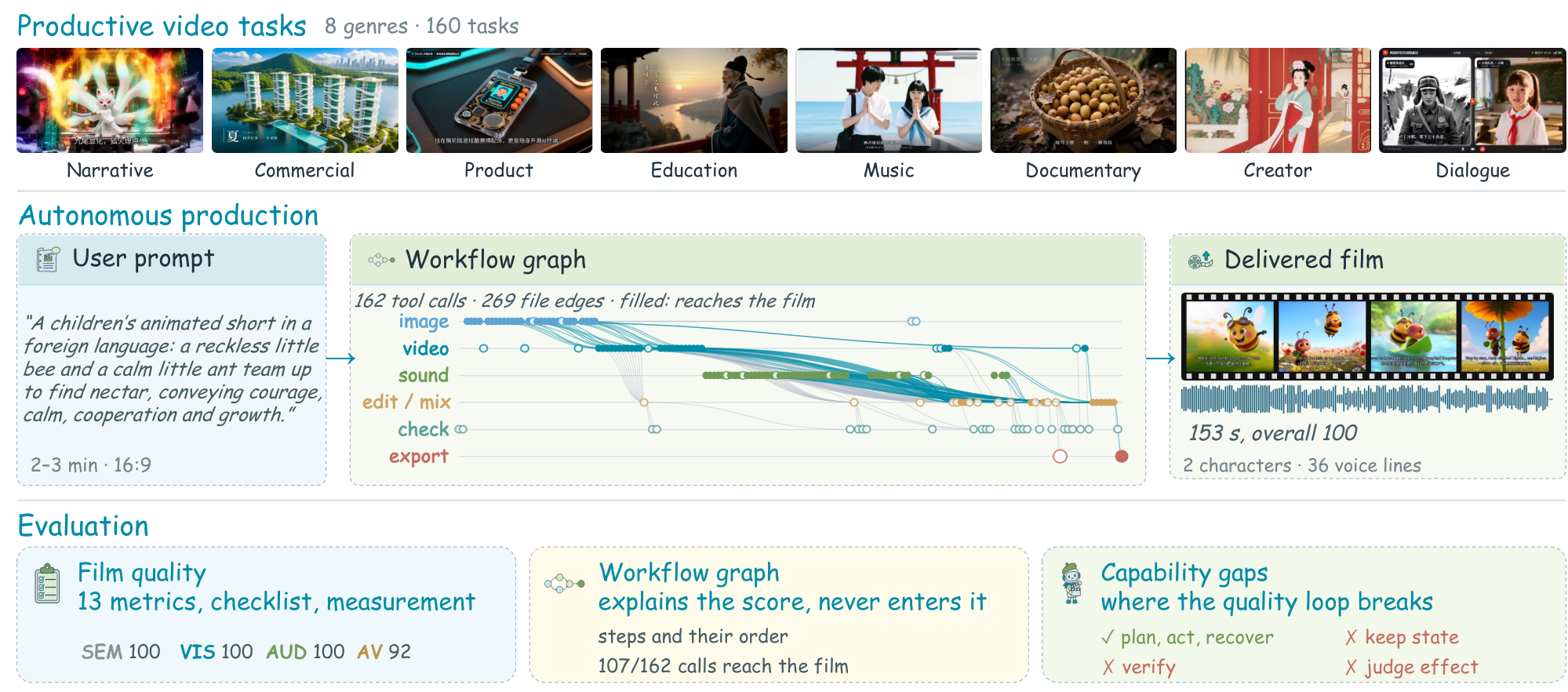
🎬 StudioBench: Benchmarking Agentic Multimodal Large Language Models for Productive Audiovisual Creation
Repo OpenRaiser/StudioBench, read from GitHub 12 min ago. OpenRaiser has not joined Take My Repo.
OpenRaiser/StudioBench is a public repo on GitHub by OpenRaiser. 🎬 StudioBench: Benchmarking Agentic Multimodal Large Language Models for Productive Audiovisual Creation. It declares the Apache-2.0 license on GitHub. It is written mainly in HTML, has 2 stars and last changed on 2026-11-19. Nobody has reviewed it on Take My Repo yet, which says nothing about its quality. Read from GitHub on 2026-11-25.
AutoGPT is the vision of accessible AI for everyone, to use and to build on. Our mission is to provide the tools, so that you can focus on what matters.
English · 简体中文
Benchmarking Agentic Multimodal Large Language Models for Productive Audiovisual Creation
🎞️ Demo • 🏆 Leaderboard • 📄 Paper (coming soon) • 📖 Docs • 🚀 Quick Start • ✒️ Citation
StudioBench asks whether a multimodal large language model (MLLM) can act as the director of a real, deliverable audiovisual work. The model receives a production brief adapted from a published AIGC video and 33 atomic tools for generation, editing, inspection and delivery — no shell, no file system, no workflow template. It must plan, generate assets, edit, check its own work, retry and export a 1–3 minute finished film. We score only the delivered film, and reconstruct a workflow graph from each run to explain how the film turned out good or bad.
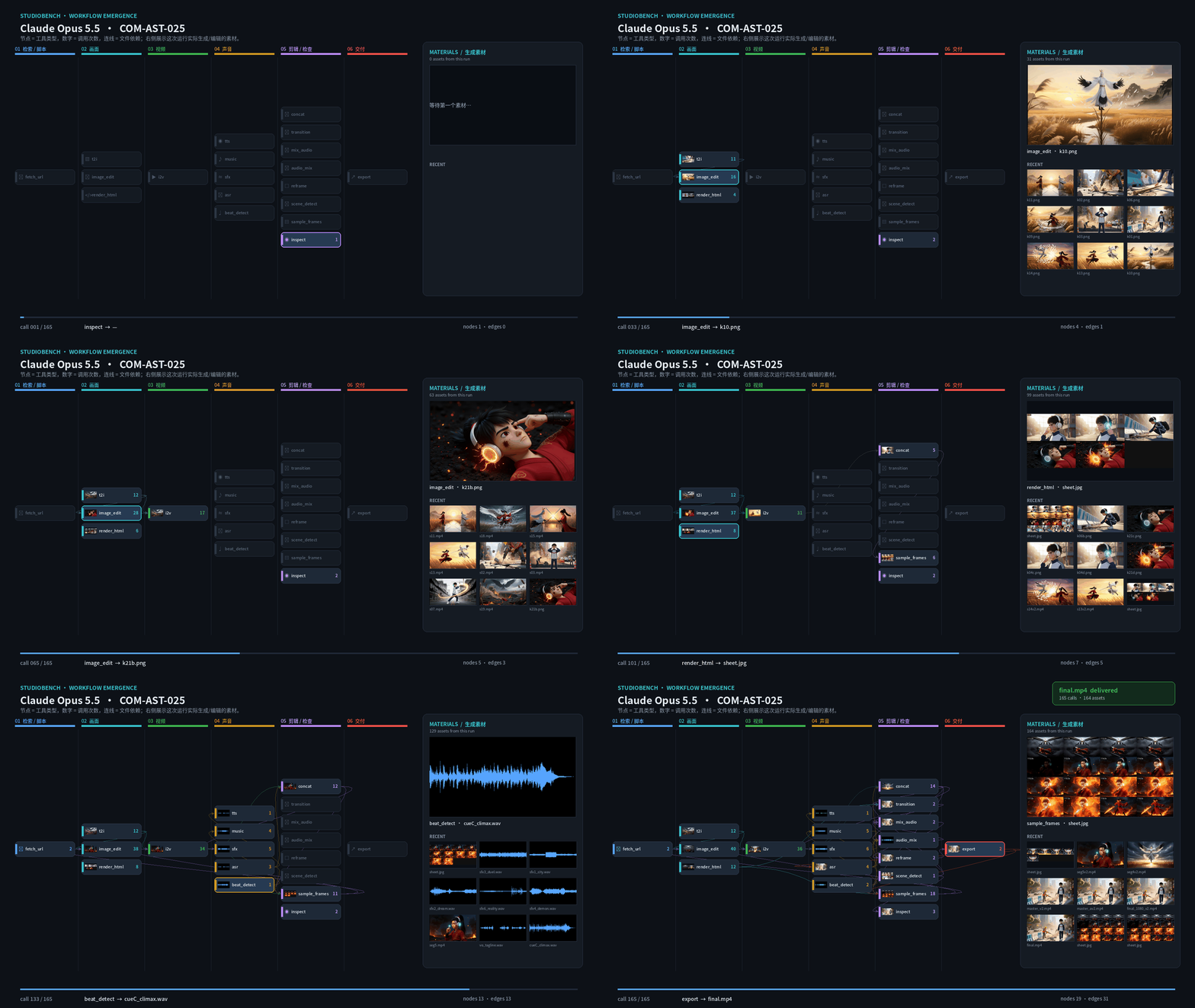
One Claude Opus 5.5 run on COM-AST-025 (165 tool calls). The model is given only atomic tools
and a brief — no workflow template. Each node is a tool type, the number is how many times it was
called, and an edge means one call consumed a file produced by another. The graph is
reconstructed from the run log and grows as the model plans, generates, reviews and edits. The right-hand panel shows the actual images, video frames and audio waveforms produced during the run.
 Claude Opus 5.5 Overall 92.2 |
 Gemini 4 Argon Overall 92.0 |
 GPT-6 Astra Overall 88.8 |
 DeepSeek V4.1 Flash Overall 88.3 |
 Doubao Seed 2.1 Pro Overall 86.9 |
 Qwen3.8 Max Overall 83.9 |
Six models, one brief (COM-AST-025, a martial-fantasy 3D animation ad), the same 2.4-second window. The clips loop inline;
longer excerpts are in docs/assets/cases/.
| 🎯 Productive tasks | 160 briefs adapted from published AIGC videos, across 8 genres (Narrative, Commercial, Product, Education, Music, Documentary, Creator, Dialogue) and 5 task types (Open Brief, Constraint, Asset-conditioned, Reference-conditioned, Audio-led). |
| 🧰 Atomic tools only | Image, video, speech, music, SFX, lip-sync, code rendering, editing, audio processing, inspection and delivery — the model must compose them into a workflow itself. |
| 🎥 Whole-film evaluation | 13 whole-film metrics over four dimensions — semantics (SEM), visual quality (VIS), audio quality (AUD) and audiovisual alignment (AV) — plus a 1,686-item requirement checklist and objective measurements of production defects. |
| 🕸️ Workflow graphs | Nodes are tool calls; an edge means one call consumed a file another call wrote. Graphs explain the score and never enter it. |
| ⚙️ Fully automatic | Running, scoring and trace analysis need no human in the loop. Automated judge rankings match human raters across all evaluated models (Spearman ρ = 1.00 on 97 human-rated tasks). |
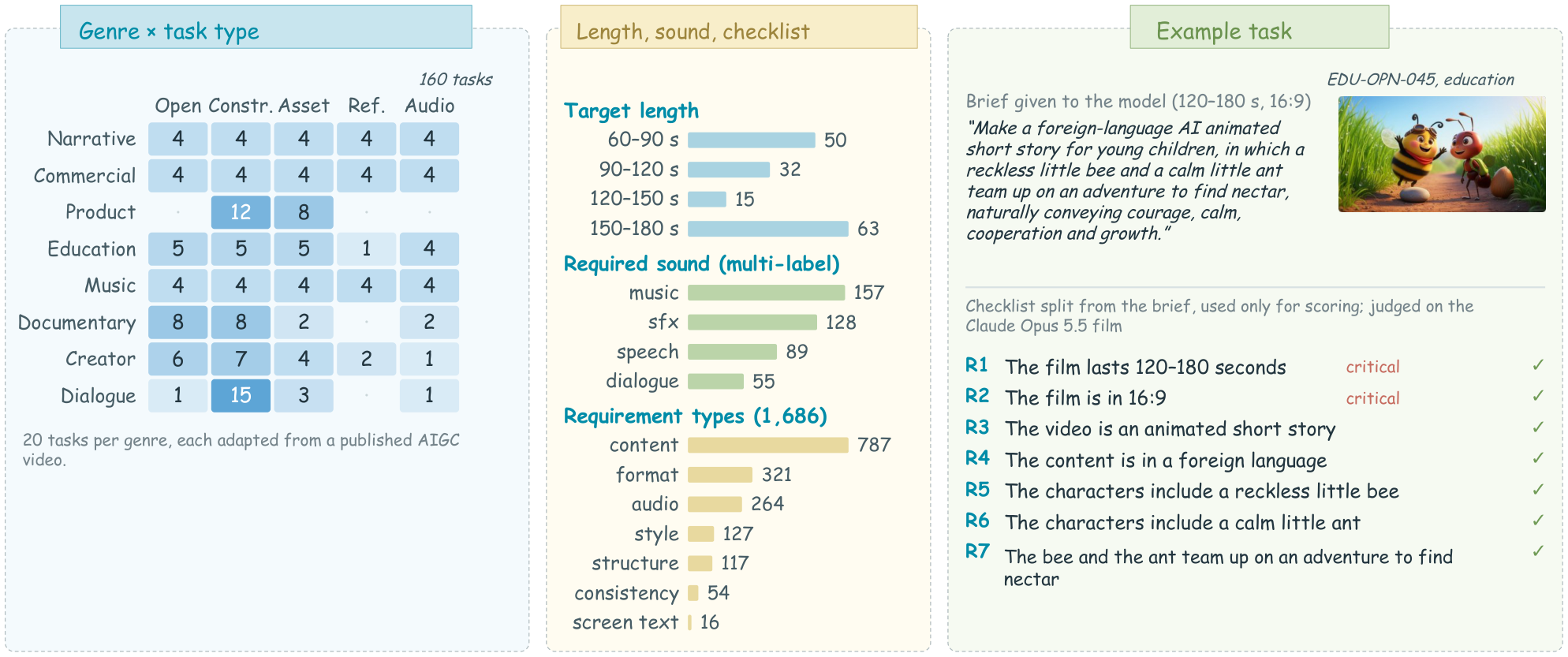
Target durations range from 60 to 180 seconds. Sound requirements are multi-label: 157 tasks need music, 128 sound effects, 89 speech and 55 dialogue. Each brief is split into atomic checklist items (4–18 per task, 545 marked critical) that are never shown to the model and used only for scoring.
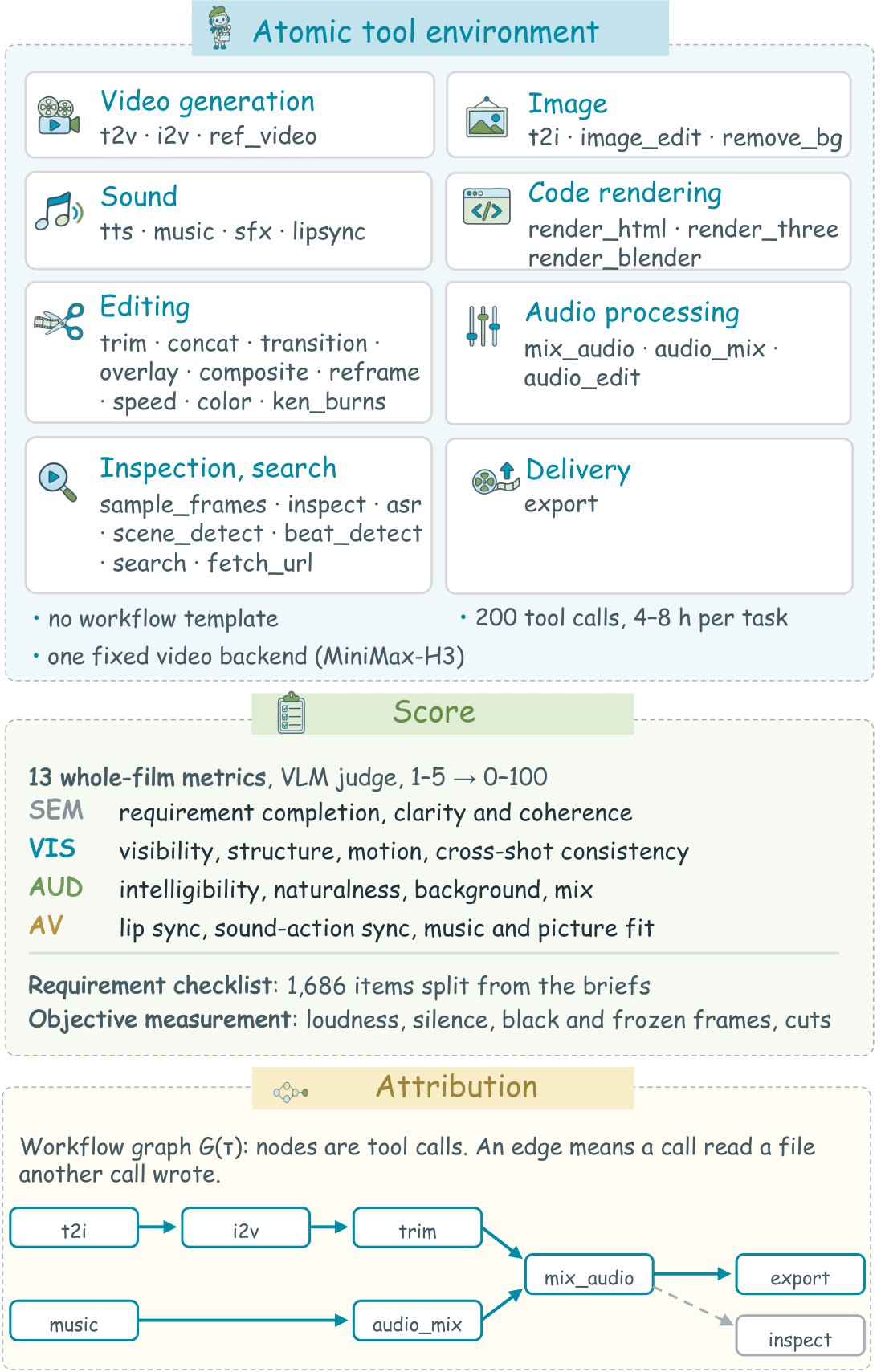 |
33 atomic tools
Every model runs under the same system prompt, tool set, generation backends and budget (200 tool calls, 4–8 hours per task), with one fixed video generator. Scoring. A VLM judge reads the film, its full audio track and sampled frames, and rates 13 metrics on a 1–5 scale with time-stamped evidence, normalized to 0–100. The overall score is the equal-weight mean of the applicable metrics. A run without a film scores 0, so every model is averaged over all 160 tasks. |
Seven MLLMs, 160 tasks each, one run per task–model pair. Scores are 0–100; Delivered counts films out of 160; Cost is the median LLM cost per task.
| # | Model | Overall | SEM | VIS | AUD | AV | Delivered | Cost |
|---|---|---|---|---|---|---|---|---|
| 🥇 | Claude Opus 5.5 | 92.2 | 96.6 | 86.3 | 95.0 | 89.4 | 156 | $8.80 |
| 🥈 | Gemini 4 Argon | 92.0 | 97.6 | 83.8 | 95.4 | 88.9 | 159 | $2.86 |
| 🥉 | GPT-6 Astra | 88.8 | 97.6 | 72.7 | 93.7 | 87.0 | 160 | $2.57 |
| 4 | DeepSeek V4.1 Flash | 88.3 | 95.1 | 76.5 | 91.8 | 86.5 | 156 | $3.29 |
| 5 | Doubao Seed 2.1 Pro | 86.9 | 94.2 | 71.6 | 92.8 | 85.0 | 160 | $0.75 |
| 6 | Qwen3.8 Max | 83.9 | 92.5 | 69.6 | 87.0 | 83.0 | 152 | $2.59 |
| 7 | MiMo v2.6 Pro | 63.4 | 71.0 | 51.8 | 67.3 | 60.9 | 120 | $3.01 |
Claude Opus 5.5 and Gemini 4 Argon are statistically tied (95% bootstrap rank intervals over tasks), but Gemini costs about a third as much per task; Doubao Seed 2.1 Pro reaches 86.9 at $0.75. MiMo v2.6 Pro delivers 75% of its tasks. The interactive board, with human ratings as a reference column, is at openraiser.github.io/StudioBench/leaderboard.
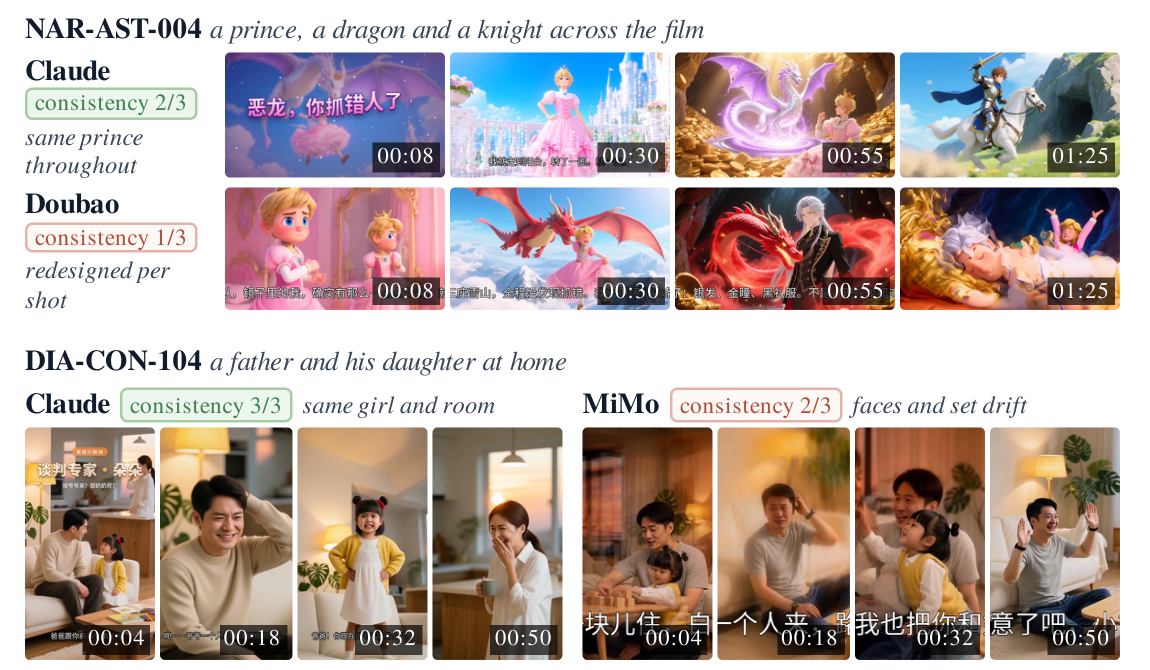
1. Explicit requirements are nearly saturated; craft separates the models. A delivered film meets 98% of its checklist items on average, and 81% of films meet every item. The models differ most in clarity and composition, body and object structure, motion, background audio, cross-shot consistency and lip sync. On the same brief, Claude Opus 5.5 keeps its characters across shots, while Doubao Seed 2.1 Pro and MiMo v2.6 Pro let them drift:
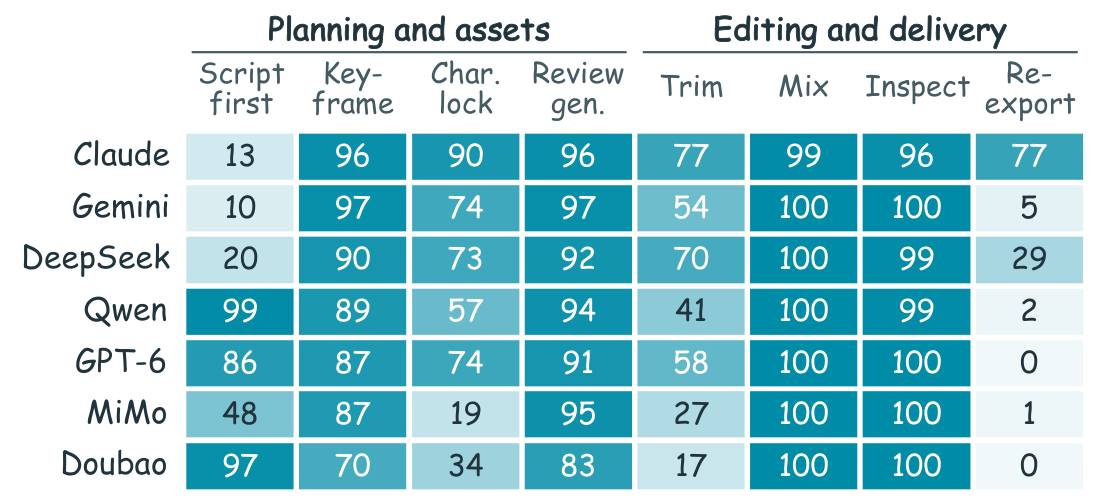
2. A production workflow emerges without any template. Every model generates keyframes before video in 70–97% of runs, reviews generated clips in 83–97%, mixes audio before export in 99–100% and inspects the final film in 96–100%. Strategies still differ: some models write a full script before any tool call, others plan as they go; character locking ranges from 19% to 90% of runs and re-exporting after review from 0% to 77%.
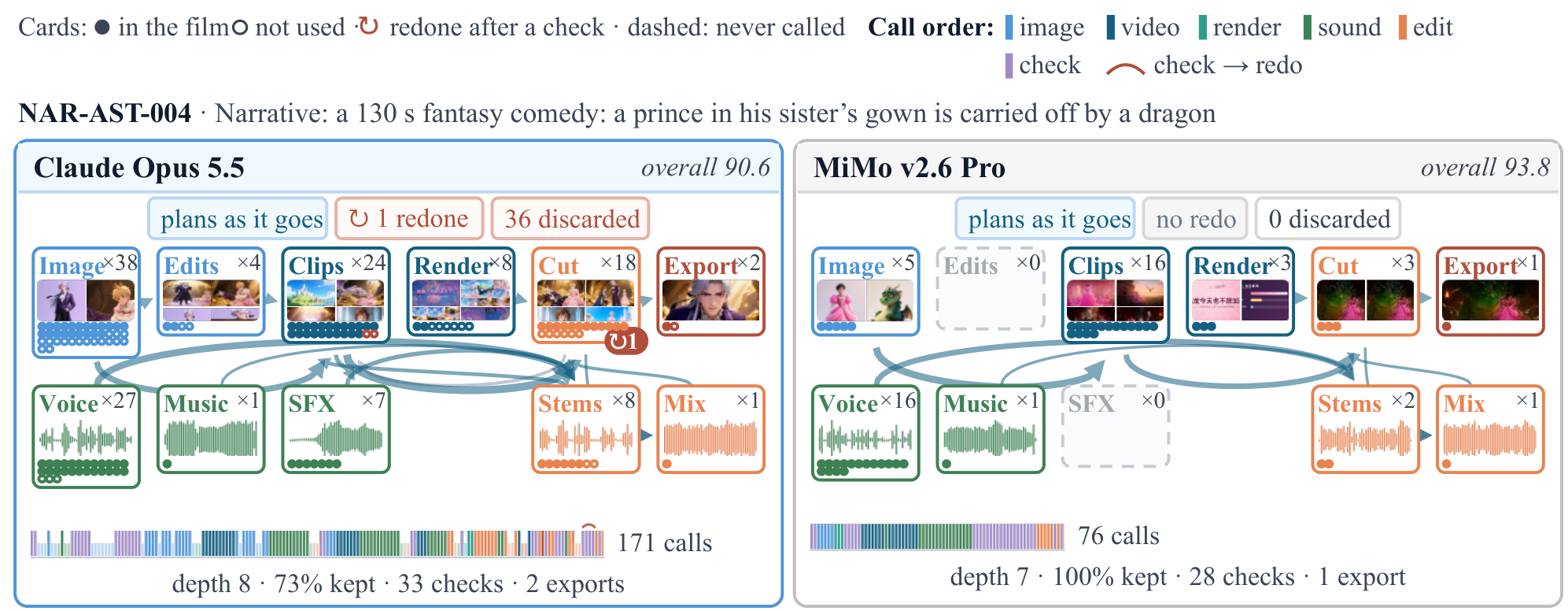
3. The quality loop is the bottleneck. Models recover from most reported tool errors, yet often miss perceptual defects that raise no error: a check that only confirms a file or an audio track exists cannot tell a silent or damaged result from a good one. More tool calls show only a weak association with quality within a model, whereas stronger models keep a smaller share of what they produce (Spearman ρ = −0.64 across models) and build deeper workflows (ρ = +0.75) — they explore, select and revise rather than simply do more.
No GPU is needed to try the pipeline end to end with mock generation backends.
git clone https://github.com/OpenRaiser/StudioBench.git
cd StudioBench
python3 -m venv .venv && . .venv/bin/activate
pip install -e ".[frames,ffmpeg]"

# 1. Check that the tool layer is importable and that ffmpeg is present
./sb preflight

# 2. Exercise every tool through the MCP server with mock generation backends
./sb selftest --mock

# 3. Run the scripted mock pipeline end to end (tools -> final.mp4 -> hard-gate eval)
./sb demo --out ./runs

# 4. Inspect the run tree
./sb monitor --runs ./runs --port 8132                 # web dashboard
./sb explorer --runs ./runs --out ./explorer_site       # static case pages
./sb leaderboard --runs ./runs --out ./board_site       # static leaderboard
./sb site --runs ./runs --out ./site --cases DEMO-TINY  # combined Pages build
Running a task end to end (sb run) drives the evaluated model through the Claude Code CLI with
a strict MCP configuration; see docs/protocol.md. Set STUDIO_BACKEND=mock
to run the whole loop without model weights; such runs are marked valid_for_bench=false.
OpenRaiser/StudioBench is a public repo on GitHub by OpenRaiser. 🎬 StudioBench: Benchmarking Agentic Multimodal Large Language Models for Productive Audiovisual Creation.
It declares the Apache-2.0 license on GitHub.
Its maker has not tagged a system, so it is unknown here. Its README says what it needs.
Open "Take it" on its page: Take My Repo writes an install plan for your machine and hands it to your AI agent (Claude Code, Codex or Cursor), which asks you before each step. Take My Repo has not tested it on any machine.
The agent harness performance optimization system. Skills, instincts, memory, security, and research-first development for Claude Code, Codex, Opencode, Cursor and beyond.
A real-time cross-platform creative coding tool for multimedia development
Reverse engineer anything with agents, from app behavior down to native binaries.
Build Agentic workflows, RAG pipelines, with rich AI model and tool support on one collaborative workspace. Deploy on cloud, VPC, or self-hosted, so teams move from prototype to production without rebuilding the stack.
Its last change on GitHub was on 2026-11-19. Take My Repo does not judge from that whether it is maintained.
Nobody has reviewed it on Take My Repo yet, which says nothing about its quality.
Take My Repo cannot say: it does not audit code and has not run StudioBench. What is known comes from GitHub. It declares the Apache-2.0 license on GitHub. Its last change was on 2026-11-19. It has 2 stars, which measure popularity, not safety. Nobody has reviewed it on Take My Repo yet, which says nothing about its quality. Read the source before you run it. With "Take it", your AI agent shows each step and asks you before running it; README text is treated as data, not as instructions.




