firecrawl
Knowledge infrastructure to make your agents smarter. Search, scrape and access 550+ data providers through one API.
- 209k
- TypeScript
- AGPL-3.0
- 60 min ago
Spotify API pipeline for public artist, album, track and playlist pages, monthly listeners and play counts via ScrapingBee.
Repo ScrapingBee/spotify-api, read from GitHub 24 h ago. ScrapingBee has not joined Take My Repo.
ScrapingBee/spotify-api is a public repo on GitHub by ScrapingBee. Spotify API pipeline for public artist, album, track and playlist pages, monthly listeners and play counts via ScrapingBee. It declares the MIT license on GitHub. It has 0 stars and last changed on 2026-10-30. Nobody has reviewed it on Take My Repo yet, which says nothing about its quality. Read from GitHub on 2026-11-24.
Knowledge infrastructure to make your agents smarter. Search, scrape and access 550+ data providers through one API.
A four stage metadata pipeline for public open.spotify.com pages, built on the Spotify API from ScrapingBee. Point it at artist, album, track and playlist links; it stores names, track lists, durations, release dates, follower and monthly listener counts, play counts and playlist save counts in SQLite, one snapshot per day, and exports CSV or JSONL.
It reads metadata and nothing else. No audio, no 30 second previews, no login, no account data. Every request goes through ScrapingBee's HTML API and every number in this README was measured against open.spotify.com on 2026-10-29.
The first fetch of open.spotify.com/artist/06HL4z0CvFAxyc27GXpf02 came back as 167 KB of nothing useful. The <title> read Spotify - Web Player (the page uses an en dash, swapped for a hyphen here), there was no JSON-LD, no artist name, and the body held three <div> elements before a run of base64 config blobs:
<script id="appServerConfig" type="text/plain">eyJhcHBOYW1lIjoid2ViX3BsYXllcl9wcm90b3R5cGUiLCJtYXJrZXQiOiJU...
<script id="featureFlags" type="text/plain">eyJlbmFibGVTaG93cyI6dHJ1ZSwiZW5hYmxlQXVkaW9ib29rcyI6ZmFsc2Us...
mode=auto billed 1 credit for that and called it a success, because the status was 200. That is the trap with a single page app: the status code says nothing about whether data arrived.
The embed route is a different application. open.spotify.com/embed/<kind>/<id> is a Next.js page (the response carried x-powered-by: Next.js), and it ships its state in the HTML:
<script id="__NEXT_DATA__" type="application/json">{"props":{"pageProps":{"state":{"data":{"entity":{"type":"album","name":"The Life of a Showgirl: The Encore","uri":"spot...
Trimmed to one row, the entity looks like this:
{
  "type": "album",
  "name": "The Life of a Showgirl: The Encore",
  "uri": "spotify:album:4hF2gTGuPYlykYuphDxi8J",
  "id": "4hF2gTGuPYlykYuphDxi8J",
  "subtitle": "Taylor Swift",
  "releaseDate": { "isoString": "2026-09-25T04:00:00Z" },
  "isExplicit": false,
  "trackList": [
    {
      "uri": "spotify:track:0Gms8M0f1kJxAA2pXuLdtI",
      "title": "The Fate of Ophelia",
      "subtitle": "Taylor Swift",
      "isExplicit": false,
      "duration": 226073,
      "playabilityReason": "PLAYABLE",
      "audioPreview": { "format": "MP3_96", "url": "https://p.scdn.co/mp3-preview/f64d..." },
      "entityType": "track"
    }
  ]
}
That is the backbone of the pipeline: 1 credit per artist, album, track or playlist, no browser.
The embed does not show everything. Monthly listeners, world rank, top cities, play counts and playlist save counts only exist in the full web player, which builds them from GraphQL calls after load. Getting those meant a real browser on a premium proxy, and json_response=true to catch the XHR bodies.
From the spb-cost header on each call:
| Request against open.spotify.com | Credits | What came back |
|---|---|---|
/artist/<id>, mode=auto |
1 | Player shell, no artist data |
/artist/<id>, premium_proxy, no JS |
10 | Same shell |
/artist/<id>, render_js on a classic proxy |
5 | Rendered, still no artist name or stats in the DOM |
/artist/<id>, premium_proxy + render_js + json_response |
25 | Full page, 102,061,916 monthly listeners, pathfinder XHR bodies |
/embed/<kind>/<id>, default (render_js on) |
5 | __NEXT_DATA__ present |
/embed/<kind>/<id>, render_js=false |
1 | Same __NEXT_DATA__, 10 KB to 154 KB |
So the pipeline defaults to 1 credit per reference and only spends 25 when you pass --stats. For a list of 500 albums that is 500 credits; for 50 artists with stats it is 1,300.
flowchart LR
    A[refs<br/>spotify: URI or URL] --> B[fetch.py]
    B -->|embed, 1 credit| C[parse.py<br/>__NEXT_DATA__]
    B -->|rendered, 25 credits<br/>only with --stats| D[parse.py<br/>pathfinder XHR]
    C --> E[normalise.py<br/>Entity + Track]
    D --> E
    E --> F[store.py<br/>SQLite snapshot]
    F --> G[entities.csv / tracks.csv<br/>JSONL]
The code is in examples/. Each stage is one file with no imports from later stages, so you can swap the store for Postgres or the fetcher for a queue worker without touching the parsers.
fetch.py)References come in as URIs or URLs, including /intl-xx/ and /embed/ forms:
URI_RE = re.compile(r"spotify:(artist|album|track|playlist):([A-Za-z0-9]{22})")
URL_RE = re.compile(r"open\.spotify\.com/(?:intl-[a-z]{2}/)?(?:embed/)?(artist|album|track|playlist)/([A-Za-z0-9]{22})")
Both fetchers share one retry loop. ScrapingBee returns HTTP 500 when the target times out or refuses, and those calls are free, so retrying them costs nothing:
def _call(self, params):
    last = None
    for attempt in range(self.retries):
        r = self.session.get(API, params=params, timeout=self.timeout)
        if r.status_code != 500:
            break
        last = r
        time.sleep(2 * (attempt + 1))
    else:
        r = last
    cost = int(r.headers.get("spb-cost", 0) or 0)
    self.credits_spent += cost
    r.raise_for_status()
    return r, cost

def fetch_embed(self, kind, spotify_id):
    r, cost = self._call({
        "url": f"https://open.spotify.com/embed/{kind}/{spotify_id}",
        "render_js": "false",
    })
    return RawPage(kind, spotify_id, "embed", r.status_code, cost, body=r.text)

def fetch_rendered(self, kind, spotify_id, wait_ms=8000):
    r, cost = self._call({
        "url": f"https://open.spotify.com/{kind}/{spotify_id}",
        "premium_proxy": "true",
        "render_js": "true",
        "block_resources": "false",
        "wait": str(wait_ms),
        "json_response": "true",
    })
    data = r.json()
    return RawPage(kind, spotify_id, "rendered", r.status_code, cost,
                   body=data.get("body", ""), xhr=data.get("xhr", []))
block_resources=false and the 8 second wait are there because the player fetches a token first and only then fires its GraphQL queries. Cut either and the XHR list comes back without the data calls.
Run it on its own to check a reference before a batch:
$ python fetch.py spotify:track:11hcBLPtbMp4aQI6zGQLub
{"kind": "track", "id": "11hcBLPtbMp4aQI6zGQLub", "status": 200, "credits": 1, "bytes": 10482, "has_next_data": true}
parse.py)Embed pages: one regex and a key path.
NEXT_DATA_RE = re.compile(r'<script id="__NEXT_DATA__"[^>]*>(.*?)</script>', re.S)

def embed_entity(html):
    state = next_data(html)["props"]["pageProps"]["state"]
    entity = state.get("data", {}).get("entity")
    if not entity:
        raise ParseError("embed page has no data.entity")
    return entity
state also contains settings.session.accessToken, an anonymous token with "isAnonymous": true. The parser never touches it. Reading what the page displays is one thing; replaying a borrowed token against Spotify's private endpoints is another, and this repo does not do it.
Rendered pages: the browser's XHR list. On the artist page the useful one was a POST to api-partner.spotify.com/pathfinder/v2/query whose request body read:
{"variables":{"uri":"spotify:artist:06HL4z0CvFAxyc27GXpf02","locale":"","preReleaseV2":false},"operationName":"queryArtistOverview","extensions":{"persistedQuery":{"version":1,"sha256Hash":"9f8134ef..."}}}
So the parser matches on operationName from post_data, never on list position:
def pathfinder_ops(xhr):
    for rec in xhr:
        if "api-partner.spotify.com/pathfinder" not in rec.get("url", ""):
            continue
        try:
            req = json.loads(rec.get("post_data") or "{}")
            body = json.loads(rec.get("body") or "{}")
        except json.JSONDecodeError:
            continue
        if "data" in body:
            yield req.get("operationName"), req.get("variables", {}), body["data"]
The artist response, data.artistUnion.stats, trimmed:
{
  "followers": 165980697,
  "monthlyListeners": 102061916,
  "topCities": {"items": [
    {"city": "London", "country": "GB", "numberOfListeners": 1573800, "region": "ENG"},
    {"city": "Quezon City", "country": "PH", "numberOfListeners": 1405680, "region": "00"}
  ]},
  "worldRank": 5
}
and the rendered DOM agrees with it:
<span aria-hidden="true">102.1M monthly listeners</span><span class="e-101040-visually-hidden" data-encore-id="visuallyHidden">102,061,916 monthly listeners</span>
On a playlist page the player sent fetchPlaylist (offset 0, limit 25) and then fetchPlaylistContents (offset 25, limit 50), plus a playlistPermissions call that is not useful here.
normalise.py)Two dataclasses, Entity and Track, fed from either source. Durations become seconds, release dates become YYYY-MM-DD, the widest image wins, and audioPreview is dropped:
def from_embed(entity):
    kind = entity["type"]
    sid = entity["id"]
    if kind == "track":
        artists = ", ".join(a["name"] for a in entity.get("artists", []))
        track = Track(sid, entity["name"], artists, round(entity["duration"] / 1000, 1),
                      bool(entity.get("isExplicit")), 1, sid)
        rows = [track]
    else:
        rows = [
            Track(_sid(t["uri"]), t["title"], t.get("subtitle", ""), round(t["duration"] / 1000, 1),
                  bool(t.get("isExplicit")), i, sid)
            for i, t in enumerate(entity.get("trackList", []), 1)
        ]
    ...
    maybe_truncated=kind in ("playlist", "album") and len(rows) >= EMBED_TRACK_CAP,
maybe_truncated matters. The embed for All Out 80s (37i9dQZF1DX4UtSsGT1Sbe) listed exactly 100 tracks. The full player reported "totalCount": 150 for the same playlist. A playlist that comes back from the embed with 100 rows should be read as "at least 100", and the record says so until a --stats fetch confirms the real total.
The pathfinder tracks carry more than the embed rows. Each playlist row has a play count and, under playlistAudioAttributes, the tempo and key the player shows:
"playcount": "1100027567",
"playlistAudioAttributes": {"bpm": 118.4749984741211, "key": {"camelotKey": {"color": "#56eff2", "value": "12A"}}}
playlist_stats() reads those, but only for the 75 rows the player loaded before it stopped and waited for a scroll. The pipeline keeps the embed's 100 rows and copies play count, BPM and key onto the rows where position and track id both match.
store.py)SQLite from the standard library, primary key (spotify_id, snapshot), so a daily cron run builds a time series and a same day rerun overwrites:
CREATE TABLE IF NOT EXISTS entities (
    spotify_id TEXT, snapshot TEXT, kind TEXT, name TEXT, subtitle TEXT,
    release_date TEXT, image TEXT, track_count_seen INTEGER,
    track_count_total INTEGER, maybe_truncated INTEGER, followers INTEGER,
    monthly_listeners INTEGER, world_rank INTEGER, top_cities TEXT,
    description TEXT,
    PRIMARY KEY (spotify_id, snapshot)
);
Store.history(id, "monthly_listeners") returns the series for one artist, which is the query A&R and playlist research work starts from.
pipeline.py is the CLI that wires the stages together.
export SCRAPINGBEE_API_KEY=...
pip install requests

# 1 credit each, embed only
python examples/pipeline.py spotify:album:4hF2gTGuPYlykYuphDxi8J \
    https://open.spotify.com/track/11hcBLPtbMp4aQI6zGQLub \
    spotify:playlist:37i9dQZF1DX0D996ZXujBy \
    --db embed.db --csv-dir out_embed
album    The Life of a Showgirl: The Encore: 16 tracks
track    Patient Zero: 1 tracks
playlist Taylor Swift | The Eras Tour Official Setlist: 44 tracks
wrote out_embed/entities.csv
wrote out_embed/tracks.csv
{"credits": 3}
With --stats on an artist and a long playlist:
python examples/pipeline.py spotify:artist:06HL4z0CvFAxyc27GXpf02 \
    https://open.spotify.com/playlist/37i9dQZF1DX4UtSsGT1Sbe \
    --stats --db stats.db --csv-dir out_stats --jsonl-dir out_stats
artist   Taylor Swift: 10 tracks, 102,061,916 monthly listeners, rank 5
playlist All Out 80s: 100/150 tracks, 12,059,999 saves (list may be cut short)
wrote out_stats/entities.csv
wrote out_stats/tracks.csv
wrote out_stats/entities.jsonl
wrote out_stats/tracks.jsonl
{"credits": 52}
The save count read 12,059,988 in the first capture of the morning and 12,059,999 in this run, which is why snapshots carry a date.
First rows of tracks.csv for the artist, from queryArtistOverview:
ScrapingBee/spotify-api is a public repo on GitHub by ScrapingBee. Spotify API pipeline for public artist, album, track and playlist pages, monthly listeners and play counts via ScrapingBee.
It declares the MIT license on GitHub.
Its maker has not tagged a system, so it is unknown here. Its README says what it needs.
Open "Take it" on its page: Take My Repo writes an install plan for your machine and hands it to your AI agent (Claude Code, Codex or Cursor), which asks you before each step. Take My Repo has not tested it on any machine.
Open-source data movement for ELT pipelines and AI agents — from APIs, databases & files to warehouses, lakes, and AI applications. Both self-hosted and Cloud.
Python ETL framework for stream processing, real-time analytics, LLM pipelines, and RAG.
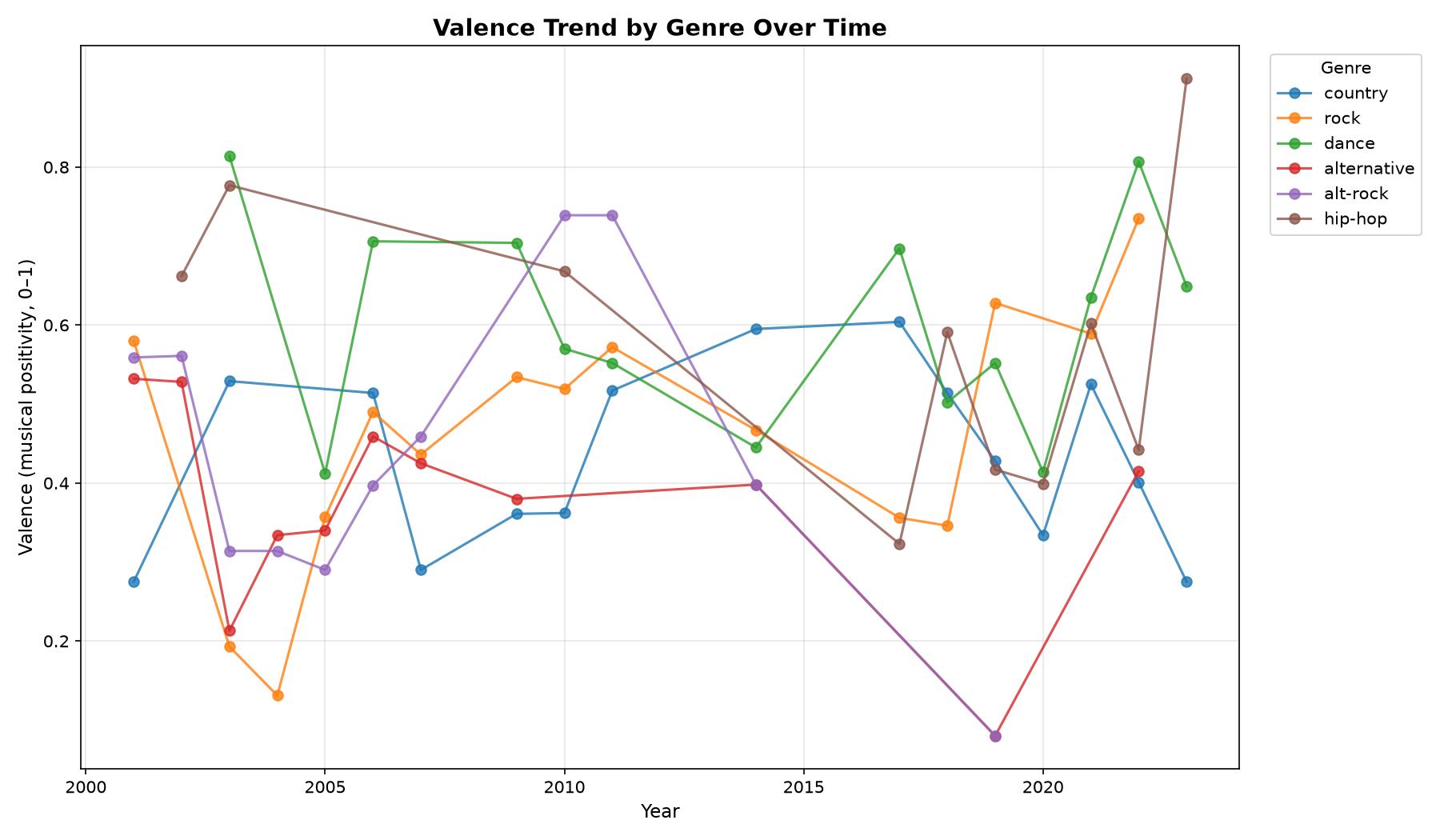
Music mood analysis with pandas & NumPy — valence trends by genre and year from Billboard + Spotify data.
12 weeks, 26 lessons, 52 quizzes, classic Machine Learning for all
Bring data to life with SVG, Canvas and HTML. :bar_chart::chart_with_upwards_trend::tada:
Its last change on GitHub was on 2026-10-30. GitHub counts 0 open issues and pull requests. Take My Repo does not judge from that whether it is maintained.
Nobody has reviewed it on Take My Repo yet, which says nothing about its quality.
Take My Repo cannot say: it does not audit code and has not run spotify-api. What is known comes from GitHub. It declares the MIT license on GitHub. Its last change was on 2026-10-30. It has 0 stars, which measure popularity, not safety. Nobody has reviewed it on Take My Repo yet, which says nothing about its quality. Read the source before you run it. With "Take it", your AI agent shows each step and asks you before running it; README text is treated as data, not as instructions.