bullet3
Bullet Physics SDK: real-time collision detection and multi-physics simulation for VR, games, visual effects, robotics, machine learning etc.
- 15k
- C++
- 6 wk ago
A toolbox that leverages source robotics drivers to easily create robotic arm kinematic chains and communication interfaces
Repo Source-Robotics/Source-Robotics-Toolbox, read from GitHub 3 h ago. Source-Robotics has not joined Take My Repo.
Source-Robotics/Source-Robotics-Toolbox is a public repo on GitHub by Source-Robotics. A toolbox that leverages source robotics drivers to easily create robotic arm kinematic chains and communication interfaces. It declares the MIT license on GitHub. It is written mainly in Python, has 3 stars and last changed on 2026-11-05. Nobody has reviewed it on Take My Repo yet, which says nothing about its quality. Read from GitHub on 2026-11-23.
Python toolbox for robot joints driven by Source Robotics motor drivers. It turns a motor's encoder ticks into the joint's position and speed after the gear reduction, and back, and finds the joint's true position at power-up with sector homing.
Guides · PyPI · Examples · Discord
What it does:
pip install SourceRoboticsToolbox
The toolbox has no dependencies of its own. Paired with the Spectral-BLDC library, which reads the drivers' encoders over CAN, it lets you write simple yet capable code for robot control. Spectral-BLDC needs a CAN adapter that speaks slcan, such as the CANvas USB-to-CAN adapter:
pip install Spectral-BLDC
import SourceRoboticsToolbox
import time

# This is represents encoder ticks where your joint should be at 0 rad
# Usually you know that joint position from your robots DH table / kinematic diagram
Master_position = 14000
Joint_reduction_ratio = 6 # Joint has reduction ratio of 6:1

Joint = SourceRoboticsToolbox.Joint(encoder_resolution = 14,
                                    master_position=Master_position,
                                    gear_ratio = Joint_reduction_ratio,
                                    offset = 0, #Change If your motor is not at 0 rad at master position
                                    dir = 0) # Change joint direction

current_motor_encoder_position = 10000 #This emulates the data you would get from your motor encoder
# Init flag; used to run .determine_sector once
Intial = 0

while True:

    # This will give you Joint position in radians
    # NOTE that joint position is value after the gear reduction of your actuator
    position_values =  Joint.get_joint_position(current_motor_encoder_position)
    print(position_values)

    # This will perform sector homing and determine the sector motor is in
    if Intial ==0 :
        Intial = 1
        Joint.determine_sector(current_motor_encoder_position)

    time.sleep(0.5)
With real motors, the encoder reading comes from the driver: two_spectral_micro.py in
Examples reads two Spectral Micro
drivers over CAN.
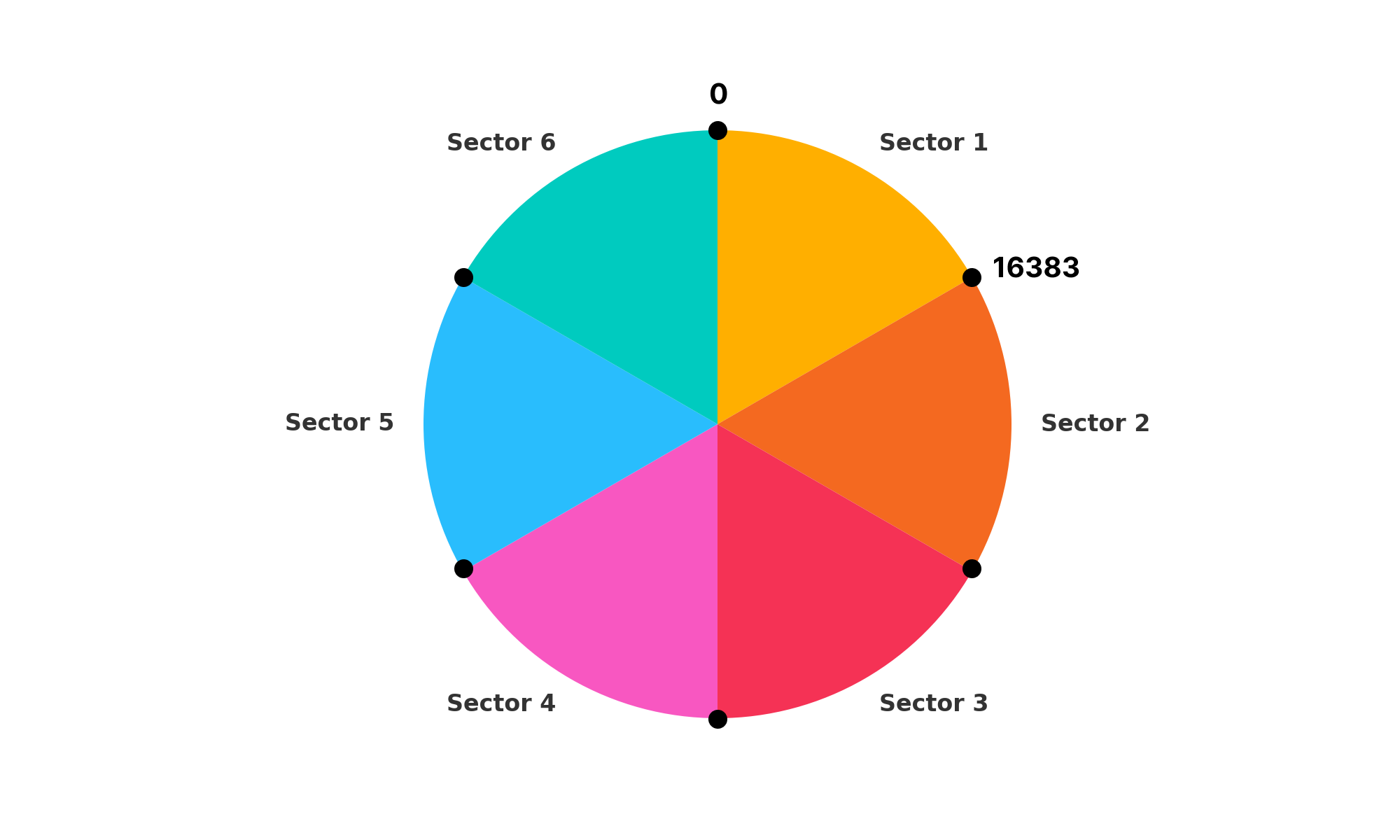
The image represents a 6:1 gear reduction with a Spectral micro BLDC driver. Each sector represents one full rotation of the BLDC motor. For the motor encoder, each sector begins at 0 encoder ticks and ends at 16,383 encoder ticks. Sector homing allows you to record the initial position of the encoder and map it to a specific value for your joint. With this setup, if your robot joint boots in the correct sector, it will know its true position.
Note: This is a simplified explanation. The algorithm is a bit more complex and includes some smart features. To learn more, check the source code.
As the gear reduction ratio increases, this method becomes less effective. However, it works well for ratios up to 15:1.
In the code: master_position is the encoder reading, within one motor revolution, at which the joint is at its
zero; call determine_sector() once with the first encoder reading after power-up, then get_joint_position()
with every reading.
| Product | Encoder | encoder_resolution |
Reading the encoder |
|---|---|---|---|
| Spectral Micro BLDC controller | 14-bit, 16384 ticks per revolution | 14 (the default) | Spectral-BLDC 1.20 or newer, firmware 107 |
| STEPFOC stepper controller | 14-bit, 16384 ticks per revolution | 14 (the default) | Spectral-BLDC 1.20 or newer, firmware 108 |
The toolbox only does the arithmetic, so another encoder works with its own resolution in bits. Older firmware: the compatibility pages of the Spectral Micro and STEPFOC manuals.
In Examples:
| Example | What it does |
|---|---|
basic.py |
the quick start: one joint with a 6:1 reduction and its master position at 14000 ticks, fed an emulated encoder reading of 10000 ticks; runs sector homing once and prints the joint position in radians every 0.5 s |
two_spectral_micro.py |
two Spectral Micro drivers (node IDs 0 and 1) on one CAN bus with an slcan adapter (COM41, 1 Mbit/s): asks both for their encoder data, runs sector homing on each joint's first reading and prints the encoder ticks and the joint positions (reductions 3:1 and 0.5:1, the first joint offset by −π/2); needs Spectral-BLDC and numpy |
The toolbox at work in the manuals and the Spectral-BLDC examples:
| Where | What |
|---|---|
| Bilateral teleoperation guide | two motors coupled so that each follows the other and feels its force; Spectral Micro manual |
| Quadruped guide | one leg of a quadruped robot, two motors on one CAN bus; Spectral Micro manual |
| SSG-48 teleoperation and MSG teleoperation | two grippers on one CAN bus, each following the other, with force feedback; the gripper manuals |
| Spectral-BLDC advanced examples | Bilateral teleop 2DOF and SSG48 gripper bilateral teleop |
Joint class: every call, its arguments and what it returnsJoint(encoder_resolution=14, master_position=9569, gear_ratio=1, offset=0, dir=0)encoder_resolution: the encoder's resolution in bits; 14 for 16384 ticks per revolution.master_position: the encoder reading, in ticks within one motor revolution, at which the joint is at its zero.gear_ratio: the joint's reduction, 6 for 6:1.offset: the joint's angle at the master position, in radians; change it if your motor is not at 0 rad at the
master position.dir: 0, or 1 to reverse the joint's direction.determine_sector(initial)Sector homing: finds the sector from the first encoder reading after power-up. Call it once.
get_joint_position(motor_position) → floatThe joint position in radians, after the gear reduction, from the motor's encoder ticks.
get_joint_speed(motor_speed) → floatThe joint speed in rad/s, after the gear reduction, from the motor's speed in ticks/s.
get_encoder_position(joint_position) → intThe motor's encoder ticks for a joint position in radians.
get_encoder_speed(joint_speed) → floatThe motor's speed in ticks/s for a joint speed in rad/s (marked "TODO check" in the code).
ticks_to_radians(ticks), radians_to_ticks(radians), ticks_to_degrees(ticks), degrees_to_ticks(degrees)Conversions at the joint, through the gear ratio; the ticks are the motor's.
unwrap_position(position_ticks) → intThe position within one motor revolution, 0 to 16383 for a 14-bit encoder.
Ask in Discussions, chat on Discord, report a bug in Issues. Follow Source Robotics:
Project is under MIT Licence
Source-Robotics/Source-Robotics-Toolbox is a public repo on GitHub by Source-Robotics. A toolbox that leverages source robotics drivers to easily create robotic arm kinematic chains and communication interfaces.
It declares the MIT license on GitHub.
Its maker has not tagged a system, so it is unknown here. Its README says what it needs.
Open "Take it" on its page: Take My Repo writes an install plan for your machine and hands it to your AI agent (Claude Code, Codex or Cursor), which asks you before each step. Take My Repo has not tested it on any machine.
Its last change on GitHub was on 2026-11-05. Take My Repo does not judge from that whether it is maintained.
Bullet Physics SDK: real-time collision detection and multi-physics simulation for VR, games, visual effects, robotics, machine learning etc.
Nobody has reviewed it on Take My Repo yet, which says nothing about its quality.
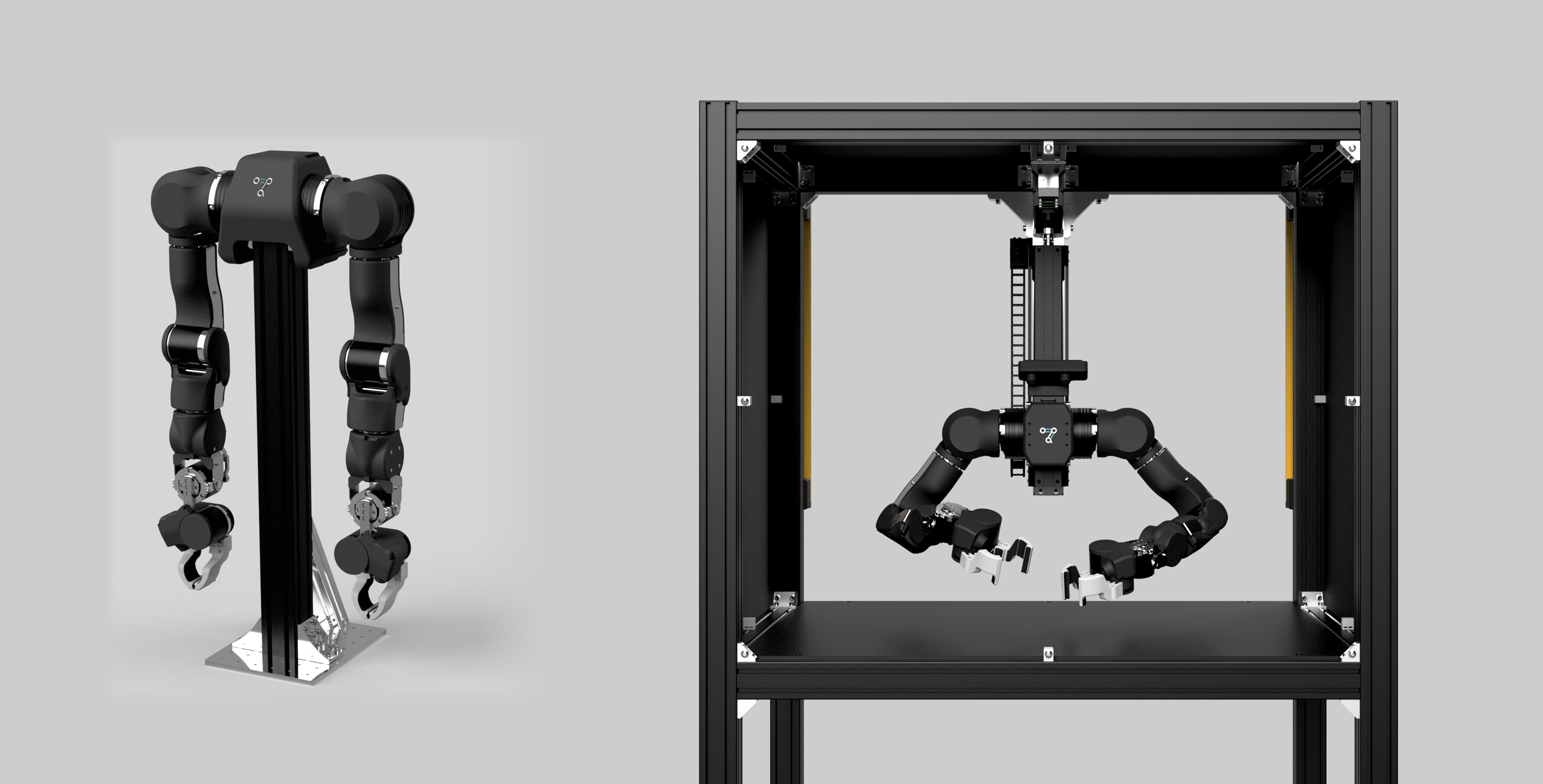
A fully open-source humanoid arm for physical AI research and deployment in contact-rich environments.
:house_with_garden: Open source home automation that puts local control and privacy first.
π RuView turns commodity WiFi signals into real-time spatial intelligence, vital sign monitoring, and presence detection — all without a single pixel of video.
PAROL6: open-source 3D-printed 6-axis desktop robot arm. BOM, STL and STEP files, firmware and build instructions.
Faze4: open-source 3D-printed 6-axis robot arm with cycloidal gearboxes and the wiring inside the arm, the files to build it.
Differential robot wrist: an open-source 3D-printed differential mechanism for a robot wrist, driven by two gimbal motors on Spectral Micro BLDC drivers.
SSG-48: open-source adaptive electric gripper with force feedback, driven by the Spectral Micro BLDC controller.
Spectral Micro: compact FOC controller for brushless (BLDC) motors, with CAN, UART and open-source firmware.