vllm
A high-throughput and memory-efficient inference and serving engine for LLMs
- 98k
- Python
- Apache-2.0
- 26 min ago
How loop count affects accuracy, written reasoning and cost in Thinking Machines' varloop research checkpoint
Repo mohi-devhub/loop-dial, read from GitHub 34 min ago. mohi-devhub has not joined Take My Repo.
mohi-devhub/loop-dial is a public repo on GitHub by mohi-devhub. How loop count affects accuracy, written reasoning and cost in Thinking Machines' varloop research checkpoint. It declares the MIT license on GitHub. It is written mainly in Python, has 0 stars and last changed on 2026-11-21. Nobody has reviewed it on Take My Repo yet, which says nothing about its quality. Read from GitHub on 2026-11-25.
A high-throughput and memory-efficient inference and serving engine for LLMs
What changes when you give a looped model more passes through the same layers?
We tested thinkingmachines/TML-d24-varloop-research, the varloop research checkpoint, not shipped Inkling 2 Mini. The model card describes a model whose loop count can change at inference. This study measures accuracy, written reasoning, latency, cache sharing and repeat variation on fixed subsets.
Read the article · Full report · All result tables · Dataset licences
The measurements show shorter written reasoning. They do not reveal what the internal loops computed or establish a general depth limit.
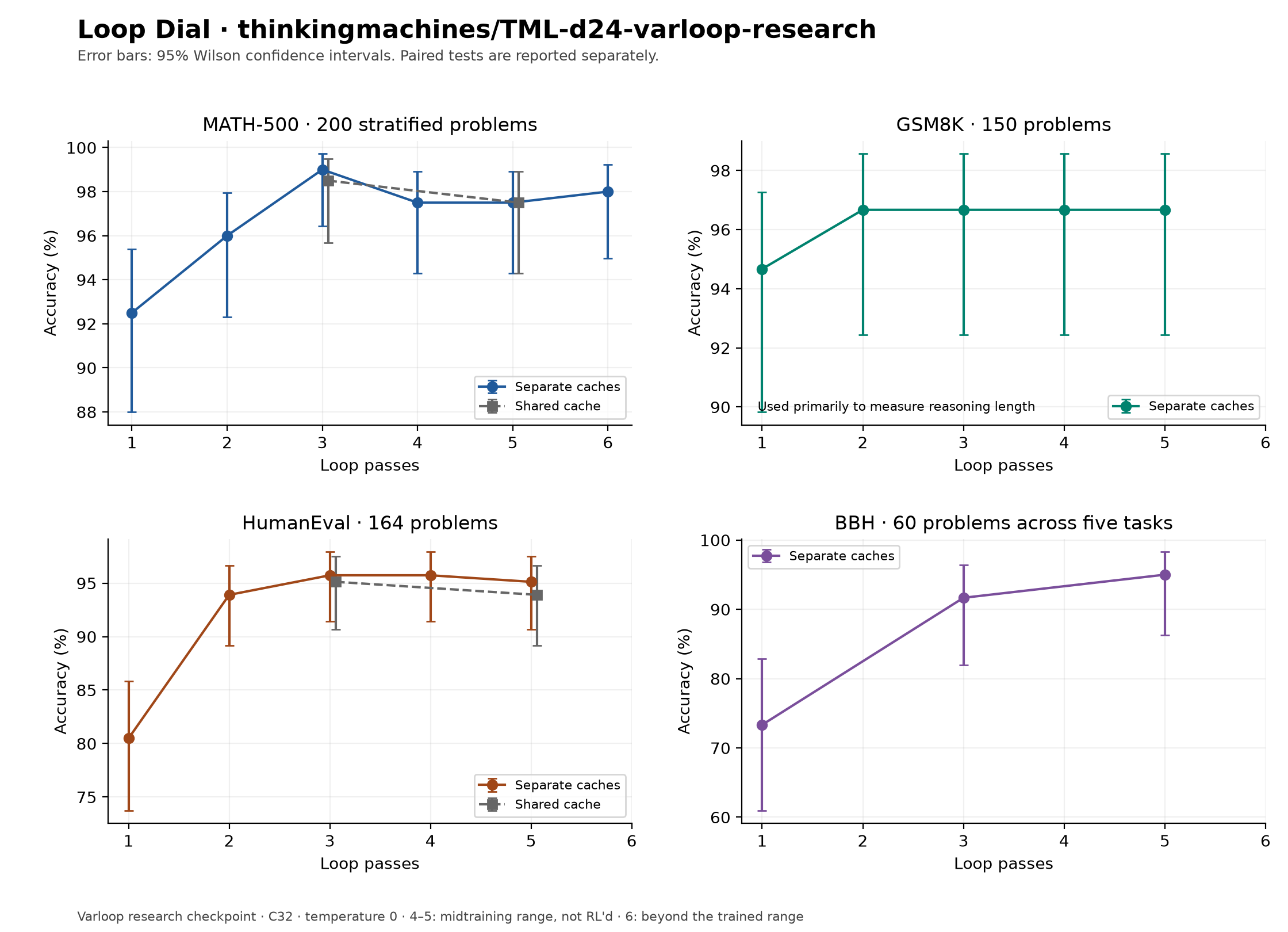
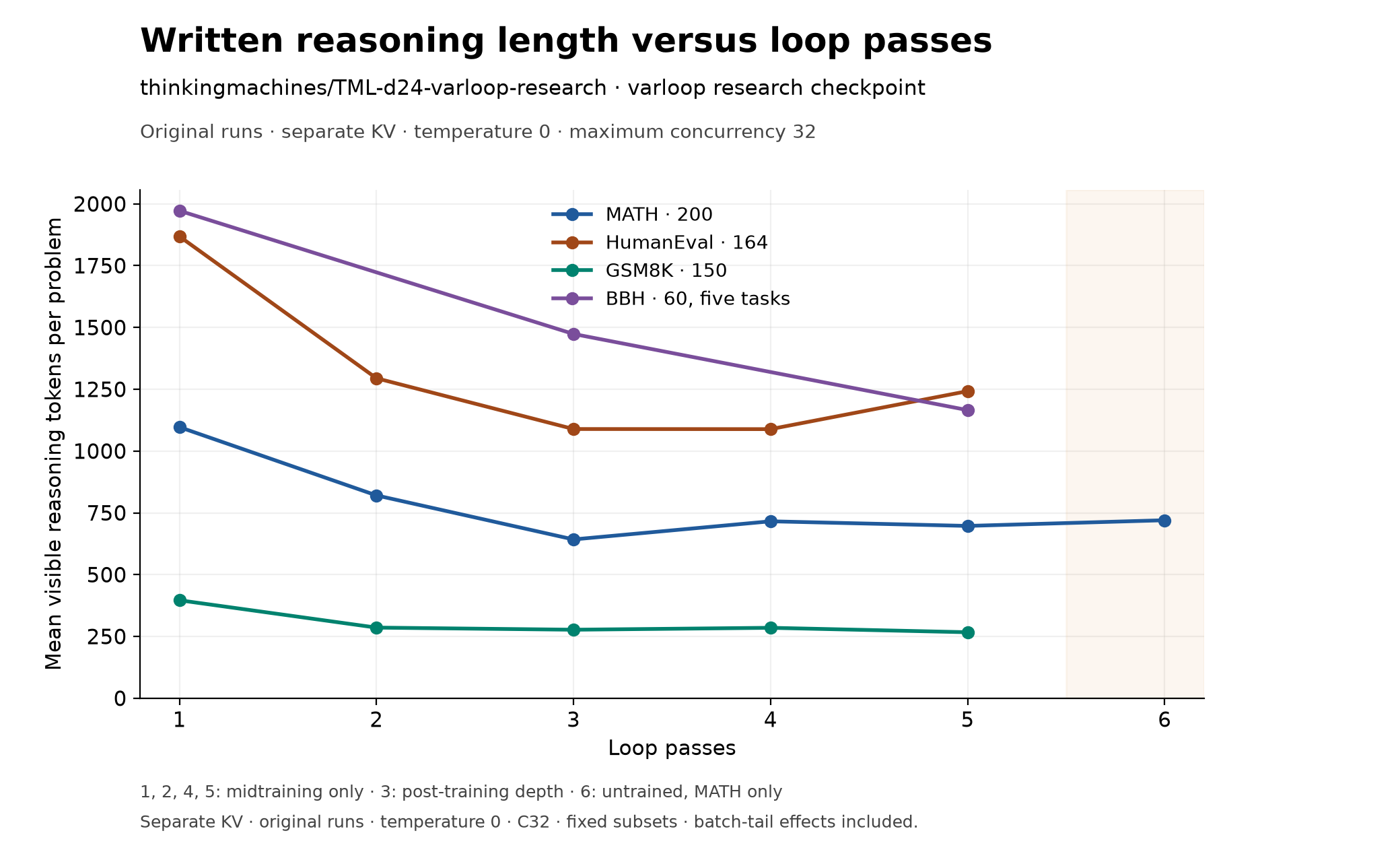
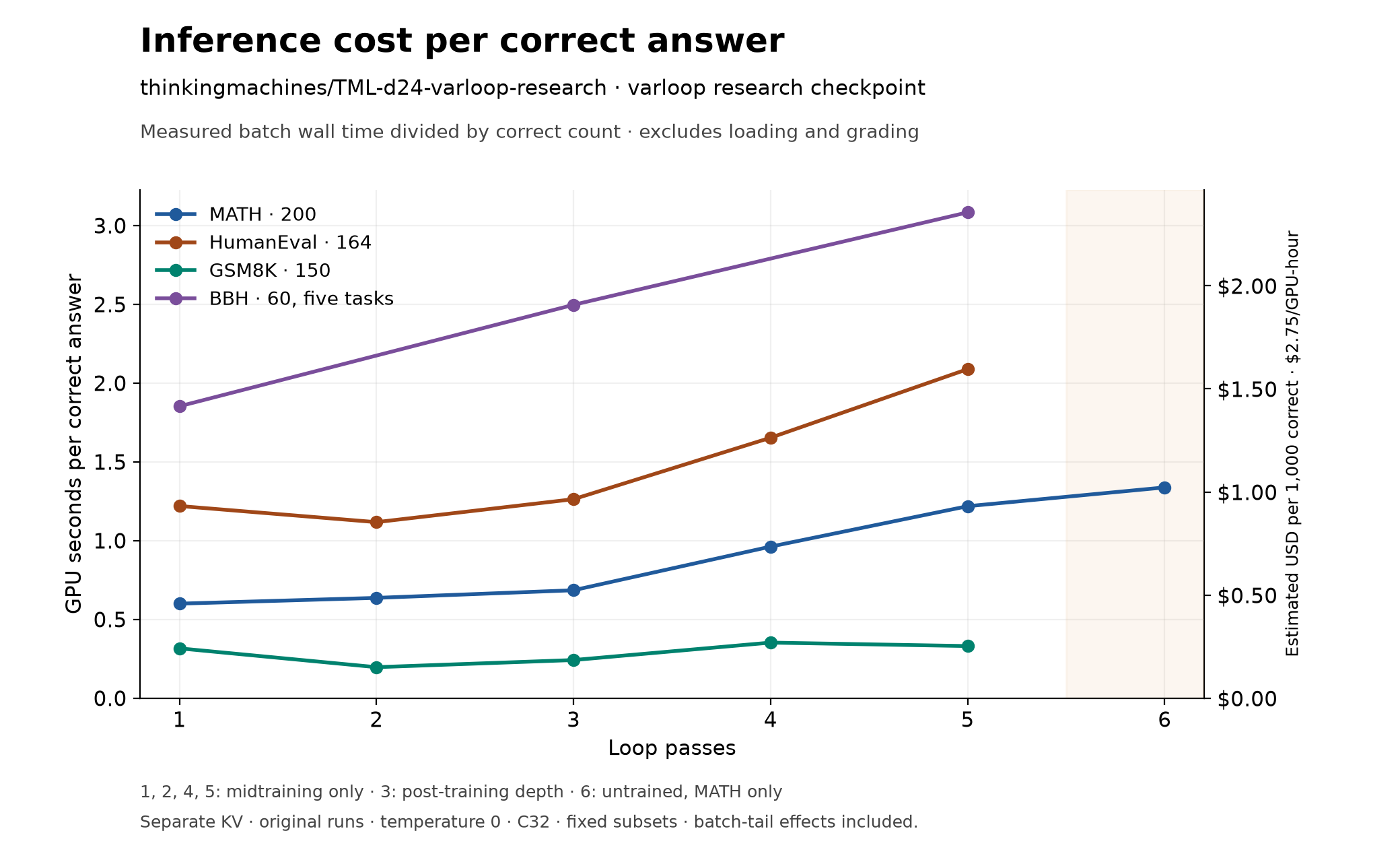
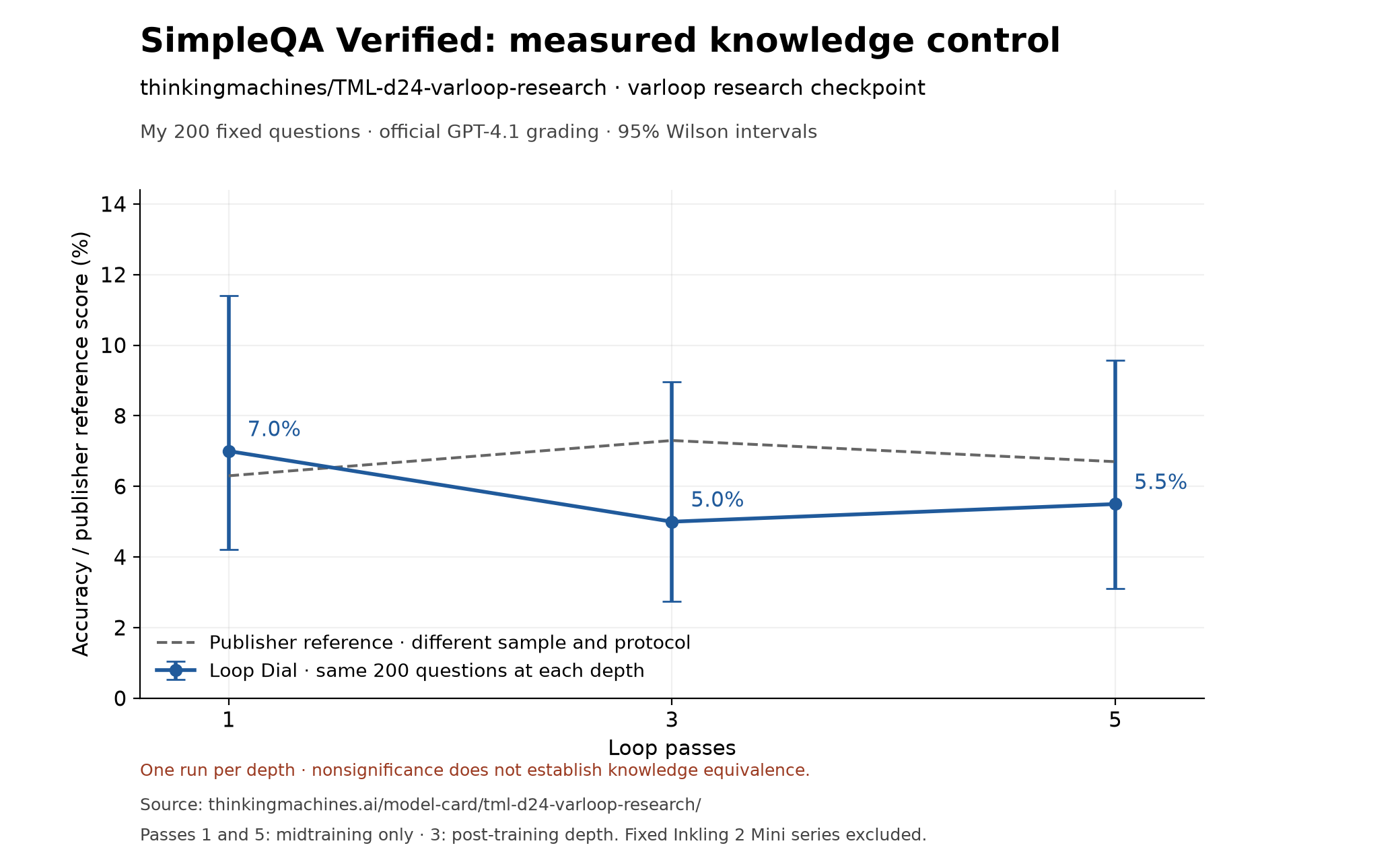
PNG and SVG versions are included. The knowledge chart uses our 95% Wilson intervals; the gray publisher curve is a reference only. The model-card context tables keep publisher results separate from ours.
The full matrix has 4,734 scored responses: GSM8K 150 problems at passes 1–5; MATH-500 200 problems, 40 per level, at passes 1–6; HumanEval 164 at passes 1–5; and 60 BBH problems across five tasks at passes 1, 3 and 5. Shared KV cache was tested at passes 3 and 5 on MATH and HumanEval. Two extra runs at passes 1 and 3 used 100 matched MATH problems and all HumanEval tasks.
The separately approved SimpleQA control adds 600 scored responses on the same 200 questions at passes 1, 3 and 5. All runs used temperature zero and maximum concurrency 32. The SGLang Inkling reasoning parser separated visible reasoning from final answers. Math uses numeric equivalence; HumanEval uses sandboxed execution; SimpleQA uses the official rubric and GPT-4.1 snapshot. Saved grades are included.
Use Python 3.13 and the pinned analysis dependencies:
python3 -m venv .venv
.venv/bin/python -m pip install -r requirements-analysis.txt
.venv/bin/python scripts/reproduce.py
After dependency installation, reproduction disables network access. It reads the saved scored results, regenerates the analyses, result tables, report, README and charts, and compares all numerical analysis values against the archived reference. No model weights, GPU, API key or paid judge is needed. It does not rerun sandbox execution or LLM grading. See REPRODUCE.md for the distinction.
The complete reasoning and answer text, scores, token counts, request timings and generated-token usage are in compressed JSONL files under results/full and results/knowledge. Per-chunk timestamp arrays were reduced to their first/last times and count. Every reported timing scalar is preserved. Raw server logs, job-account identifiers, credentials and workstation paths are excluded.
The dataset manifest and knowledge manifest publish subset IDs and source revisions. scripts/fetch_datasets.py fetches original sources and verifies their hashes. The inference code is included for inspection and future experiments with your own credentials and budget. Archived configurations cannot launch paid jobs by default.
The original full-study resource upper bound was $4.79. The knowledge control added $1.75. Together this is approximately $6.54, before any billing discounts and excluding the earlier pilot. These are timestamp- and returned-token-based estimates, not verified invoices. BUDGET.md records the components and caps.
The checkpoint was exposed to passes 1–5 in later midtraining, sampled in the ratio 1:2:6:2:1, and post-trained at three passes. Passes 1, 2, 4 and 5 are midtraining only; six is beyond the trained range. The model card is the source for those labels.
MATH is near saturation in this subset. Level 5 scored 38/40 at three passes, or 95.0%, with a wide 95% CI of 83.5% to 98.6%. Recovering both remaining errors would add only one point overall. Fixed benchmark familiarity, an 8,192-token output cap, one GPU/runtime, three repeats in selected cells and one run per knowledge depth limit generalization. Nonsignificance does not establish equivalence. Compute-matched observations are not controlled token-budget experiments.
Study code is MIT. Third-party dataset text retains its upstream licence and attribution. See LICENSE, DATASETS.md and THIRD_PARTY_NOTICES.md. Model weights are not redistributed.
Sources: research model card, Thinking Machines release post, and SGLang cookbook. The cookbook reports GSM8K 84.0% at one pass, 88.5% at three and 90.0% at three with shared cache. Its figures use a different, incompletely pinned protocol and are not merged with our measurements.
mohi-devhub/loop-dial is a public repo on GitHub by mohi-devhub. How loop count affects accuracy, written reasoning and cost in Thinking Machines' varloop research checkpoint.
It declares the MIT license on GitHub.
Its maker has not tagged a system, so it is unknown here. Its README says what it needs.
Open "Take it" on its page: Take My Repo writes an install plan for your machine and hands it to your AI agent (Claude Code, Codex or Cursor), which asks you before each step. Take My Repo has not tested it on any machine.
A game theoretic approach to explain the output of any machine learning model.
The agent harness performance optimization system. Skills, instincts, memory, security, and research-first development for Claude Code, Codex, Opencode, Cursor and beyond.
:sunrise: A comprehensive, cutting-edge open-source framework for next-generation Transformers/LLM, with compute-matched benchmarking and a platform for autonomous architecture research.
Ultralytics YOLOv5 in PyTorch for object detection, instance segmentation, classification, training, and export.
Its last change on GitHub was on 2026-11-21. Take My Repo does not judge from that whether it is maintained.
Nobody has reviewed it on Take My Repo yet, which says nothing about its quality.
Take My Repo cannot say: it does not audit code and has not run loop-dial. What is known comes from GitHub. It declares the MIT license on GitHub. Its last change was on 2026-11-21. It has 0 stars, which measure popularity, not safety. Nobody has reviewed it on Take My Repo yet, which says nothing about its quality. Read the source before you run it. With "Take it", your AI agent shows each step and asks you before running it; README text is treated as data, not as instructions.