awesome-selfhosted
A list of Free Software network services and web applications which can be hosted on your own servers
- 339k
- 4 d ago
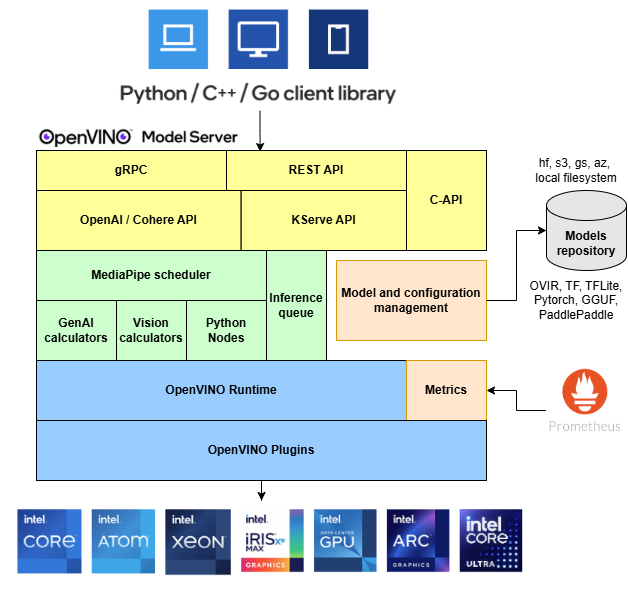
A scalable inference server for models optimized with OpenVINO™
Repo openvinotoolkit/model_server, read from GitHub 1 min ago. openvinotoolkit has not joined Take My Repo.
openvinotoolkit/model_server is a public repo on GitHub by openvinotoolkit. A scalable inference server for models optimized with OpenVINO™. It declares the Apache-2.0 license on GitHub. It is written mainly in C++, has 962 stars and last changed on 2026-11-21. Nobody has reviewed it on Take My Repo yet, which says nothing about its quality. Read from GitHub on 2026-11-21.
High-performance model serving for Generative AI and classic deep learning — powered by OpenVINO and optimized for Intel hardware.
OpenVINO Model Server (OVMS) is a production-grade, C++ inference server that exposes ML models over standard network APIs. It serves both Generative AI, Agentic workloads (LLMs, VLMs, image generation, audio) and classic deep learning models (object detection, classification, OCR, and more).

On Linux (Docker):
mkdir -p ${HOME}/models
# Model is downloaded automatically from HuggingFace to models folder
docker run --rm -p 8000:8000 \
  --user $(id -u):$(id -g) -v ${HOME}/models:/models:rw \
  openvino/model_server:latest \
  --source_model OpenVINO/Qwen3-4B-int4-ov \
  --model_repository_path /models \
  --rest_port 8000
For GPU acceleration, use the
latest-gpuimage tag and pass--device /dev/dri --group-add $(stat -c '%g' /dev/dri/render* | head -n1)to expose the Intel GPU device.
On Windows (binary package):
mkdir c:\models
ovms.exe --source_model OpenVINO/Qwen3-4B-int4-ov --model_repository_path c:\models --rest_port 8000
Query the model:
pip install openaifrom openai import OpenAI client = OpenAI(base_url="http://localhost:8000/v1", api_key="unused") stream = client.chat.completions.create( model="OpenVINO/Qwen3-4B-int4-ov", messages=[{"role": "user", "content": "What are the 3 main tourist attractions in Paris?"}], stream=True, extra_body={"chat_template_kwargs": {"enable_thinking": False}} ) for chunk in stream: if chunk.choices[0].delta.content: print(chunk.choices[0].delta.content, end="", flush=True)
Download the model:
curl -L https://huggingface.co/OpenVINO/resnet50-int8-ov/resolve/main/resnet50.bin -O
curl -L https://huggingface.co/OpenVINO/resnet50-int8-ov/resolve/main/resnet50.xml -O
On Linux (Docker):
docker run --rm -d -u $(id -u) -v ${PWD}:/models -p 9000:9000 \
  openvino/model_server:latest \
  --model_name resnet --model_path /models/resnet50.xml \
  --mean "[123.675,116.28,103.53]" --scale "[58.395,57.12,57.375]" --layout "NHWC:NCHW" \
  --port 9000
For GPU acceleration, use the
latest-gpuimage tag and pass--device /dev/dri --group-add $(stat -c '%g' /dev/dri/render* | head -n1)to expose the Intel GPU device.
Windows (binary package):
ovms --model_name resnet --model_path resnet50.xml --mean "[123.675,116.28,103.53]" --scale "[58.395,57.12,57.375]" --layout "NHWC:NCHW" --port 9000
Run inference with a sample client
pip install numpy tritonclient[grpc]
curl -L -o image.jpeg https://github.com/openvinotoolkit/model_server/blob/main/demos/common/static/images/bee.jpeg?raw=true
import numpy as np
import tritonclient.grpc as grpcclient
with open("image.jpeg", "rb") as f:
    image_bytes = f.read()
client = grpcclient.InferenceServerClient(url="localhost:9000")
inputs = [grpcclient.InferInput("image", [1], "BYTES")]
inputs[0].set_data_from_numpy(np.array([image_bytes], dtype=object))
outputs = [grpcclient.InferRequestedOutput("output")]
result = client.infer(model_name="resnet", inputs=inputs, outputs=outputs)
output = result.as_numpy("output")  # (1, 1000) FP32
print("Top-1 class index:", int(np.argmax(output[0])))
/v1/embeddings/v1/images/generations| Topic | Link |
|---|---|
| Deployment | Deploying the server |
| Model repository | Preparing models |
| Client libraries | Writing client code |
| Demos & examples | Demos |
| Release notes | GitHub Releases |
Docker images:
docker pull openvino/model_server:latest        # Intel CPU
docker pull openvino/model_server:latest-gpu    # Intel CPU,GPU,NPU

docker pull openvino/model_server:weekly        # pre-production version with all accelerators enabled
Binary official packages (Linux & Windows): GitHub Releases
Binary pre-production packages (Linux & Windows): storage.openvinotoolkit.org
Contributions are welcome! Please open an issue or pull request on GitHub.
See the contributing guide for contribution guidelines. For responsible disclosure, see the security policy.
* Other names and brands may be claimed as the property of others.
openvinotoolkit/model_server is a public repo on GitHub by openvinotoolkit. A scalable inference server for models optimized with OpenVINO™.
It declares the Apache-2.0 license on GitHub.
Its maker has not tagged a system, so it is unknown here. Its README says what it needs.
Open "Take it" on its page: Take My Repo writes an install plan for your machine and hands it to your AI agent (Claude Code, Codex or Cursor), which asks you before each step. Take My Repo has not tested it on any machine.
Its last change on GitHub was on 2026-11-21. Take My Repo does not judge from that whether it is maintained.
Nobody has reviewed it on Take My Repo yet, which says nothing about its quality.
A list of Free Software network services and web applications which can be hosted on your own servers
Apache Airflow - A platform to programmatically author, schedule, and monitor workflows
The agent harness performance optimization system. Skills, instincts, memory, security, and research-first development for Claude Code, Codex, Opencode, Cursor and beyond.
OpenVINO™ is an open source toolkit for optimizing and deploying AI inference
Pre-trained Deep Learning models and demos (high quality and extremely fast)
Neural Network Compression Framework for enhanced OpenVINO™ inference
Run Generative AI models with simple C++/Python API and using OpenVINO Runtime