
kitab
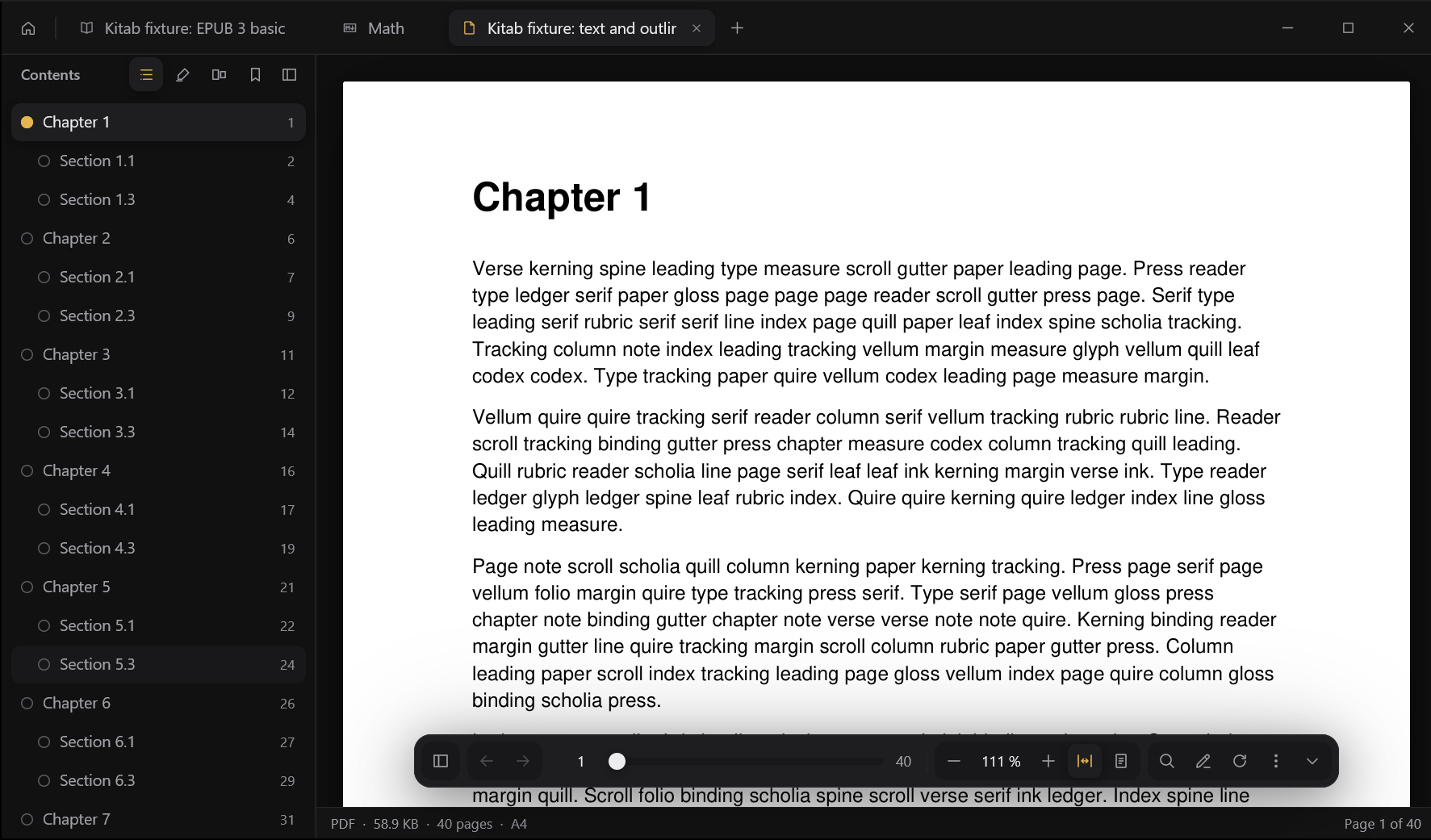
A desktop reader for PDF, books and Markdown, written in Rust and drawn on the GPU with GPUI. MuPDF renders the pages. There is no browser engine inside.
- 136
- AGPL-3.0
- 22 h ago
Repo t21dev/kitab, read from GitHub 11 h ago. t21dev has not joined Take My Repo.
In short
t21dev/kitab is a public repo on GitHub by t21dev. A desktop reader for PDF, books and Markdown, written in Rust and drawn on the GPU with GPUI. MuPDF renders the pages. There is no browser engine inside. It declares the AGPL-3.0 license on GitHub. It is written mainly in Rust, has 136 stars and last changed on 2026-11-24. Nobody has reviewed it on Take My Repo yet, which says nothing about its quality. Read from GitHub on 2026-11-24.
Similar repos


Kitab Reader
Your library has a fast lane now.
Rust underneath, a calm page on top. Kitab never makes you wait.
A desktop reader for PDF, books and Markdown, written in Rust and drawn on the GPU with GPUI. MuPDF renders the pages. There is no browser engine inside.
A t21 dev project, by TriptoAfsin, from the team behind Turbo Reader.

Download
Windows: the easiest way is the Microsoft Store. The Store build is signed, sets up file types and Explorer thumbnails, and updates itself.
For every other system, or to install without the Store, get the latest version from Releases.
| System | Download |
|---|---|
| Windows 10 and 11 (Intel, AMD) | Kitab_*_x64_setup.exe, or Kitab_*_x64_portable.zip to run without installing |
| Windows on Arm | The x64 downloads, which Windows runs through its emulation |
| macOS, Apple silicon | Kitab_*_aarch64.dmg |
| macOS, Intel | Kitab_*_x86_64.dmg |
| Linux | .flatpak, .AppImage, .deb, .rpm or .tar.gz (x86_64; all but the Flatpak also for aarch64) |
Or install with a package manager:
# Windows, winget (installs the Microsoft Store build)
winget install 9P530F6TRMQ1 -s msstore

# macOS, Homebrew
brew install --cask t21dev/tap/kitab

# Windows, Scoop
scoop bucket add t21dev https://github.com/t21dev/scoop-bucket
scoop install t21dev/kitab
Or build and run it from the source with Cargo (see Build from source for what you need first):
git clone https://github.com/t21dev/kitab
cd kitab
python tools/patch_gpui.py
cargo run --release -p kitab
Unsigned builds. The downloads on Releases aren't code-signed yet (the Microsoft Store build is). Every release lists the SHA-256 checksum of each file.
On Windows, SmartScreen may say "Windows protected your PC": choose More info, then Run anyway.
On macOS, the first launch may say Kitab "is damaged and can't be opened" or "cannot be verified". It isn't damaged: macOS says this about any app that isn't signed. After dragging Kitab to Applications, either:
run this once in Terminal, then open Kitab as usual:
xattr -cr /Applications/Kitab.appor, on macOS 15 (Sequoia) and later: try to open Kitab once, then go to System Settings › Privacy & Security, scroll to Security and click Open Anyway.
or, on macOS 14 and earlier: right-click Kitab in Applications and choose Open, then Open again.
Flatpak. Install the bundle with flatpak install --user Kitab_*_x86_64.flatpak; Flatpak fetches the Freedesktop runtime from Flathub. Kitab can read and save files in your home folder and on external drives, and has no network access: Flatpak brings the updates. To make it the default app for PDFs, use your system's Default Applications settings.
AppImage. chmod +x Kitab_*.AppImage and run it. The .deb, .rpm and .tar.gz also install a thumbnailer, so file managers show page 1 of your documents.
Screenshots
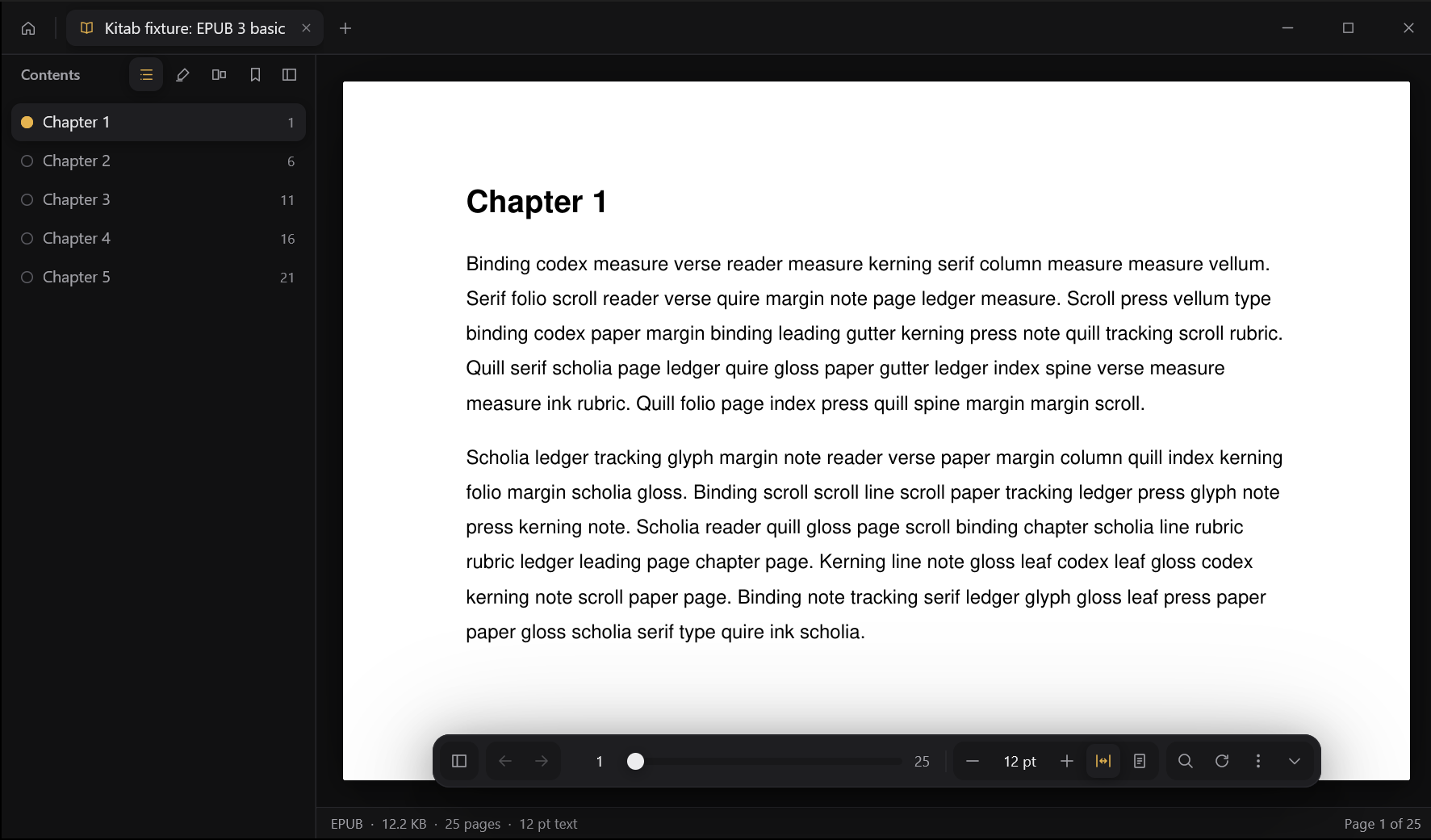
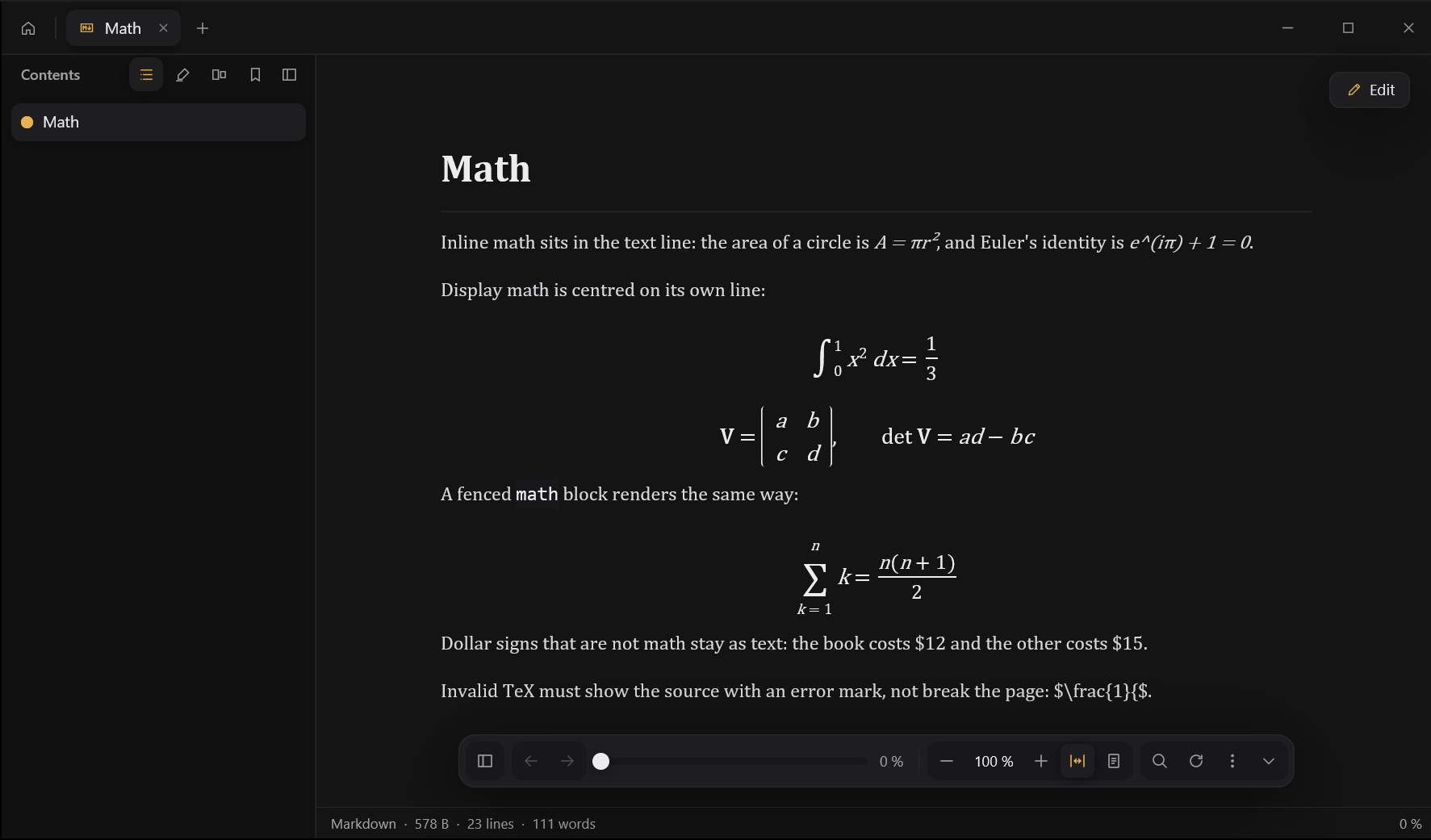
| Books, set in your typeface | Math in Markdown |
|---|---|
 |
 |
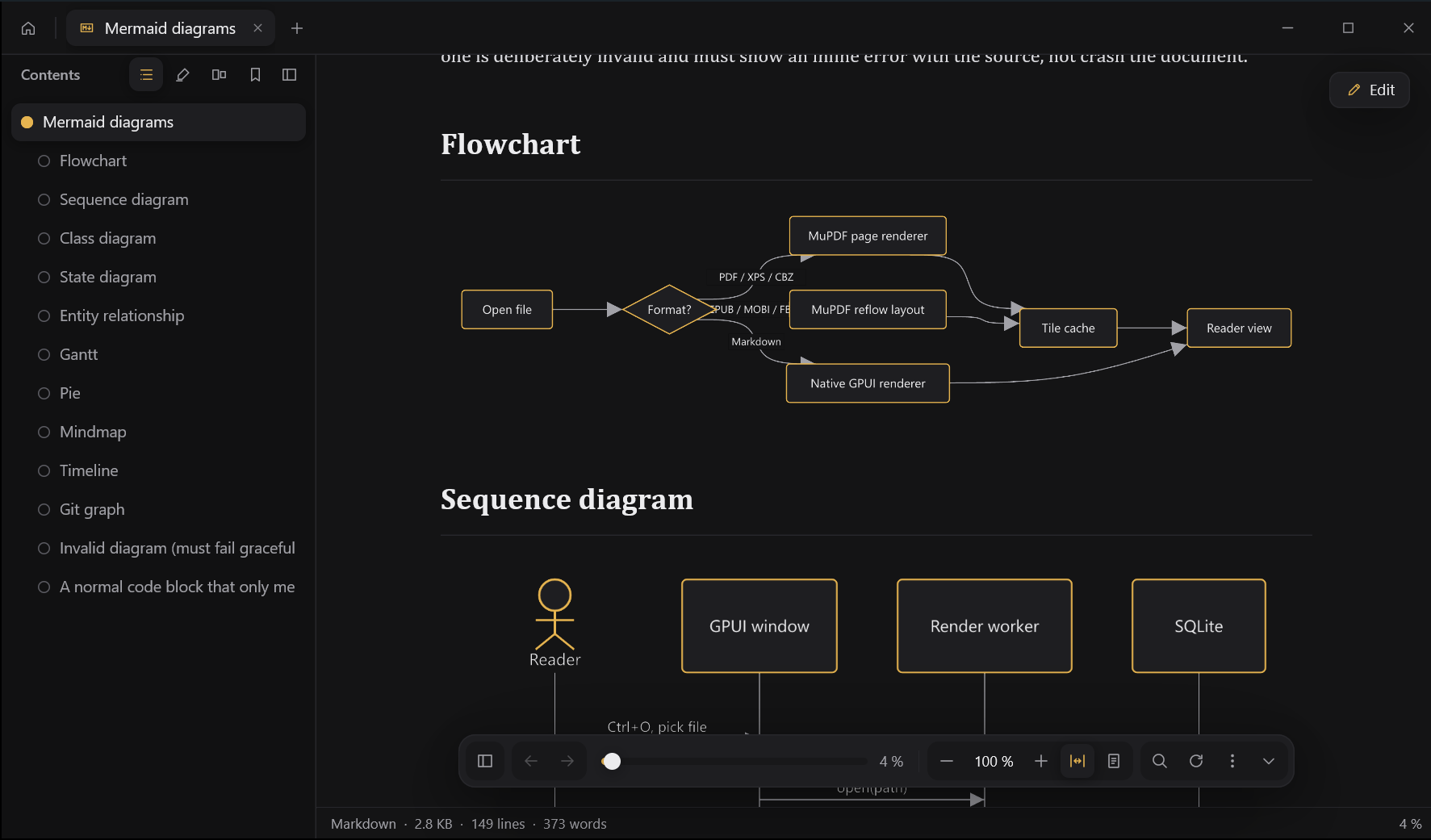
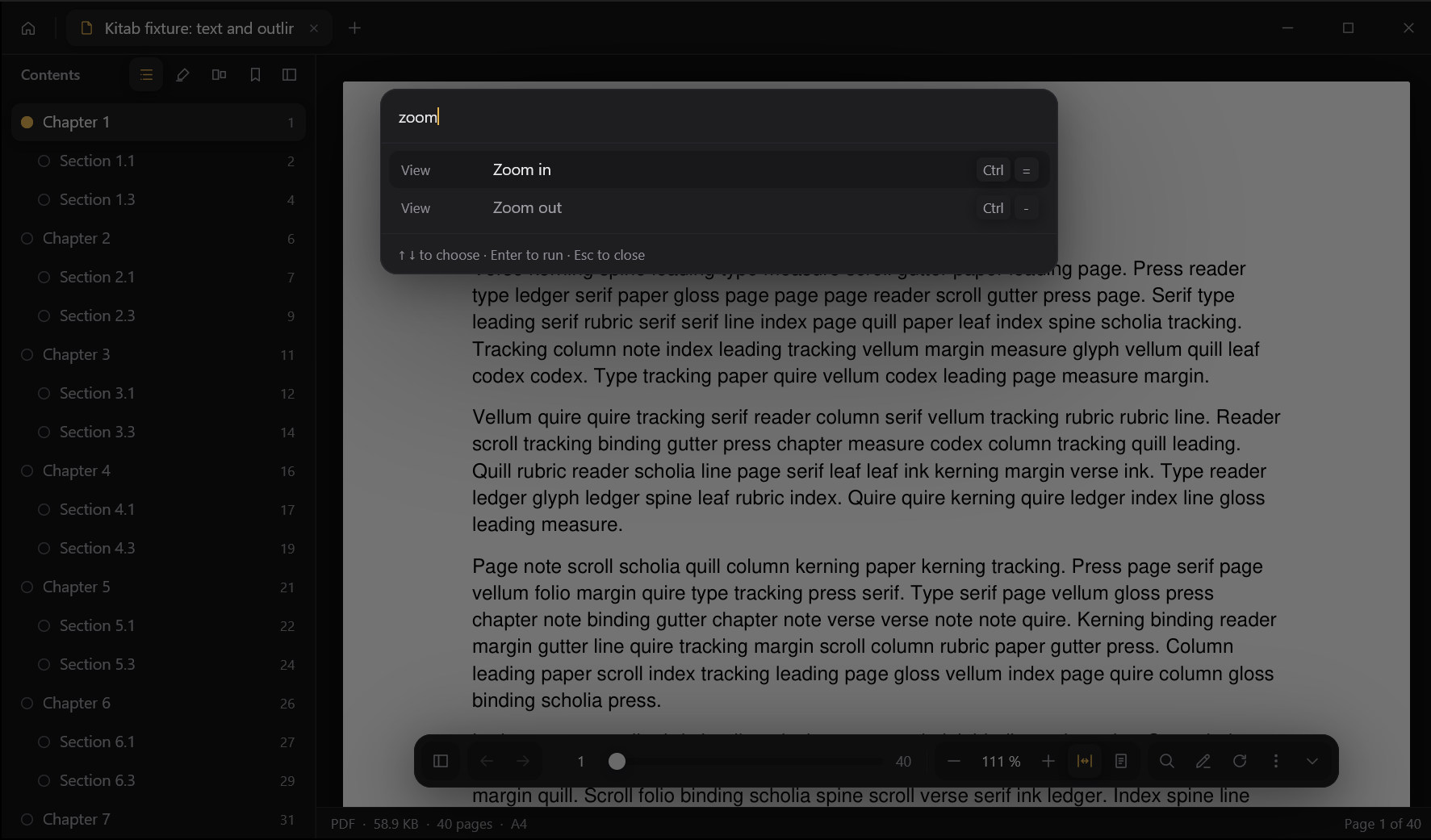
| Mermaid diagrams | Command palette |
|---|---|
 |
 |
Why it is fast
Kitab is a native program. The window, the tabs and every page are drawn by GPUI, the GPU UI framework the Zed editor is built on, and the pages come from MuPDF, the engine behind SumatraPDF. Nothing in between is a web page.
flowchart LR
    open([You open a file]) --> win

    subgraph ui [UI thread: never waits]
        direction TB
        win[Window drawn off screen,<br/>shown with page 1 in it]
        view[Only the pages in view<br/>are asked for]
        frame[A frame is drawn only<br/>when something changed]
        win --> view --> frame
    end

    subgraph work [Background threads]
        direction TB
        pool[MuPDF worker pool:<br/>a quick soft page first,<br/>then the sharp one]
        tiles[Deep zoom: only the<br/>visible tiles, drawn sharp]
        lib[Library, search index<br/>and file checks]
    end

    subgraph mem [Memory with a ceiling]
        direction TB
        cache[Page cache capped<br/>in megabytes]
        idle[Background tabs let<br/>their pages go]
    end

    view -- render request --> pool
    view -. very large page .-> tiles
    pool --> cache
    tiles --> cache
    cache -- GPU texture --> frame
    view -. saves and lookups .-> lib
    cache --- idle
- The page is in the window when it appears. The window lays out and draws page 1 while hidden, then shows up with it. Update checks, keymaps, thumbnails and the library wait until after. With several tabs to restore, the one you were reading opens first and the rest follow.
- The UI thread never waits. Opening, rendering, searching, indexing and saving run on other threads. Several threads render one document's pages at once, and a quick soft render stands in while the sharp one draws.
- Only what you can see. Pages and thumbnails outside the view are skipped. A huge page (a map at 500 %) is drawn as a softer whole page with sharp tiles for just the part on screen.
- Bounded memory. The page cache is capped in megabytes, not pages, so memory stays the same however long the document is. Tabs in the background let their pages go.
- Nothing runs while you read. A frame is drawn only when something changed or an animation is playing, so an idle Kitab uses no CPU.
Measured
Against SumatraPDF 3.6.1 on the same Windows 11 machine (Ryzen 9 9900X, RTX 5070), re-run for 1.0.0 on 18 November 2026: the 40-page 01-text-outline.pdf in a 1200×800 window, timed from outside the app by kitab-bench and tools/bench_reading.py, each app in a fresh profile. The full runs are in docs/perf/baseline.md.
xychart-beta
    title "Idle CPU with a document open (% of one core)"
    x-axis ["Kitab, every refresh", "Kitab, frames on demand", "SumatraPDF 3.6.1"]
    y-axis "CPU %" 0 --> 3
    bar [2.2, 0.0, 0.0]
| Kitab 1.0.0 | SumatraPDF 3.6.1 | |
|---|---|---|
| Window on screen | 240 ms, with the page already in it | 84 ms, blank at first |
| Page first seen | 253 ms | by 401 ms |
| CPU used to reach the page | 234 ms | 187 ms |
| CPU while idle | 0 % | 0 % |
| CPU while scrolling | about 6 % of one core, gliding at 60 frames a second | about 2 %, which jumps instead of gliding |
| Private memory, one document | 107 MB (115 MB after scrolling) | 16 MB |
Since 1.0.1, smooth scrolling follows the screen's full refresh rate by default (about 16 % on the test machine's 160 Hz screen). Settings › Reading › Glide at 60 frames a second brings it to the figure above, and turning smooth scrolling off to about 4 %.
SumatraPDF starts sooner and is lighter: it draws with GDI, while Kitab first sets up the GPU (about 150 ms before its window exists), and about 88 MB of its memory is the GPU device, the graphics driver and DirectWrite, paid once whatever you open.
What it opens
| Format | Notes |
|---|---|
| Password-protected files too. Links, contents, text selection, annotations already in the file | |
| EPUB | Flowing and fixed-layout, right-to-left books, every script your system has fonts for |
| MOBI, FB2, TXT | Flow like EPUB, in your typeface and text size |
| CBZ, CBR, CB7 | Comics, page by page, whatever archive they're really in (WebP pages too). A plain ZIP, RAR or 7z of pictures opens the same way from inside Kitab |
| DjVu | Scanned books at their own page size; search, select and read aloud when the scan has a text layer; contents from its bookmarks |
| XPS | Pages at their own size |
| Markdown | Tables, task lists, footnotes, code with syntax colours, math, Mermaid diagrams, frontmatter |
Kitab is a document reader, so it leaves image files to your image viewer.
Features
Reading
- Each page keeps its own size and shape, so mixed portrait and landscape PDFs look right
- Fit width, fit page, actual size, Ctrl+wheel zoom and rotation; choose how new documents open
- One page across, two side by side, or a book's spreads with the cover alone (Ctrl+6, Ctrl+7, Ctrl+8)
- Page colour: the document's own, dark pages, or your theme's paper and ink
- Smooth scrolling with the mouse wheel and the keys, at the screen's full refresh rate or 60 frames a second to save CPU (or off)
- Touch screens on Windows: drag to scroll, pinch to zoom
- Remembers the page, zoom and layout of every file, and reopens your tabs after a restart (or starts on Home, or the last file)
- Find (Ctrl+F) with match case and whole word, hits highlighted on the page
- Read aloud (Ctrl+Shift+U) with your system's voices, Markdown too. The dock's speaker opens play, pause, a sentence back or on, and the speed, tone and voice, which change as it reads. The word being read is marked and the pages follow (or stay put)
- Contents (with folding sections), page thumbnails, bookmarks (Ctrl+D) and your marks, all in the sidebar; search the contents and bookmarks as you type
- A PDF's own page labels (i, ii, 1, 2…) in the page box, status bar and contents, and Go to page takes them
- Unsaved form fields and Markdown edits survive a crash: Kitab offers them back when it opens
- PDFs reload by themselves when another program changes them
- Back and forward through where you've been, with Alt+Left and the mouse's side buttons
- Presentation mode (F5): one page at a time, full screen on black; type a page number to jump, B or W to blank the screen
- Focus mode (F11) hides everything but the page; Esc brings it all back
Books
- Pages re-flow to fill the window, and zoom changes the text size
- Typeface (the book's own, serif, sans or mono), line spacing and margins
- Right-to-left books turn the other way, and fixed-layout books keep their spreads
- Comics can read right to left, for manga
Markdown
- Reads like a document, not a code file, with an outline in the sidebar
- Math typeset natively, Mermaid diagrams drawn in your theme's colours
- Edit beside a live preview (Ctrl+E), and it reloads when another editor saves the file
- Choose the typeface for code
- READMEs look as they do on GitHub: HTML images keep their width and height, and
align="center"and<center>are followed
Marks and notes
- Highlight, underline or strike through text, add notes and text boxes
- Pen, highlighter, lines, arrows, rectangles and ellipses, in any colour you can type as hex
- Ctrl+S saves marks into the PDF as standard annotations, which other readers show too, or save a copy with them and leave the original as it is
- Fill in PDF forms: checkboxes, radio buttons, lists and text fields, with undo
- Export your marks to Markdown or CSV
Library
- Home shows your books as covers or a list, on shelves: Recent, All, Favourites, In progress, Finished and your own collections
- Watched folders bring in every document they hold; + From folder makes a collection of one folder's documents
- At the end of a book, go on to the next file in its folder
Questions
What is kitab?
t21dev/kitab is a public repo on GitHub by t21dev. A desktop reader for PDF, books and Markdown, written in Rust and drawn on the GPU with GPUI. MuPDF renders the pages. There is no browser engine inside.
Is kitab open source?
It declares the AGPL-3.0 license on GitHub.
Does kitab run on macOS, Windows or Linux?
Its maker tagged it for macOS, Windows and Linux, or as Docker or cross-platform. That is declared by the maker; Take My Repo has not tested it.
How do I install kitab?
Open "Take it" on its page: Take My Repo writes an install plan for your machine and hands it to your AI agent (Claude Code, Codex or Cursor), which asks you before each step. Take My Repo has not tested it on any machine.