utmos-pytorch
Unofficial fairseq-free PyTorch implementation of UTMOS (v1, 2022), matching the original system.
- 38
- Python
- MIT
- 6 mo ago
RubatoCodec: Budgeted Adaptive Speech Tokenization with Streaming Decoding
Repo third-intelligence/RubatoCodec, read from GitHub 5 h ago. third-intelligence has not joined Take My Repo.
third-intelligence/RubatoCodec is a public repo on GitHub by third-intelligence. RubatoCodec: Budgeted Adaptive Speech Tokenization with Streaming Decoding. It declares the Apache-2.0 license on GitHub. It is written mainly in Python, has 30 stars and last changed on 2026-10-30. Nobody has reviewed it on Take My Repo yet, which says nothing about its quality. Read from GitHub on 2026-11-23.
RubatoCodec is a neural speech codec that adaptively allocates variable-duration events under an exact utterance-level event budget and supports streaming waveform decoding. Each event contains discrete code indices and a duration. The released model represents speech at approximately 12.5 events/s, with 16-kHz input and 44.1-kHz output from a causal streaming decoder.
T frames,
the event count is exactly max(1, min(T, round(target_ratio · T))), with
target_ratio=0.25 by default. No separate boundary predictor, boundary
labels, or rate loss is required.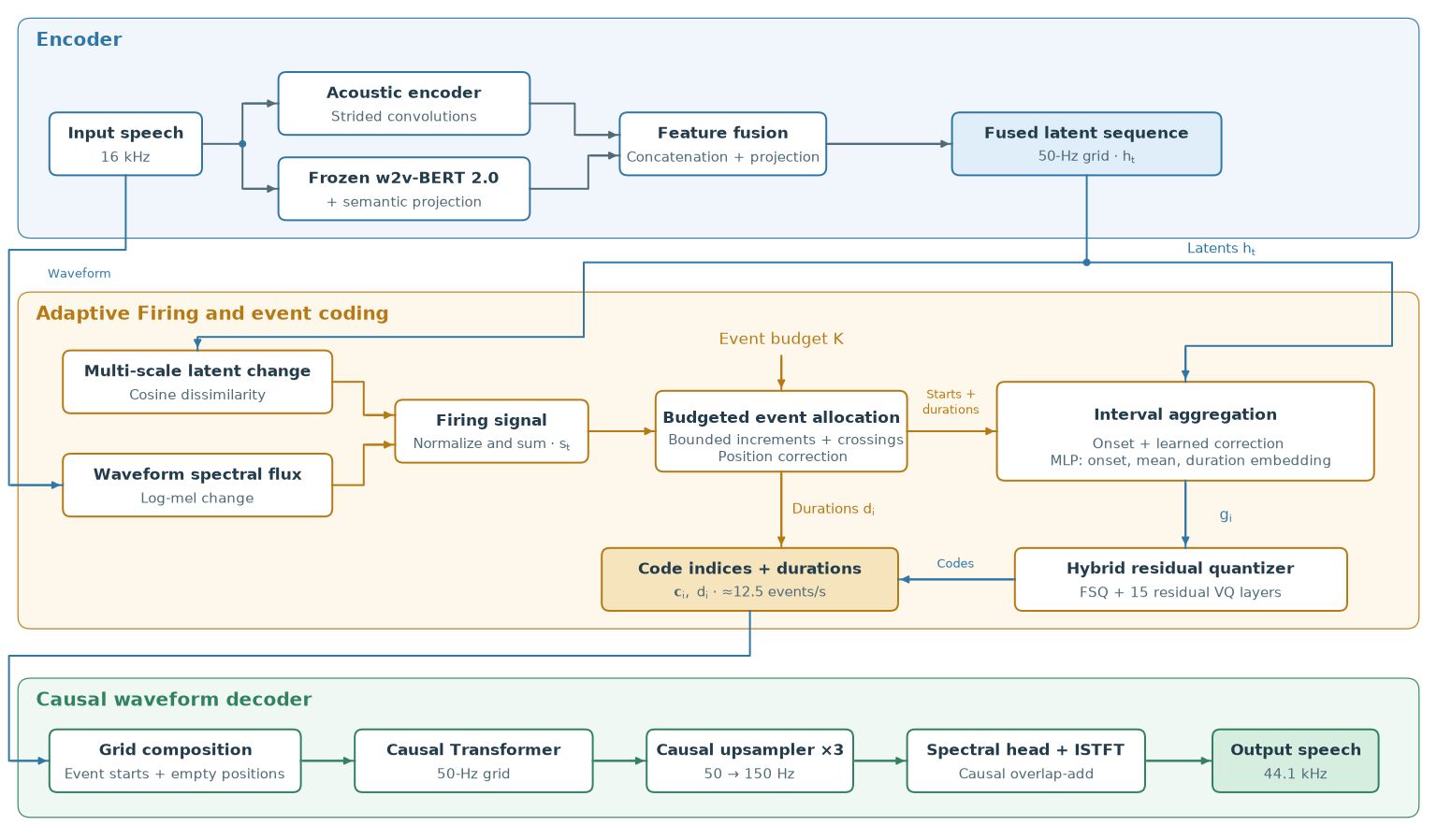
| Document | Contents |
|---|---|
| docs/architecture.md | Full architecture: encoder, Adaptive Firing, quantizer, decoder, code format, bitrate, causality. |
| docs/inference.md | Loading, encode/decode, streaming API and inference settings. |
| docs/training.md | Training stack, data, losses, phase schedule, launch commands. |
| docs/config_reference.md | Configuration keys and shipped defaults. |
| docs/evaluation.md | Evaluation workflow, results on five datasets, baseline comparisons, and throughput. |
With uv:
uv sync                # inference only
uv sync --extra train  # + training stack (Lightning + Hydra)
uv sync --extra eval   # + evaluation metrics
import soundfile as sf
import torch

from rubatocodec import RubatoCodec

codec = RubatoCodec.from_pretrained("third-intelligence/RubatoCodec", device="cuda")
# or: RubatoCodec.from_checkpoint("path/to/model.safetensors", device="cuda")

data, sr = sf.read("speech.wav", dtype="float32")  # mono waveform
wav = torch.from_numpy(data)

enc = codec.encode(wav, sr=sr)  # {"codes": (16, K) int64, "durs": (K,) int64}
audio = codec.decode(enc)  # (1, 1, T_audio) at 44.1 kHz, full depth
audio = codec.decode(enc, depth=8)  # bitrate control via residual depth

sf.write("recon.wav", audio[0, 0].cpu().numpy(), codec.output_sr)
For long recordings, opt into lower-memory encoding:
codec = RubatoCodec.from_pretrained(
    "third-intelligence/RubatoCodec", device="cuda", low_memory_encode=True,
)
The same option is available on from_checkpoint. It preserves full semantic
attention context without splitting the waveform. Short inputs use the original
path; the default remains False. See long recordings
for scope and limitations.
Streaming decode:
codes, durs = enc["codes"], enc["durs"]
out = []
for i in range(codes.shape[1]):
    chunk = codec.decode_streaming(
        codes[:, i : i + 1],
        "session-0",
        durs=durs[i : i + 1],
        finish=(i == codes.shape[1] - 1),
    )
    if chunk is not None:
        out.append(chunk)
audio = torch.cat(out, dim=2)
See docs/inference.md for details.
| Input / output sample rate | 16 kHz / 44.1 kHz |
| Latent grid | 50 Hz (320-sample hop size) |
| Nominal event rate | ≈12.5 events/s (target_ratio 0.25) |
| Quantizer | 16 layers × 4,096 (12 bits); layer 0 semantically distilled FSQ, layers 1–15 DAC-style VQ |
| Bitrate | Code indices: 150–2,400 bit/s (depths 1–16), plus duration information |
| Decoder | Fully causal (streaming) |
| Parameters | 72 M encoder / 173 M decoder / 1 M quantizer (246 M total; + frozen w2v-BERT 2.0 for encoding) |
The released model is evaluated on LibriSpeech test-clean, VCTK, JVS, JVNV, and seed-tts-eval test-zh. At depths 8 and 16, its estimated bitrate is approximately 1.23 and 2.43 kbit/s, including timing information. Among the compared codecs, RubatoCodec shows the best intelligibility preservation on the English and Japanese benchmarks at comparable bitrates, with high predicted quality, while the strongest comparators retain higher PESQ-WB and STOI. The tables below show a subset of the compared codecs. Within each bitrate band, bold marks the best and underline the second-best score among the displayed codecs.
LibriSpeech test-clean (English)
| Codec | Event rate (Hz) | Bitrate (kbit/s) | UTMOSv2 ↑ | DNSMOS ↑ | PESQ-WB ↑ | STOI ↑ | dWER (%) ↓ | SIM ↑ |
|---|---|---|---|---|---|---|---|---|
| Lower bitrate band | ||||||||
| FlexiCodec, τ=1, depth 8 | 12.5 | 1.24 | 3.194 | 3.284 | 2.813 | 0.940 | 0.83 | 0.846 |
| MiMo-Audio-Tokenizer, depth 6 | 25.0 | 1.20 | 3.183 | 3.291 | 2.677 | 0.927 | 0.86 | 0.848 |
| MOSS-Audio-Tokenizer, depth 10 | 12.5 | 1.25 | 3.230 | 3.217 | 3.052 | 0.949 | 0.89 | 0.904 |
| DTM-Codec, 80-Hz target | 81.5 | 1.28 | 3.421 | 3.334 | 2.971 | 0.947 | 1.41 | 0.871 |
| RubatoCodec, depth 8 | 12.5 | 1.23 | 3.478 | 3.327 | 2.684 | 0.931 | 0.75 | 0.871 |
| Higher bitrate band | ||||||||
| Qwen3-TTS-Tokenizer-12Hz | 12.5 | 2.20 | 3.230 | 3.273 | 3.177 | 0.958 | 0.53 | 0.941 |
| MiMo-Audio-Tokenizer, depth 13 | 25.0 | 2.42 | 3.210 | 3.288 | 3.094 | 0.947 | 0.67 | 0.896 |
| MOSS-Audio-Tokenizer, depth 20 | 12.5 | 2.50 | 3.239 | 3.203 | 3.536 | 0.968 | 0.62 | 0.954 |
| RubatoCodec, depth 16 | 12.5 | 2.43 | 3.486 | 3.314 | 3.029 | 0.950 | 0.50 | 0.928 |
JVNV (Japanese)
| Codec | Event rate (Hz) | Bitrate (kbit/s) | UTMOSv2 ↑ | DNSMOS ↑ | PESQ-WB ↑ | STOI ↑ | dCER (%) ↓ | SIM ↑ |
|---|---|---|---|---|---|---|---|---|
| Lower bitrate band | ||||||||
| FlexiCodec, τ=1, depth 8 | 12.5 | 1.24 | 1.811 | 3.128 | 2.062 | 0.862 | 5.52 | 0.786 |
| MiMo-Audio-Tokenizer, depth 6 | 25.0 | 1.20 | 2.681 | 3.173 | 2.295 | 0.872 | 7.88 | 0.821 |
| MOSS-Audio-Tokenizer, depth 10 | 12.5 | 1.25 | 2.396 | 3.089 | 3.032 | 0.917 | 5.44 | 0.924 |
| DTM-Codec, 80-Hz target | 46.1 | 0.77 | 2.523 | 3.154 | 2.081 | 0.862 | 14.82 | 0.783 |
| RubatoCodec, depth 8 | 12.5 | 1.23 | 2.628 | 3.164 | 2.650 | 0.907 | 1.92 | 0.907 |
| Higher bitrate band | ||||||||
| Qwen3-TTS-Tokenizer-12Hz | 12.5 | 2.20 | 2.638 | 3.097 | 3.041 | 0.931 | 3.01 | 0.951 |
| MiMo-Audio-Tokenizer, depth 13 | 25.0 | 2.42 | 2.708 | 3.176 | 2.949 | 0.911 | 4.21 | 0.885 |
| MOSS-Audio-Tokenizer, depth 20 | 12.5 | 2.50 | 2.383 | 3.057 | 3.496 | 0.941 | 3.96 | 0.963 |
| RubatoCodec, depth 16 | 12.5 | 2.43 | 2.651 | 3.138 | 3.032 | 0.929 | 1.54 | 0.946 |
See docs/evaluation.md for the protocol, all compared codecs, VCTK, JVS, and Mandarin results, and H200 throughput measurements.
rubatocodec/               public inference API, checkpoint settings, and firing
rubatocodec/modules/       encoder, decoder, attention, and semantic components
rubatocodec/quantization/  hybrid residual quantizer and DAC VQ layers
training/                 PyTorch Lightning + Hydra training stack and schedules
eval/                     objective evaluation metrics (UTMOS, DNSMOS, PESQ, ...)
examples/                 audio reconstruction example
scripts/                  checkpoint conversion (Lightning -> safetensors)
docs/                     architecture, usage, and configuration documentation
incl_licenses/            licenses of derived / vendored third-party code
@misc{arata2026rubatocodecbudgetedadaptivespeech,
      title={RubatoCodec: Budgeted Adaptive Speech Tokenization with Streaming Decoding},
      author={Chihiro Arata and Shohei Taniguchi and Gouki Minegishi and Kan Hatakeyama-Sato},
      year={2026},
      eprint={2610.29434},
      archivePrefix={arXiv},
      primaryClass={cs.SD},
      url={https://arxiv.org/abs/2610.29434},
}
Apache 2.0 — see LICENSE. Third-party components retain their
respective licenses; see incl_licenses/.
third-intelligence/RubatoCodec is a public repo on GitHub by third-intelligence. RubatoCodec: Budgeted Adaptive Speech Tokenization with Streaming Decoding.
It declares the Apache-2.0 license on GitHub.
Its maker has not tagged a system, so it is unknown here. Its README says what it needs.
Open "Take it" on its page: Take My Repo writes an install plan for your machine and hands it to your AI agent (Claude Code, Codex or Cursor), which asks you before each step. Take My Repo has not tested it on any machine.
Its last change on GitHub was on 2026-10-30. Take My Repo does not judge from that whether it is maintained.
Nobody has reviewed it on Take My Repo yet, which says nothing about its quality.
Unofficial fairseq-free PyTorch implementation of UTMOS (v1, 2022), matching the original system.
🐸💬 - a deep learning toolkit for Text-to-Speech, battle-tested in research and production
利用 AI 大模型和自动化工作流,根据主题或关键词一键生成高清短视频。Generate HD short videos from a topic or keyword with an automated AI workflow.
VoiceStudio is the open-source, fully-local ElevenLabs alternative — voice cloning, voice design, video dubbing, dictation, transcription & audiobook creation in 646 languages.
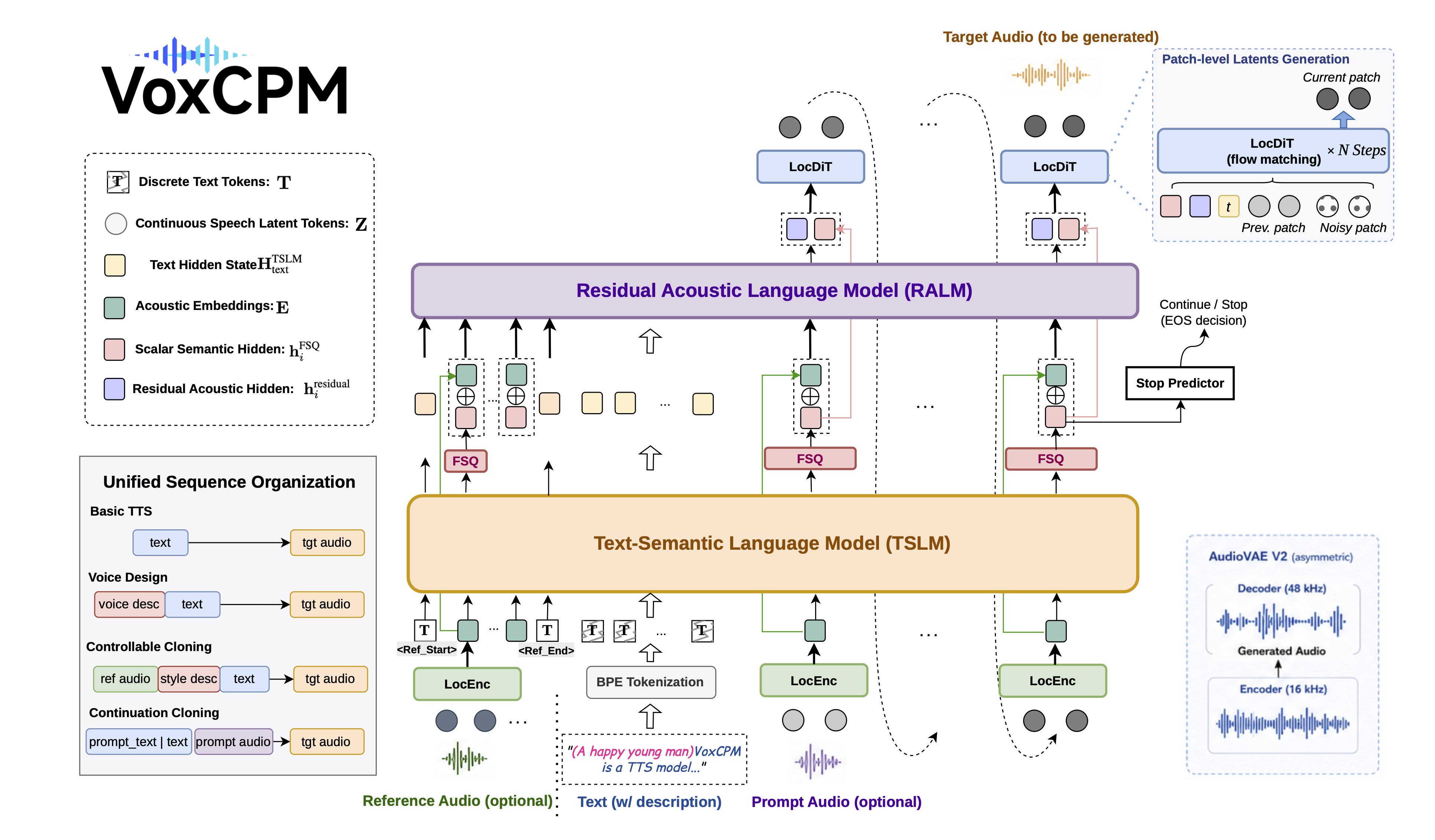
VoxCPM2: Tokenizer-Free TTS for Multilingual Speech Generation, Creative Voice Design, and True-to-Life Cloning
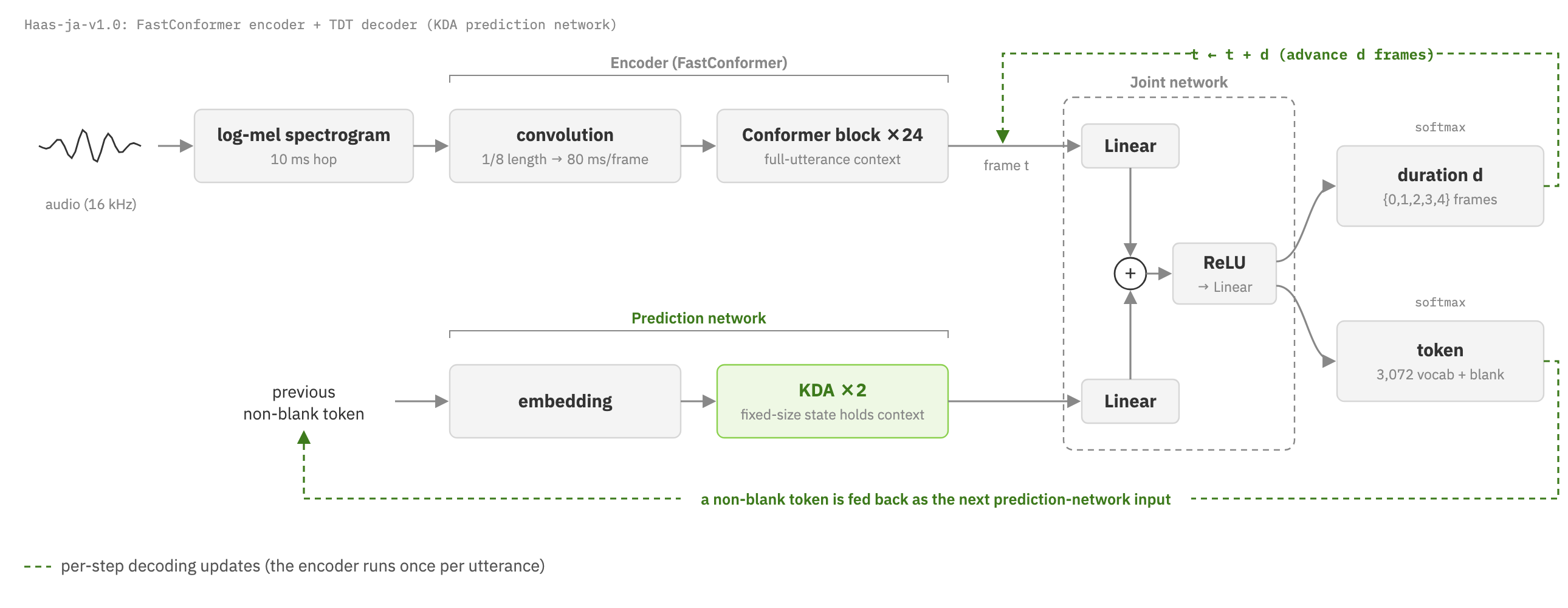
Inference code for Haas, fast and accurate Japanese speech recognition
A character error rate (CER) library for Japanese speech recognition that accounts for spelling and notation variants
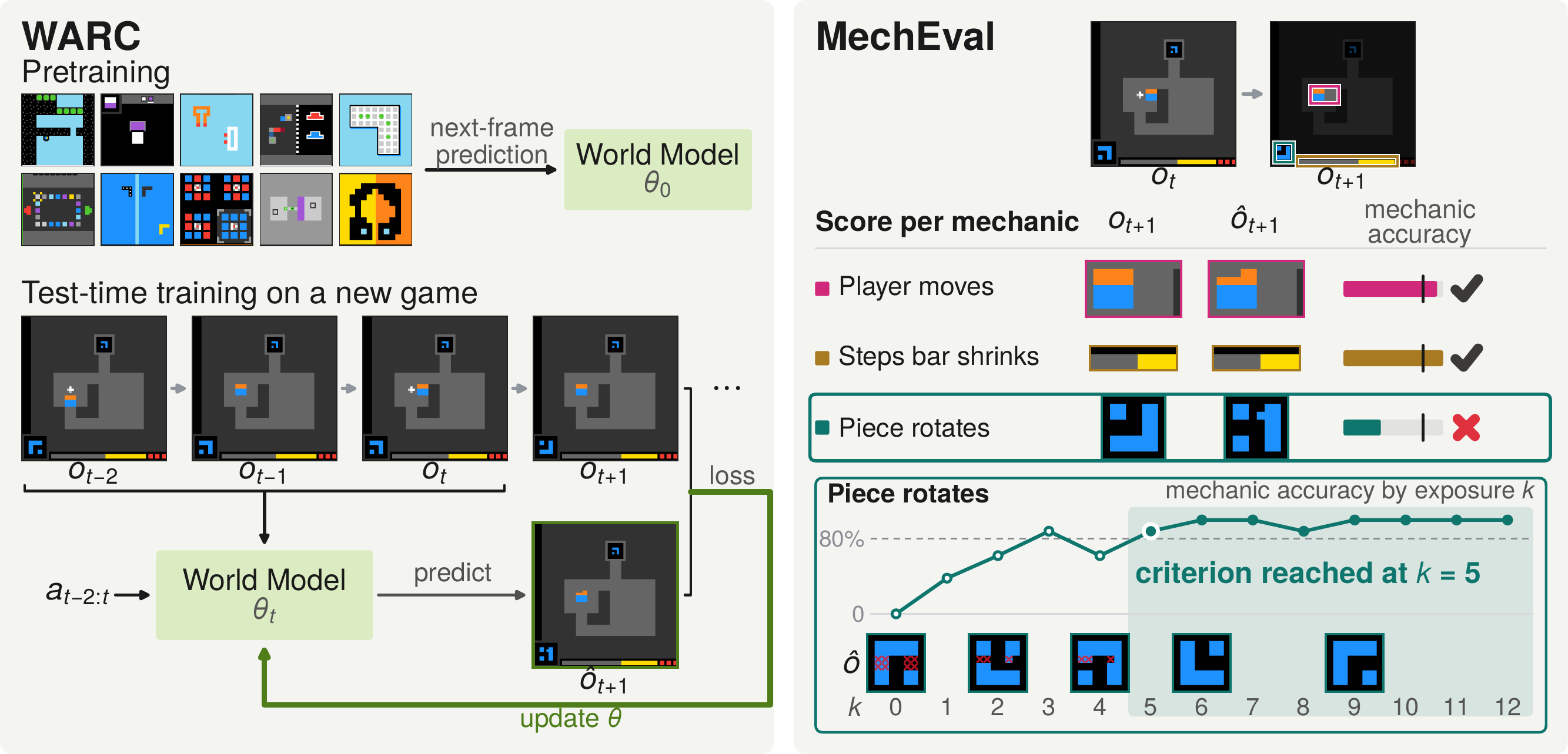
How Many Exposures Does a World Model Need? Learning Unseen Game Mechanics at Test Time