llmfit
Hundreds of models & providers. One command to find what runs on your hardware.
- 39k
- Rust
- MIT
- 3 d ago
Gumbel-Softmax post-training quantization for LLMs (1–3 bit scalar, INT/GGUF-compatible).
Repo IST-DASLab/GSQ, read from GitHub 1 h ago. IST-DASLab has not joined Take My Repo.
IST-DASLab/GSQ is a public repo on GitHub by IST-DASLab. Gumbel-Softmax post-training quantization for LLMs (1–3 bit scalar, INT/GGUF-compatible). It declares the Apache-2.0 license on GitHub. It is written mainly in Python, has 146 stars and last changed on 2026-07-11. Nobody has reviewed it on Take My Repo yet, which says nothing about its quality. Read from GitHub on 2026-11-21.
Paper: GSQ: Highly-Accurate Low-Precision Scalar Quantization for LLMs via Gumbel-Softmax Sampling (preprint) Authors: Alireza Dadgarnia, Soroush Tabesh, Mahdi Nikdan, Michael Helcig, Eldar Kurtić, Max Kleinegger, Dan Alistarh — ISTA / ETH Zürich / TU Wien / Red Hat AI
GSQ is a post-training scalar quantization method that learns per-coordinate grid assignments and per-group scales using a Gumbel-Softmax relaxation of the discrete grid. It closes most of the accuracy gap between simple scalar PTQ (GPTQ, QuIP, EfficientQAT) and second-wave vector / trellis methods (QTIP, AQLM, PV-Tuning) at 2–3 bits per parameter, while keeping a symmetric, group-wise scalar format that is directly compatible with existing INT inference kernels and with GGUF K-Quant deployment stacks. The same discrete-assignment optimization scales from dense Llama-3.1-8B/70B all the way to trillion-parameter MoE models such as Kimi-K2.5 and Qwen3.5-MoE, and can also refine publicly released GGUF K-Quant checkpoints in-format.
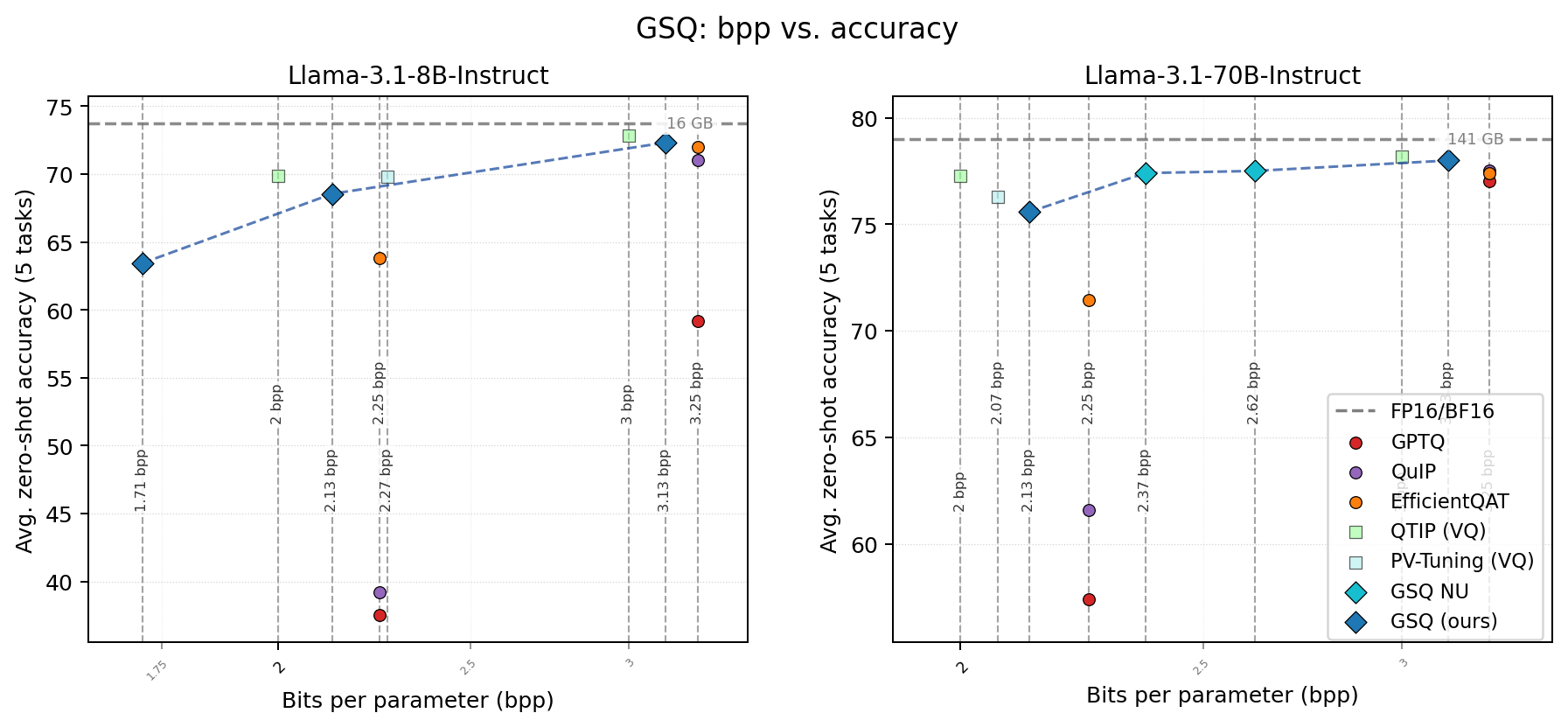
GSQ pushes the size-vs-accuracy Pareto frontier across model scales and bit widths, matching or beating prior scalar PTQ methods at the same footprint and closing most of the gap to vector-quantized baselines.

GSQ compresses Kimi-K2.5 from ~4.5 bpp down to 2.13 bpp while preserving most of the model's reasoning, coding, and long-context behaviour. It even beats the base model on MATH 500 and LiveCodeBench v6 under our evaluation pipeline, and stays competitive on OpenAI-MRCR up to 256k tokens.

Starting from public Unsloth GGUF checkpoints, GSQ refines the discrete assignments and projects the result back into the same K-Quant format, so the optimized checkpoint runs unchanged on llama.cpp / Ollama. The gains are largest in the aggressive Q2_K setting (avg score 50.03 → 56.28).

GSQ is the strongest scalar PTQ method we measured, and lands within ~1.7 points of the QTIP / PV-Tuning vector-quantized frontier at 70B.
| Method | 8B Avg | 70B Avg |
|---|---|---|
| FP16 | 73.71 | 78.99 |
| GPTQ | 37.53 | 57.38 |
| QuIP | 39.20 | 61.57 |
| EfficientQAT | 63.79 | 71.43 |
| QTIP (VQ) | 69.88 | 77.25 |
| PV-Tuning (VQ) | 69.83 | 76.27 |
| GSQ (ours) | 68.55 | 75.57 |
Plots are produced from paper-table data by scripts/make_readme_plots.py — re-run with python scripts/make_readme_plots.py --out assets/ after editing the literals at the top of that file.
GSQ quantizes LLM weights layer by layer using a two-stage pipeline:
init_method: rtn is also supported as an ablation.).safetensors shards and offloaded to a meta device, so models much larger than GPU VRAM can be quantized.save_model.py merges the per-layer shards into a complete HuggingFace-compatible checkpoint with a compressed-tensors quantization config for vLLM auto-detection.For each linear layer $f(x; w)$, GSQ minimizes the layer-wise reconstruction error
$$ \hat{w} = \arg\min_{\tilde{w}} \lVert f(x;\tilde{w}) - f(x;w) \rVert_F^2 \quad \text{s.t.} \quad \tilde{w} \in \mathcal{C}, $$
where the constraint set $\mathcal{C}$ encodes the target quantization grid (e.g. ternary $\lbrace -s, 0, s \rbrace^d$, 2-bit $\lbrace -2, -1, 0, 1 \rbrace \cdot s$, or a general $b$-bit symmetric grid). Each weight slot gets its own learnable logit vector over the small grid $\mathcal{D}$ (size 2 for ternary mask/sign, 4 for 2-bit, ...). At each step a Gumbel-Softmax sample turns those logits into a soft one-hot vector — the temperature $\tau$ is annealed high → low so gradients flow through several candidates early and collapse onto a single grid value at the end, while the logit scale $\kappa$ is annealed low → high to sharpen the distribution. The binary case uses a single logit $\ell$ and treats $-\ell$ as the other class, which halves the parameter count and is why each bit-width has its own quantizer module (src/quantization/gumbel_quantizer_{1bit,2bit,ternary}.py). Optimization runs in bf16 (or fp32, see quantization.logits_dtype) using the Lion optimizer with a cosine LR schedule on top of the GPTQ-initialized scales. The custom autograd op replays the RNG state in the backward pass to compute exact gradients through the Gumbel sample. After training, logits are hard-rounded and the resulting integer grid + scales are serialized — staying in the symmetric scalar format means the result drops into existing INT kernels and into GGUF K-Quant deployment stacks without changes.
The GSQ precision is controlled by the quantization.gsq_bits config key:
gsq_bits |
Quantizer Class | Bits/weight | Codebook | Description |
|---|---|---|---|---|
2 (default) |
GumbelQuantizer2Bit |
2-bit | {-2, -1, 0, 1} × scale |
4-level integer with learned per-group scale |
> 2 |
GumbelQuantizerInt |
n-bit | (init + {-2, -1, 0, 1, -2}) × scale |
5-level integer with learned per-group scale |
"ternary" |
GumbelQuantizerTernary |
~1.58-bit | {-1, 0, +1} × scale |
Separate sign and mask logits with learned scale |
| Model Family | Wrapper | Notes |
|---|---|---|
| Meta LLaMA | LLaMAWrapper |
Dense |
| Qwen3 | Qwen3Wrapper |
Dense |
| Qwen3-MoE | Qwen3MoeWrapper / Qwen3MoeDistributedWrapper |
MoE, expert-parallel, 128 experts (Qwen3-235B-A22B and Qwen3-30B-A3B) |
| Qwen3.5/3.6 | Qwen35Wrapper |
Dense |
| Qwen3.5/3.6-MoE | Qwen35MoeWrapper / Qwen35MoeDistributedWrapper |
MoE, hybrid attention, shared experts (35B-A3B / 122B-A10B / 397B-A17B) |
| Gemma-4-35B | Gemma4Wrapper |
Dense |
| Kimi K2 / K2.5 | KimiK2Wrapper / KimiK2DistributedWrapper |
MoE, expert-parallel; K2.5 has 384 experts (~260 GB) |
Qwen3.5-MoE requires transformers >= 5.3 (this currently conflicts with Kimi-K2.5; swap as needed per run).
GSQ has only been tested on NVIDIA Hopper (H100, sm_90). Training itself should work on any reasonably modern CUDA GPU (we've also run training on L40S/Ada), but the vLLM serving / lm-eval step requires Hopper or Ampere (sm ≥ 80). On Ada (L40S, sm_89) vLLM has no Marlin kernel for compressed-tensors WNA16 fused MoE and falls back to a Triton path that crashes inside moe_sum during profile_run. scripts/serve_model.sh emits a warning when launched on sm < 80 or sm == 89. See research_logs/knowledge/04-hopper-ampere-required-for-serve.md for the diagnosis. If you need to serve quantized MoE checkpoints on Ada, that is currently a vLLM-upstream gap, not a GSQ one.
TP for MoE serving. vLLM requires num_attention_heads % TP == 0 (and num_key_value_heads % TP == 0 when GQA). The Marlin WNA16 MoE kernel additionally requires (moe_intermediate_size / TP) % max(64, group_size) == 0; otherwise vLLM silently falls back to the same broken Triton path. With the default groupsize=128, effective max TP on 8 GPUs (Marlin ∩ attention heads):
| Model | moe_intermediate_size |
num_attention_heads |
Max valid TP on 8 GPUs |
|---|---|---|---|
| Qwen3-30B-A3B, Qwen3.5-35B-A3B | 768 | 32 | 2 (Marlin allows 6, but 32 % 6 ≠ 0) |
| Qwen3-235B-A22B, Qwen3.5-122B/397B | 1536 | 64 | 4 (Marlin allows 6, but 64 % 6 ≠ 0) |
| Kimi-K2 / K2.5 | 2048 | 64 | 8 |
scripts/serve_model.sh auto-clamps TP_SIZE to the largest valid value for the assembled checkpoint's config.json and logs a warning when it changes the requested TP. Set TP_SIZE_FORCE=1 to skip the clamp. See research_logs/knowledge/05-vllm-tp-marlin-moe-shape-constraint.md.
GSQ uses uv for environment management. Install it first:
curl -LsSf https://astral.sh/uv/install.sh | shThen clone and run the setup script:
git clone https://github.com/IST-DASLab/GSQ.git
cd GSQ
cp .env.example .env   # optional template; add HF_TOKEN before gated models / WandB
bash scripts/setup_env.sh        # uv sync + flash-attn + import sanity check
scripts/setup_env.sh runs uv sync to create ./.venv from uv.lock (PyTorch, vLLM, lm-eval, and the rest of the runtime stack), installs flash-attn on top, and verifies that all required packages import. Override defaults with VENV_PATH=<path>, PYTHON_VERSION=3.11, SKIP_FLASH_ATTN=1, or TORCH_CUDA=cu124 (default is cu128, pinned in pyproject.toml under [[tool.uv.index]]).
If you prefer to manage the venv by hand:
uv sync                                                  # locked deps -> ./.venv
uv pip install flash-attn --no-cache-dir --no-build-isolation

# Different CUDA target (e.g. cu124 instead of the default cu128):
UV_INDEX_PYTORCH=https://download.pytorch.org/whl/cu124 uv sync
The PyTorch wheel index is pinned via [[tool.uv.index]] in pyproject.toml; override it with UV_INDEX_PYTORCH=<url> (or pass TORCH_CUDA=cu124 to setup_env.sh).
The scripts/*.sh helpers activate ./.venv automatically; source .venv/bin/activate is only needed for an interactive shell.
A HuggingFace account with access to gated models (e.g. Kimi-K2.5) is required for those model families.
GSQ source code lives under src/ (config, trainer, model wrappers, quantizers, MoE ops, GPTQ prior). Training entry point: main.py; reassembly: save_model.py; evaluation: eval_model.py. Bare-metal entry scripts (no Slurm, no containers) are in scripts/ — see "Run GSQ on Your Model" below.
bash scripts/run.sh                         # default config, all visible GPUs
SMOKE_TEST=1 bash scripts/run.sh            # 2-layer smoke test

# Or invoke main.py directly via uv (no activation needed):
uv run python main.py --config configs/local/config.yaml
uv run python main.py --config configs/local/config.yaml --max-layers 2
Each run is assigned a unique ID (e.g. 20260306-143025_a1b2c3) and checkpoints are stored under training.checkpoint_dir/<run_id>/. The run ID is printed at startup and logged to WandB.
NPROC=4 bash scripts/run.sh
# Or directly:
uv run torchrun --standalone --nproc-per-node=4 main.py --config configs/local/config.yaml
Per-GPU memory scales up with
NPROCfor dense models. Dense runs are data-parallel: every rank builds the full set of quantizers for the resident layer and only the calibration batch is split. Per-GPU memory is therefore roughly the single-GPU working set plus NCCL communicator overhead (~0.5-0.7 GB per rank), soNPROC>1needs more headroom per card thanNPROC=1, not the same. On tight VRAM preferNPROC=1, bumpingNPROCwill not reduce the per-rank floor. (Sharding the weights themselves would require dense tensor parallelism, which GSQ does not implement.)Debugging OOMs —
expandable_segments. The scripts default toPYTORCH_CUDA_ALLOC_CONF=expandable_segments:True(set inscripts/_common.sh) because it reduces fragmentation on the large target models. On some setups this can surface an out-of-memory condition as a misleadingCUDA driver error: device not readyinstead of a clean OOM. If you hit that, re-run withPYTORCH_CUDA_ALLOC_CONF=expandable_segments:Falseto get an actionabletorch.OutOfMemoryError.
For multi-node MoE runs (Kimi, Qwen-MoE), set the standard PyTorch distributed env vars (WORLD_SIZE, RANK, LOCAL_RANK, MASTER_ADDR, MASTER_PORT) on each node before invoking bash scripts/run.sh; the launcher will detect them and skip its built-in torchrun. The wrappers initialize NCCL from those env vars directly.
The bare-metal entry scripts live under scripts/ and are wrappers around main.py / save_model.py / eval_model.py. They activate the local venv (./.venv by default), load .env through scripts/_common.sh, and launch via torchrun --standalone --nproc-per-node=$(visible GPUs).
| Model | Config | Command | Approx GPUs |
|---|---|---|---|
| Llama-3.1-8B-Instruct | configs/local/config.yaml (set model.name) |
CONFIG_FILE=<cfg> bash scripts/run.sh |
1× H100/A100 (80 GB) |
| Llama-3.1-70B-Instruct | configs/local/config.yaml (set model.name) |
CONFIG_FILE=<cfg> bash scripts/run.sh |
4× H100 (80 GB) |
| Qwen3-30B-A3B (Instruct / Thinking) | configs/qwen3/qwen3_30B_A3B_*.yaml |
CONFIG_FILE=<cfg> bash scripts/run.sh |
4× H200 (single node) |
| Qwen3-235B-A22B (Instruct / Thinking) | configs/qwen3/qwen3_235B_A22B_*.yaml |
CONFIG_FILE=<cfg> bash scripts/run.sh |
8× H200 (single node) or multi-node |
| Qwen3.5-35B-A3B | configs/qwen35/qwen35_35B_A3B.yaml |
CONFIG_FILE=<cfg> bash scripts/run.sh |
4× H200 |
| Qwen3.5-122B-A10B | configs/qwen35/qwen35_122B_A10B.yaml |
CONFIG_FILE=<cfg> bash scripts/run.sh |
8× H200 |
| Qwen3.5-397B-A17B | configs/qwen35/qwen35_397B_A17B.yaml |
CONFIG_FILE=<cfg> bash scripts/run.sh |
16× H200 (multi-node); needs transformers >= 5.3 |
| Kimi-K2 (Instruct / Thinking) | configs/kimi-k2/kimi_k2_{instruct,thinking}.yaml |
CONFIG_FILE=<cfg> bash scripts/run.sh |
8× H100/H200 (full node) minimum |
| Kimi-K2.5 (default target, ~260 GB) | configs/kimi-k2.5/kimi_k2.5_2bit_gptq_gsq.yaml |
CONFIG_FILE=<cfg> bash scripts/run.sh |
8× H100/H200 (full node), typically 1–2 nodes |
Set CONFIG_FILE=<path> (relative to the repo root or absolute), NPROC=<n> to override GPU count, RESUME=latest|<run_id> to resume, or SMOKE_TEST=1 for a 2-layer dry run. Resume support, checkpoint reassembly, and benchmark evaluation work the same across all models (see sections below).
The configs/kimi-k2.5/ directory ships with a full sweep that's already been used in the paper experiments:
kimi_k2.5_2bit_gptq_gsq.yaml, kimi_k2.5_3bit_gptq_gsq.yaml, kimi_k2.5_ternary_gptq_gsq.yamlkimi_k2.5_2bit_rtn_gsq.yaml, kimi_k2.5_3bit_rtn_gsq.yaml, kimi_k2.5_ternary_rtn_gsq.yamlkimi_k2.5_2bit_gptq_nogsq.yaml, kimi_k2.5_3bit_gptq_nogsq.yaml, kimi_k2.5_ternary_gptq_nogsq.yamlkimi_k2.5_*_fp32.yamlkimi_k2.5_*_random_gsq.yamlThe knobs that meaningfully change a run:
| Key | Values / default | Effect |
|---|---|---|
quantization.gsq_bits |
2 (default) / 3 / 4 / "ternary" |
Selects the GSQ quantizer / target precision |
quantization.init_method |
"gptq" (default) / "rtn" |
Initialization before GSQ refinement |
quantization.gsq_enabled |
true (default) / false |
false = init-only run (baseline; tagged gptq+nogsq) |
quantization.logits_dtype |
"bfloat16" (default) / "float32" |
Precision of sign_logits, mask_logits, quant_logits |
quantization.groupsize |
128 |
Per-group quantization granularity |
quantization.temperature |
[2.0, 0.05] |
Gumbel temperature schedule (high → low) |
quantization.scale |
[100, 500] |
Gumbel logit scale schedule (low → high) |
quantization.strength |
6 |
Regularization strength |
data.dataset_name |
c4 / fineweb_edu / open_thoughts |
Calibration data — paper uses FineWeb-Edu for Llama, OpenThoughts for Kimi |
training.num_epochs |
10 |
Per-layer training epochs |
training.device_microbatch_size |
2 |
Per-GPU microbatch size (memory knob) |
CLI: --max-layers N |
— | Quantize only the first N layers (smoke test) |
CLI: --resume [run_id] |
— | Resume the latest run, or a specific run_id |
| Script / command | Purpose |
|---|---|
bash scripts/setup_env.sh |
uv sync + flash-attn + import sanity check (one-shot setup) |
uv sync |
Just refresh ./.venv from uv.lock (no flash-attn, no checks) |
bash scripts/download.sh |
Pre-download HF models and calibration datasets |
bash scripts/run.sh |
Run quantization (single-node multi-GPU via torchrun) |
bash scripts/save_model.sh |
Assemble per-layer shards into a HF checkpoint |
bash scripts/serve_model.sh |
Launch a vLLM OpenAI-compatible server (single node) |
bash scripts/eval_model.sh |
Run lm-eval benchmarks against a running vLLM server |
bash scripts/verify_setup.sh |
Sanity-check the environment + a tiny multi-GPU all-reduce |
All scripts read knobs from environment variables (e.g. CONFIG_FILE, RUN_ID, MODEL_PATH, VLLM_URL, NPROC, GSQ_RUNTIME) and forward unknown CLI args to the underlying Python entry point.
All training parameters are controlled via a single YAML file. Configs are loaded with strict validation (src.config.load_config): unknown top-level sections or unknown keys within a section raise an error. Omitted keys use defaults (see src/config.py or the commented defaults in configs/kimi-k2.5/kimi_k2.5_2bit_gptq_gsq.yaml).
After loading, every string value in the parsed YAML tree is passed through os.path.expandvars, so you can write POSIX-style substitutions such as $HOME/..., ${GSQ_RUNTIME}/checkpoints/..., or ${SLURM_JOB_ID} anywhere in the tree (paths, model IDs, nested strings). Undefined variables expand to empty, like POSIX shells. scripts/_common.sh exports GSQ_RUNTIME (defaults to <repo>/runtime; not the machine SCRATCH many clusters set) before launching Python, so ${GSQ_RUNTIME}/... resolves when you use scripts/run.sh. Your site-wide SCRATCH is left untouched for other tools.
Separately, the following environment variables override the merged config (env wins over YAML) when present, including entries from .env read by load_dotenv() / _common.sh:
| Variable | Effect |
|---|---|
GSQ_MODEL_NAME |
Overrides model.name. |
GSQ_CHECKPOINT_DIR |
Overrides training.checkpoint_dir. |
GSQ_LOG_DIR |
Overrides training.log_dir. |
GSQ_ACT_CACHE_DIR |
Overrides training.act_cache_dir. |
WANDB_PROJECT |
Overrides wandb.project (if omitted in YAML and not set here, default is gsq). |
WANDB_ENTITY |
Overrides wandb.entity. |
There is no GSQ_RUNTIME column above on purpose: it is not patched into the dataclass. Set GSQ_RUNTIME in _common.sh / .env / shell whenever you launch so ${GSQ_RUNTIME}/... placeholders in YAML expand (expandvars). Artifacts typically live under ${GSQ_RUNTIME}/checkpoints, ${GSQ_RUNTIME}/logs, ${GSQ_RUNTIME}/models, etc. — not under an extra gsq/ directory. It stays separate from the cluster SCRATCH variable — GSQ scripts no longer export or redefine SCRATCH.
Values for these overrides are also run through expandvars, so $VAR substitutions work there too.
The default config path is configs/local/config.yaml:
model:
  name: "moonshotai/Kimi-K2.5"   # HuggingFace model ID or local path
  device: "cuda"
  dtype: "bfloat16"

data:
  dataset_name: "open_thoughts"   # c4 | fineweb_edu | open_thoughts
  batch_size: 64
  num_samples: 4096
  max_length: 4096
  num_workers: 8                  # per-GPU workers; keep <= cpus_per_task
  val_samples: 128

quantization:
  gsq_bits: 2                     # GSQ precision: 1, 2, or "ternary"
  init_method: "gptq"             # "gptq" or "rtn"
  gsq_enabled: true               # false = init-only (no Gumbel refinement)
  start_layer: 0
  self_attn: false
  std: 0.01
  temperature: [2, 0.05]          # annealed 2.0 -> 0.05 over training
  scale: [100, 500]               # logit scale annealed 100 -> 500
  groupsize: 128
  strength: 6
  logits_dtype: "bfloat16"        # "bfloat16" (default) or "float32"

training:
  num_epochs: 10
  device_microbatch_size: 2
  masks_lr: 0.0002
  signs_lr: 0.0001
  scales_lr: 0.0001
  weight_decay: 1.0
  checkpoint_dir: "kimi-k2.5"     # base dir; each run creates a subdirectory
  log_dir: "logs"
  eval_baseline: true             # evaluate full-precision baseline at startup
  ppl_eval_every_n_layers: 6      # WikiText2 PPL eval cadence (layers)
  # act_cache_dir: ""             # optional; full path for activation cache mmap

gptq:
  nsamples: 512
  wbits: 2                        # GPTQ initialization bit-width
  sym: true
  percdamp: 0.1
  blocksize: 128
  groupsize: 128

wandb: true   # or use mapping form: { enabled: true, project: "gsq", entity: "" }
If WANDB_PROJECT or WANDB_ENTITY appears in the process environment at config load, it overrides any wandb.project / wandb.entity from YAML; if YAML leaves wandb.project empty and WANDB_PROJECT is unset, the project defaults to "gsq".
Copy the template (.env.example); the real .env is gitignored:
cp .env.example .env
Common keys:
HF_TOKEN=your_huggingface_token         # required for gated models
WANDB_API_KEY=your_wandb_api_key        # required if wandb: true in YAML
WANDB_ENTITY=your_wandb_entity          # overrides wandb.entity in YAML when set in env
WANDB_PROJECT=your_wandb_project        # overrides wandb.project in YAML when set; else default for empty YAML is gsq

# Optional — cluster / large-model layouts (see .env.example):
# HF_HOME=...                           # default: ~/.cache/huggingface
# HF_DATASETS_CACHE=...                 # default: ${HF_HOME}/datasets
# SCRATCH=/path/cluster-scratch                     # unrelated; GSQ scripts do not mutate it

# ----- GSQ artifact directory (exported by scripts/_common.sh; YAML can use "${GSQ_RUNTIME}/...")
# Overrides default ${REPO_ROOT}/runtime. Not the cluster-wide SCRATCH name.
# GSQ_RUNTIME=/path/to/gsq-artifacts
# HF_HUB_OFFLINE=0
# CUDA_HOME=...                         # optional; builds and some CUDA tooling paths

# Overrides YAML (`load_config`; same names as GSQ_* in Configuration Reference):
# GSQ_MODEL_NAME=...
# GSQ_CHECKPOINT_DIR=...
# GSQ_LOG_DIR=...
# GSQ_ACT_CACHE_DIR=...
scripts/_common.sh loads .env before applying defaults, so anything you set there wins over the portable defaults above. For uv run python main.py (or plain python main.py) without scripts/run.sh, main.py also calls python-dotenv's load_dotenv() so the same file is read. Distributed variables (WORLD_SIZE, RANK, LOCAL_RANK) are set by torchrun or your multi-node launcher, not by .env.
If a run crashes or is interrupted, resume from the last completed layer:
# Resume the most recent run (under the active config's checkpoint_dir)
python main.py --config configs/local/config.yaml --resume

# Resume a specific run by ID
python main.py --config configs/local/config.yaml --resume 20260306-143025_a1b2c3
With the bare-metal launcher: RESUME=latest bash scripts/run.sh (or RESUME=<run_id>).
On resume, the code:
progress.json from the run's checkpoint directory.Notes:
latest is resolved within the active config's training.checkpoint_dir only; it scans run subdirectories under that root and picks the one whose progress.json has the newest modification time.After training completes, assemble per-layer shards into a HuggingFace-compatible model:
# Export the latest completed run
python save_model.py --config configs/local/config.yaml

# Export a specific run
python save_model.py --config configs/local/config.yaml --run-id 20260306-143025_a1b2c3

# Custom output directory
python save_model.py --config configs/local/config.yaml --out-dir ./my-quantized-model
The assembled model is written to checkpoint_dir/<run_id>/assembled/ and can be loaded directly with transformers or served with vLLM. It includes a quantization_config in config.json (compressed-tensors format) for auto-detection by vLLM and HuggingFace.
Humming is a MARLIN-based low-bit GEMM library that runs quantized Linear layers directly on packed integer codes, without dequantizing to fp16 first. GSQ ships a converter that takes an assembled compressed-tensors checkpoint and rewrites it into Humming's native on-disk layout, so each MLP Linear can be served by the Humming kernel instead of a dense matmul.
| Layout | compressed-tensors checkpoint |
Humming checkpoint |
|---|---|---|
| Container | uint4 (used as storage for any 2 to 4 bit codes) |
Native uint{2..8}, packed at effective bits |
| Per-Linear | weight_packed, weight_scale, weight_shape |
weight, weight_scale, zero_point (FP) |
| Inference | dequantize -> bf16 matmul | direct packed-int GEMM via Humming kernel |
The converter infers the effective bit width per layer from the observed code range. A 2-bit GSQ run that GSQ stored in a uint4 container (because compressed-tensors has no uint2 pack format) is repacked into Humming's true uint2 format, halving the packed-weight footprint on disk.
humming-kernels is on PyPI and ships [cu12] and [cu13] extras that pull the matching CUDA wheels (nvcc, nvrtc, runtime, cccl) for the kernel JIT. Pick the extra that matches your torch wheel: GSQ's scripts/setup_env.sh defaults to TORCH_CUDA=cu130, so use [cu13]. If you overrode it to cu128 or similar, use [cu12].
uv pip install "humming-kernels[cu13]" # or [cu12] for torch on CUDA 12.x
If humming.ops.humming_gemm later fails inside torch.utils.cpp_extension.load(...) because CUDA_HOME is unset, point it at the nvcc bundle that came with the extra and add a libcudart.so symlink (the cu13 wheels ship only libcudart.so.13):
CU_DIR=$(python -c "import nvidia, os; print(os.path.join(nvidia.__path__[0], 'cu13'))")
export CUDA_HOME=$CU_DIR
export PATH=$CUDA_HOME/bin:$PATH
ln -sf libcudart.so.13 $CUDA_HOME/lib/libcudart.so
If you previously installed humming-kernels without the extra (or installed the source tree directly), uninstall and reinstall with the extra so the right CUDA deps land in the env:
uv pip uninstall humming-kernels
uv pip install "humming-kernels[cu13]"# 1. Assemble the compressed-tensors checkpoint as usual. python save_model.py --config configs/local/config.yaml \ --out-dir ./runtime/assembled-ct # 2. Rewrite it into Humming's layout. python convert_to_humming.py \ --in-dir ./runtime/assembled-ct \ --out-dir ./runtime/assembled-humming \ --verify-one '.*\.layers\.0\.mlp\.gate_proj$'
--verify-one <regex> picks the first matching Linear, runs an actual Humming kernel forward, and compares it to the dequantized reference. Use it as a smoke test before kicking off the full conversion. Pass --verify-only to skip writing the output.
Pass --symmetric to emit Humming's offset-binary symmetric format: no per-layer zero_point tensor on disk, the kernel applies an implicit 2^(eff_bits-1) offset instead. This is bit-identical to the default FP-zero-point path for all current GSQ codebooks (2/3/4-bit Gumbel quantizers span the full unsigned range), and trims a few MB off the checkpoint (3.94 MB on the Qwen3-0.6B 2-bit smoke run). The converter asserts the codebook-spans-full-range invariant before omitting the zero_point.
The resulting assembled-humming/ directory has a config.json with quant_method: "humming" and a per-layer dynamic regex map encoding the effective bits, plus safetensors shards in Humming's native layout. Layers can be loaded with humming.layer.HummingLayer.from_safetensors(dir, prefix=<linear_name>).
tests/eval_humming_model.py loads the model twice (once with compressed-tensors decompression, once with the Humming kernel) and compares logits + perplexity:
python tests/eval_humming_model.py \
    --ct-dir      ./runtime/assembled-ct \
    --humming-dir ./runtime/assembled-humming \
    --base-model  Qwen/Qwen3-0.6B \
    --ppl-tokens  4096
Both pipelines compute the same quantized model via different code paths, so the perplexities should agree to within bf16 accumulation noise. On a Qwen3-0.6B 2-bit smoke run we measured |delta_ppl| / ppl = 0.79% (337.32 vs 339.99) with 91.7% top-1 token agreement on a 12-token logit comparison.
The converter handles effective bit widths in {2, 3, 4, 5, 6, 7, 8}. GSQ today emits 2 / >2 / ternary codes through src/quantization/gumbel_quantizer_*.py.
Evaluation uses lm-evaluation-harness against a running vLLM server.
Step 1 — Start the vLLM server:
vllm serve ./path/to/assembled --tensor-parallel-size 4 --trust-remote-code
Step 2 — Run benchmarks:
python eval_model.py --config configs/local/config.yaml \
    --base-url http://localhost:8000/v1/completions
Options:
# Custom tasks
python eval_model.py --config configs/local/config.yaml \
    --base-url http://host:8000/v1/completions \
    --tasks gsm8k,arc_challenge

# Specific run ID
python eval_model.py --config configs/local/config.yaml --run-id 20260306-143025_a1b2c3 \
    --base-url http://host:8000/v1/completions

# Direct model path (no config resolution)
python eval_model.py --model-path /path/to/assembled \
    --base-url http://host:8000/v1/completions

# Skip WandB logging
python eval_model.py --config configs/local/config.yaml \
    --base-url http://host:8000/v1/completions --no-wandb
Default tasks: GSM8k, ARC-Challenge, ARC-Easy, Winogrande, PIQA. Results are logged to the same WandB run under the eval/ prefix.
Benchmark clients (lm-eval, vLLM) are already listed in pyproject.toml and are installed by uv sync / scripts/setup_env.sh.
Each training run creates a unique subdirectory under checkpoint_dir:
kimi-k2/
├── 20260306-143025_a1b2c3/          # run 1
│   ├── progress.json                # tracks last completed layer + WandB run ID
│   ├── model_layers_1_mlp_experts_0.safetensors
│   ├── model_layers_1_mlp_experts_1.safetensors
│   ├── ...
│   └── assembled/                   # output of save_model.py
│       ├── config.json
│       ├── model-00001-of-00062.safetensors
│       └── ...
├── 20260307-091200_b7c8d9/          # run 2
│   ├── progress.json
│   └── ...
progress.json is written atomically after each layer completes (safe against mid-write crashes).--resume without an ID automatically finds the latest run within the active checkpoint_dir.progress.json stores run_id, last_completed_layer, wandb_run_id, and a timestamp..safetensors shards plus progress.json; activations are not checkpointed.For MoE models, the checkpoint format is per-expert and can be resumed with a different world_size / node count. Expert ownership is recomputed at load time, so already-completed layers can still be loaded and replayed. However, the continuation is not numerically identical: changing topology changes expert placement, per-step sample partitioning, and floating-point reduction behaviour, so the remaining updates will be similar in scale but not bit-for-bit the same. If you want the closest possible continuation, resume with the same world_size.
Set wandb: true in your config (e.g. configs/local/config.yaml). You can set wandb.project and wandb.entity in YAML (mapping form wandb: { enabled: true, project: "gsq", entity: "myteam" }). At load_config, if WANDB_PROJECT or WANDB_ENTITY exists in the process environment (including .env via python-dotenv / _common.sh), it overrides the YAML value; if YAML leaves project empty and WANDB_PROJECT is unset, the project defaults to "gsq".
| Category | Metrics |
|---|---|
| Per training step | train/step_loss, train/learning_rate, train/temperature, train/scale, train/global_step |
| Per epoch | {layer}/train_loss, {layer}/val_soft_loss, {layer}/val_hard_loss, {layer}/epoch_time_sec |
| Per layer | gptq/avg_loss, timing/gptq_init_sec, timing/training_sec, timing/layer_total_sec |
| Progress | layer/index, layer/progress (0.0 to 1.0) |
| GPU | gpu/max_memory_allocated_gb, gpu/max_memory_reserved_gb |
| Evaluation | eval/ppl (WikiText2 perplexity, every 6 layers) |
| Benchmarks | eval/gsm8k/acc, eval/arc_challenge/acc_norm, eval/arc_easy/acc_norm, eval/winogrande/acc, eval/piqa/acc_norm |
| Summary | timing/total_wall_clock_sec |
{ModelShortName}_{pipeline}_n{num_samples}_b{batch_size}_e{epochs}_lr{masks_lr}_t{temp[0]}-{temp[1]}_s{scale[0]}-{scale[1]}_str{strength}
{pipeline} is gptq+gsq (default) or gptq+nogsq (gsq_enabled: false baseline).Kimi_gptq+gsq_n4096_b64_e10_lr0.0002_t2.0-0.05_s100-500_str6.The full training config YAML is logged as wandb.config, along with:
checkpoint_run_id — maps the WandB run to its checkpoint directory.world_size, num_nodes, gpus_per_node — distributed topology.gsq_bits — GSQ quantizer precision (1, 2, or "ternary").gptq_wbits — GPTQ initialization bit-width.init_method, gsq_enabled — pipeline configuration.Source code is snapshotted with each run via wandb.run.log_code().
On resume, the same WandB run is continued (not a new run), so all metrics appear on a single dashboard.
GSQ supports distributed training for MoE models via expert parallelism: each GPU owns a subset of the model's routed experts, and tokens are routed between GPUs using all-to-all communication.
| Model | Architecture | Recommended Setup |
|---|---|---|
| LLaMA, Qwen, Gemma | Dense | 1 GPU (8B) / 4 GPUs (70B) |
| Qwen3-30B-A3B | MoE (128 experts) | 4 GPUs (single node) |
| Qwen3-235B-A22B | MoE (128 experts) | 8–32 GPUs (2–8 nodes) |
| Qwen3.5-397B-A17B | MoE (512 experts, hybrid attn) | 16–64 GPUs (4–16 nodes) |
| Kimi-K2.5 | MoE (384 experts, ~260 GB) | 8–32 GPUs (2–8 nodes) |
The model is never fully loaded into memory. Only one layer at a time is on GPU, with experts sharded across ranks.
For multi-node bare-metal runs, set WORLD_SIZE, RANK, LOCAL_RANK, MASTER_ADDR, and MASTER_PORT per node before invoking bash scripts/run.sh — the launcher detects them and skips its built-in torchrun.
For each transformer layer the trainer executes:
quantization.init_method):
"gptq" (default): collect 512 calibration activations, run GPTQ to obtain initial quantized weights Q and per-group scales."rtn": apply round-to-nearest quantization directly (no Hessian).quantization.gsq_enabled: true):
gsq_bits: 1-bit, 2-bit, or ternary) from Q and scales. Quantizer parameters (sign_logits, mask_logits, quant_logits) use logits_dtype (default: bfloat16).2.0 -> 0.05 and logit scale 100 -> 500 over epochs..safetensors to the run checkpoint directory.progress.json (enables crash recovery).meta device and advance to the next layer.WikiText2 perplexity is evaluated every ppl_eval_every_n_layers layers (default: 6).
@article{dadgarnia2026gsq,
  title  = {GSQ: Highly-Accurate Low-Precision Scalar Quantization for LLMs via Gumbel-Softmax Sampling},
  author = {Dadgarnia, Alireza and Tabesh, Soroush and Nikdan, Mahdi and Helcig, Michael and Kurti{\'c}, Eldar and Kleinegger, Max and Alistarh, Dan},
  journal = {arXiv preprint arXiv:2604.18556},
  year   = {2026}
}
IST-DASLab/GSQ is a public repo on GitHub by IST-DASLab. Gumbel-Softmax post-training quantization for LLMs (1–3 bit scalar, INT/GGUF-compatible).
It declares the Apache-2.0 license on GitHub.
Its maker has not tagged a system, so it is unknown here. Its README says what it needs.
Open "Take it" on its page: Take My Repo writes an install plan for your machine and hands it to your AI agent (Claude Code, Codex or Cursor), which asks you before each step. Take My Repo has not tested it on any machine.
Its last change on GitHub was on 2026-07-11. Take My Repo does not judge from that whether it is maintained.
Nobody has reviewed it on Take My Repo yet, which says nothing about its quality.
Hundreds of models & providers. One command to find what runs on your hardware.
The agent harness performance optimization system. Skills, instincts, memory, security, and research-first development for Claude Code, Codex, Opencode, Cursor and beyond.
SOTA low-bit LLM quantization (INT8/FP8/MXFP8/INT4/MXFP4/NVFP4) & sparsity; leading model compression techniques on PyTorch, TensorFlow, and ONNX Runtime
Code for the ICLR 2023 paper "GPTQ: Accurate Post-training Quantization of Generative Pretrained Transformers".
FP16xINT4 LLM inference kernel that can achieve near-ideal ~4x speedups up to medium batchsizes of 16-32 tokens.
Code for the ICML 2023 paper "SparseGPT: Massive Language Models Can Be Accurately Pruned in One-Shot".
Code for the paper "QMoE: Practical Sub-1-Bit Compression of Trillion-Parameter Models".