Flash-dLLM
[NeurIPS 2026] Official implementaion for Flash-dLLM: IO-Aware KV Caching and Parallel Decoding for Fast, Memory-Efficient Diffusion LLMs
- 20
- Apache-2.0
- 7 wk ago
Repo VILA-Lab/Flash-dLLM, read from GitHub 2 d ago. VILA-Lab has not joined Take My Repo.
In short
VILA-Lab/Flash-dLLM is a public repo on GitHub by VILA-Lab. [NeurIPS 2026] Official implementaion for Flash-dLLM: IO-Aware KV Caching and Parallel Decoding for Fast, Memory-Efficient Diffusion LLMs. It declares the Apache-2.0 license on GitHub. It is written mainly in Python, has 20 stars and last changed on 2026-10-07. Nobody has reviewed it on Take My Repo yet, which says nothing about its quality. Read from GitHub on 2026-11-20.

Flash-dLLM: IO-Aware KV Caching and Parallel Decoding for Fast, Memory-Efficient Diffusion LLMs
Official implementation of Flash-dLLM, a training-free inference acceleration framework for diffusion large language models. Demo videos are on the project page.
Contents
Overview
Diffusion large language models generate text through iterative denoising, creating opportunities to decode multiple tokens in parallel. However, repeated KV-cache updates and redundant GPU memory transfers can limit the practical benefits of caching and parallel decoding.
Flash-dLLM jointly optimizes memory access and token decoding through two complementary components:
- Flash-Cache: I/O-aware KV caching with fused cache-update operations, block-scheduled attention, and selective refresh of influential decoded tokens.
- Flash-Verify: KV-cache-driven draft-and-verify decoding in which the diffusion model serves as both drafter and verifier, without an auxiliary model or additional training.
Together, these components reduce cache-management overhead and enable more tokens to be accepted per denoising step, with configurable accuracy-throughput trade-offs.
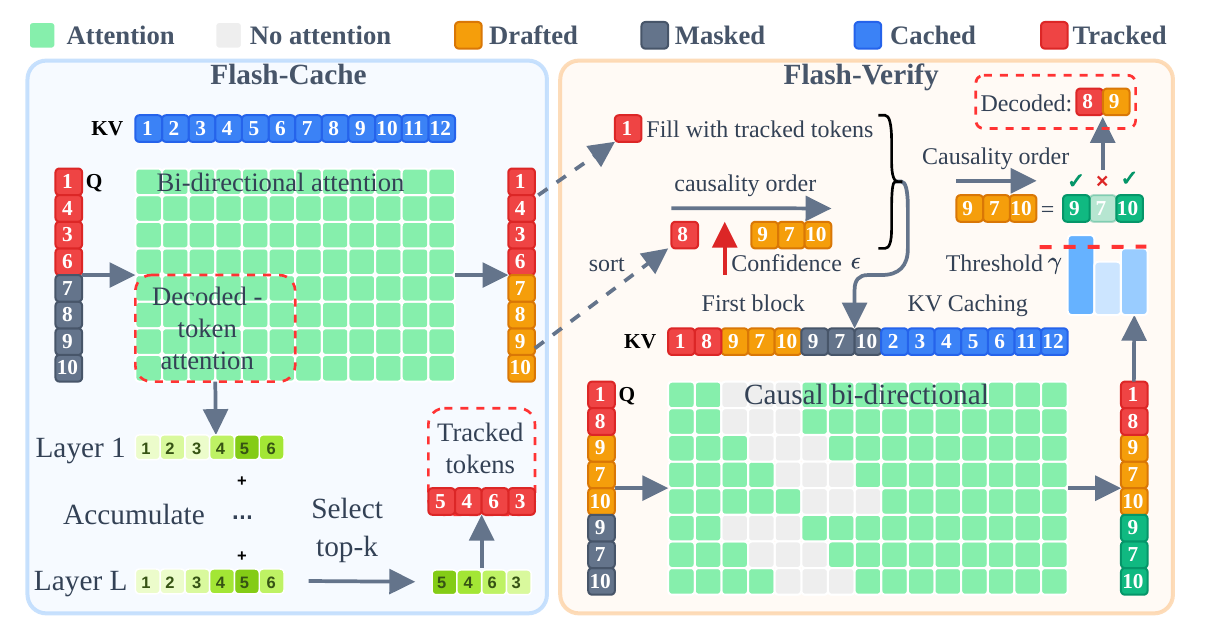
Figure 2 from the paper. Flash-Cache and Flash-Verify share the fused kernel and KV cache.
Contributions
I/O-aware KV-cache management. Flash-Cache fuses QKV projection, rotary positional embedding (RoPE), and cache writes. Intermediate keys and values are not materialized in GPU high-bandwidth memory; the resulting states are written directly to the cache. Scheduled attention uses a block table to handle different query lengths within a batch.
Attention-guided selective refresh. Rather than recomputing all decoded positions, Flash-Cache updates newly decoded tokens and a fixed-budget set of influential decoded tokens selected by attention importance. These tracked positions and the current masked window attend to the full KV cache, while other positions are served from cached states.
Training-free parallel self-verification. Flash-Verify first accepts predictions above the confidence threshold $\epsilon$. Remaining candidates are ordered by draft confidence and represented twice in the verification query: once as draft tokens and once as [MASK] tokens. A causal attention mask prevents a position from accessing its own draft while allowing earlier drafts in the verification order to provide context. In the paper's formulation, a candidate is accepted when the draft and mask-view predictions agree and the mask-view confidence meets $\gamma$; acceptance stops at the first rejection.
Motivating observations and kernel design
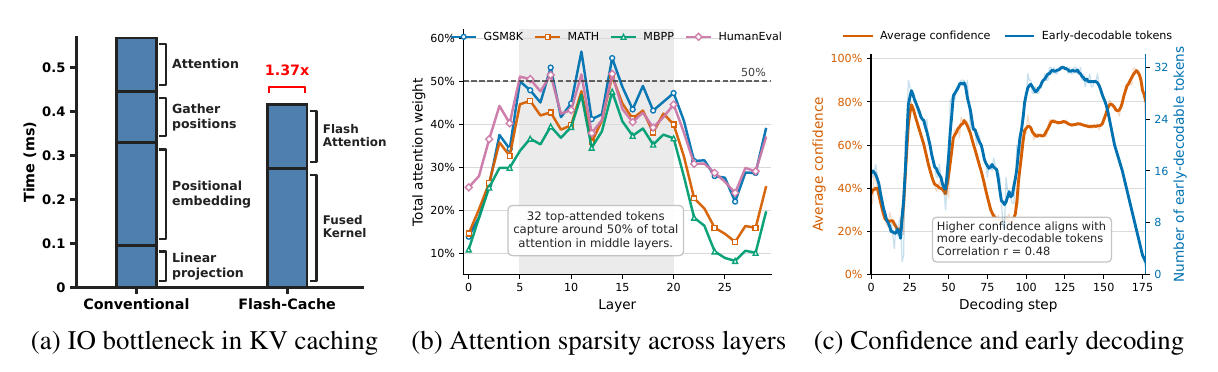
Figure 1 from the paper. The fused cache pipeline achieves a 1.37× per-layer speedup in the RTX 3090 microbenchmark. The top-32 most-attended decoded tokens capture approximately 50% of attention in middle layers, motivating selective tracking. Prediction confidence is positively correlated with the number of early-decodable tokens.
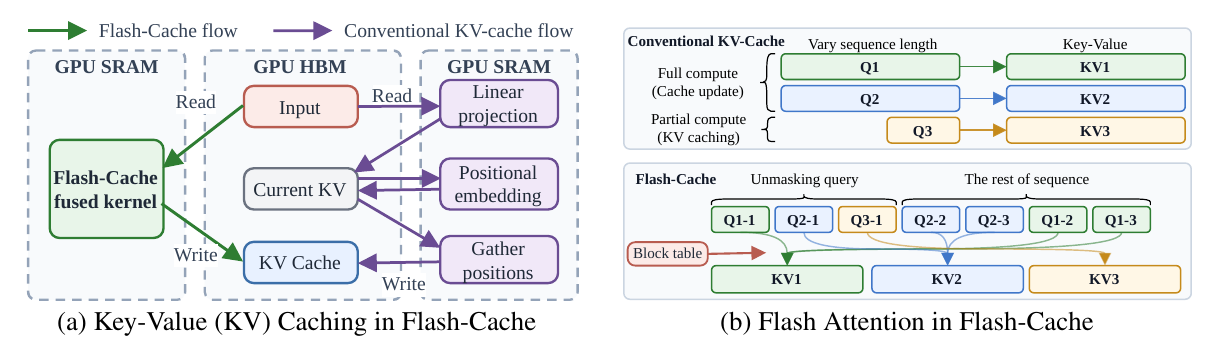
Figure 3 from the paper. I/O-aware memory management in Flash-Cache. The fused kernel reduces intermediate memory traffic, while block-table scheduling supports full and partial computations with different query lengths.
Key results
On LLaDA-1.5, Flash-Cache + Flash-Verify achieves the highest throughput among the configurations in Table 1 across all eight benchmark/length settings:
- 22.3×-148.2× speedup over greedy decoding without caching, with 148.0-210.6 tokens/s.
- 5.1× and 11.0× speedups over Elastic-Cache on GSM8K-512 and HumanEval-512, respectively, based on the Table 1 throughput ratios.
- 23.5%-45.0% higher throughput than Flash-Cache with confidence-aware decoding across the eight settings.
Main benchmark results
The following results reproduce the Flash-Cache + Flash-Verify column of Table 1. The main benchmark experiments use a single NVIDIA A100 80GB GPU; the benchmark-specific settings in Table 3 use batch size 32. Length is the requested generation length in tokens. Scores are percentages: GSM8K uses flexible_extract exact match, MATH uses math_verify, and HumanEval and MBPP use pass@1.
| Benchmark | Length | Score (%) | Throughput (tokens/s) | Speedup vs. greedy, no cache |
|---|---|---|---|---|
| GSM8K (5-shot) | 256 | 81.88 | 194.9 | 29.1× |
| GSM8K (5-shot) | 512 | 83.02 | 210.6 | 81.0× |
| MATH (4-shot) | 256 | 36.56 | 189.7 | 22.3× |
| MATH (4-shot) | 512 | 35.98 | 210.1 | 42.0× |
| HumanEval (0-shot) | 256 | 39.63 | 209.2 | 29.9× |
| HumanEval (0-shot) | 512 | 40.24 | 185.6 | 58.0× |
| MBPP (3-shot) | 256 | 38.20 | 148.0 | 61.7× |
| MBPP (3-shot) | 512 | 39.00 | 148.2 | 148.2× |
Accuracy depends on the task and decoding configuration. Flash-Cache + Flash-Verify achieves both the highest accuracy and throughput on GSM8K-512. It is not the most accurate configuration in every setting: for example, confidence-aware Flash-Cache achieves 42.07% on HumanEval-512, compared with 40.24% for Flash-Verify, at lower throughput. Select a configuration according to the required accuracy-throughput balance rather than treating acceleration as universally lossless.
Full comparison: greedy, confidence-aware, and Flash-Verify decoding
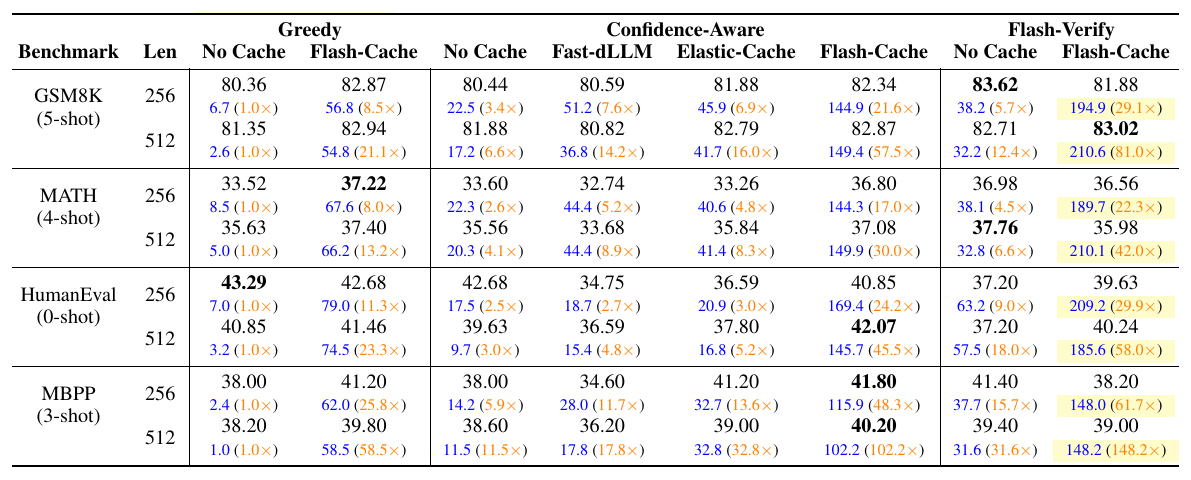
Table 1 from the paper. Each cell reports accuracy on the first line and throughput with speedup over greedy decoding without caching on the second line. Bold denotes the highest accuracy in a row; yellow shading denotes the highest throughput.
Memory efficiency and batch scaling
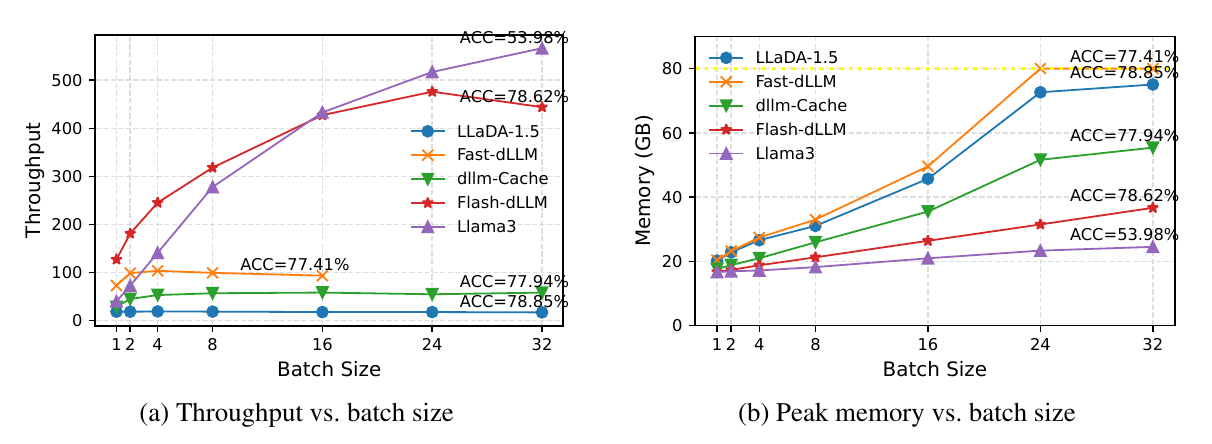
Figure 4 from the paper: GSM8K-512, 1-shot prompting, LLaDA-1.5. Flash-dLLM supports batch size 32, whereas Fast-dLLM encounters an out-of-memory limit at batch size 24 in the reported experiment. At batch size 16, Section 3.3 reports approximately 26 GB of GPU memory for Flash-dLLM versus 50 GB for Fast-dLLM, a reduction of about 48%.
This is a 1-shot scalability experiment, separate from the 5-shot GSM8K results in Table 1. Llama3-8B is included as an autoregressive reference, not as an accuracy-matched diffusion baseline.
Accuracy-throughput trade-offs across tracking budgets and thresholds
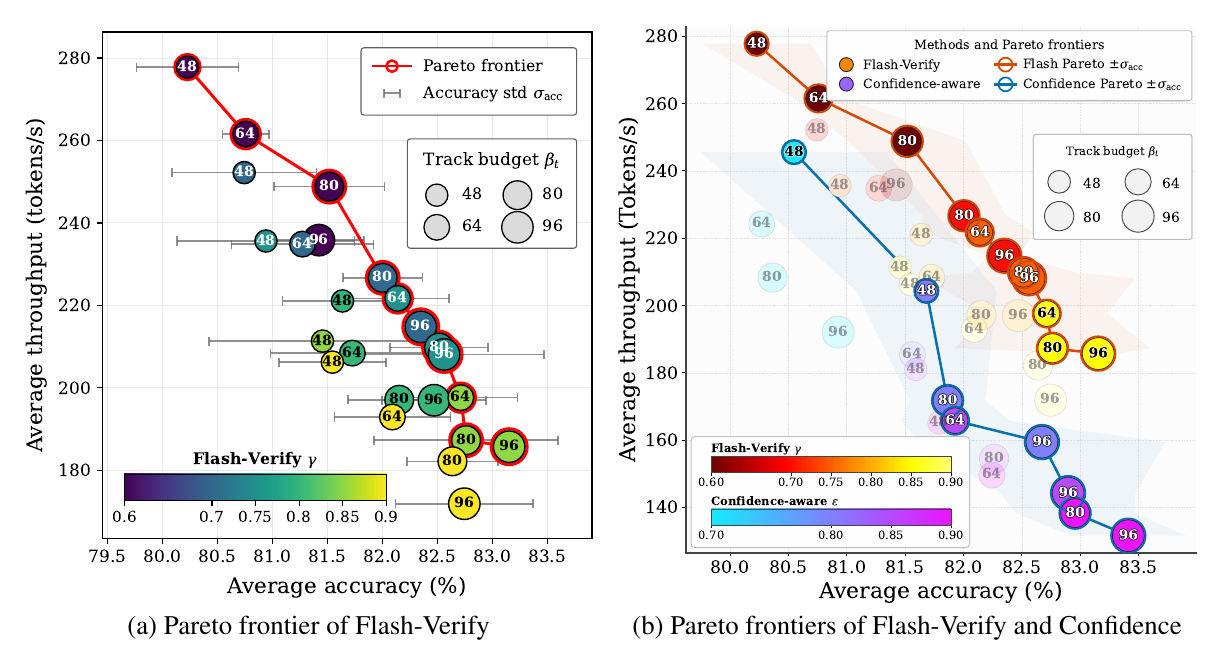
Figure 5 from the paper. Means and standard deviations are computed over five random seeds. Tracking budget $\beta_t$ and the verification/confidence thresholds $\gamma$/$\epsilon$ control the operating point. Larger tracking budgets generally improve accuracy at additional computational cost. Flash-Verify offers higher throughput across most of the shared accuracy range, while confidence-aware decoding reaches a slightly higher peak accuracy in this sweep.
Setup
Clone the repository and install its dependencies in a virtual environment:
git clone https://github.com/VILA-Lab/Flash-dLLM.git
cd Flash-dLLM

python -m venv .venv
source .venv/bin/activate
python -m pip install -r requirements.txt

cd llada
All evaluation and post-processing commands below are run from llada/. The reference hardware for the main benchmark results is an NVIDIA A100 80GB GPU; the RTX 3090 measurement above is a separate kernel microbenchmark.
Evaluation
The evaluator supports two Flash-Cache configurations through verify in --model_args:
| Configuration | Model argument |
|---|---|
| Flash-Cache + confidence-aware decoding | verify=False |
| Flash-Cache + Flash-Verify | verify=True |
Benchmark scripts
The scripts cover mathematical reasoning and code generation. Their shared defaults are batch size 32, generation length 512, block length 16, confidence threshold 0.9, and mask_num=4.
| Command | Harness task | Few-shot examples | gamma |
track_num |
|---|---|---|---|---|
bash eval_gsm8k.sh |
gsm8k |
5 | 0.8 | 4 |
bash eval_math.sh |
minerva_math |
4 | 0.85 | 4 |
bash eval_humaneval.sh |
humaneval |
0 | 0.85 | 4 |
bash eval_mbpp.sh |
mbpp |
3 | 0.8 | 3 |
These settings are assignments near the top of each script, not command-line options. Edit the assignments to change the script configuration.
Code-execution warning: HumanEval, MBPP, and HumanEval post-processing execute generated Python. Run code-generation evaluations in an isolated environment.
Small evaluation
This example evaluates two GSM8K samples, using one process and a batch size of one. It still loads the full model. Remove --limit 2 to evaluate the full task.
export HF_DATASETS_TRUST_REMOTE_CODE=true

CUDA_VISIBLE_DEVICES=0 accelerate launch --num_processes 1 eval_llada.py \
  --model llada_dist \
  --tasks gsm8k \
  --num_fewshot 5 \
  --batch_size 1 \
  --limit 2 \
  --model_args model_path=GSAI-ML/LLaDA-1.5,gen_length=512,block_length=16,threshold=0.9,gamma=0.8,track_num=4,mask_num=4,verify=False,show_speed=True \
  --output_path evals_results/gsm8k-smoke \
  --log_samples
Set verify=True in --model_args to enable Flash-Verify. Use a different --output_path for each configuration to keep results separate.
Change model_path to select a checkpoint. The scripts also reference GSAI-ML/LLaDA-8B-Instruct. The wrapper applies a chat template only when the model path contains instruct, case-insensitively; the default GSAI-ML/LLaDA-1.5 path receives raw task prompts.
Device selection and launch behavior
GSM8K, MATH, and HumanEval set CUDA_VISIBLE_DEVICES=0 on each launch. MBPP uses the devices visible in the environment and sets CUDA_LAUNCH_BLOCKING=1 and PYTORCH_CUDA_ALLOC_CONF=expandable_segments:True.
Accelerate controls the launch configuration. Use the direct command above to explicitly select a device and one process rather than relying on the shell wrappers or a saved Accelerate configuration.
Generation settings
Pass model settings as comma-separated key=value pairs in --model_args. Set the evaluation batch size separately with the harness's --batch_size option.
| Setting | Role in the current implementation |
|---|---|
model_path |
Hugging Face model identifier or local checkpoint path. |
gen_length |
Requested answer length in tokens. |
block_length |
Token block size used during generation. |
threshold |
Confidence threshold for accepting predicted tokens. |
gamma |
Threshold for accepting draft tokens based on verification probabilities. |
track_num |
Number of decoded blocks to refresh, selected by attention scores. A negative value refreshes all positions outside the active block. |
mask_num |
Number of masked blocks. |
verify |
Enables Flash-Verify when True. |
Adapter details. Supply numeric threshold and gamma values when invoking the adapter directly. Their constructor defaults are None, but generation expects numbers. For a small evaluation, keep the batch size no larger than the number of requests because generation initializes a full batch from the prompts.
Paper notation and adapter semantics. The paper defines $\gamma$ through mask-view confidence and agreement with the draft. The adapter documentation describes gamma in terms of cumulative verification probabilities. These descriptions should not be assumed to be interchangeable when interpreting threshold values.
Matching the paper's experimental settings
The script defaults are not the complete paper configuration. Table 3 specifies batch size 32, generation lengths 256 and 512, a masked-window size of 64 tokens, and tracking budgets of 64 tokens for GSM8K, MATH, and HumanEval or 48 tokens for MBPP. The benchmark-specific gamma values are listed in the script table above.
The implementation expresses refresh spans in blocks, while the paper reports token budgets. With block_length=16, four blocks represent 64 tokens and three blocks represent 48 tokens. Section 3.1 also gives a general default tracking budget of 80 tokens; use Table 3 for the benchmark-specific presets rather than substituting that general default.
For comparisons with the reported results, match the checkpoint, generation length, few-shot setting, batch size, refresh budgets, decoding mode, and post-processing. A two-sample evaluation checks the execution path; it is not a throughput reproduction. Throughput and memory measurements depend on the experiment configuration.
Results and logs
The shell scripts redirect standard output to timestamped files under:
logs/<task>_batch<batch_size>_length<length>_block<block_length>/
Filenames record decoding settings and the verification mode. Standard error is not redirected, so errors and progress output may still appear in the terminal.
Only the HumanEval wrapper explicitly supplies --output_path and --log_samples, using its log directory for harness results and samples. For the other tasks, pass those options in a direct command to save structured results and samples, as shown in the small-evaluation example.
HumanEval post-processing
After running eval_humaneval.sh, locate the samples JSONL file under its output directory and pass that specific file to:
python postprocess_code.py path/to/samples_humaneval.jsonl
Replace the example path with the actual samples file. The script extracts and sanitizes generated Python, evaluates each completion with the code_eval metric, prints the mean pass@1, and writes <input-file>.cleaned alongside the input. Each output record contains task_id, completion, and pass_at_1.
Run post-processing separately for each verification mode's samples file. This utility expects HumanEval fields such as doc.prompt, doc.entry_point, doc.task_id, target, and resps; it is not a general MBPP post-processor. Run it in an isolated environment because it executes generated code.
Citation
Please cite the paper when using Flash-dLLM in your research:
@article{nguyentri2026flashdllm,
  title   = {{Flash-dLLM}: IO-Aware KV Caching and Parallel Decoding for Fast, Memory-Efficient Diffusion LLMs},
  author  = {Nguyen-Tri, Quan and Ranjan, Mukul and Shen, Zhiqiang},
  journal = {arXiv preprint arXiv:2609.26796},
  year    = {2026}
}
Acknowledgments
This work is supported by the MBZUAI-WIS Joint Program for Artificial Intelligence Research.
This repository is built upon LLaDA, Fast-dLLM, Elastic-Cache, and lm-evaluation-harness.
License
This project is licensed under the Apache License 2.0. See the LICENSE file for details.
Questions
What is Flash-dLLM?
VILA-Lab/Flash-dLLM is a public repo on GitHub by VILA-Lab. [NeurIPS 2026] Official implementaion for Flash-dLLM: IO-Aware KV Caching and Parallel Decoding for Fast, Memory-Efficient Diffusion LLMs.
Is Flash-dLLM open source?
It declares the Apache-2.0 license on GitHub.
Does Flash-dLLM run on macOS, Windows or Linux?
Its maker has not tagged a system, so it is unknown here. Its README says what it needs.
How do I install Flash-dLLM?
Open "Take it" on its page: Take My Repo writes an install plan for your machine and hands it to your AI agent (Claude Code, Codex or Cursor), which asks you before each step. Take My Repo has not tested it on any machine.
Is Flash-dLLM still maintained?
Its last change on GitHub was on 2026-10-07. GitHub counts 2 open issues and pull requests. Take My Repo does not judge from that whether it is maintained.
What do people who ran Flash-dLLM say?
Nobody has reviewed it on Take My Repo yet, which says nothing about its quality.