Dive-into-Claude-Code
A Systematic Analysis and Discussion of Claude Code for Designing Today's and Future AI Agent Systems
- 2.2k
- 11 d ago
Official implementation of paper: From Masks to Pixels and Meaning: A New Taxonomy, Benchmark, and Metrics for VLM Image Tampering (ECCV2026)
Repo VILA-Lab/PIXAR, read from GitHub 1 min ago. VILA-Lab has not joined Take My Repo.
VILA-Lab/PIXAR is a public repo on GitHub by VILA-Lab. Official implementation of paper: From Masks to Pixels and Meaning: A New Taxonomy, Benchmark, and Metrics for VLM Image Tampering (ECCV2026). It declares the MIT license on GitHub. It is written mainly in Python, has 16 stars and last changed on 2026-03-27. Nobody has reviewed it on Take My Repo yet, which says nothing about its quality. Read from GitHub on 2026-11-21.

Xinyi Shang*
Yi Tang*
Jiacheng Cui*
Ahmed Elhagry
Salwa K. Al Khatib
Sondos Mahmoud Bsharat
Jiacheng Liu
Xiaohan Zhao
Jing-Hao Xue
Hao Li
Salman Khan
Zhiqiang Shen†
* Equal contribution | † Corresponding author

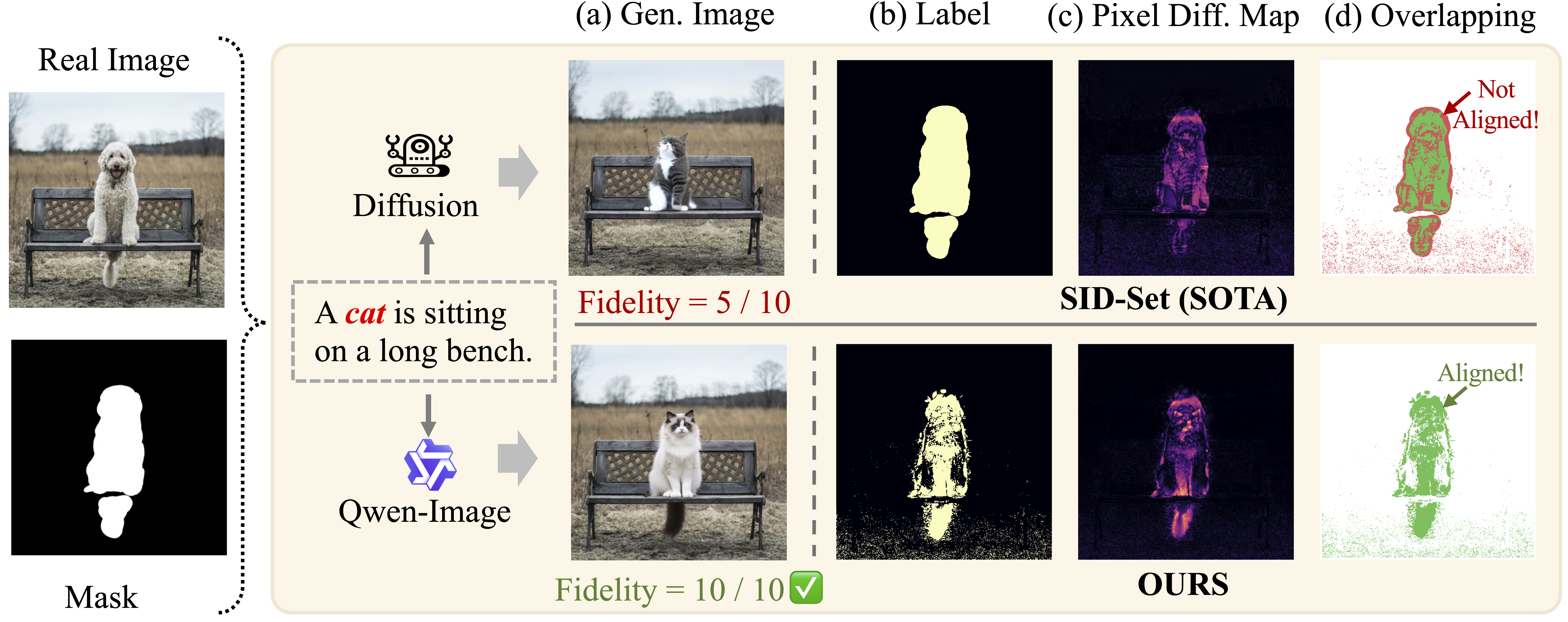
Mask-based labels misalign with true edit signals (top). Our pixel-difference labels are precisely aligned with the generative footprint (bottom).
TL;DR We expose a fundamental flaw in mask-based tampering benchmarks and introduce PIXAR: a 420K+ benchmark with pixel-faithful labels, 8 manipulation types, and a VLM detector that simultaneously localizes, classifies, and describes tampered regions, achieving 2.7× IoU improvement over prior SOTA.
| Model | Base | Training Data | HuggingFace |
|---|---|---|---|
| PIXAR-7B | SIDA-7B | Full training set (train_0.05) |
🤗 Link |
| PIXAR-7B_lite | SIDA-7B | Lite training set (train_mask-only_0.05) |
🤗 Link |
| PIXAR-13B | SIDA-13B | Full training set (train_0.05) |
🤗 Link |
| PIXAR-13B_lite | SIDA-13B | Lite training set (train_mask-only_0.05) |
🤗 Link |
_lite variants are fine-tuned on a subset of our training data that contains masks to guide the generation of tampered image.
Existing tampering benchmarks rely on coarse object masks as ground truth, which severely misalign with the true edit signal: many pixels inside a mask are untouched, while subtle yet consequential edits outside the mask are treated as natural. We reformulate VLM image tampering from coarse region labels to a pixel-grounded, meaning- and language-aware task.
PIXAR is a large-scale benchmark and training framework with three core contributions:
Existing benchmarks typically rely on coarse object masks as ground truth, which often conflates unedited pixels within the mask with actual tamper evidence, while simultaneously overlooking subtle edits beyond the mask boundaries. To alleviate this, we replace binary masks with a per-pixel difference map $D = |I_{\text{orig}} - I_{\text{gen}}|$. By applying a tunable threshold $\tau$, we derive $M_\tau$, which is a dynamic ground truth that encapsulates both micro-edits at lower $\tau$ values and high-confidence semantic changes at higher $\tau$ values.

Pixel-level labels under different τ.
| Split | Size | Labels |
|---|---|---|
| Training | 420K+ image pairs | Pixel-level $M_\tau$, semantic class, text description, tampered or not |
| Test | 40K image pairs (balanced) | Pixel-level $M_\tau$, semantic class, text description, tampered or not |

Built on LLaVA + LLaMA-2 with LoRA fine-tuning, integrated with SAM ViT-H for pixel-level decoding and CLIP ViT-L/14 for visual-language alignment. Three special tokens anchor the multi-task heads in the token sequence:
| Token | Role |
|---|---|
[CLS] |
Hidden state → 2-way classification (real / tampered) via FC_cls |
[OBJ] |
Hidden state → multi-label object recognition (81 COCO classes) via FC_obj |
[SEG] |
Hidden state → SAM prompt for pixel localization via FC_seg |
$$\mathcal{L}_\text{total} = \lambda_\text{sem},\mathcal{L}_\text{sem} + \lambda_\text{bce},\mathcal{L}_\text{bce} + \lambda_\text{dice},\mathcal{L}_\text{dice} + \lambda_\text{text},\mathcal{L}_\text{text} + \lambda_\text{cls},\mathcal{L}_\text{cls}$$
Default weights: $\lambda_\text{sem}$ = 0.5, $\lambda_\text{cls}$ = 1.0, $\lambda_\text{bce}$ = 1.0, $\lambda_\text{dice}$ = 1.0, $\lambda_\text{text}$ = 3.0.
The [SEG] token embedding can be fused with the generated text description in three modes:
| Mode | Description |
|---|---|
seg_only |
Uses seg_emb only |
text_only |
Uses text_emb only |
fuse |
gate · seg_emb + (1 − gate) · text_emb, where gate = σ(MLP([seg_emb, text_emb])) |

model/ — Core model (PIXARForCausalLM): LLaVA backbone + SAM ViT-H encoder + [CLS]/[OBJ]/[SEG] multi-task heads.finetune/ — DeepSpeed training scripts for various LoRA and hyperparameter configurations.evaluation/ — Evaluation launchers and metrics; text_eval/compute_css.py scores descriptions via CSS.utils/ — Dataset class, IoU metrics, and distributed batch sampler.preprocess_raw/ — End-to-end dataset preprocessing pipeline:
1_download-data/ — rclone scripts to download and extract the raw PIXAR dataset from Google Drive.2_construct_dataset/ — Builds the dataset from raw image pairs: generates pixel-difference maps and labels at any $\tau$.train_PIXAR.py — Main training entry point.test_parallel.py — Multi-GPU parallel evaluation.chat.py — Interactive single-image inference.merge_lora_weights_and_save_hf_model.py / merge.sh — Merges LoRA adapters and exports to HuggingFace format.Requires Python 3.10.
pip install -r requirements.txt
Some packages require minor patches after installation. Run:
bash fix/fix.sh
If issues persist, run fix/fix_again.sh.
Download the following weights and place them in your preferred directory:
| Component | Details |
|---|---|
| SIDA-7B base model | HuggingFace-format LLaVA-LLaMA-2 base |
| SAM ViT-H | sam_vit_h_4b8939.pth |
| CLIP ViT-L/14 | openai/clip-vit-large-patch14 (auto-downloaded) |
See the Data section below.
We provide two ways to obtain the PIXAR dataset:
Option A — Download preprocessed data (recommended) Training and test sets preprocessed at $\tau$ = 0.05 are available on Google Drive.
The drive contains 9 files in total:
File Description train_0.05.tar.gzFull training set — includes all tampered type images train_mask-only_0.05.tar.gzLite training set — mask-only tampered type images only; intended for training the lite model variant test_full_0.05.tar.gzFull test set — contains all 6 generation sources combined (see splits below) test_qwen_0.05.tar.gzTest split — Qwen-generated images test_gemini2.5_0.05.tar.gzTest split — Gemini 2.5-generated images test_gemini3_0.05.tar.gzTest split — Gemini 3-generated images test_flux2_0.05.tar.gzTest split — FLUX 2-generated images test_gpt_0.05.tar.gzTest split — GPT-generated images test_seedream_0.05.tar.gzTest split — SeeDream-generated images
test_full_0.05.tar.gzaggregates all 6 per-source test splits (qwen, gemini2.5, gemini3, flux2, gpt, seedream).
Option B — Build from raw data with a custom $\tau$ We release the raw image pairs alongside the pixel-difference maps, allowing labels to be re-derived at any $\tau$. See Custom Dataset Processing for details.
dataset_dir/
├── train/
│   ├── real/               # Authentic images
│   ├── full_synthetic/     # fully generated (empty)
│   ├── tampered/           # AI-Tampered images
│   ├── masks/              # masks used to generate the tampered images
│   ├── soft_masks/         # Pixel-difference maps M_τ (default τ = 0.05)
│   └── metadata/           # JSON per tampered image: {"cls": [...], "text": "..."}
└── validation/
    └── (same structure)
If you want to build the dataset from scratch at a different $\tau$, follow these two steps.
Step 1 — Download raw data
Follow preprocess_raw/1_download-data/README.md to configure rclone, populate preprocess_raw/1_download-data/files.txt with the raw zip filenames, and run:
bash preprocess_raw/1_download-data/download.sh
Step 2 — Build dataset at your preferred $\tau$
Edit the config block in preprocess_raw/2_construct_dataset/generate_v2.sh:
DATASET_DIR="/path/to/raw_outputs"   # output of download.sh
OUT_DIR="/path/to/output_dataset"    # where to write the processed dataset
TAOS=(0.05)                          # e.g. (0.01) (0.1) (0.2) or multiple values
Then run:
cd preprocess_raw/2_construct_dataset

bash generate_v2.sh          # mask-only labels
bash generate_v2-text.sh     # labels + text descriptions (requires descriptions.csv)
$\tau$ selection guide:
| $\tau$ | Effect |
|---|---|
| 0.01 | Captures micro-edits and subtle pixel changes |
| 0.05 | Default — balanced sensitivity (recommended) |
| 0.1 | High-confidence semantic changes only |
| 0.2 | Conservative — only large, obvious edits |
You can launch training directly or use the provided scripts under finetune/:
deepspeed --include localhost:0 --master_port=12345 train_PIXAR.py \
  --version <path_to_base_model> \
  --dataset_dir <path_to_dataset> \
  --vision_pretrained <path_to_sam_vit_h.pth> \
  --val_dataset <path_to_validation_set> \
  --batch_size 2 --epochs 10 --steps_per_epoch 1000 \
  --lr 1e-4 --dice_loss_weight 1.0 --seg_prompt_mode seg_only \
  --precision bf16 --exp_name "pixar_experiment" --log_base_dir ./runs
Key hyperparameters: LoRA rank 8, $\lambda_\text{dice}$ = 1.0, $\lambda_\text{sem}$ = 0.1, $\lambda_\text{text}$ = 3.0, $\tau$ = 0.05.
After training, convert the DeepSpeed checkpoint and merge LoRA adapters before evaluation:
# Step 1: Convert DeepSpeed checkpoint to fp32
cd runs/<exp_name>/ckpt
python zero_to_fp32.py . ../pytorch_model.bin

# Step 2: Merge LoRA adapters into the base model
# Set the path to pytorch_model.bin in merge.sh, then run:
bash merge.sh
See evaluation/README.md for the full guide.
# Multi-GPU parallel evaluation
python test_parallel.py \
  --version <merged_model> --dataset_dir <test_data> \
  --vision_pretrained <sam.pth> --gpus 0,1,2,3 \
  --output_dir ./evaluation/logs/my_exp \
  --seg_prompt_mode seg_only --precision bf16 --save_generated_text

# Text quality (CSS score, requires --save_generated_text above)
cd evaluation/text_eval
python compute_css.py \
  --json_path ../logs/my_exp/generated_texts.json \
  --output_path ./logs/my_exp/css_scores.json
python chat.py --version <merged_model> --precision bf16 --seg_prompt_mode seg_only
We also provide a set of demo notebooks in the playground/ directory that you can use to explore the model interactively.
If you find this work useful, please cite:
@article{shang2026masks,
  title={From Masks to Pixels and Meaning: A New Taxonomy, Benchmark, and Metrics for VLM Image Tampering},
  author={Shang, Xinyi and Tang, Yi and Cui, Jiacheng and Elhagry, Ahmed and Khatib, Salwa K Al and Bsharat, Sondos Mahmoud and Liu, Jiacheng and Zhao, Xiaohan and Xue, Jing-Hao and Li, Hao and others},
  journal={arXiv preprint arXiv:2603.20193},
  year={2026}
}
VILA-Lab/PIXAR is a public repo on GitHub by VILA-Lab. Official implementation of paper: From Masks to Pixels and Meaning: A New Taxonomy, Benchmark, and Metrics for VLM Image Tampering (ECCV2026).
It declares the MIT license on GitHub.
Its maker has not tagged a system, so it is unknown here. Its README says what it needs.
Open "Take it" on its page: Take My Repo writes an install plan for your machine and hands it to your AI agent (Claude Code, Codex or Cursor), which asks you before each step. Take My Repo has not tested it on any machine.
Its last change on GitHub was on 2026-03-27. Take My Repo does not judge from that whether it is maintained.
Nobody has reviewed it on Take My Repo yet, which says nothing about its quality.
A Systematic Analysis and Discussion of Claude Code for Designing Today's and Future AI Agent Systems
The official GitHub repo for the survey paper "A Survey on Diffusion Language Models".
A principled instruction benchmark on formulating effective queries and prompts for large language models (LLMs). Our paper: https://arxiv.org/abs/2312.16171
An Automated AI Agent Tool for Plotting Your Data in Any Paper's Figure Style.
(NeurIPS 2023 spotlight) Large-scale Dataset Distillation/Condensation, 50 IPC (Images Per Class) achieves the highest 60.8% on original ImageNet-1K val set.
[NeurIPS25 & ICML25 Workshop on Reliable and Responsible Foundation Models] A Simple Baseline Achieving Over 90% Success Rate Against the Strong Black-box Models of GPT-4.5/4o/o1. Paper at: https://arxiv.org/abs/2503.10635