
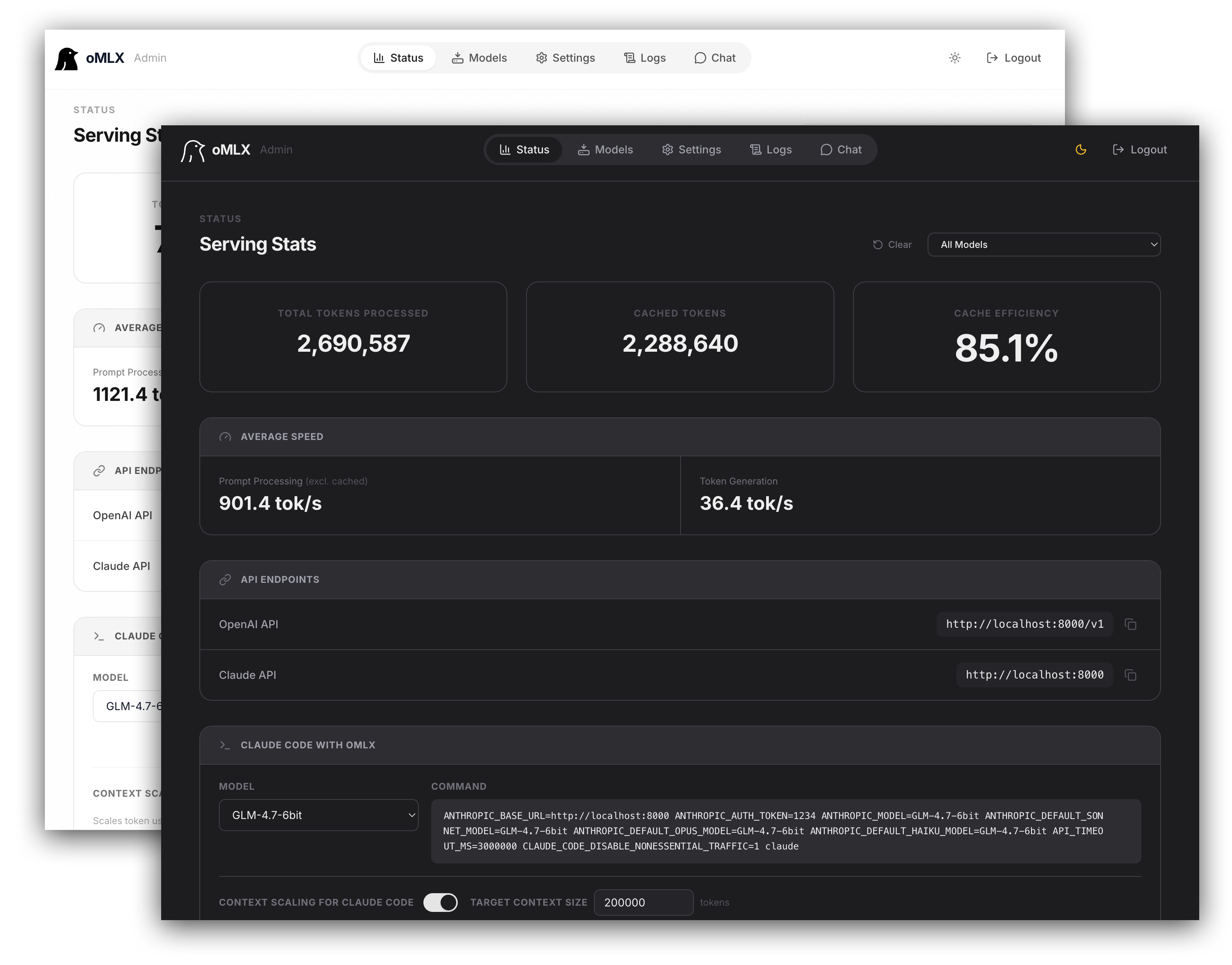
omlx
LLM inference server with continuous batching & SSD caching for Apple Silicon — managed from the macOS menu bar
- 24k
- Python
- Apache-2.0
- 23 h ago
Config + tooling for a local agentic coding stack: oMLX-served open-weight LLMs driving an OpenCode multi-agent pipeline on Apple Silicon, with reproducible throughput benchmarks
Repo edseabolt/local-agent-stack, read from GitHub 7 min ago. edseabolt has not joined Take My Repo.
edseabolt/local-agent-stack is a public repo on GitHub by edseabolt. Config + tooling for a local agentic coding stack: oMLX-served open-weight LLMs driving an OpenCode multi-agent pipeline on Apple Silicon, with reproducible throughput benchmarks. It declares the MIT license on GitHub. It is written mainly in Python, has 1 stars and last changed on 2026-11-17. Nobody has reviewed it on Take My Repo yet, which says nothing about its quality. Read from GitHub on 2026-11-24.
LLM inference server with continuous batching & SSD caching for Apple Silicon — managed from the macOS menu bar
My local agentic coding setup: open-weight LLMs served by oMLX on a Mac Studio, driven by OpenCode with a multi-agent pipeline where each role gets the model that suits it. Nothing leaves the machine.
The pipeline gates themselves (plan approval, test evidence before review, reviewer round caps) are enforced by turnstile. This repo is the model and server side. The omlx-benchmark skill runs oMLX's admin-API throughput benchmark (single-request prefill/decode at chosen context lengths, plus 2x/4x/8x concurrent batches) and prints README-ready tables; the omlx-install skill applies any template change to the live config.
My models can be found on huggingface
All four are quantized with oMLX's oQ format, and all run with MTP (multi-token prediction) speculative decoding. See Benchmarks for the full measured data.
| Model | Quant | Context | Input | Prefill tok/s | Decode tok/s | Notes |
|---|---|---|---|---|---|---|
| GLM-5.3-Flash | oQ6 | 256K in OpenCode (server allows 1M) | text, image | ~486–560 | ~41–71 | All agent roles run on it. Decode rises with context (41.4 at pp1024 → 70.6 at pp131072). |
| Qwen3.8-Flash-Next | oQ4 | 256K | text, image | ~1126–1358 | ~58–104 | Fastest flat prefill; defined but no agent role uses it today. |
| Ornith-1.5-35B-A3B | oQ8 | 256K | text, image, video | ~2331–3086, ~1108 at pp131072 | ~131–158, ~102 at pp131072 | MoE, ~3B active parameters. Fastest short-context model. Pinned in memory. Runs title and summary. |
| Qwen3.8-27B | oQ8 | 128K | text, image, video | ~410–435, ~271 at pp131072 | ~43–71, non-monotonic with context | Dense. Defined but no agent role uses it today. |
Full per-context tables, median and min–max, and methodology: docs/benchmarks-current.md. Qwen3.8-Flash-Next and Qwen3.8-27B stay loaded and benchmarked, but no agent role points at them right now.
Server-side defaults for every model: temperature 1.0, top-p 0.95, top-k 20 (not set for GLM), thinking enabled with reasoning_effort: low. force_sampling is off, so the temperature OpenCode sends with each request wins. (oMLX also has a global fallback sampling profile for models without a per-model entry; the per-model values above are what matter here.)
Defined in opencode/opencode.jsonc.
| Role | Model | Why |
|---|---|---|
| default, planner, plan-reviewer, executor, test-runner, reviewer, debugger | GLM-5.3-Flash (oQ6) | One model for every reasoning role keeps the prefix cache hot across turns. The 256K context holds a plan, diff, and test log at once. |
| title, summary | Ornith-1.5-35B-A3B | Cheap housekeeping calls. |
Each model also has three OpenCode variants: precise (0.1), balanced (0.5), and creative (0.9). turnstile further clamps executor, test-runner, and debugger to ≤ 0.2 and both reviewers to 0.
From omlx/settings.json and omlx/model_settings.json:
memory_guard_custom_ceiling_gb is set but only applies with tier custom, so it's inert here.)preserve_mid_system_cache keeps the shared system prompt cached across agent turns.limit.context values are 256K for GLM, Qwen3.8-Flash-Next, and Ornith, and 128K for Qwen3.8-27B, so OpenCode compacts at 256K even though the GLM server entry allows 1M.Install oMLX and download the models into your oMLX models directory.
Run the install skill (or python3 opencode/skills/omlx-install/scripts/install.py): it creates .env (harvesting keys/hostname from an existing install, or generating them), substitutes the sentinels, backs up and installs ~/.omlx/settings.json, ~/.omlx/model_settings.json, ~/.config/opencode/opencode.jsonc, and ~/.config/opencode/skills/. The installed client config gets a literal baseURL/apiKey, so no .env sourcing is needed at launch.
Export .env if other tools need the values (set -a; source .env; set +a), then run opencode.
0.0.0.0 so other machines on the LAN can use it. If you only use it locally, set host to 127.0.0.1.git log, rg, jq, and similar) plus npm run *, gh *, and a few low-risk utilities (find *, sleep *, git branch *, git stash *); destructive git operations (git push * --force*, git worktree remove/prune, gh pr merge) ask first, and everything else (edits, any other shell command) asks.model_settings.json also keeps entries for the unsuffixed base checkpoints (for example GLM-5.3-Flash). Only the -oQ6-mtp / -oQ8-mtp entries are used by this setup.Throughput is measured with the /omlx-benchmark skill
(opencode/skills/omlx-benchmark/): 3 runs per model, single request at
four prompt lengths plus a 1x–8x batching sweep.
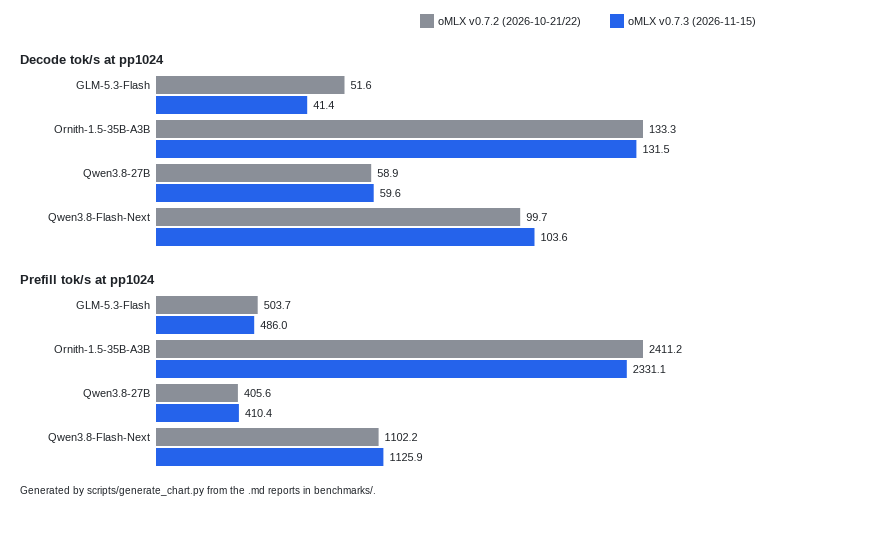
Current — oMLX v0.7.3 (2026-11-15): full tables — single-request cells with mean ± stddev, median, and min–max (batching cells: mean ± stddev and min–max) — plus methodology and per-model observations, in docs/benchmarks-current.md.
Historical — oMLX v0.7.2 (2026-10-21/22): the previous run's tables and observations, clearly labeled, in docs/benchmarks-historical.md.
Headline (single request, pp1024, decode tok/s, mean of 3): GLM-5.3-Flash oQ6 41.4 · Qwen3.8-Flash-Next oQ4 103.6 · Ornith-1.5-35B-A3B oQ8 131.5 · Qwen3.8-27B oQ8 59.6.
MIT
edseabolt/local-agent-stack is a public repo on GitHub by edseabolt. Config + tooling for a local agentic coding stack: oMLX-served open-weight LLMs driving an OpenCode multi-agent pipeline on Apple Silicon, with reproducible throughput benchmarks.
It declares the MIT license on GitHub.
Its maker tagged it for macOS. That is declared by the maker; Take My Repo has not tested it.
A coding agent for open models like Kimi K3.1 and GLM 5.3
The agent harness performance optimization system. Skills, instincts, memory, security, and research-first development for Claude Code, Codex, Opencode, Cursor and beyond.
macOS menu bar app that tells you, in plain English, what each USB-C cable plugged into your Mac can actually do
Open "Take it" on its page: Take My Repo writes an install plan for your machine and hands it to your AI agent (Claude Code, Codex or Cursor), which asks you before each step. Take My Repo has not tested it on any machine.
Its last change on GitHub was on 2026-11-17. GitHub counts 0 open issues and pull requests. Take My Repo does not judge from that whether it is maintained.
Nobody has reviewed it on Take My Repo yet, which says nothing about its quality.
Take My Repo cannot say: it does not audit code and has not run local-agent-stack. What is known comes from GitHub. It declares the MIT license on GitHub. Its last change was on 2026-11-17. It has 1 stars, which measure popularity, not safety. Nobody has reviewed it on Take My Repo yet, which says nothing about its quality. Read the source before you run it. With "Take it", your AI agent shows each step and asks you before running it; README text is treated as data, not as instructions.






