VoiceStudio
VoiceStudio is the open-source, fully-local ElevenLabs alternative — voice cloning, voice design, video dubbing, dictation, transcription & audiobook creation in 646 languages.
- 116k
- Python
- AGPL-3.0
- 1 h ago
Pre-tensor-core (Pascal GTX 1070) inference optimizations for llama.cpp: native Turbo3 compressed-KV flash attention, PTQ1 ternary DP4A matmuls, chunked gated-delta-net, TurboQuant/VBR KV on 80K-262K contexts
Repo joris-sta/llama-cpp-pascal, read from GitHub 16 h ago. joris-sta has not joined Take My Repo.
joris-sta/llama-cpp-pascal is a public repo on GitHub by joris-sta. Pre-tensor-core (Pascal GTX 1070) inference optimizations for llama.cpp: native Turbo3 compressed-KV flash attention, PTQ1 ternary DP4A matmuls, chunked gated-delta-net, TurboQuant/VBR KV on 80K-262K contexts. It declares no license on GitHub. Public does not mean open source: without a license, nobody is granted the right to reuse it. It is written mainly in Cuda, has 22 stars and last changed on 2026-11-09. Nobody has reviewed it on Take My Repo yet, which says nothing about its quality. Read from GitHub on 2026-11-22.
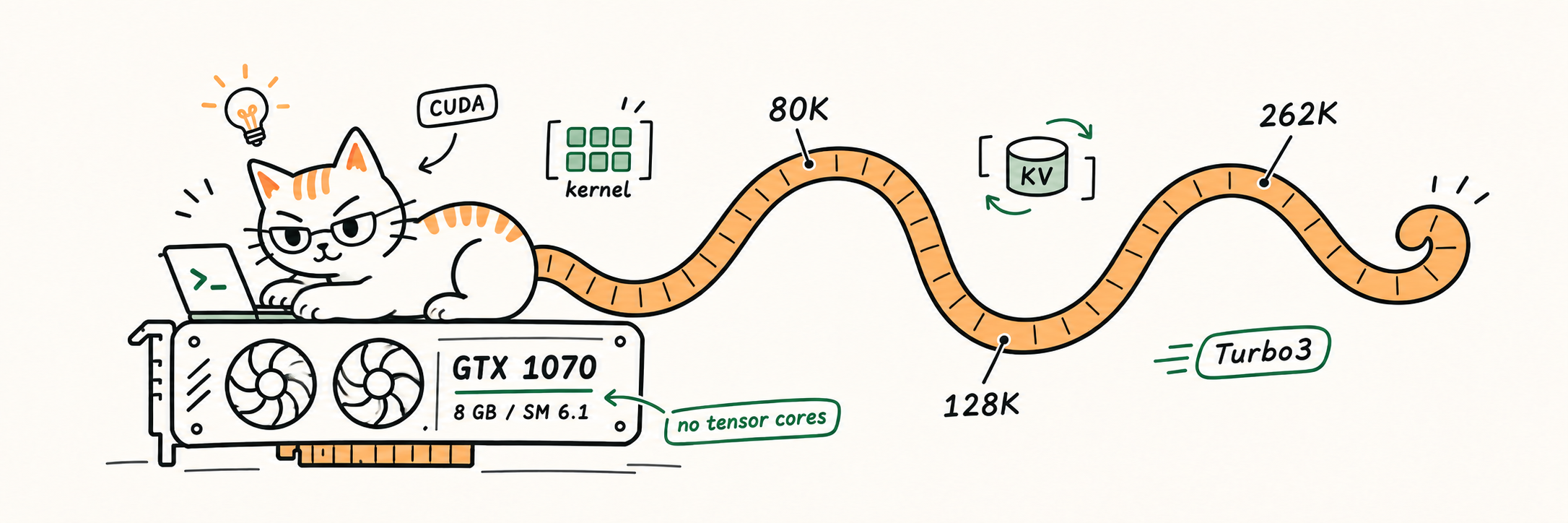
A 27B model with a 96K-token context, fully resident on a 2016 GTX 1070 — no tensor cores, 8 GB of VRAM, serving real agent workloads.
What was done. Hand-written CUDA kernels for pre-tensor-core GPUs — compressed-KV flash attention (decode and prefill) that never materializes the cache in FP16, ternary-weight matmul kernels, and a chunked recurrent-memory kernel — on top of a compressed KV cache that fits ~3× the values of FP16 in the same VRAM. The pieces compose, they do not multiply: each number here is an isolated arm against its own baseline.
Average result. +50–70% generation speed on the 27B ternary model from the decode kernels alone at 512-token to 32K depth, +49% prompt processing on ternary weights at parity perplexity, and +15–34% deeper-context decode for the recurrent-hybrid family.
Two verified examples.
- Bonsai-2-27B (PTQ1 ternary quants): production server at ~80–96K context; 6.4 → 10.9 tok/s at shallow depth and 5.7 → 8.7 tok/s at a filled 32K window from the decode kernels alone, outputs identical.
- Qwen3.5-native 9B hybrid: 335 tok/s at a filled 32K window; +15–34% decode at 32–128K depth, the top end at a full 128K window (8.6 → 11.5 tok/s) with identical greedy output.
Every number is a paired, greedy-output-matched comparison on an idle GPU.
docs/keeps the logs — including the experiments that were rejected and why.
Fork of ggml-org/llama.cpp — with the TurboQuant/VBR KV stack and Bonsai ternary integration in its lineage (Credits) — rebuilt around that constraint. Upstream behavior is intact; this repository publishes the engine's own additions as browsable kernel sources, campaign documentation, and a reviewable patch series.
What ships here instead of a 5,700-file fork tree:
kernels/ — the custom CUDA kernels, copied verbatim from the
build tree so you can read them without cloning the base.docs/ — the tuning/validation campaign logs behind every number,
including what was measured, rejected and why.patches/ — the layer of changes described below as a
git format-patch series.The companion write-up is in
Project_description.md.
| Component | What it does | Measured (GTX 1070) |
|---|---|---|
| Turbo3 native attention | Compressed-KV flash attention decoded inside the tile: no FP16 cache materialization on decode, GQA row sharing, register-resident D=256/GQA=4 kernel | 128K attention 8.65 → 5.48 ms; decode +15/+24/+34% at 32/64/128K, greedy-identical output |
| Turbo3 prefill tiles | Small multi-token suffix batches stay on the native path; graph packs strided queries | Filled-window prefill 335 / 245 / 163 tok/s at 32K/64K/128K |
| Ternary (PTQ1) DP4A matmuls | MMQ prefill entries lift the Q8 shared tile to ternary; dense PTQ1 GEMV reuses one Q8 activation row across four output rows, fused with signed-FWHT rotation | Bonsai PTQ prefill 747 → ~1,112 tok/s (+49%) at parity perplexity |
| Gated delta net (Pascal) | Recurrent hybrid memory: per-warp register state shards, fused delta-rule update, exact recurrent order | SM 6.1 chunk kernel, auto/off/staged + chunk 16/32 knobs |
| TurboQuant KV + VBR | Custom cache ladder (8 → 1.25 eff. bits/value) in rotated space; runtime in-place degradation controller with per-model measured orders; per-layer Q8 pinning | ~3× KV density vs f16; dynamic VBR runs coherent at full degradation |
| Server retention engine | Disk-budgeted persistent resume, checkpoint anchor-coverage authority, cache identity digests, atomic streaming tool calls | Sessions survive restarts as authenticated artifacts |
Correctness is backed by dedicated numerical tests, notably
test-turbo3-native: 87 cases comparing compressed CUDA decode against FP32
CPU attention over the same decoded centroids, each with and without forced
CUDA graph replay.
kernels/ggml-cuda/)| File | Role |
|---|---|
fattn-tile.cu / fattn-tile.cuh |
Dispatch and tile templates for the native T3 decode + prefill paths |
fattn-turbo3-decode.cuh |
The register-resident decode kernel family |
fattn.cu |
Flash-attention entry points, rotation-once query handling, prefill gating |
fwht.cu / fwht.cuh |
Signed Fast Walsh–Hadamard transforms used for the rotated cache space and fused quantization |
gated_delta_net.cu / gdn-chunk-pascal.cuh |
Chunk-staged recurrent memory kernel |
mmvq-ptq1-pascal.cuh / ptq1-pascal-layout.cuh |
Dense ternary decode path and shared tile geometry |
test-turbo3-native.cpp, test-ptq1-pascal.cu, test-gdn-chunk-pascal.cu |
Numerical oracles for each kernel family |
These files reference their surrounding llama.cpp context (headers, config
plumbing) and are published as reference sources — apply
patches/ onto the base fork to integrate them.
patches/ applies cleanly onto the lineage these changes were developed
against (llama.cpp with the TurboQuant KV stack and Bonsai ternary
integration); the upstream-linked base is the one this repository's docs
describe:
git clone <base-fork> llama.cpp && cd llama.cpp
git am --3way /path/to/patches/*.patch
# build the test wheel
cmake -S . -B build-pascal -DGGML_CUDA=ON \
  -DCMAKE_CUDA_COMPILER=/usr/bin/nvcc \
  -DCMAKE_CUDA_ARCHITECTURES=61 -DCMAKE_BUILD_TYPE=Release \
  -DGGML_CUDA_FA=ON -DGGML_CUDA_TURBO_FA=ON
cmake --build build-pascal --target llama-server llama-bench \
      test-turbo3-native test-ptq1-pascal test-gdn-chunk-pascal -j
ctest -L cuda
Build/run/flag documentation for the integrated engine is in
docs/, notably the VBR flag surface
(docs/vbr.md) and the production tuning log
(docs/qwen-native-turbo3.md).
A coding agent can do the Applying the changes flow — amendment, build, test cycle, and conflict resolution — from one prompt. Paste this and give it the paths it asks for:
Apply a llama.cpp patch series to my build.

Inputs you need from me (ask if not already known):
- REPO:    the llama.cpp checkout to patch (git working tree, clean or dirty —
           tell me if it is dirty and I will say whether to stash)
- PATCHES: the directory holding the *.patch files from
           joris-sta/llama-cpp-pascal (or a git remote to fetch them from)
- CUDA:    nvcc path and CUDA architectures to build for (e.g. 61, 86)

Do this end to end:
1. Preflight: confirm REPO is a llama.cpp tree (llama.h exists, ggml/ dir),
   print its HEAD commit, and confirm git am is available.
2. Apply: `git am --3way "$PATCHES"/*.patch`. If a patch conflicts, stop,
   show me the conflict and the upstream context around it, and propose a
   resolution for my approval before continuing — do not resolve silently.
3. Configure + build, Release, GGML_CUDA=ON with my CUDA archs and
   GGML_CUDA_FA=ON + GGML_CUDA_TURBO_FA=ON, targets llama-server llama-bench
   test-turbo3-native test-ptq1-pascal test-gdn-chunk-pascal.
4. Test: run the three custom numerical tests directly, then `ctest -L cuda`.
   All of test-turbo3-native (87 cases), test-ptq1-pascal and
   test-gdn-chunk-pascal must pass.
5. Debug: if anything fails to compile or a test fails, bisect the failure
   yourself — read the error, form a hypothesis, fix or report. Report exact
   compiler/CTEST output for anything you cannot resolve. Do NOT paper over
   failures by relaxing tests or tolerances; if a test fails after your fix,
   say so explicitly.
6. Report: applied patch list, build summary, test results table
   (pass/fail per test), and any files you modified beyond the patches.
Agent guardrails worth keeping, from this repository's own debugging campaigns: never widen a numerical tolerance to make a test pass (the original campaigns kept 1e-7 NMSE limits and explicitly recorded where the limit had to be revisited and why); do not patch around missing GGML ops — they mean the base tree lacks what the kernels expect; and prefer reporting a conflict to a resolution that silently changes kernel semantics.
docs/.joris-sta/llama-cpp-pascal is a public repo on GitHub by joris-sta. Pre-tensor-core (Pascal GTX 1070) inference optimizations for llama.cpp: native Turbo3 compressed-KV flash attention, PTQ1 ternary DP4A matmuls, chunked gated-delta-net, TurboQuant/VBR KV on 80K-262K contexts.
It declares no license on GitHub. Public does not mean open source: without a license, nobody is granted the right to reuse it.
Its maker has not tagged a system, so it is unknown here. Its README says what it needs.
Open "Take it" on its page: Take My Repo writes an install plan for your machine and hands it to your AI agent (Claude Code, Codex or Cursor), which asks you before each step. Take My Repo has not tested it on any machine.
VoiceStudio is the open-source, fully-local ElevenLabs alternative — voice cloning, voice design, video dubbing, dictation, transcription & audiobook creation in 646 languages.
Its last change on GitHub was on 2026-11-09. GitHub counts 1 open issue and pull requests. Take My Repo does not judge from that whether it is maintained.
Nobody has reviewed it on Take My Repo yet, which says nothing about its quality.

The official repo of Qwen (通义千问) chat & pretrained large language model proposed by Alibaba Cloud.
The agent harness performance optimization system. Skills, instincts, memory, security, and research-first development for Claude Code, Codex, Opencode, Cursor and beyond.
A high-throughput and memory-efficient inference and serving engine for LLMs
Blender to ComfyUI bridge: live depth, normal, UV, beauty and outline render passes streamed over localhost into ComfyUI nodes for ControlNet and conditioning workflows.