
n8n
Fair-code workflow automation platform with native AI capabilities. Combine visual building with custom code, self-host or cloud, 400+ integrations.
- 212k
- TypeScript
- 2 h ago
DevGuard Backend — Open-source software supply chain security: SBOM, CVE and VEX management, scanner integration, SLSA Dependency Ingestion Platform, Dependency Firewall and attestation-based compliance as code. An OWASP Incubator Project & OpenSSF General Member.
Repo l3montree-dev/devguard, read from GitHub 24 h ago. l3montree-dev has not joined Take My Repo.
l3montree-dev/devguard is a public repo on GitHub by l3montree-dev. DevGuard Backend — Open-source software supply chain security: SBOM, CVE and VEX management, scanner integration, SLSA Dependency Ingestion Platform, Dependency Firewall and attestation-based compliance as code. An OWASP Incubator Project & OpenSSF General Member. It declares no license on GitHub. Public does not mean open source: without a license, nobody is granted the right to reuse it. It is written mainly in Go, has 224 stars and last changed on 2026-11-23. Nobody has reviewed it on Take My Repo yet, which says nothing about its quality. Read from GitHub on 2026-11-23.
Fair-code workflow automation platform with native AI capabilities. Combine visual building with custom code, self-host or cloud, 400+ integrations.
SafeLine is a self-hosted WAF(Web Application Firewall) / reverse proxy to protect your web apps from attacks and exploits.

An OWASP Incubating Project & OpenSSF General Member · Made in Germany 🇩🇪 for the world 🌍
Documentation · Live Demo · Report Bug · Chat (Matrix)
[!NOTE] Join the monthly DevGuard Open Community Call — always at 17:00 (UTC+2) on the last thursday of the month. You can find the agenda in the Discussions. Help shape new features and discuss contributions. For support, join the community Matrix space.
DevGuard is a single platform that finds, prioritizes, and tracks vulnerabilities across your entire software supply chain — from source code and third-party dependencies to container images, infrastructure-as-code, and deployed artifacts.
It replaces the patchwork of disconnected scanners, spreadsheets, and manual triage with one system that scans, prioritizes, tracks, and documents security findings across the whole SDLC. DevGuard is built exclusively on open standards — SBOM, VEX, SARIF, SLSA, in-toto — so there's no vendor lock-in and no proprietary formats.
This repository contains the DevGuard Backend (Go API + PostgreSQL). The web frontend lives at l3montree-dev/devguard-web.

Traditional security tools treat vulnerability management as something separate from development — generating 50–80% false-positive noise, living in spreadsheets, and demanding context switches from engineers who just want to ship. DevGuard flips that: security intelligence is delivered where developers already work (pull requests, CI, issue trackers), and real risks surface first thanks to multi-dimensional scoring.
Use DevGuard if you need to:
DevGuard is for developers, DevOps engineers, and security teams. No specialized security knowledge required.

| Capability | What it does |
|---|---|
| Full DevSecOps pipeline | Secret scanning, SAST, SCA, IaC scanning, container scanning, and license compliance — one CLI, one CI integration |
| Risk-based prioritization | Scores every finding as (CVSS-BE × (EPSS + 1)) / 2 / Component Depth so you fix what actually matters first |
| SBOM & VEX management | CycloneDX SBOMs, full VEX workflows, and live SBOM/VEX endpoints that always reflect current state |
| Dependency Firewall | Proxies npm, Go, and Python registries — blocks known-malicious and vulnerable packages before download |
| Supply-chain integrity | in-toto attestations, SLSA provenance, cosign signatures, reproducible builds with Nix |
| Policy enforcement | Organization-wide security policies written in OPA/Rego, enforced automatically |
| Bring your own scanner | Ingests SBOM (CycloneDX) and SARIF from Trivy, Grype, Semgrep, and any standards-compliant tool |
| Issue tracker integration | GitHub Issues, GitLab Issues, and Jira — bidirectional sync with slash-command triage |


The full documentation lives at docs.devguard.org. It covers installation, quickstart, CI/CD integration, scanner usage, and configuration.
For details on connecting to your CI, setting up the dependency firewall, or self-hosting in production, see the documentation.
The full documentation lives at docs.devguard.org. Start here:
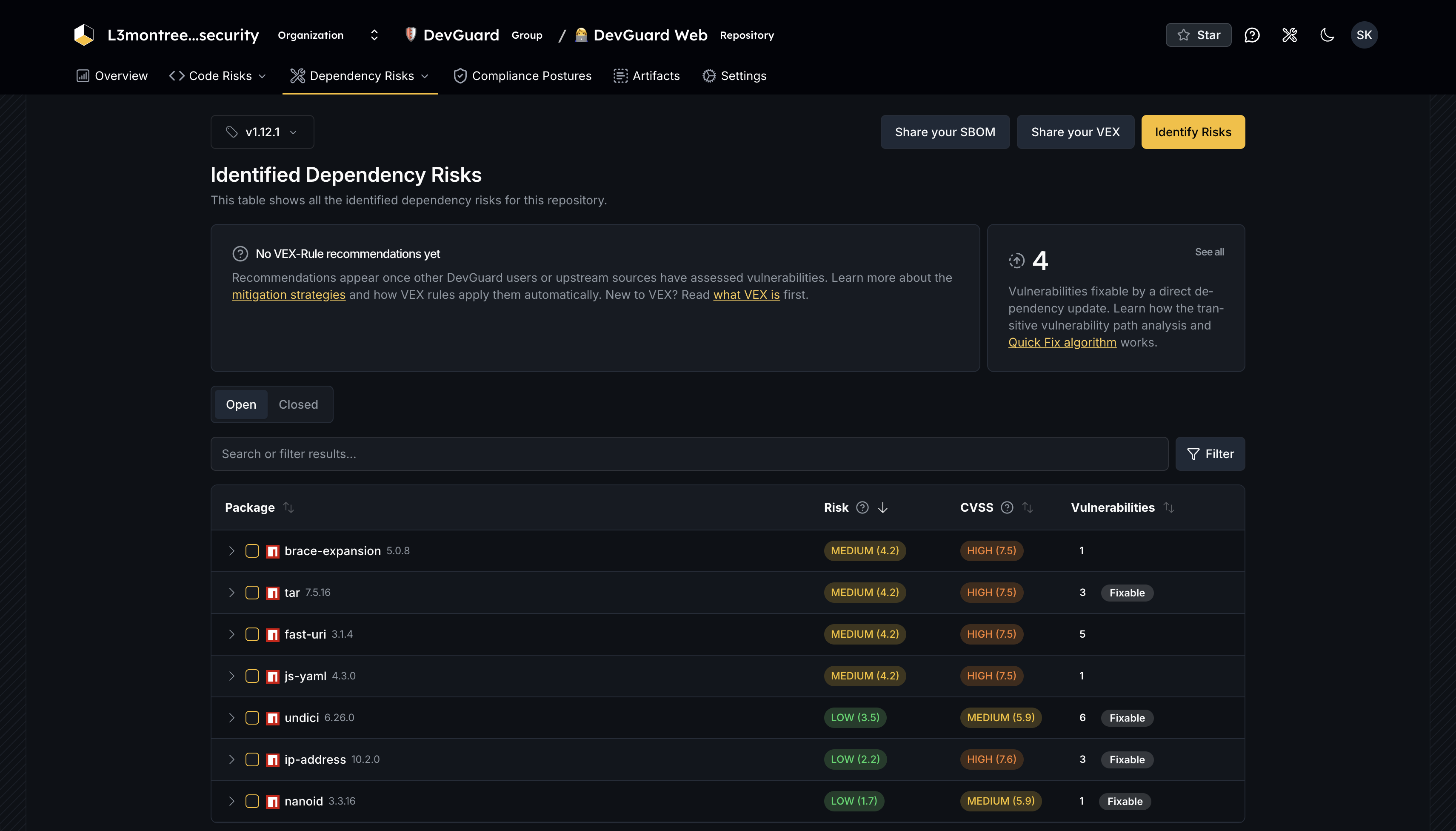
We scan DevGuard with DevGuard. Browse the public instance to see real vulnerability data, SBOMs, and VEX assessments on a live project:
main.devguard.org/l3montree-cybersecurity/projects/devguard
Live (always-current) SBOM and VEX endpoints for this project:
| Component | SBOM | VEX |
|---|---|---|
| Backend (this repo) | SBOM | VEX |
| Web Frontend | SBOM | VEX |
Please follow the Code of Conduct when participating.
DevGuard is licensed under AGPL-3.0-or-later. See LICENSE.txt.






l3montree-dev/devguard is a public repo on GitHub by l3montree-dev. DevGuard Backend — Open-source software supply chain security: SBOM, CVE and VEX management, scanner integration, SLSA Dependency Ingestion Platform, Dependency Firewall and attestation-based compliance as code. An OWASP Incubator Project & OpenSSF General Member.
It declares no license on GitHub. Public does not mean open source: without a license, nobody is granted the right to reuse it.
Reverse engineer anything with agents, from app behavior down to native binaries.
A list of Free Software network services and web applications which can be hosted on your own servers
Build Agentic workflows, RAG pipelines, with rich AI model and tool support on one collaborative workspace. Deploy on cloud, VPC, or self-hosted, so teams move from prototype to production without rebuilding the stack.
Its maker has not tagged a system, so it is unknown here. Its README says what it needs.
Open "Take it" on its page: Take My Repo writes an install plan for your machine and hands it to your AI agent (Claude Code, Codex or Cursor), which asks you before each step. Take My Repo has not tested it on any machine.
Its last change on GitHub was on 2026-11-23. GitHub counts 115 open issues and pull requests. Take My Repo does not judge from that whether it is maintained.
Nobody has reviewed it on Take My Repo yet, which says nothing about its quality.
Take My Repo cannot say: it does not audit code and has not run devguard. What is known comes from GitHub. It declares no license on GitHub. Public does not mean open source: without a license, nobody is granted the right to reuse it. Its last change was on 2026-11-23. It has 224 stars, which measure popularity, not safety. Nobody has reviewed it on Take My Repo yet, which says nothing about its quality. Read the source before you run it. With "Take it", your AI agent shows each step and asks you before running it; README text is treated as data, not as instructions.




