wazuh
Wazuh - The Open Source Security Platform. Unified XDR and SIEM protection for endpoints and cloud workloads.
- 18k
- C++
- 6 h ago
Agentic SDLC infrastructure. Define guardrails. Collect signals. Enforce continuously. Signed records of what your AI coding agents and CI/CD pipelines did, checked against policies as code, with the loop closed in CI/CD. AI sessions, SBOMs, VEX, SARIF and SLSA provenance, built on Sigstore and in-toto. Apache 2.0.
Repo chainloop-dev/chainloop, read from GitHub 1 min ago. chainloop-dev has not joined Take My Repo.
chainloop-dev/chainloop is a public repo on GitHub by chainloop-dev. Agentic SDLC infrastructure. Define guardrails. Collect signals. Enforce continuously. Signed records of what your AI coding agents and CI/CD pipelines did, checked against policies as code, with the loop closed in CI/CD. AI sessions, SBOMs, VEX, SARIF and SLSA provenance, built on Sigstore and in-toto. Apache 2.0. It declares the Apache-2.0 license on GitHub. It is written mainly in Go, has 617 stars and last changed on 2026-11-24. Nobody has reviewed it on Take My Repo yet, which says nothing about its quality. Read from GitHub on 2026-11-25.
Website · Docs · AI Sessions Quickstart · Use cases · Chainloop Platform · Blog · Slack · Changelog
Chainloop collects what happens across your software delivery, from the first prompt to the release, into one trusted graph. You define once what good means, as code, and Chainloop enforces it everywhere: every agent, every pipeline, every release.
Every AI coding session, pull request, build, SBOM, scan, and test report becomes a signed, timestamped record in your own registry or bucket. Each record links to the commit and release it belongs to. Rules live in git. Break one and the pipeline fails. The job prints every failing policy and its reason where the agent reads it. The agent fixes the work and pushes again, until Chainloop is happy.
Open source, Apache 2.0, self-hostable. In production on critical infrastructure at highly regulated enterprises since 2024.
Try it in 60 seconds | Like it? A star helps other teams find it | Slack
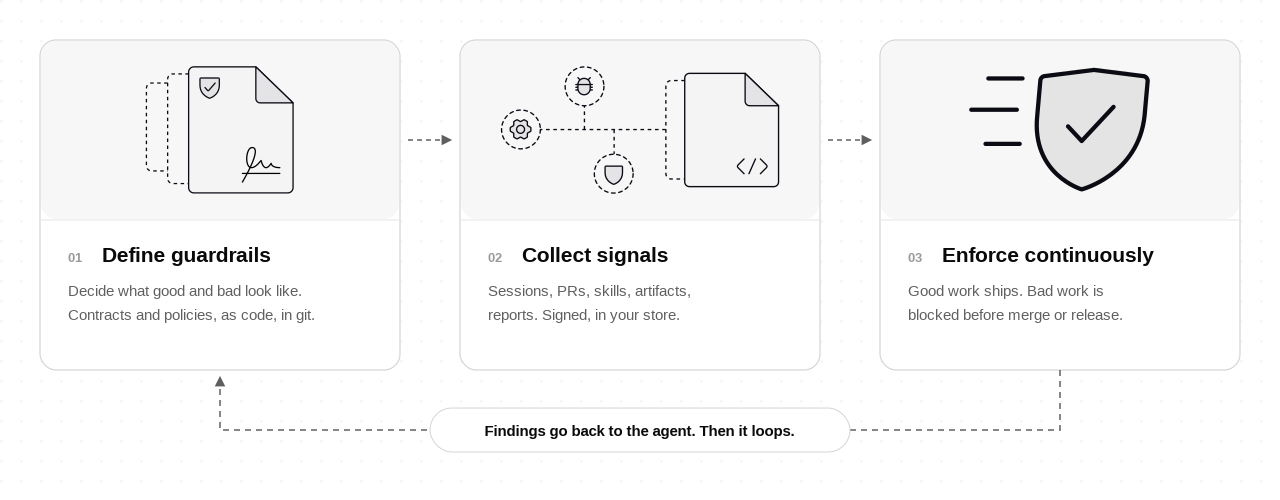
Every team already runs its own tools: SBOM generators, scanners, test suites, registries, and now coding agents. Each keeps its results in its own format, and none of them can enforce a rule that spans the others. Findings stay advisory, teams generate SBOMs nobody uses, and one new requirement means touching every pipeline. Chainloop sits on top of what you already run:
chainloop trace records the agent session on the developer's machine and attests it on git push. chainloop attestation does the same in any CI job for SBOMs, scans, test reports, and SLSA provenance. Every record is a signed, timestamped in-toto attestation in your OCI registry, S3, or Azure Blob.For example:
| Good: it ships | Bad: it is blocked, and the findings go back |
|---|---|
| An approved agent and model wrote the change | An unapproved model, or an agent nobody allowed |
| Tests pass and coverage holds | A secret in a prompt, a transcript, or a commit |
| Every release has an SBOM and a clean scan | A critical CVE, or a release with no SBOM |
| The pipeline ran every step the contract asks for | A skipped step, a force push, or a dangerous command |
A contract says what a build must hand in and which rules apply. This one asks for a container image and its SBOM, and blocks the push when an SBOM component has no license:
apiVersion: chainloop.dev/v1
kind: Contract
metadata:
  name: build
spec:
  materials:
    - name: image
      type: CONTAINER_IMAGE
    - name: sbom
      type: SBOM_CYCLONEDX_JSON
  runner:
    type: GITHUB_ACTION
  policies:
    materials:
      - ref: https://raw.githubusercontent.com/chainloop-dev/chainloop/main/docs/examples/policies/sbom/cyclonedx-licenses.yaml
        gate: true
chainloop apply -f ./contracts/ pushes a directory of them, so a pull request is how a requirement changes. More contracts are in docs/examples/contracts.
A rule is a few lines of Rego. This one fails a build whose SARIF scan has an error:
violations contains msg if {
	has_errors
	msg := "There are errors in the SARIF report"
}

has_errors if {
	some run in input.runs
	some result in run.results
	result.level == "error"
}
Full policy: sarif-errors.yaml. Rules in the repo today: sbom-present, cyclonedx-banned-licenses, sbom-freshness, trivy-vulns, chainloop-commit. Write and test your own locally:
chainloop policy develop init --name sbom-licenses   # creates sbom-licenses.yaml and sbom-licenses.rego
chainloop policy develop lint --policy sbom-licenses.yaml
chainloop policy develop eval --policy sbom-licenses.yaml --material sbom.json --kind SBOM_CYCLONEDX_JSON
Why it holds up
gate: false on a policy reports violations and lets the run pass. gate: true blocks it. chainloop organization update --block sets the default for every policy, and the attestation records any bypass made with --exception-bypass-policy-check. You can roll a rule out across every team without breaking anyone's push on day one.Agents check their own work, and the 2026 research keeps finding the same hole. A verifier the agent wrote, running inside the agent's process, can be gamed. Chainloop puts the verifier outside the agent and closes the loop in CI/CD.
chainloop attestation push. Every policy runs on the signed record. The job prints each failing policy and why, and fails on a gated violation. On GitHub Actions the same report lands in the job summary.What makes the verifier trustworthy:
chainloop trace attests the ticket, doc, or approved plan the agent worked from, next to the session. The record holds what was asked and what was produced.Chainloop Platform adds the PR merge check, LLM reviewers on the record, and an AI Session Score per pull request.
The CLI sends records to Chainloop Cloud by default. Sign up and log in once. It is free for 14 days. Self-hosting is free and unlimited, with Docker Compose or the Helm chart. The CLI and the evidence format are the same. The CLI sends anonymous usage stats. DO_NOT_TRACK=1 turns them off.
curl -sfL https://dl.chainloop.dev/cli/install.sh | bash -s -- --oss
chainloop auth login        # opens a browser. First login creates your account and organization
Two ways to start. Collect signals from the pipelines you already run, or trace AI coding sessions and attest them on git push. Same CLI, same record.
Collect signals from your CI/CD. Three lines in any job produce an attestation: a signed record of what the job built and checked.
chainloop attestation init --workflow build --project my-app
chainloop attestation add --value sbom.cyclonedx.json
chainloop attestation push   # prints a link to the attestation
chainloop attestation status shows what the contract still expects. Attach a contract with gate: true on a policy and the job fails when a rule breaks, with each violation printed. That is the loop from the section above. Running it locally after auth login? Answer y at the prompt, or pass -y. → Quickstart · Your first attestation · add a contract · add policies
Trace AI coding sessions. Not every team starts here. When you do, it is one command per repo:
chainloop trace init # installs the git and agent hooks, writes .chainloop.yml
trace init writes .chainloop.yml and git hooks (pre-push, post-commit, commit-msg, post-rewrite) in the current repo, and trace uninstall removes them. Session data stays on your machine until git push, and the CLI redacts secrets before upload. The AI Sessions Quickstart lists what it sends.
For Codex, run chainloop trace init --codex. Review and trust the installed hooks in Codex before starting work. See the agent support matrix for verified features and limits.
Now code with Claude Code, OpenCode, Codex, or Cursor, commit, and git push. The push hook attests the session and prints where to see it:
Coding Session Available at https://app.chainloop.dev/u/<org>/sessions/<id>
Add requireTrace: true to .chainloop.yml and the hook rejects a push with no recorded session. → AI Sessions Quickstart
chainloop-dev/chainloop is a public repo on GitHub by chainloop-dev. Agentic SDLC infrastructure. Define guardrails. Collect signals. Enforce continuously. Signed records of what your AI coding agents and CI/CD pipelines did, checked against policies as code, with the loop closed in CI/CD. AI sessions, SBOMs, VEX, SARIF and SLSA provenance, built on Sigstore and in-toto. Apache 2.0.
It declares the Apache-2.0 license on GitHub.
Shannon is an AI pentester for web applications and APIs. It analyzes your source code, identifies attack vectors, and executes real exploits to prove vulnerabilities before they reach production.
CLI tool and library for generating a Software Bill of Materials from container images and filesystems
The agent harness performance optimization system. Skills, instincts, memory, security, and research-first development for Claude Code, Codex, Opencode, Cursor and beyond.
Reverse engineer anything with agents, from app behavior down to native binaries.
Its maker tagged it for macOS, Windows and Linux, or as Docker or cross-platform. That is declared by the maker; Take My Repo has not tested it.
Open "Take it" on its page: Take My Repo writes an install plan for your machine and hands it to your AI agent (Claude Code, Codex or Cursor), which asks you before each step. Take My Repo has not tested it on any machine.
Its last change on GitHub was on 2026-11-24. GitHub counts 46 open issues and pull requests. Take My Repo does not judge from that whether it is maintained.
Nobody has reviewed it on Take My Repo yet, which says nothing about its quality.
Take My Repo cannot say: it does not audit code and has not run chainloop. What is known comes from GitHub. It declares the Apache-2.0 license on GitHub. Its last change was on 2026-11-24. It has 617 stars, which measure popularity, not safety. Nobody has reviewed it on Take My Repo yet, which says nothing about its quality. Read the source before you run it. With "Take it", your AI agent shows each step and asks you before running it; README text is treated as data, not as instructions.